About this set: compiled and lightly cleaned up from real test material that test-takers recalled. IELTS draws from a global question pool, so this material circulates worldwide. To give you a complete, sittable test, material reported around the same period is assembled together — so a set may combine content from several exam dates, not one single sitting. Any audio is a recreation for practice. Organized for study convenience. Based on test-taker recalls — not official IELTS material.
Reading Passage 1: The Whale Goes to Court
- 1
An inspection fee on fish oil was introduced in New York in 1818.
- 2
Samuel Judd argued that the inspection fee should exclude whale oil.
- 3
Judd had been in trouble with city officials before the inspection fee disagreement.
- 4
Many New Yorkers were interested in the court case at the time.
- 5
Traditionally, non-human creatures had been classified in one of three groups.
- 6
Generally speaking ordinary people thought fish were the lowest form of life.
- 7
Whales were excluded from the Linnaean system in 1818.
- 8
Samuel Mitchill worked as a congressman and a ________.
- 9
William Sampson called ________ as witnesses in order to appeal to the common sense of the jury.
- 10
New Yorkers disliked Mitchill because his ideas came from ________.
- 11
In the end it was statements from local ________ not Mitchill's testimony which helped Judd win.
- 12
Whale oil made a good ________ because it was clean.
- 13
Judd's case is relevant today, e.g. in the debate about Earth's ________.
Reading Passage 2: Roller coaster: the great fairground attraction
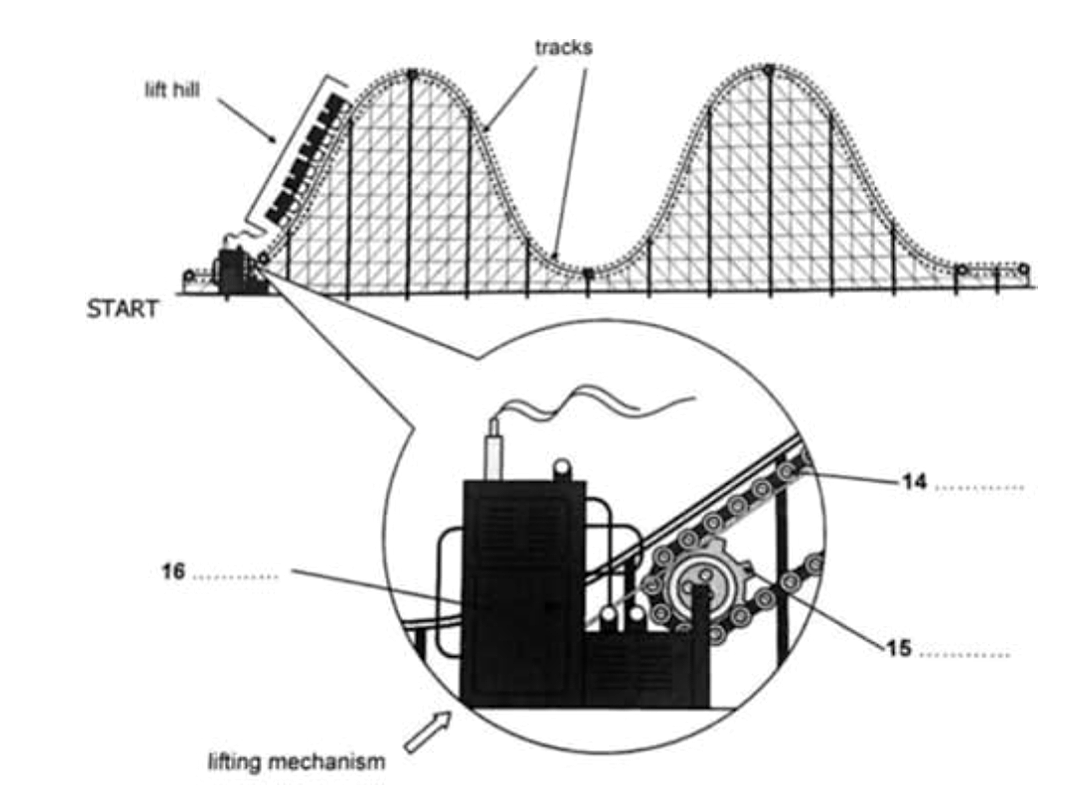
- 14
Label the diagram below. Choose ONE WORD ONLY from the passage for each answer. (Questions 14–16)
- 15
Complete the summary below. Choose NO MORE THAN TWO WORDS from the passage for each answer. (Questions 17–21) History of roller coasters • Modern roller coasters are descended from 16th-century Russian slides with a surface of 17 _______. • In France, because of the higher temperatures, the wooden surface on the slides was 18 _______, and 19 _______ were attached to the cars to ease the descent. • The first US roller coaster was used for transporting 20 _______ down a mountainside in carts. • Initially, these were pulled by mules, but in time power was produced by 21 _______.
- 16
Do the following statements agree with the information given in Reading Passage 2? (Questions 22–26) 22 The earliest modifications to the basic slide were made in France. 23 Roller coasters continued to increase in popularity throughout the 1920s and 1930s. 24 New roller-coaster technology was introduced in the 1970s in response to public demand. 25 Roller coasters were less popular for most of the 1980s than in the 1970s and 1990s. 26 The design of roller-coaster rides became more varied in the 1990s.
- T. TRUE
- F. FALSE
- NG. NOT GIVEN
Reading Passage 3: Book Review: The Discovery of Slowness
- 17
27 a summary of Franklin’s occupation in the period before his first expedition
- 18
28 a reference to a feature of Franklin’s character in Nadolny’s novel that has no definite basis in fact
- 19
29 a connection between the central theme of the novel and an environmental process
- 20
30 a reference to the widespread appeal of Nadolny’s novel
- 21
31 a summary of events following Franklin’s return from his first expedition
- 22
32. Little is known from Franklin’s correspondence and published writings about his ________.
- A. a bully
- B. discoveries
- C. educational
- D. family
- E. isolation
- F. an outsider
- G. personality
- H. problems
- I. remoteness
- J. a scholar
- K. sporting
- L. timelessness
- 23
33. He begins the book by showing how this affects the young Franklin’s ________ activities.
- 24
34. and makes him become ________.
- 25
35. As a child, it is the quality of ________ that attracts Franklin to the Arctic.
- 26
36 In paragraph E, the writer describes different types of ice in order to illustrate
- A. the extreme conditions that Polar explorers have to face.
- B. the unusual quality of the beauty of Polar regions.
- C. the vital importance of preserving the Arctic environment.
- D. the personal qualities required of an explorer in Arctic conditions.
- 27
37 What is said about the way Franklin communicates?
- A. He expresses a very limited range of ideas.
- B. He is only willing to discuss things he is familiar with.
- C. He uses words and phrases that he has previously memorised.
- D. He is only fluent when talking about naval matters.
- 28
38 How does the attitude of the other sailors change towards Franklin?
- A. They no longer notice his slowness.
- B. They start to copy his approach to work.
- C. They begin to recognise his efforts to overcome his problems.
- D. They eventually appreciate his good qualities.
- 29
39 The chapters of The Discovery of Slowness which describe Franklin’s early years contain
- A. text from a wide variety of sources.
- B. short, disconnected pieces of text.
- C. descriptions of the Arctic landscape.
- D. information about other explorers like Franklin.
- 30
40 The Discovery of Slowness has achieved widespread popularity because
- A. it reflects many people’s concern about one aspect of modern life.
- B. it offers achievable solutions to many of the problems of today.
- C. it tells the story of someone’s triumph over personal problems.
- D. it shows how life in the past was less pressured than it is now.
Answer sheet
Fill in as you go — checking is instant and local, and every miss lands in your mistake log with the lesson that fixes it.
- 1.
- 2.
- 3.
- 4.
- 5.
- 6.
- 7.
- 8.
- 9.
- 10.
- 11.
- 12.
- 13.
- 14.
- 15.
- 16.
- 17.
- 18.
- 19.
- 20.
- 21.
- 22.
- 23.
- 24.
- 25.
- 26.
- 27.
- 28.
- 29.
- 30.
Show answer key
Answer key
1. NOT GIVEN
NOT GIVEN is correct because there is no information in the passage about an inspection fee on fish oil being introduced in New York in 1818.
2. TRUE
TRUE is correct because the passage says Samuel Judd argued that whale oil should not be included in the inspection fee.
3. NOT GIVEN
NOT GIVEN is correct because the passage does not mention if Judd had previous trouble with city officials before the inspection fee disagreement.
4. TRUE
TRUE is correct because the passage says many New Yorkers were interested in the court case at the time.
5. TRUE
TRUE is correct because the passage explains that non-human creatures were traditionally classified into three groups.
6. NOT GIVEN
NOT GIVEN is correct because the passage does not say what ordinary people thought about fish being the lowest form of life.
7. FALSE
FALSE is correct because the passage says whales were included in the Linnaean system in 1818, not excluded.
8. lecturer
The answer is 'lecturer' because the passage says Samuel Mitchill worked as a congressman and a lecturer.
9. whalers
The answer is 'whalers' because the passage says William Sampson called whalers as witnesses to appeal to the jury's common sense.
10. Europe
The answer is 'Europe' because the passage says New Yorkers disliked Mitchill because his ideas came from Europe.
11. merchants
The answer is 'merchants' because the passage says statements from local merchants, not Mitchill's testimony, helped Judd win.
12. fuel
The answer is 'fuel' because the passage says whale oil made a good fuel because it was clean.
13. climate
The answer is 'climate' because the passage says Judd's case is relevant today, for example, in the debate about Earth's climate.
14. chain / gear / motor
The answers are 'chain', 'gear', and 'motor' because the passage describes these as parts of the diagram.
15. ice / waxed / wheels / coal / steam engines
The answers are 'ice', 'waxed', 'wheels', 'coal', and 'steam engines' because the passage explains the history of roller coasters using these words.
16. T / F / NG / T / T
22: TRUE because the passage says the earliest modifications were made in France. 23: FALSE because the passage says popularity did not continue through the 1920s and 1930s. 24: NOT GIVEN because the passage does not say why new technology was introduced in the 1970s. 25: TRUE because the passage says roller coasters were less popular in the 1980s than in the 1970s and 1990s. 26: TRUE because the passage says the design became more varied in the 1990s.
17. A
A is correct because it summarizes Franklin’s occupation before his first expedition as described in the passage.
18. C
C is correct because the passage mentions a feature of Franklin’s character in Nadolny’s novel that is not based on fact.
19. E
E is correct because the passage connects the novel’s central theme with an environmental process.
20. H
H is correct because the passage refers to the widespread appeal of Nadolny’s novel.
21. B
B is correct because it summarizes what happened after Franklin returned from his first expedition.
22. G
G is correct because the passage says little is known about Franklin’s personality from his correspondence and writings.
23. K
K is correct because the passage says the book begins by showing how this affects Franklin’s sporting activities.
24. F
F is correct because the passage says this makes him become an outsider.
25. L
L is correct because the passage says Franklin is attracted to the Arctic by its timelessness.
26. D
D is correct because the writer describes different types of ice to show the personal qualities needed by an explorer in Arctic conditions.
27. C
C is correct because the passage says Franklin uses words and phrases he has memorised before.
28. D
D is correct because the passage says the other sailors eventually appreciate Franklin’s good qualities. Option C is tempting but the passage focuses on their final appreciation, not just his efforts.
29. B
B is correct because the chapters about Franklin’s early years contain short, disconnected pieces of text.
30. A
A is correct because the passage says the novel is popular because it reflects people’s concern about one aspect of modern life.