About this set: compiled and lightly cleaned up from real test material that test-takers recalled. IELTS draws from a global question pool, so this material circulates worldwide. To give you a complete, sittable test, material reported around the same period is assembled together — so a set may combine content from several exam dates, not one single sitting. Any audio is a recreation for practice. Organized for study convenience. Based on test-taker recalls — not official IELTS material.
Reading Passage 1: The Way the Brain Buys
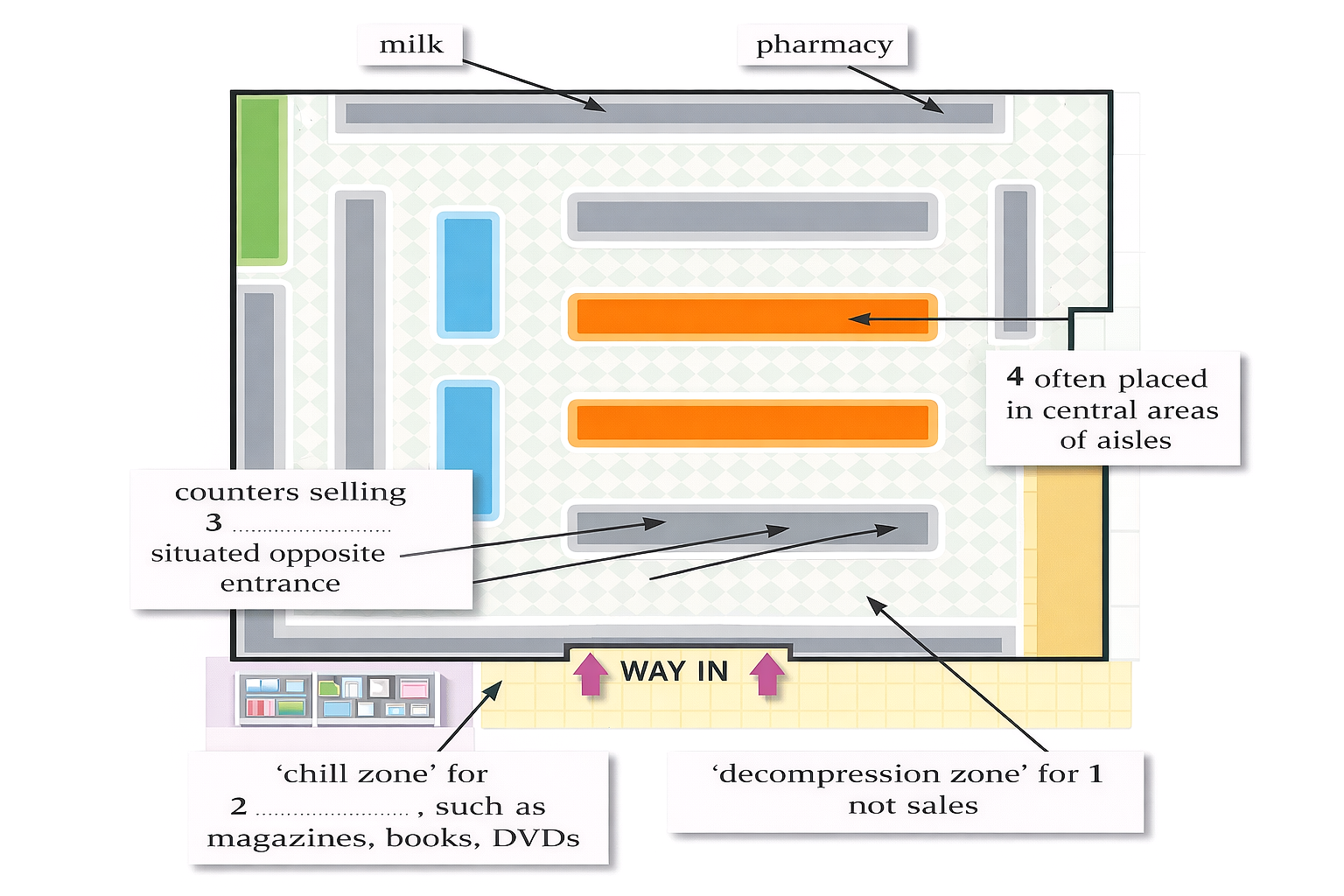
- 1
Layout of Typical Supermarket: 1
- 2
Layout of Typical Supermarket: 2
- 3
Layout of Typical Supermarket: 3
- 4
Layout of Typical Supermarket: 4
- 5
Do the following statements agree with the information given in the reading passage? 5. The ‘greeters’ at Walmart increase sales.
- TRUE. TRUE
- FALSE. FALSE
- NOT GIVEN. NOT GIVEN
- 6
People feel better about their shopping if they buy fruit and vegetables before they buy other food.
- 7
In-store bakeries produce a wider range of products than central bakeries.
- 8
Supermarkets find right-handed people easier to persuade than left-handed people.
- 9
The most frequent reason for leaving shops without buying something is price.
- 10
‘Decoy’ items are products which the store expects customers to choose.
- 11
In-store bread production process: The supermarket is sent __________ and other items which have been prepared earlier.
- 12
In-store bread production process: Baking bread in-store produces an aroma. Shoppers’ __________ are stimulated.
- 13
In-store bread production process: They are then keener to buy food, including bread and __________.
Reading Passage 2: The Fascinating World of Attine Ants
- 14
two things at which leaf-cutter ants have succeeded but humans have failed.
- 15
a comparison between the nests of leaf-cutter ants and lower attine ants.
- 16
an assessment of the impact leaf-cutter ants have on their environment.
- 17
the effect Escovopsis has on ant communities.
- 18
the advantage for lower attine ants of growing a range of fungi.
- 19
the discovery of the age of the attine-ant fungi.
- 20
the use of dead vegetation to cultivate their fungus
- A. Leaf-cutting ants
- B. Lower attines
- C. Both leaf-cutting ants and lower attine ants
- 21
very small ants that keep the fungus free of foreign organisms
- 22
the ability to safely eat harmful plants
- 23
the cultivation of a single fungus
- 24
a nest with a very large number of rooms for growing fungus
- 25
What does the writer say about Cameron Currie’s research?
- A. No previous work had been done in this area.
- B. Earlier studies did not support his theory.
- C. Textbooks on this subject lacked specific detail.
- D. Currie’s initial theory had proven to be incorrect.
- 26
Using a microscope, Currie was the first to discover that the body of attine ants
- A. has a white covering.
- B. is covered in wax.
- C. is poisonous to humans.
- D. has a substance useful to humans.
Reading Passage 3: Risk Taking
- 27
K. C. Cole points out that avoiding a loss seems more important to people than
- A. planning for the future.
- B. predicting their errors.
- C. continuing in the present situation.
- D. recent findings on the most effective solutions to problems.
- E. achieving a gain.
- F. changes occurring externally.
- G. a high level of agreement.
- 28
According to Andrew S. Grove, it can be very dangerous for companies to ignore
- 29
Reid J. Lifset argues that environmental agencies can benefit from
- 30
The writer suggests that government leaders need to focus more on
- 31
the areas of study that help us understand risk
- 32
reference to key actions that might benefit the world
- 33
examples of statistical predictions that the majority of the public react to in the same way
- 34
the variety of contexts in which risk occurs
- 35
mention of a habit that has been proved to be very risky
- 36
reference to market forces motivating change
- 37
the writer’s current attitude towards risk
- 38
a reason why some individuals avoid making a career change
- 39
how some people over-react to information about risk
- 40
At the end of the passage the writer concludes that
- A. risk is something we must try to avoid.
- B. experts should be truthful about risk to the public.
- C. optimists are better able to deal with risk than pessimists.
- D. it is important to take risks in order to fulfil social obligations.
Answer sheet
Fill in as you go — checking is instant and local, and every miss lands in your mistake log with the lesson that fixes it.
- 1.
- 2.
- 3.
- 4.
- 5.
- 6.
- 7.
- 8.
- 9.
- 10.
- 11.
- 12.
- 13.
- 14.
- 15.
- 16.
- 17.
- 18.
- 19.
- 20.
- 21.
- 22.
- 23.
- 24.
- 25.
- 26.
- 27.
- 28.
- 29.
- 30.
- 31.
- 32.
- 33.
- 34.
- 35.
- 36.
- 37.
- 38.
- 39.
- 40.
Show answer key
Answer key
1. promotion
The answer is 'promotion' because the layout shows areas where special offers or promotions are placed to attract customers' attention.
2. unplanned purchases
The answer is 'unplanned purchases' because the layout is designed to encourage shoppers to buy things they did not plan to buy.
3. fruit and vegetables
The answer is 'fruit and vegetables' because these are usually placed at the entrance to make the store look fresh and healthy.
4. popular items
The answer is 'popular items' because these are often placed at the back of the store so customers have to walk past many other products to reach them.
5. NOT GIVEN
The answer is 'NOT GIVEN' because there is no information in the passage about whether Walmart greeters increase sales.
6. TRUE
The answer is 'TRUE' because the passage says people feel better about their shopping if they buy fruit and vegetables first.
7. NOT GIVEN
The answer is 'NOT GIVEN' because the passage does not compare the range of products from in-store bakeries and central bakeries.
8. NOT GIVEN
The answer is 'NOT GIVEN' because there is no information about right-handed or left-handed people being easier to persuade.
9. FALSE
The answer is 'FALSE' because the passage says the most frequent reason for leaving without buying is not price, but something else.
10. FALSE
The answer is 'FALSE' because 'decoy' items are not products the store expects customers to choose, but are used to make other products look better by comparison.
11. frozen ingredients
The answer is 'frozen ingredients' because the process starts when the supermarket receives frozen ingredients and other items prepared earlier.
12. appetites
The answer is 'appetites' because baking bread in-store creates a smell that stimulates shoppers' appetites.
13. ready meals
The answer is 'ready meals' because after smelling the bread, shoppers are more likely to buy food, including bread and ready meals.
14. H
The answer is 'H' because this section describes two things leaf-cutter ants have succeeded at but humans have not.
15. C
The answer is 'C' because this part compares the nests of leaf-cutter ants and lower attine ants.
16. B
The answer is 'B' because this section assesses the impact leaf-cutter ants have on their environment.
17. F
The answer is 'F' because it explains the effect Escovopsis has on ant communities.
18. G
The answer is 'G' because it discusses the advantage for lower attine ants of growing a range of fungi.
19. D
The answer is 'D' because this part describes the discovery of the age of the attine-ant fungi.
20. B
The answer is 'B' because lower attines use dead vegetation to cultivate their fungus, not leaf-cutting ants.
21. A
The answer is 'A' because very small ants that keep the fungus free of foreign organisms are found among leaf-cutting ants.
22. C
The answer is 'C' because both leaf-cutting ants and lower attines can safely eat harmful plants.
23. A
The answer is 'A' because only leaf-cutting ants cultivate a single fungus.
24. A
The answer is 'A' because leaf-cutting ants have nests with a very large number of rooms for growing fungus.
25. B
The answer is 'B' because earlier studies did not support Currie's theory, but his research found new evidence.
26. D
The answer is 'D' because Currie discovered that the body of attine ants has a substance useful to humans.
27. E
The answer is 'E' because K. C. Cole says people care more about avoiding a loss than achieving a gain.
28. F
The answer is 'F' because Andrew S. Grove warns it is dangerous for companies to ignore changes happening outside.
29. D
The answer is 'D' because Reid J. Lifset argues that environmental agencies can benefit from recent findings on the most effective solutions.
30. A
The answer is 'A' because the writer suggests government leaders need to focus more on planning for the future.
31. B
The answer is 'B' because this section talks about the areas of study that help us understand risk.
32. F
The answer is 'F' because this part refers to key actions that might benefit the world.
33. C
The answer is 'C' because it gives examples of statistical predictions that most people react to in the same way.
34. A
The answer is 'A' because this section shows the variety of contexts where risk occurs.
35. B
The answer is 'B' because it mentions a habit that has been proved to be very risky.
36. E
The answer is 'E' because this part refers to market forces motivating change.
37. H
The answer is 'H' because it describes the writer’s current attitude towards risk.
38. D
The answer is 'D' because it gives a reason why some people avoid making a career change.
39. C
The answer is 'C' because it explains how some people over-react to information about risk.
40. B
The answer is 'B' because at the end, the writer concludes that experts should be truthful about risk to the public.