IELTS Academic Reading Practice Test — October 2026 Test 3

Exam month: 2026-10

About this set: compiled and lightly cleaned up from real test material that test-takers recalled. IELTS draws from a global question pool, so this material circulates worldwide. To give you a complete, sittable test, material reported around the same period is assembled together — so a set may combine content from several exam dates, not one single sitting. Any audio is a recreation for practice. Organized for study convenience. Based on test-taker recalls — not official IELTS material.

Reading Passage 1: Australia's Airborne Dentists

Australians living or travelling in rural and remote areas can face particular difficulties when they need medical care. Hundreds of kilometres from major cities and many hours by road from the closest hospital or clinic, some rural Australians do not have easy access to doctors, nurses and dentists. Organisations such as the Royal Flying Doctor Service (RFDS) have been established to bring health services to outback Australian communities. The RFDS provides free medical care to people who live, work or travel in remote and regional parts of Australia. This non-profit organisation is the oldest and largest airborne health service of its kind in the world, and since 1928 it has used small aircraft to send doctors and nurses to some of Australia's most far-away communities.
In recent years, the RFDS has also started to fly dentists to regional Australia. As well as offering mobile dental clinics, the RFDS offers a range of preventative and educational services. Looking after the teeth of people in remote areas presents special challenges. These include providing care to disparate communities with no established dental facilities, and dealing with higher incidences of other diseases which are linked to, or caused by poor dental health.
People in remote areas have very infrequent visits by health staff. RFDS dentists might only visit a community once every few months, or sometimes once per year. Because of infrequent dentist visits, patients in these areas often need to put up with their dental problems before they can get treatment. Consequently, people in remote areas are more likely to have tooth decay (the blackening and deterioration of teeth) and develop gum and other mouth diseases.
In some locations that the RFDS visits, there are no suitable dental facilities, so dentists have to bring everything with them. This includes drills, dentists' chairs, portable X-ray machines, and computers for keeping track of patients' treatments. Equipment can weigh up to 100 kilograms, and since the small planes that transport dentists have limited space, dentists cannot always bring everything that they need.
While dentists in town or city centres can specialise in certain types of treatment, RFDS dentists need to be 'all-rounders'. They need to be able to do all kinds of dental procedures, as they don't have the ability to refer patients to more specialised dentists. Even with their broad experience, there are some services that are particularly challenging for RFDS dentists. For example, dentures (or artificial teeth) can be very difficult to provide, as they need to be the right shape and size for the patient, and this requires many visits over a long period of time. As a result, it is not practical to make dentures available.
Some chronic illnesses are more common in remote communities than in the rest of Australia. These illnesses can in turn lead to a lowered resistance to infection, including gum and other oral infections. As a result, people in outback Australian communities are more likely to experience oral health problems than city folk, and this poses extra challenges for both the dentists and the doctors of the RFDS.
Because there aren't a lot of dental services in remote areas, people living in these areas also receive less education about good dental hygiene than their city counterparts do. Australians in very remote communities might not be aware of things that people in cities take for granted, such as the importance of daily tooth brushing. Also, basic dental hygiene items such as toothpaste and toothbrushes can be more expensive in outback areas. Many people are on low incomes, meaning they have extra difficulty affording these products. If this is the case, the RFDS supplies these.
As well as treating patients, RFDS dentists try to focus on preventative oral health and educate their patients on good oral hygiene, such as tooth brushing and flossing. The RFDS also provides mouthguards for young sports players. Playing contact sports, such as rugby league or Australian rules football, can damage young people's teeth, so mouthguards provide protection which prevents accidental injuries.
Adding fluoride to water supplies has been proven to reduce the incidence of tooth decay in many parts of the world. City dwellers in Australia use water supplies that have been fluoridated, and their rates of tooth decay are lower because of this. In remote areas, it is not practical to fluoridate drinking water supplies, and so people living in these areas are more subject to tooth decay. As a result, it is particularly important that people living in areas without fluoridated water pay special attention to regular brushing of their teeth with fluoridated toothpaste.
Despite many challenges, the RFDS continues to offer much needed dental and medical support. Its presence in isolated communities greatly improves the quality of dental health, and supports important oral hygiene and health initiatives.

Questions 1–7

Do the following statements agree with the information given in Reading Passage 1?

In boxes 1–7 on your answer sheet, write

TRUE if the statement agrees with the information

FALSE if the statement contradicts the information

NOT GIVEN if there is no information on this

  1. 1

    Many of the RFDS doctors work as volunteers.

    • A. TRUE
    • B. FALSE
    • C. NOT GIVEN
  2. 2

    RFDS dentists make trips to outback communities each month.

  3. 3

    RFDS dentists are accompanied on their journeys to remote areas by a dental nurse.

  4. 4

    RFDS dentists must provide a wide range of dental services.

  5. 5

    Rural dental patients are more informed about oral hygiene than urban patients.

  6. 6

    RFDS dentists educate patients about good eating habits.

  7. 7

    Urban Australians generally have better teeth because their water is treated.

Questions 8–13

Complete the notes below.

Choose ONE WORD ONLY from the passage for each answer.

Write your answers in boxes 8–13 on your answer sheet.

Challenges faced by RFDS dentists
need to bring equipment including (8) ________ for records.
aircraft used to carry equipment have restricted (9) ________.
problems offering some services, e.g. fitting (10) ________.
people in remote areas are more likely to have infection in their mouth.
Products supplied by RFDS dentists
If necessary RFDS provides:
(11) ________ and (12) ________ for regular use.
(13) ________ to limit dental accidents on the sports field.

Reading Passage 2: Animal Minds: Parrot Alex

A. In 1977 Irene Pepperberg, a recent graduate of Harvard University, did something very bold. At a time when animals still were considered automatons, she set out to find what was on another creature’s mind by talking to it. She brought a one-year-old African gray parrot she named Alex into her lab to teach him to reproduce the sounds of the English language. “I thought if he learned to communicate, I could ask him questions about how he sees the world.”
B. When Pepperberg began her dialogue with Alex, who died last September at the age of 31, many scientists believed animals were incapable of any thought. They were simply machines, robots programmed to react to stimuli but lacking the ability to think or feel. Any pet owner would disagree. We see the love in our dogs’ eyes and know that, of course, they have thoughts and emotions. But such claims remain highly controversial. Gut instinct is not science, and it is all too easy to project human thoughts and feelings onto another creature. How, then, does a scientist prove that an animal is capable of thinking—that it is able to acquire information about the world and act on it? “That’s why I started my studies with Alex,” Pepperberg said. They were seated—she at her desk, he on top of his cage—in her lab, a windowless room about the size of a boxcar, at Brandeis University. Newspapers lined the floor; baskets of bright toys were stacked on the shelves. They were clearly a team—and because of their work, the notion that animals can think is no longer so fanciful.
C. Certain skills are considered key signs of higher mental abilities: good memory, a grasp of grammar and symbols, self-awareness, understanding others’ motives, imitating others, and being creative. Bit by bit, in ingenious experiments, researchers have documented these talents in other species, gradually chipping away at what we thought made human beings distinctive while offering a glimpse of where our own abilities came from. Scrub jays know that other jays are thieves and that stashed food can spoil; sheep can recognize faces; chimpanzees use a variety of tools to probe termite mounds and even use weapons to hunt small mammals; dolphins can imitate human postures; the archerfish, which stuns insects with a sudden blast of water, can learn how to aim its squirt simply by watching an experienced fish perform the task. And Alex the parrot turned out to be a surprisingly good talker.
D. Thirty years after the Alex studies began; Pepperberg and a changing collection of assistants were still giving him English lessons. The humans, along with two younger parrots, also served as Alex’s flock, providing the social input all parrots crave. Like any flock, this one—as small as it was—had its share of drama. Alex dominated his fellow parrots, acted huffy at times around Pepperberg, tolerated the other female humans, and fell to pieces over a male assistant who dropped by for a visit. Pepperberg bought Alex in a Chicago pet store where she let the store’s assistant pick him out because she didn’t want other scientists saying later that she’d particularly chosen an especially smart bird for her work. Given that Alex’s brain was the size of a shelled walnut, most researchers thought Pepperberg’s interspecies communication study would be futile.
E. “Some people actually called me crazy for trying this,” she said. “Scientists thought that chimpanzees were better subjects, although, of course, chimps can’t speak.” Chimpanzees, bonobos, and gorillas have been taught to use sign language and symbols to communicate with us, often with impressive results. The bonobo Kanzi, for instance, carries his symbol-communication board with him so he can “talk” to his human researchers, and he has invented combinations of symbols to express his thoughts. Nevertheless, this is not the same thing as having an animal look up at you, open his mouth, and speak. Under Pepperberg’s patient tutelage, Alex learned how to use his vocal tract to imitate almost one hundred English words, including the sounds for various foods, although he calls an apple a “banerry.” “Apples taste a little bit like bananas to him, and they look a little bit like cherries, so Alex made up that word for them,” Pepperberg said.
F. It sounded a bit mad, the idea of having lessons to practice, and willingly doing it. But after listening to and observing Alex, it was difficult to argue with Pepperberg’s explanation for his behaviors. She wasn’t handing him treats for the repetitious work or rapping him on the claws to make him say the sounds. “He has to hear the words over and over before he can correctly imitate them,” Pepperberg said, after pronouncing “seven” for Alex a good dozen times in a row. “I’m not trying to see if Alex can learn a human language,” she added. “That’s never been the point. My plan always was to use his imitative skills to get a better understanding of avian cognition.”
G. In other words, because Alex was able to produce a close approximation of the sounds of some English words, Pepperberg could ask him questions about a bird’s basic understanding of the world. She couldn’t ask him what he was thinking about, but she could ask him about his knowledge of numbers, shapes, and colors. To demonstrate, Pepperberg carried Alex on her arm to a tall wooden perch in the middle of the room. She then retrieved a green key and a small green cup from a basket on a shelf. She held up the two items to Alex’s eye. “What’s same?” she asked. Without hesitation, Alex’s beak opened: “Color.” “What’s different?” Pepperberg asked. “Shape,” Alex said. His voice had the digitized sound of a cartoon character. Since parrots lack lips (another reason it was difficult for Alex to pronounce some sounds, such as ba), the words seemed to come from the air around him, as if a ventriloquist were speaking. But the words—and what can only be called the thoughts—were entirely his.
H. For the next 20 minutes, Alex ran through his tests, distinguishing colors, shapes, sizes, and materials (wool versus wood versus metal). He did some simple arithmetic, such as counting the yellow toy blocks among a pile of mixed hues. And, then, as if to offer final proof of the mind inside his bird’s brain, Alex spoke up. “Talk clearly!” he commanded, when one of the younger birds Pepperberg was also teaching talked with wrong pronunciation. “Talk clearly!” “Don’t be a smart aleck,” Pepperberg said, shaking her head at him. “He knows all this, and he gets bored, so he interrupts the others, or he gives the wrong answer just to be obstinate. At this stage, he’s like a teenager; he’s moody, and I’m never sure what he’ll do.”

Questions 14–19

Do the following statements agree with the information given in Reading Passage 2?

In boxes 14–19 on your answer sheet, write

TRUE if the statement agrees with the information

FALSE if the statement contradicts the information

NOT GIVEN if there is no information on this

  1. 14. Firstly, Alex has grasped quite a lot of vocabulary.

    • A. TRUE
    • B. FALSE
    • C. NOT GIVEN
  2. 15. At the beginning of study, Alex felt frightened in the presence of humans.

  3. 16. Previously, many scientists realized that animals possess the ability of thinking.

  4. 17. It has taken a long time before people get to know cognition existing in animals.

  5. 18. As Alex could approximately imitate the sounds of English words, he was capable of roughly answering Irene’s questions regarding the world.

  6. 19. By breaking in other parrots as well as producing the incorrect answers, he tried to be focused.

Questions 20–23

Complete the summary below.

Choose NO MORE THAN TWO WORDS AND/OR A NUMBER from the passage for each answer.

Write your answers in boxes 20–23 on your answer sheet.

After the framing of Irene, Parrot Alex can use his vocal tract to pronounce more than (20) ________, while other scientists believe that animals have no this advanced ability of thinking, they would rather teach (21) ________.
Pepperberg clarified that she wanted to conduct a study concerning (22) ________ but not to teach him to talk.
The store’s assistant picked out a bird at random for her for the sake of avoiding other scientists saying that the bird is (23) ________ afterwards.

Questions 24–26

Answer the questions below.

Choose NO MORE THAN TWO WORDS from the passage for each answer.

Write your answers in boxes 24–26 on your answer sheet.

  1. 24. What did Alex reply regarding the similarity of the subjects showed to him?

  2. 25. What is the problem of the young parrots except Alex?

  3. 26. To some extent, through the way he behaved what we can call him?

Reading Passage 3: Elephant Communication V2
(A) O’ Connell-Rodwell, a post-doctoral fellow at Stanford University, has traveled to Namibia’s first-ever wildlife reserve to explore the mystical and complicated realm of elephant communication. She, along with her colleagues, is part of a scientific revolution that started almost 20 years ago. This revolution has made a stunning revelation: elephants are capable of communicating with one another over long distances by means of low-frequency sounds, also known as infrasound, which are too deep for humans to hear.
(B) As might be expected, African elephants’ ability to detect seismic sound may have something to do with their ears. The hammer bone in an elephant’s inner ear is proportionally huge for a mammal, but it is normal for animals that use vibrational signals. Thus, it may be a sign that elephants can use seismic sounds to communicate.
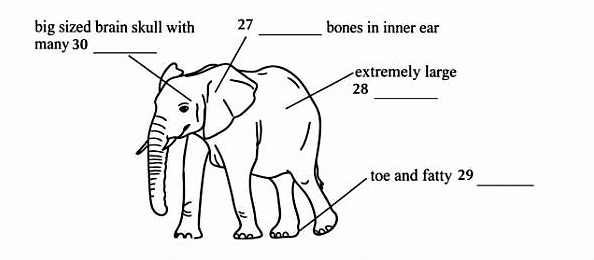
(C) Other aspects of elephant anatomy also support this ability. First, their massive bodies, which enable them to give out low-frequency sounds almost as powerful as the sound a jet makes during take-off, serve as ideal frames for receiving ground vibrations and transmitting them to the inner ear. Second, the elephant’s toe bones are set in a fatty pad, which might help focus vibrations from the ground into the bone. Finally, the elephant has an enormous brain that sits in the cranial cavity behind the eyes, in line with the auditory canal. The front of the skull is riddled with sinus cavities, which might function as resonating chambers for ground vibrations.
(D) It remains unclear how elephants detect such vibrations, but O’ Connell-Rodwell suggests that the pachyderms are ‘listening’ with their trunks and feet instead of (or in addition to) their ears. The elephant trunk may be the most versatile appendage in nature: it is used for drinking, bathing, smelling, feeding and scratching. Both trunk and feet contain two types of nerve endings that are sensitive to pressure—one detects infrasonic vibration and the other responds to vibrations of slightly higher frequencies. As O’ Connell-Rodwell sees it, this research has a boundless and unpredictable future. ‘Our work is really at the interface of geophysics, neurophysiology and ecology,’ she says. ‘We’re raising questions that have never even been considered before.’
(E) Scientists have long known that seismic communication is widespread among small animals such as spiders, scorpions, insects and many vertebrates, including white-lipped frogs, blind mole-rats, kangaroo rats and golden moles. Nevertheless, O’ Connell-Rodwell was the first to argue that a giant land animal is also sending and receiving seismic signals. ‘I used to lay a male planthopper on a stem and replay the calling sound of a female; the male would exhibit the same kind of behaviour that happens in elephants: he would freeze, press down on his legs, move forward a little, then stay still again. I found it fascinating, and it made me think that perhaps auditory communication is not the only thing going on.’
(F) Scientists have confirmed that an elephant’s capacity to communicate over long distances is essential for survival, especially in places like Etosha, where more than 2,400 savanna elephants range over an area larger than New Jersey. It is already difficult for an elephant to find a mate in such a vast wilderness, and elephant reproductive biology only complicates matters. Breeding herds also adopt low-frequency sounds to warn of predators. Even though adult elephants have no enemies other than human beings, calves are vulnerable and susceptible to attacks from lions and hyenas. At the sight of a predator, older herd members clump together to protect the young before running away.
(G) We now know that elephants can respond to warning calls in the air, but can they detect signals transmitted solely through the ground? To investigate, the research team designed an experiment in 2002 that used electronic devices to send signals through the ground at Mushara. ‘The outcomes of our 2002 study revealed that elephants could indeed sense warning signals through the ground,’ O’ Connell-Rodwell observes.
(H) Last year, an experiment was set up to pursue the problem further. It used three different recordings: the 1994 warning call from Mushara, an anti-predator call recorded by scientist Joyce Poole in Kenya, and a made-up warble tone. ‘The data I’ve observed so far imply that the elephants responded exactly as I expected. However, the fascinating finding is that the anti-predator call from Kenya—unfamiliar to them—caused them to gather, tense up and rumble aggressively as well; but they didn’t always flee. I didn’t expect the results to be that clear-cut.’
Recreated diagram of an elephant for questions 27–30

Questions 27–30

Label the diagram below.

Choose NO MORE THAN TWO WORDS from the passage for each answer.

Write your answers in boxes 27–30 on your answer sheet.

(27) ________ bones in inner ear
extremely large (28) ________
toe and fatty (29) ________
big sized brain skull with many (30) ________

Questions 31–38

Complete the summary below.

Choose NO MORE THAN THREE WORDS from the passage for each answer.

Write your answers in boxes 31–38 on your answer sheet.

How the elephants sense these sound vibrations is still unknown, but O’Connell-Rodwell, a post-doctoral researcher at Stanford University, proposes that elephants are ‘listening’ with their (31) ________ by two kinds of nerve endings that respond to vibrations with both (32) ________ frequency and slightly higher frequencies.
O’Connell-Rodwell’s work is at the combination of geophysics, neurophysiology and (33) ________.
It was known that seismic communication existed extensively within small animals, but O’Connell-Rodwell was the first person to indicate that a large land animal would send and receive (34) ________ too.
Also, she noticed the freezing behaviour by putting a (35) ________ on a stem and playing back a female call, which might prove the existence of other communicative approaches besides (36) ________.
Scientists have determined that an elephant’s ability to communicate over long distances is essential, especially when elephant herds are finding a (37) ________ or are warning of predators.
Finally, the results of our 2002 study showed us that elephants could detect warning calls through the (38) ________.

Questions 39–40

Choose the correct letter, A, B, C or D.

Write the correct letter in boxes 39–40 on your answer sheet.

  1. 39. According to the passage, it is determined that an elephant needs to communicate over long distances for its survival.

    • A. when a threatening predator appears.
    • B. when young elephants meet humans.
    • C. when older members of the herd want to flee from the group.
    • D. when a female elephant is in estrus.
  2. 40. What is the author’s attitude toward the experiment using three different recordings in the last paragraph?

    • A. The outcome is definitely out of the original expectation.
    • B. The data cannot be very clearly obtained.
    • C. The result can be somewhat undecided or inaccurate.
    • D. The result can be unfamiliar to the public.

Answer sheet

Fill in as you go — checking is instant and local, and every miss lands in your mistake log with the lesson that fixes it.

  1. 1.
  2. 2.
  3. 3.
  4. 4.
  5. 5.
  6. 6.
  7. 7.
  8. 8.
  9. 9.
  10. 10.
  11. 11.
  12. 12.
  13. 13.
  14. 14.
  15. 15.
  16. 16.
  17. 17.
  18. 18.
  19. 19.
  20. 20.
  21. 21.
  22. 22.
  23. 23.
  24. 24.
  25. 25.
  26. 26.
  27. 27.
  28. 28.
  29. 29.
  30. 30.
  31. 31.
  32. 32.
  33. 33.
  34. 34.
  35. 35.
  36. 36.
  37. 37.
  38. 38.
  39. 39.
  40. 40.
Saved on this device — no account needed. Sign in on your progress page if you want it synced elsewhere.
Show answer key

Answer key

  1. 1. C

    The passage does not mention whether RFDS doctors work as volunteers, so the answer is NOT GIVEN.

  2. 2. B

    The passage says RFDS dentists might only visit a community once every few months or sometimes once per year, so it is FALSE that they make trips each month.

  3. 3. C

    There is no information in the passage about RFDS dentists being accompanied by a dental nurse, so the answer is NOT GIVEN.

  4. 4. A

    The passage says RFDS dentists need to be 'all-rounders' and able to do all kinds of dental procedures, so they must provide a wide range of dental services.

  5. 5. B

    The passage states that people in remote areas receive less education about good dental hygiene than city counterparts, so it is FALSE that rural dental patients are more informed.

  6. 6. C

    The passage does not mention RFDS dentists educating patients about good eating habits, so the answer is NOT GIVEN.

  7. 7. A

    The passage explains that city dwellers use fluoridated water and have lower rates of tooth decay, so it is TRUE that urban Australians generally have better teeth because their water is treated.

  8. 8. computers

  9. 9. space

  10. 10. dentures

  11. 11. toothpaste

  12. 12. toothbrushes

  13. 13. mouthguards / mouth guards

  14. 14. C

    The passage does not state how much vocabulary Alex has learned, so the answer is NOT GIVEN.

  15. 15. C

    There is no information about Alex feeling frightened at the beginning of the study, so the answer is NOT GIVEN.

  16. 16. B

    The passage says many scientists believed animals were incapable of any thought, so it is FALSE that they realized animals possess the ability of thinking.

  17. 17. A

    The passage says it has taken time and research to show animals can think, so it is TRUE that it has taken a long time for people to know cognition exists in animals.

  18. 18. A

    The passage explains that because Alex could imitate English words, Pepperberg could ask him questions about his knowledge, so it is TRUE.

  19. 19. B

    The passage says Alex interrupts others or gives wrong answers because he gets bored, not to be focused, so it is FALSE.

  20. 20. 100 English words / one hundred English words / 100 / one hundred

  21. 21. chimpanzees

  22. 22. avian cognition

  23. 23. particularly chosen

  24. 24. Color

    When asked 'What’s same?' Alex replied 'Color,' so the answer is Color.

  25. 25. wrong pronunciation

    The passage says the young parrots talked with wrong pronunciation, so the answer is wrong pronunciation.

  26. 26. teenager

    The passage says Alex is like a teenager because he is moody and unpredictable, so the answer is teenager.

  27. 27. hammer

  28. 28. body

  29. 29. pad

  30. 30. sinus cavities

  31. 31. trunks and feet

  32. 32. infrasonic

  33. 33. ecology

  34. 34. seismic signals

  35. 35. male planthopper

  36. 36. auditory communication

  37. 37. mate

  38. 38. ground

  39. 39. A

    The passage says breeding herds use low-frequency sounds to warn of predators and clump together to protect the young before running away, so the answer is A. when a threatening predator appears. The tempting wrong option D (when a female elephant is in estrus) is not directly linked to survival communication in the passage.

  40. 40. A

    The author says the results were more clear-cut than expected and that the anti-predator call from Kenya caused a strong reaction, so the answer is A. The outcome is definitely out of the original expectation. The tempting wrong option C (the result can be somewhat undecided or inaccurate) fails because the author found the results clear-cut.