Reading 2026-07 Test 4

Exam month: 2026-07

Rebuilt from test-taker recalls — not official IELTS material. Audio and passages are recreations for practice.

Reading Passage 1 — Radiocarbon Dating: The Profile of Nancy Athfield

Have you ever picked up a small stone off the ground and wondered how old it was? Chances are, that stone has been around many more years than your own lifetime. Many scientists share this curiosity about the age of inanimate objects like rocks, fossils and precious stones. Knowing how old an object is can provide valuable information about our prehistoric past. In most societies, human beings have kept track of history through writing. However, scientists are still curious about the world before writing, or even the world before humans. Studying the age of objects is our best way to piece together histories of our pre-historic past. One such method of finding the age of an object is called radiocarbon dating. This method can find the age of any object based on the kind of particles and atoms that are found inside of the object. Depending on what elements the object is composed of, radiocarbon can be a reliable way to find an object's age. One famous specialist in this method is the researcher Nancy Athfield.
Athfield studied the ancient remains found in the country of Cambodia. Many prehistoric remains were discovered by the local people of Cambodia. These objects were thought to belong to some of the original groups of humans that first came to the country of Cambodia. The remains had never been scientifically studied, so Nancy was greatly intrigued by the opportunity to use modern methods to discover the true age of these ancient objects.
Athfield had this unique opportunity because her team, comprised of scientists and filmmakers, was in Cambodia working on a documentary. The team was trying to discover evidence to prove a controversial claim in history: that Cambodia was the resting place for the famous royal family of Angkor. At that time, written records and historic accounts conflicted on the true resting place. Many people across the world disagreed over where the final resting place was. For the first time, Athfield and her team had a chance to use radiocarbon dating to find new evidence. They had a chance to solve the historic mystery that many had been arguing over for years.
Athfield and her team conducted radiocarbon dating of many of the ancient objects found in the historic site of Angkor Wat. Nancy found the history of Angkor went back to as early as 1620. According to historical records, the remains of the Angkor royal family were much younger than that, so this evidence cast a lot of doubt as to the status of the ancient remains. The research ultimately raised more questions. If the remains were not of the royal family, then whose remains were being kept in the ancient site? Athfield’s team left Cambodia with more questions unanswered. Since Athfield’s team studied the remains, new remains have been unearthed at the ancient site of Angkor Wat, so it is possible that these new remains could be the true remains of the royal family. Nancy wished to come back to continue her research one day.
In her early years, the career of Athfield was very unconventional. She didn’t start her career as a scientist. At the beginning, she would take any kind of job to pay her bills. Most of them were low-paying jobs or brief community service opportunities. She worked often but didn’t know what path she would ultimately take. But eventually, her friend suggested that Athfield invest in getting a degree. The friend recommended that Athfield attend a nearby university. Though doubtful of her own qualifications, she applied and was eventually accepted by the school. It was there that she met Willard Libby, the inventor of radiocarbon dating. She took his class and soon had the opportunity to complete hands-on research. She soon realised that science was her passion. After graduation, she quickly found a job in a research institution.
After college, Athfield’s career in science blossomed. She eventually married, and her husband landed a job at the prestigious organisation GNN. Athfield joined her husband in the same organisation, and she became a lab manager in the institution. She earned her PhD in scientific research, and completed her studies on a kind of rat in New Zealand. There, she created original research and found many flaws in the methods being used in New Zealand laboratories. Her research showed that the subject’s diet led to the fault in the earlier research. She was seen as an expert by her peers in New Zealand, and her opinion and expertise were widely respected. She had come a long way from her old days of working odd jobs. It seemed that Athfield’s career was finally taking off.
But Athfield’s interest in scientific laboratories wasn’t her only interest. She didn’t settle down in New Zealand. Instead, she expanded her areas of expertise. Athfield eventually joined the field of Anthropology, the study of human societies, and became a well-qualified archaeologist. It was during her blossoming career as an archaeologist that Athfield became involved with the famous Cambodia project. Even as the filmmakers ran out of funding and left Cambodia, Athfield continued to stay and continue her research.
In 2003, the film was finished in uncertain conclusions, but Nancy continued her research on the ancient ruins of Angkor Wat. This research was not always easy. Her research was often delayed by lack of funding, and government paperwork. Despite her struggles, she committed to finishing her research. Finally, she made a breakthrough. Using radiocarbon dating, Athfield completed a database for the materials found in Cambodia. As a newcomer to Cambodia, she lacked a complete knowledge of Cambodian geology, which made this feat even more difficult.
Through steady determination and ingenuity, Athfield finally completed the database. Though many did not believe she could finish, her research now remains an influential and tremendous contribution to geological sciences in Cambodia. In the future, radiocarbon dating continues to be a valuable research skill. Athfield will be remembered as one of the first to bring this scientific method to the study of the ancient ruins of Angkor Wat.

Questions 1-7: True/False/Not Given

Do the following statements agree with the information given in Reading Passage? In boxes 1-7 on your answer sheet, write TRUE if the statement agrees with the information FALSE if the statement contradicts with the information NOT GIVEN if there is no information on this

  1. 1

    Nancy Athfield first discovered the ancient remains in Cambodia.

  2. 2

    The remains found in the Cambodia were in good condition.

  3. 3

    Nancy took some time off from her regular work to do research in Cambodia.

  4. 4

    The Cambodian government asked Nancy to radiocarbon the remains.

  5. 5

    The filmmakers aimed to find out how the Angkor was rebuilt.

  6. 6

    Nancy initially doubted whether the royal family was hidden in Cambodia.

  7. 7

    Nancy disproved the possibility that the remains belonged to the Angkor royal family.

Questions 8-13: Flow Chart Completion

Complete the flowchart below. Choose ONE WORD ONLY from the passage for each answer.

The Career of Nancy Athfield
8. During her mid-teens, Nancy wasn't expected to attend _________ .
Willard Billy later helped Nancy to find that she was interested in science.
9. Her PhD degree was researching when a kind of _________ first went into New Zealand.
10. Her research showed that the subject's _________ accounted for the fault in the earlier research.
11. She was a professional _________ before she went back to Cambodia in 2003.
12. When she returned Cambodia, the lack of _________ was a barrier for her research.
13. Then she compiled the _________ of the Cambodia radiocarbon dating of the ancients.
After that, the lack of a detailed map of the geology of Cambodia became a hindrance of her research.

Reading Passage 2 — Introduction to a Book about the Assessment of Carbon Footprints

A As this book is about ways of measuring the carbon footprint of particular things, I should start by making it clear what I mean. I am using the word 'carbon' as shorthand for all the different global-warming greenhouse gases, and I am using the word 'footprint' as a metaphor for the total impact that something has. So I am using the phrase 'carbon footprint' as shorthand to mean the full climate-change impact of something. That something could be anything – an activity, an item, a lifestyle, a company, a country, or even the whole world.
B Measuring carbon footprints is a long way from being an exact process, whatever anyone claims, or whatever numbers you might see written on the side of products in some shops. All my numbers are best estimates and nothing more, even though I have reached them as carefully as I can.
C I have used a variety of different methods and sources. I have drawn on a range of data sets and models taken from publicly available reports of life-cycle* studies. I have also used studies carried out for businesses across different industries by my own company, Small World Consulting, using models that we are developing all the time. Often I have arrived at numbers by a couple of different routes, to check that the results agree with each other. Occasionally, it has been more a case of putting my finger in the air and guessing, but when that has been the case I have tried to make it clear.
D The publicly available data sets I have used were arrived at by two main methods. The first of these, process-based life-cycle analysis, is the most common approach to carbon footprint calculations. It is often referred to as 'bottom-up' because you start off identifying, one by one, all the processes that have had to happen in order for, say, a product to be created. Then you add up the emissions from each process, and that is the footprint of the product. It may sound simple, but it is not at all. It is back-breaking work, and since the number of processes you really need to include is always infinite, the job is never quite complete, so you end up with an underestimate. In fact, the omissions from the calculation are often shocking: they can be fifty per cent or more. To make matters worse, these problems are commonly overlooked, even in the development of government-backed and government-funded guidelines, such as the UK's PAS 2050 standard. But for all the problems, process-based life-cycle analysis is still an essential source of detailed information that can't be gathered any other way.
E The other method is environmental input-output analysis. This is a neat alternative to process-based life-cycle analysis. It is not as popular, perhaps because it is a bit less easy to understand, but it is at least as robust as anything else in the dim world of measuring carbon footprints. It is sometimes called a 'top-down' approach because it begins by looking at the whole economy. It uses macroeconomic modelling to understand the way in which the activities of one industry trigger activities and emissions in every other industry. Input-output analysis' key 'trick' is a piece of ingenious maths (for which a man called Wassily Leontief got a Nobel Prize) that succeeds in capturing the endless ripple effects in a way that is one hundred per cent complete. It has the further advantage that if you know how much something costs, you can get an instant crude estimate of its carbon footprint. It is like a magic trick. And just like all the best magic it is also a bit too good to be true – in many cases the results can be ridiculously general and of little value.
F Input-output analysis is nevertheless a powerful tool, both because it does not omit things, and because once a specific model has been built it is often easy to use, the basic technique well established. The specific model I have used is one that was developed at Small World Consulting in collaboration with Lancaster University in the UK, and draws mainly on data obtained from government sources. It was based on a 2007 picture of the UK economy. It deals with all the greenhouse gases, and employs a weighting factor for gases emitted at a high altitude, which have a greater impact than ground-level emissions. A key weakness, which I sometimes adjust for, is that it treats imported products as though they had the same carbon intensity as products from within the UK, whereas in reality they are usually more carbon-intensive.
G Most of the time I have used a combination of life-cycle analysis and input-output analysis to get my numbers. At its best, life-cycle analysis can be more precise, but input-output analysis is often able to get at information that life-cycle analysis is unable to reach. Putting the two methods together is sometimes called a hybrid approach, and the result is a bit like looking through both a microscope and a telescope at the same time. They each show you different things, and between them, if the lenses are clean, you end up with a passable understanding of whatever it is you are looking at. * life-cycle: the stages of a product's life from beginning to end (i.e. from raw material extraction through materials processing, manufacture, distribution, use, repair and maintenance, and disposal or recycling).

Questions 14–19: Matching Information to Paragraphs

The text has seven paragraphs, A-G. Which paragraph contains the following information? NB you may choose any paragraph more than once.

  1. 14

    reference to an award-winning formula

    • A. Paragraph A
    • B. Paragraph B
    • C. Paragraph C
    • D. Paragraph D
    • E. Paragraph E
    • F. Paragraph F
    • G. Paragraph G
  2. 15

    an acknowledgement of the general shortcomings of carbon footprint calculations

  3. 16

    mention of a working partnership

  4. 17

    reference to the demanding nature of one way of calculating carbon footprints

  5. 18

    the advantage of combining two different methods

  6. 19

    a comparison between goods from home and abroad

Questions 20–21: Multiple Choice (Process-based life-cycle analysis)

Choose TWO correct answers. The list below describes some of the possible features of process-based life-cycle analysis. Which TWO of these features are mentioned by the writer of the passage?

A. It is more complicated than it sounds.
B. It usually produces exaggerated results.
C. It is a frequently used procedure.
D. Its faults are widely recognised.
E. It was first developed in the UK.
  1. 20

    Which TWO of these features are mentioned by the writer of the passage?

    • A. It is more complicated than it sounds.
    • B. It usually produces exaggerated results.
    • C. It is a frequently used procedure.
    • D. Its faults are widely recognised.
    • E. It was first developed in the UK.

Questions 22–23: Multiple Choice (Environmental input-output analysis)

Choose TWO correct answers. The list below describes some of the possible features of environmental input-output analysis. Which TWO of these features are mentioned by the writer of the passage?

A. It is often the basis of national guidelines.
B. Its starting point is the manufacturing process.
C. It is comprehensive in scope.
D. It is a relatively new method of calculation.
E. It can use prices to get approximate carbon footprints.
  1. 22

    Which TWO of these features are mentioned by the writer of the passage?

    • A. It is often the basis of national guidelines.
    • B. Its starting point is the manufacturing process.
    • C. It is comprehensive in scope.
    • D. It is a relatively new method of calculation.
    • E. It can use prices to get approximate carbon footprints.

Questions 24–26: Summary Completion

Complete the summary. Write ONE WORD ONLY from the text for each answer.

Small World Consulting has collaborated with a UK University to develop a version of the environmental input-output model of analysis, using data provided by the 24 _______ about the UK economy in 2007. This model is able to take into account the altitude at which greenhouse gases are produced. A significant 25 _______ is that it does not distinguish between 26 _______ of different origin, but the writer occasionally makes allowances for that.

Reading Passage 3 — Nature works Polylactic acid

A dozen years ago, scientists at Cargill got the idea of converting lactic acid made from corn into plastic while examining possible new uses for materials produced from corn wet milling processes. In the past, several efforts had been made to develop plastics from lactic acid, but with limited success. Achieving this technological breakthrough didn’t come easily, but in time the efforts did succeed. A fermentation and distillation process using corn was designed to create a polymer suitable for a broad variety of applications.
As an agricultural based firm, Cargill had taken this product as far as it could by 1997. The company needed a partner with access to plastics markets and polymerization capabilities, and began discussions with The Dow Chemical Company. The next step was the formation of the joint venture that created Cargill Dow LLC. Cargill Dow’s product is the world’s first commercially available plastic made from annually renewable resources such as corn:
Nature Works™ PLA is a family of packaging polymers (carbon-based molecules) made from non-petroleum based resources.
Ingeo is a family of polymers for fibers made in a similar manner.
By applying their unique technology to the processing of natural plant sugars, Cargill Dow has created a more environmentally friendly material that reaches the consumer in clothes, cups, packaging and other products. While Cargill Dow is a stand-alone business, it continues to leverage the agricultural processing, manufacturing and polymer expertise of the two parent companies in order to bring the best possible products to market.
The basic raw materials for PLA are carbon dioxide and water. Growing plants, like corn, take these building blocks from the atmosphere and the soil. They are combined in the plant to make carbohydrates (sucrose and starch) through a process driven by photosynthesis. The process for making Nature Works PLA begins when a renewable resource such as corn is milled, separating starch from the raw material. Unrefined dextrose, in turn, is processed from the starch.
Cargill Dow turns the unrefined dextrose into lactic acid using a fermentation process similar to that used by beer and wine producers. This is the same lactic acid that is used as a food additive and is found in muscle tissue in the human body. Through a special condensation process, a lactide is formed. This lactide is purified through vacuum distillation and becomes a polymer (the base for Natureworks PLA) that is ready for use through a solvent-free melt process. Development of this new technology allows the company to “harvest” the carbon that living plants remove from the air through photosynthesis. Carbon is stored in plant starches, which can be broken down into natural plant sugars. The carbon and other elements in these natural sugars are then used to make Natureworks PLA.
Nature Works PLA fits all disposal systems and is fully compostable in commercial composting facilities. With the proper infrastructure, products made from this polymer can be recycled back to a monomer and re-used as a polymer. Thus, at the end of its life cycle, a product made from Nature Works PLA can be broken down into its simplest parts so that no sign of it remains.
PLA is now actively competing with traditional materials in packaging and fiber applications throughout the world; based on the technology’s success and promise, Cargill Dow is quickly becoming a premier player in the polymers market. This new polymer now competes head-on with petroleum-based materials like polyester. A wide range of products that vary in molecular weight and crystallinity can be produced, and the blend of physical properties of PLA makes it suited for a broad range of fiber and packaging applications. Fiber and non-woven applications include clothing, fiberfill, blankets and wipes. Packaging applications include packaging films and food and beverage containers.
As Nature Works PLA polymers are more oil- and grease-resistant and provide a better flavor and aroma barrier than existing petroleum-based polymers, grocery retailers are increasingly using this packaging for their fresh foods. As companies begin to explore this family of polymers, more potential applications are being identified. For example, PLA possess two properties that are particularly useful for drape fabrics and window furnishings. Their resistance to ultraviolet light is particularly appealing as this reduces the amount of fading in such fabrics, and their refractive index is low, which means fabrics constructed from these polymers can be made with deep colors without requiring large amounts of dye. In addition, sportswear makers have been drawn to the product as it has an inherent ability to take moisture away from the skin and when blended with cotton and wool, the result is garments that are lighter and better at absorbing moisture.
PLA combines inexpensive large-scale fermentation with chemical processing to produce a value-added polymer product that improves the environment as well. The source material for PLA is a natural sugar found in plants such as corn and using such renewable feedstock presents several environmental benefits. As an alternative to traditional petroleum-based polymers, the production of PLA uses 20%-50% less fossil fuel and releases a lower amount of greenhouse gasses than comparable petroleum based plastic; carbon dioxide in the atmosphere is removed when the feedstock is grown and is returned to the earth when the polymer is degraded. Because the company is using raw materials that can be regenerated year after year, it is both cost-competitive and environmentally responsible.

Questions 27–30: Matching (Nature Works PLA and Ingeo)

Write the letters A-F in boxes 27-30 on your answer sheet.

A make things like clothes
B produce plastic from plant
C selling plastic in market
D fermentation process
E drape fabrics
F wrapping products
  1. 27

    scientists manage to

    • A. make things like clothes
    • B. produce plastic from plant
    • C. selling plastic in market
    • D. fermentation process
    • E. drape fabrics
    • F. wrapping products
  2. 28

    Cargill needs to have contacts with

  3. 29

    Nature work is used for

  4. 30

    Ingeo is used to

Questions 31–34: Summary Completion

Complete the following summary of the paragraphs of Reading Passage. Using NO MORE THAN TWO WORDS from the Reading Passage for each answer.
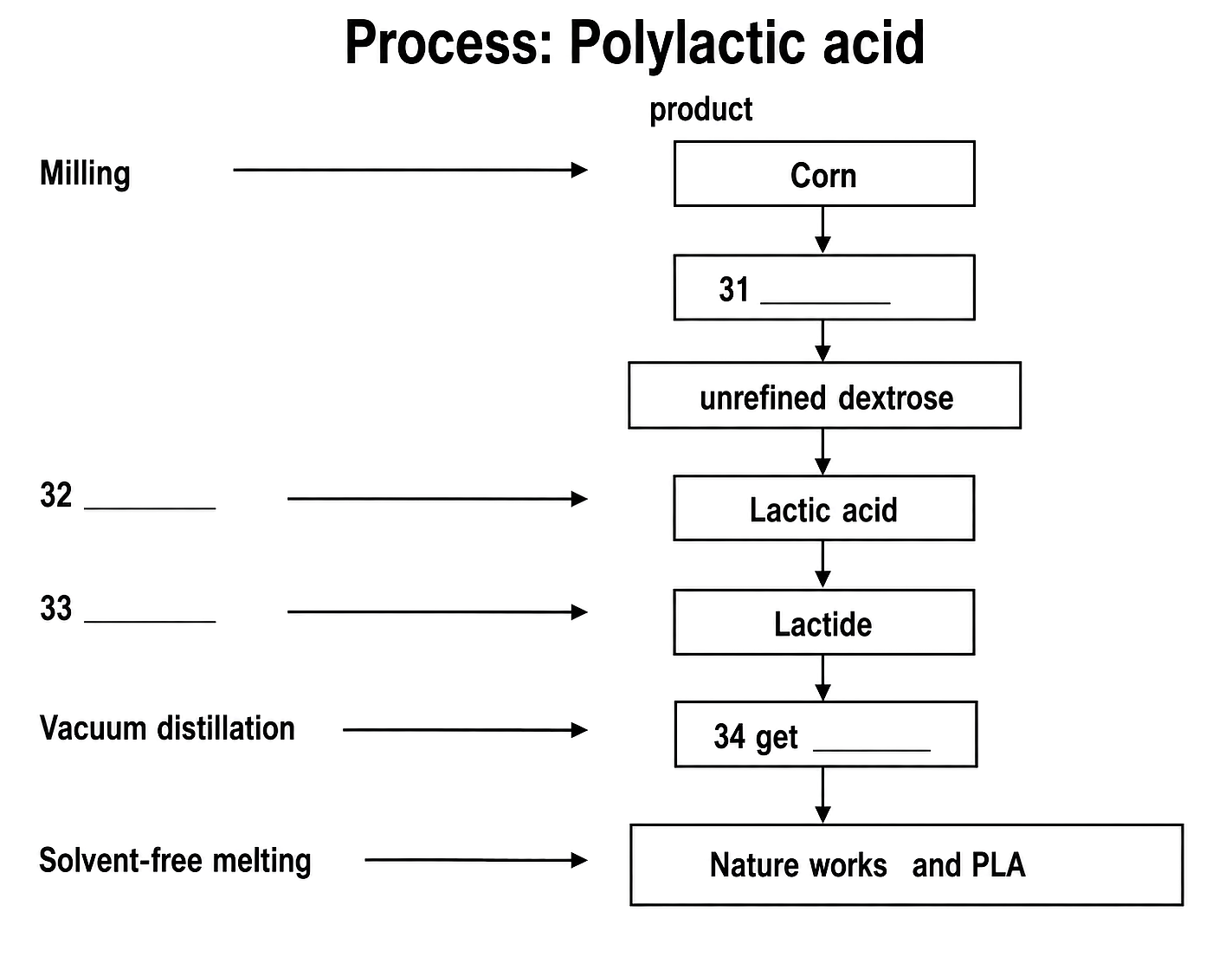
Recreated diagram for questions 31, 32, 33, 34
  1. 31

    __________

  2. 32

    __________

  3. 33

    __________

  4. 34

    __________

Questions 35–36: Multiple Choice

Choose the correct letter, A, B, C or D.

  1. 35

    Why did choose the PLA as material for food packaging?

    • A. It smells good
    • B. It can save food freshness
    • C. It can be used on other materials
    • D. Some other things need to be revised about it.
  2. 36

    What is PLA packaging is used for?

    • A. absorbing moisture
    • B. composting facilities
    • C. Packaging fresh food.
    • D. manufacturing

Questions 37–38: Multiple Choice (Features of PLA)

Which TWO features of PLA are correct?

A. It takes in moisture of skin
B. It is waterproof
C. comfortable sportswear
D. It’s fading under the sun
E. It is only made in deep color
  1. 37

    Which TWO features of PLA are correct?

    • A. It takes in moisture of skin
    • B. It is waterproof
    • C. comfortable sportswear
    • D. It’s fading under the sun
    • E. It is only made in deep color

Questions 39–40: Multiple Choice (Features of PLA)

Which TWO features of PLA are correct?

A. It is made of renewable raw materials
B. It involves the removal of carbon dioxide
C. It is no use of fossil fuel product
D. It uses renewable raw resources
E. It is sustenance which can absorb the CO2 in the atmosphere
  1. 39

    Which TWO features of PLA are correct?

    • A. It is made of renewable raw materials
    • B. It involves the removal of carbon dioxide
    • C. It is no use of fossil fuel product
    • D. It uses renewable raw resources
    • E. It is sustenance which can absorb the CO2 in the atmosphere

Answer sheet

Fill in as you go — checking is instant and local, and every miss lands in your mistake log with the lesson that fixes it.

  1. 1.
  2. 2.
  3. 3.
  4. 4.
  5. 5.
  6. 6.
  7. 7.
  8. 8.
  9. 9.
  10. 10.
  11. 11.
  12. 12.
  13. 13.
  14. 14.
  15. 15.
  16. 16.
  17. 17.
  18. 18.
  19. 19.
  20. 20.
  21. 22.
  22. 24.
  23. 25.
  24. 26.
  25. 27.
  26. 28.
  27. 29.
  28. 30.
  29. 31.
  30. 32.
  31. 33.
  32. 34.
  33. 35.
  34. 36.
  35. 37.
  36. 39.
Saved on this device — no account needed. Sign in on your progress page if you want it synced elsewhere.
Show answer key

Answer key

  1. 1. False

    False is correct because the passage says that 'Many prehistoric remains were discovered by the local people of Cambodia,' not by Nancy Athfield herself.

  2. 2. Not Given

    Not Given is correct because the passage does not mention the condition of the remains found in Cambodia.

  3. 3. Not Given

    Not Given is correct because there is no information about Nancy taking time off from her regular work to do research in Cambodia.

  4. 4. False

    False is correct because the passage says Nancy was interested in the remains and used modern methods, but there is no mention that the Cambodian government asked her to do radiocarbon dating.

  5. 5. False

    False is correct because the filmmakers aimed to find evidence about the royal family of Angkor, not about how Angkor was rebuilt.

  6. 6. Not Given

    Not Given is correct because the passage does not say whether Nancy doubted the royal family was hidden in Cambodia.

  7. 7. True

    True is correct because Nancy's research found the remains were much older than the royal family, which 'cast a lot of doubt as to the status of the ancient remains,' disproving they belonged to the royal family.

  8. 8. university

    The answer is 'university' because the passage says Nancy was doubtful of her own qualifications but applied and was accepted by the school after her friend suggested she attend a nearby university.

  9. 9. rat

    The answer is 'rat' because the passage says Nancy completed her studies on a kind of rat in New Zealand for her PhD.

  10. 10. diet

    The answer is 'diet' because her research showed that the subject’s diet led to the fault in earlier research.

  11. 11. archaeologist

    The answer is 'archaeologist' because the passage says Nancy became a well-qualified archaeologist before returning to Cambodia in 2003.

  12. 12. funding

    The answer is 'funding' because the passage says her research was often delayed by lack of funding and government paperwork.

  13. 13. database

    The answer is 'database' because Nancy completed a database for the materials found in Cambodia using radiocarbon dating.

  14. 14. E

    E is correct because Paragraph E mentions 'a piece of ingenious maths (for which a man called Wassily Leontief got a Nobel Prize),' which is an award-winning formula.

  15. 15. B

    B is correct because Paragraph B says, 'Measuring carbon footprints is a long way from being an exact process... All my numbers are best estimates and nothing more,' acknowledging the shortcomings.

  16. 16. F

    F is correct because Paragraph F describes a model developed at Small World Consulting in collaboration with Lancaster University, showing a working partnership.

  17. 17. D

    D is correct because Paragraph D says process-based life-cycle analysis is 'back-breaking work,' showing it is demanding.

  18. 18. G

    G is correct because Paragraph G explains that using both life-cycle and input-output analysis together gives a better understanding, showing the advantage of combining methods.

  19. 19. F

    F is correct because Paragraph F says the model 'treats imported products as though they had the same carbon intensity as products from within the UK,' comparing goods from home and abroad.

  20. 20. A / C

    A and C are correct because the passage says process-based life-cycle analysis 'may sound simple, but it is not at all' (A), and it is 'the most common approach to carbon footprint calculations' (C). B is tempting but the passage says it usually underestimates, not exaggerates.

  21. 22. C / E

    C and E are correct because Paragraph E says input-output analysis is 'one hundred per cent complete' (comprehensive in scope) and 'if you know how much something costs, you can get an instant crude estimate of its carbon footprint' (uses prices).

  22. 24. government

    The answer is 'government' because Paragraph F says the model draws mainly on data obtained from government sources about the UK economy in 2007.

  23. 25. weakness

    The answer is 'weakness' because Paragraph F says, 'A key weakness, which I sometimes adjust for, is that it treats imported products as though they had the same carbon intensity as products from within the UK.'

  24. 26. products

    The answer is 'products' because the passage says the model does not distinguish between products of different origin.

  25. 27. B

    B is correct because the passage says scientists at Cargill succeeded in making plastic from lactic acid made from corn, which is producing plastic from plants.

  26. 28. C

    C is correct because the passage says Cargill needed a partner with access to plastics markets, which means selling plastic in the market.

  27. 29. F

    F is correct because the passage says Nature Works PLA is used for packaging, which means wrapping products.

  28. 30. A

    A is correct because Ingeo is described as a family of polymers for fibers, and the passage says it reaches consumers in clothes.

  29. 31. starch

    The answer is 'starch' because the process for making Nature Works PLA begins when corn is milled, separating starch from the raw material.

  30. 32. fermentation

    The answer is 'fermentation' because Cargill Dow turns unrefined dextrose into lactic acid using a fermentation process.

  31. 33. condensation

    The answer is 'condensation' because the passage says, 'Through a special condensation process, a lactide is formed.'

  32. 34. polymer

    The answer is 'polymer' because the lactide is purified and becomes a polymer, which is the base for Natureworks PLA.

  33. 35. B

    B is correct because the passage says Nature Works PLA is more oil- and grease-resistant and provides a better flavor and aroma barrier, which helps keep food fresh.

  34. 36. C

    C is correct because the passage says grocery retailers are using this packaging for their fresh foods.

  35. 37. A / D

    A and D are correct because the passage says PLA has an inherent ability to take moisture away from the skin (A) and its resistance to ultraviolet light reduces fading (D).

  36. 39. A / C

    A and C are correct because the passage says PLA is made from renewable resources (A) and its production uses 20%-50% less fossil fuel than petroleum-based plastic (C).

Reading 2026-07 Test 4 — IELTS Academic Reading Practice Test with Answers | Ieltsa