About this set: compiled and lightly cleaned up from real test material that test-takers recalled. IELTS draws from a global question pool, so this material circulates worldwide. To give you a complete, sittable test, material reported around the same period is assembled together — so a set may combine content from several exam dates, not one single sitting. Any audio is a recreation for practice. Organized for study convenience. Based on test-taker recalls — not official IELTS material.
Show transcript
Part one.
You will hear a woman talking to a builder who is going to do some building work at her
house.
First, you have some time to look at questions one to four.
Now listen carefully and answer questions one to four.
Morning. Thanks for coming round. I'm Sally.
Morning. Um, so just before we get started, I'll just make a few notes. So, um, we're at
Fifteen Hill Street.
Yes, that's right.
Okay, great. And then I need to write down your contact information just for the office,
you know. So first, what's your surname, please, Sally?
It's Keyworth. I'll spell that K-E-Y-W-O-R-T-H.
And your phone number. I've got that somewhere. Yes, oh two seven five eight four six
six one three.
That's right.
Okay, Sally, so what building work would you like to have done?
Well, let's go into the kitchen first.
So you see, it's quite dark in here. We've tried having a few lights fitted, but it hasn't
really made any difference. So what we've decided is the window is too small. We'd like
a larger one.
That shouldn't be a problem. And is there anything else you'd like done in the kitchen?
Well, at this time of year, I mean, I shouldn't complain really, but I wish it wasn't so hot
in here. Is there anything you can do about that?
Air conditioning?
It's too expensive.
How about a fan then?
Yes, that would be perfect.
Uh, righto. Uh, and what's next, Sally?
Well, if we walk through into the bathroom, the thing is, when my father's staying, he
can't use the bath. So I thought here on the back wall, I'd like you to fit a shower. Is that
possible?
Shouldn't be too hard. I'll get you some brochures because there are a few ways of doing
that.
Thanks.
Now, those tiles on the wall look new, so do you want to keep those?
Yes, the tiles are new, but actually my husband doesn't like them. We want to change to
those very small ones. But do I have to choose a color now?
You can do that later. I'll get some charts for you to look at.
Before you hear the rest of the conversation, you have some time to look at questions five
to ten.
Now listen and answer questions five to ten.
Now, the last thing, let's walk outside. I need to show you some things outside the house.
Righto. Oh, nice garden. And the fence looks in good condition.
Yes, it's new, but the thing is the gate, it's too low. You have to bend down to open it. We
need something that's higher.
Right. I'll see to that.
Then the other thing is the garage here. We had a break-in, actually.
Ah. Yeah, I can see. Um, the door should be fine, but the lock, I'll replace that, shall I?
Yes. Thanks. Then also, if you step back here and look up on the roof, you can see that
it's damaged.
Did that happen in the storm a couple of weeks ago?
Yes, that's right.
I'll get up there and take a look at that then. That might be quite a big job, but I'll get back
to you once I've had a look.
Okay.
Uh, I can see that your rain gutter is broken as well.
Can you fix that?
Well, I'll need to replace it. Maybe with a steel one. It'd be stronger.
No, plastic will be fine, thanks. It's cheaper.
Okay.
And that's everything, I think. Is there any other information you need? What about a
start date?
Well, I'm completely booked all April, and I've got a job on May the fifth. That'll be a
few days, so let's say May the eighth.
Okay.
Now, what about a key in case you're out?
We have a security code. I'll give you that. It's a mix of letters and numbers. The code is
A-G four one seven six.
Got that. Okay, we'll organize some sche-
That is the end of part one. You now have one minute to check your answers to part one.
---
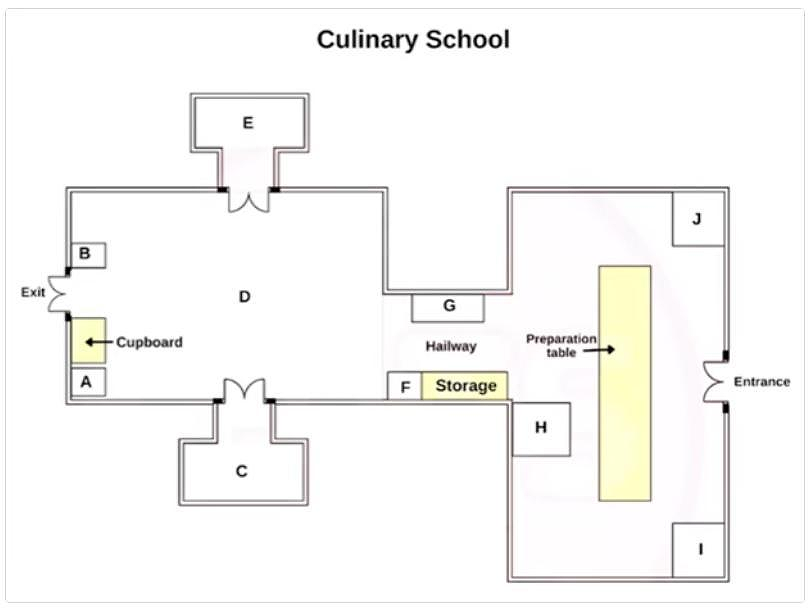
Section two. You will hear the director of a cooking school talking to a group of people
about the different programs.
First, you have some time to look at questions eleven to sixteen on page three.
Now listen carefully and answer questions eleven to sixteen.
Welcome to the cooking school. I am Julie Brooks, head of programs. I'm here to give
you information about the different tours and classes we offer as well as to show you our
cooking facilities here. Our tours and classes are very popular. The most popular cooking
tour is in the early summer in Northern California, which is famous for its cheeses. This
four-day tour is special because each student receives one-on-one classes with a master
chef. Then you'll take part in visits to the great cheese producers of the region, and you'll
taste cheeses and see how they are made.
If you're looking to take a really adventurous vacation, take one of our cooking vacations
in Italy and learn the passion of the Italian kitchen and have fun doing it. This cooking
vacation takes place in a historic villa. There will be time to relax and enjoy the
surroundings or to do some sightseeing in the area.
On the second day, a bus excursion is organized, leaving after lunch with visits to a
salami factory and an olive oil mill, returning to the villa in time for dinner. On the third
day, you go to the market, then cook your own dinner with a range of local ingredients.
One of the school's most popular tours is to the famous US city of New Orleans. This is a
three-day tour where you will be staying in a hotel near the city's famous French Quarter.
You'll have time to explore on your own before taking a unique city tour on foot led by a
local chef.
Every afternoon, there's a cooking class for the group at your hotel's professional kitchen.
If you'd rather not spend the time to travel, we offer one-day cooking classes here at the
school's state-of-the-art kitchen taught by our very talented chefs.
In the Budget Feasts class, you will learn how to make great-tasting meals that don't have
to break your budget or require a lot of preparation time. For big families, this helps a lot.
Many couples take our Cooking for Two class when their children go off to college. We
teach how to make meals that are nutritious and elegant. They're even a bit romantic.
In the class called Variations on a Theme, you learn to cook a variety of dishes using a
specific ingredient in each. For example, in the next class, you will prepare meals using
lemon. The lemon chicken meal is divine.
Before you hear the rest of the talk, you have some time to look at questions seventeen to
twenty on page four.
Now listen and answer questions seventeen to twenty.
I'd like to give you a tour of our beautiful kitchen where the meals are made. Our one-day
classes meet here. Just walk through the entrance. Right. Now, you can see the large
preparation table in the middle of the main kitchen. This beautiful table is large enough
for twelve students to work on.
This room also has a state-of-the-art oven. It's large enough for up to twenty-five cakes.
It's just past the preparation table on the left near the entrance to the hallway. Perishable
items are kept in this industrial-sized refrigerator next to the storage in the hallway. We
keep non-perishable items in the storage.
As you exit from the hallway, you'll come into the large demonstration kitchen. Here, we
hold smaller classes, but mainly it's used for cooking demonstrations and tasting events.
The last thing I want to point out is our utensil cabinet. It sits right next to the exit. It
contains a variety of cooking pots and pans and an amazing range of forks and spoons.
Please feel free to stay around the school to check out our very...
That is the end of section two. You now have half a minute to check your answers.
---
Part three. You will hear two psychology students and their tutor discussing plans for a
class debate. First, you have some time to look at questions twenty-one to twenty-six.
Now listen carefully and answer questions twenty-one to twenty-six.
Right. Now, you wanted to organize a formal discussion of some sort in the class. Is that
right, Daniel?
Yes. We thought it would be really good to end our psychology course with a formal
debate.
Mm.
You know, where there's a statement, and people argue for or against it.
Mm, good idea. Where did the enthusiasm come from? Have either of you organized
debates before? Fiona?
No, but one of my friends did in his last year at secondary school, and he says he got a lot
out of doing it, and I know they have debates in lots of other departments here at the
university.
I see. So what do you think the students, you and the others, would get out of this?
Well, a debate will encourage people to study all sides of the subject matter, and I also
think listening to other people's ideas can have a focusing effect on your own. Sometimes
you kind of don't know what you truly believe until you hear something you disagree
with.
[laughs] Okay, what about the topic for the debate?
We've got three to choose from. We'll show you in a minute to check they're okay. At
first, we thought we'd ask the other students to suggest something, but we were afraid
we'd get thirty different topics.
[laughs]
So instead, we brainstormed some, just the two of us, then made a shortlist, and we'll get
them to vote for the one they like best.
Right.
But the thing is, if people don't know how debates work, they could feel at a disadvantage.
I mean, it wouldn't affect their grades or anything, but it could put them off.
So we thought we should have a meeting beforehand to make sure everyone's clear about
what's involved in a debate and how to prepare for it.
I think that's a good idea.
And we thought we could establish some key points of a successful debate there, like that
debates are effective methods for considering an issue and that you need to understand
both sides of an argument in order to support one side effectively.
Mm.
We think it'll be best if we can use an issue that the students already have strong opinions
about.
Then some people will be happy to speak in support of it and others to oppose it.
Right.
What else do you want to do at the meeting?
Well, we've got to think about how people will do the background research for the debate.
We could organize everyone into two teams. That should save time for the main speakers.
They won't have to do it on their own. And we'll need to decide on some rules, like how
long each person speaks for, and to select a chair for the debate, someone who's really
confident.
Fine.
Now, I think you should have some sort of follow-up to the debate.
Mm.
After it's over, I'd like you to get everyone to write a short essay focusing on what they
gained from participating in it, and in turn, that can feed into the work we've been doing
on learning and motivation.
But would you be willing to read them and report back? I mean, give some feedback on
them.
[laughs] I wouldn't have made the suggestion if I wasn't.
Thanks.
Before you hear the rest of the discussion, you have some time to look at questions
twenty-seven to thirty.
Now listen and answer questions twenty-seven to thirty.
Okay, now let's think a bit more about the meeting. You need to decide exactly how
you'll introduce the students to different features of a debate.
Well, first of all, we need to inform everyone about what actually happens at a debate, the
procedures and so on. We could talk about that and write the main information on the
board.
Or instead of that, we could make a summary of the main stages and hand that out.
Then talk it through. Yes, okay. That's better.
Mm.
Okay, but we do need to talk about body language as well.
Yes, that's a very important tool. I've got an interesting article on that with some good
diagrams of techniques for things like eye contact. I'll make some copies for you to give
out.
Great.
Then we need to think about where people will find the information on the debate topic.
So they'll need to know where to look for the information. We could compile a list of
sources, textbooks and articles and so on.
We could, but couldn't people offer their own suggestions and advice on that at the
meeting instead?
Yes, get everyone involved.
Right.
What about preparation for asking and answering questions? We could try to demonstrate
that, but I'm not sure how.
Maybe we could put up a list of points on the board, then discuss them.
Yes, that sounds better. Thanks.
Okay. Well, let's meet up again...
That is the end of part three. You now have thirty seconds to check your answers to part
three.
---
Part four. You will hear part of a lecture about research into bird habitats and
conservation in Australia.
First, you have some time to look at questions thirty-one to forty.
Now listen carefully and answer questions thirty-one to forty.
Good afternoon. This is the third session of the series of lectures on wildlife. For this
lecture, we're going to look at two studies on the habitats of birds and protection
measures taken in Australia, including the basic methodology and related areas of
research. Now, let me give you some background information about the first research
project on birds. The study was carried out by R. B. Cunningham and his team from the
Australian National University in nineteen ninety-five. The primary goal was to detect
the breeding habits and resting sites of some birds, especially those protected species in
urban regions. These species included birds like peregrine falcons and kestrels in
Australia. The bird dataset consisted of a total of a hundred and fifty-three species
recorded from nine hundred and forty-six sites. One might expect that in order to obtain
valid data on their distribution patterns and population densities, researchers had to count
through binoculars. Instead, they managed to estimate with various standard distance
sampling methods like random sampling. In addition, a mapping system was used to
study their companionship behavior. It recorded proposed birds nesting sites to monitor
the mating behavior of targeted species. To obtain valid data of birds' whereabouts,
researchers attached identity tags to birds' legs transmitting radio signals. The tagging
process was done when the birds were between five and seven days of age. After the
initial tagging, data was collected from subsets of radio-tagged birds, making it possible
to assess the trends of birds over fifteen months. So what did they find? Well, as it turned
out, many of the birds tagged had the tendency to nest in the same habitat where they
grew up. Their nesting sites were quite varied and included freshwater reed beds, tidal
reed beds, agricultural crops, and man-made sites. Even though naturally occurring nests
were common, birds sometimes accidentally nested in man-made devices like power
towers, chimneys, and tunnels. This research also studied the impact of humans on bird
communities and found out that pollution had contributed greatly to the declining birth
rates of some species, which were considered to be extinct or threatened to vanish from
the study area. These species are dependent on natural forests because of their breeding
holes. They will become extinct when local natural forests continue to be polluted heavily.
A number of measures were thus taken by members from local animal conservation
organizations to boost their alarming survival rates. Firstly, breeding boxes were placed
in trees taking on the role of breeding holes that were contaminated. Protection guidelines
were also introduced strictly prohibiting killing, disturbance, and habitat destruction. A
further measure was taken to ensure the safety of birds from wind farms. In fact, birds are
sometimes shedded by wind turbine blades. A great deal of work was done on how to
prevent them from colliding with turbines. A case in point was protecting space for bird
migration by ensuring that migratory routes were kept free. Falcons generally cope well
with wind turbines, but not in weather conditions where visibility is bad. So with
knowledge of how fast falcons fly, bird stations in northern Australia can notify wind
farms further south of the falcon's approach so that turbines can be shut down as they
pass by.
Then another piece of research was done a couple of years later by Conway in two
thousand and six. His team detected the calling frequency of seabirds flying at night.
Acoustic signals are important communication tools for birds. These signals can indicate
social cohesion, prey location, and breeding behavior. Courtship songs are common
among various species during mating seasons. Males produce calling songs that attract
distant females, and then courtship songs will induce nearby females to respond.
Surveyors also took recordings of the sounds of all the individual birds detected. A tablet
PC was used to process detailed information like sound pitch, spectrum, length, and
timing of surveys. To minimize the disturbance on the bird community, all the sounds
were recorded from a distance using microphones to detect noise. They found that the
probability of call events was much higher for solitary birds communicating early and
late in the day.
That is the end of part four. You now have forty-five seconds to check your answers to
part four.