About this set: compiled and lightly cleaned up from real test material that test-takers recalled. IELTS draws from a global question pool, so this material circulates worldwide. To give you a complete, sittable test, material reported around the same period is assembled together — so a set may combine content from several exam dates, not one single sitting. Any audio is a recreation for practice. Organized for study convenience. Based on test-taker recalls — not official IELTS material.
Show transcript
Part one. You will hear a woman phoning a festival office to inquire about some festival
activities.
First, you have some time to look at questions one to six.
Now listen carefully and answer questions one to six.
Beechen Festival office.
Oh, hello. I want to check some details about the festival. I know tickets are running out
fast, and I haven't got access to the Internet at present. My computer's down.
Okay. Well, the first activity is on June the nineteenth at seven PM, and it's a concert
with local musicians performing.
Oh, lovely. Is it in the theater like last year?
Yes, that's right. And for the next activity on the twentieth, the time's changed.
Is that the tour?
Yes. Now, it does say on the tickets that it's a three-forty start, but that's an error. There
wasn't time to update them, unfortunately, so it should say four thirty instead. The correct
time is on the website, though.
Oh, right. Because one of my friends wants to go on that to see Beechen with an expert
and find out about the town and its history. Does she need to get a ticket in advance?
No, just turn up at the station where the guide will be waiting. They'll start from there,
and I think the plan is to stop for a break in the park, and there's no charge for the tour.
And the tour will finish with a visit to the sixteenth-century mill where they used to make
flour. It's recently been restored.
Fine.
And then on the twenty-first, there's an all-day event for children.
Oh, that could be good for my visitors. They're bringing theirs, you see.
Right. Well, the plan was to have a painting competition for the kids, but it's now going
to be cooking instead. And there'll be prizes for all the different age groups.
Oh, great.
And it's in Beechen Community Center.
Oh, yes, I know where that is.
They don't need to bring any ingredients, but they'll need to have a plate to put whatever
they've made on so they can display it and then take it home.
Sounds good. And are they going ahead with the fireworks in the evening, or is that
canceled? There was an article in the paper after last year's display which suggested it
might not be happening again.
That's right. No, that's still on. It's getting more popular each year, and having it in the
town square was starting to be a bit difficult because of the numbers, which is why it's
next to the river this time. It'll be easy for large numbers of people to get to.
Yes, of course. I'm sure there's lots to look forward to.
Before you hear the rest of the conversation, you have some time to look at questions
seven to ten on page two.
Now listen and answer questions seven to ten.
Okay. Now, I just want to check how it's going to impact on me as a local resident. I
mean, some people last year thought it was too noisy at night.
Yes, I know. And that's why this year, evening events won't go on beyond eleven fifteen.
I know previously some activities lasted until eleven forty-five, and the new time applies
now to all the events every evening.
Okay.
And another change, perhaps you know about this already, is that because of high visitor
numbers, parking in the town center isn't going to be allowed. It'll be outside town.
Oh, yes. To keep the streets clear, I suppose, for all the visitors. I, I did know, actually,
and it's not really going to be a problem for me.
Right.
I mean, I, I can just walk into town from my home.
Okay. Well, anyway, if you want to check any more details about the festival once you're
back online, you can look at www.events.com. And you'll be able to comment on what
activities you enjoyed and what would really help the organizers would be if people could
use the website to give feedback about what they enjoyed and that kind of thing. This will
help them plan for next year.
That's probably a good idea. And with pricing, I know local residents...
That is the end of section one. You now have half a minute to check your answers.
---
Part two. You will hear a member of staff called Mary Linden giving some information
about their community center. First, you have some time to look at questions eleven to
fourteen.
Now, listen carefully and answer questions eleven to fourteen.
On behalf of our community center, I'd like to welcome you all here today. My name is
Mary Linden. As you can see here, this multipurpose hall is a great venue for various
events, including banquets, seminars, or dances. The center provides services for all ages.
As the majority of you have already signed up for our dance workshops, I'll introduce
relevant information first before we start the tour and get ourselves oriented. Okay. Now,
when participants check in for their first dancing session, they will be given a class list
printed with available seasonal classes ranging from Zumba to ballet, as well as detailed
descriptions and schedules. The dance studio will also give you a complimentary shoe
bag to store your dance shoes. Every week will be a surprise in cardio movement. Our
fitness professional will guide you through an upbeat, heart-pumping, lively dance class.
Therefore, it is highly advised to bring a face towel and a water bottle with you. As things
get mixed up easily, you might also want to attach a name tag to your belongings. It will
be sent to you by mail in advance. Now, let us get a closer look at our dance workshops
and its curriculum. There is a list of activities to participate during and after each session.
You'll have the chance to make your own costume, but it won't be held until tomorrow.
You can also practice dance with music whenever the studio is available. In the first
afternoon and evening of your dance class, there will be an introduction to the
development of dance for the past few decades. Then we'll warm up with an informal
dance. I know you don't have much experience in dancing, but we'll get there soon. Rest
assured, there won't be a dance test until the end of the course.
Before you hear the rest of the talk, you have some time to look at questions fifteen to
twenty.
Now listen and answer questions fifteen to twenty.
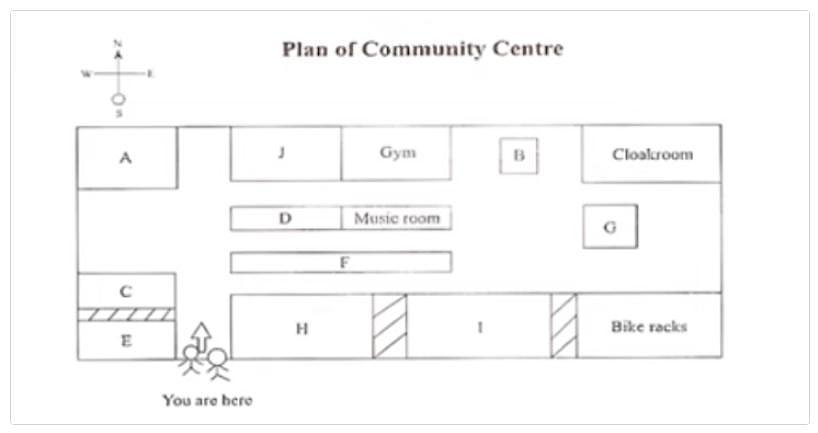
Okay. Now, a word about the layout of the center. Our beautiful facility has twenty-five
rooms altogether, which are both very functional and aesthetically pleasing. We're
standing here right at the entrance. To your left, you can see two rooms in a row. After
each dance session, you're probably soaking in sweat and in desperate need of a shower.
Just go straight ahead, turn left, and the shower room is on your left-hand side. If you just
want to take a nap, there is a six-bed bunk room. It's immediately to the left of where you
are standing right before the shower room. We also have a games room with dart boards,
table tennis, pool, and card games. It is a good place to have fun with friends. Just take
the first right. It is the second area to your right. You can explore it well later during our
tour. Further ahead, in the corner, there are the bike racks. You can either park your bike
here or hire one if you want to ride. The first hour is free. Part of our dance sessions will
take place in the music room. It has a large mirror with various musical instruments and
state-of-the-art stereos. If you want to get there, just go straight, take the second right,
and it's the second area to your left. Our friendly reception team is an invaluable resource
for any visitor to the center. If your mobile phone needs charging, we have several
adapters and can easily get your phone back up and running again. We also offer a range
of chargeable services, including photocopy, scanning, and faxing. The reception is
located in the center to the south of the music room. There is a medical center providing a
full spectrum of care and treatment, especially for sports injuries like a sprained knee. It's
right opposite the reception to the left of the music room. Now, I have to tell you about
our gym, where some of our dance sessions take place. It is also equipped with the latest
equipment, including exercise bikes, treadmills, rowing machines, et cetera. If you walk
straight ahead before you come to the end and turn right, it's the second room to your left.
And speaking of food, if you ever feel hungry, you can either cook in the kitchen or grab
a snack at the store. To reach it, keep straight on until you get to the third passageway,
turn right, and it's the one after the gym. And the kitchen sits right next to the gym on the
same side of the passageway. It has all the utensils you'll need: spatulas, frying pans,
ladles, and plates. You name it. Just feel free to use it. By the way, if you have coats,
umbrellas, or any large bags with you, the cloak room is available. It's the room in the top
right corner on the far side. Right. Well, if you're ready, we'll start the tour of our lovely
community center.
That is the end of part two. You now have thirty seconds to check your answers to part
two.
---
Part three.
You will hear two students discussing their assignment on how children learn. First, you
have some time to look at questions twenty-one to twenty-six.
Now listen carefully and answer questions twenty-one to twenty-six.
So Daniel, should we compare a few ideas for our assignment on how babies and children
learn?
Good idea. I've started the reading. One thing I read about was these learning videos.
Oh, yeah. I read about learning videos. The baby watches a short film with some basic
vocabulary, maths, and science, and they learn as they watch. That's the idea. Certainly,
babies will pay attention to videos for long periods of time.
Yeah, but there's been research to show that babies don't learn effectively from screens.
Actually, they learn by interacting with their parents and other caregivers. That's the best
approach.
Hmm. It's interesting. Another issue with learning videos is that babies ought to have
playtime.
You mean in a group?
Not necessarily. It can be alone, actually. But what's important is that they investigate
their own environment. They should examine the objects around them and experiment, so
they discover information for themselves, and they don't get that sitting in front of a film.
That's a good point. Then I also thought I'd write about the present research in my
assignment.
Oh, yeah. I read a bit about the present research, and it's true, isn't it? When you give a
baby a present or gift, some of them are more interested in the wrapping paper than the
present itself.
But it's not some of them. The research shows that pretty much every baby prefers the
paper to the present, whether male or female. It's just a human characteristic.
Really? I thought there'd be more exceptions.
Apparently not. It seems that playing with the paper or ribbons or box stimulates the
baby's senses. They touch everything, climb into the box, put the ribbon into their mouths,
and brain scans have shown that sight, sound, touch, smell, and taste are all stimulated in
this way.
It's amazing the research has produced so much specific information just from studying
presence. I hadn't expected that. The results cover so many different aspects of baby
behavior.
Yeah, exactly. But it shows us that babies learn by playing.
So we shouldn't stop wrapping up baby's presents.
No, definitely not.
Then I also read about babies and second languages. There was a really interesting
bilingual experiment in Spain. They tried teaching English to a group of two hundred and
eighty Spanish children in different preschools.
So the research subjects were in different schools?
Yes, but the researchers deliberately selected teachers who all had the same education.
They had been trained to use a style that focused on play and social interaction. So
because of that, the experiment was standardized across all the schools. That's really
important.
Yeah, I agree. That was a great idea.
The subjects were aged between seven months and three years old, and the children were
given a one-hour English lesson for eighteen weeks.
Did they seem to enjoy the lessons?
I don't have any information on that. But at the end of the experiment, each child could
produce an average of seventy-four English words or phrases.
But did they remember them?
Well, follow-up testing showed that the classes had a long-term benefit. Yes.
Wow, that's remarkable, especially considering some of the children were so young.
I think so, too. It really shows how babies and small children can learn through playing.
Yeah. I wonder if other schools will try the same thing in future.
It'll be interesting to see what happens.
Before you hear the rest of the talk, you have some time to look at questions twenty-
seven to thirty. Now listen and answer questions twenty-seven to thirty.
So Maya, let's discuss some more ideas about how babies learn. What other research have
you read about?
Well, I read about Dr. Pritchard's study. In her experiment, babies were given toys to play
with, and their caregivers sometimes repeated the same movements as the baby and
sometimes did something different. And Dr. Pritchard monitored the baby's electrical
brain activity. The results showed that babies were happiest when parents or caregivers
imitated their behavior.
Maybe that could be used as a teaching tool.
Yeah, absolutely.
Then I read about a study of three-year-olds. This was interesting. The researchers
experimented by doing things like dropping a pen or knocking something off a desk.
And did the children do the same thing?
No. What they often did, though, was pick up the pen. They wanted to give someone
assistance if they could, if they thought someone else had a problem. So I think that
shows how babies are more likely to learn by working with caregivers and teachers rather
than in isolation.
Then have you heard of Professor Mitchelson?
Is he a linguist?
You're thinking of someone else. Professor Mitchelson did a study where babies had to
push buttons. Some buttons switched on a light, and some didn't. And after a little
experimentation, the babies nearly always pushed a button that switched on a light.
You mean they knew the light would come on?
Professor Mitchelson thinks so. He believes they recognized that a certain thing would
happen as a result of a certain action. So maybe that has implications for learning.
Interesting. I also looked at a study in the United States. This showed that babies as
young as sixteen months have some knowledge of how language is structured. In a
simple sense, they seem to know the function of nouns and verbs, and the researchers
believe this is linked to the way they learn the meaning of new words.
Oh, really? Amazing they start so young. I'd like to read about that study 'cause that
sounds so amazing.
That is the end of part three. You now have half a minute to check your answers to part
three.
---
Part four. You will hear part of a lecture about a research project on crocodiles in
Australia. First, you have some time to look at questions thirty-one to forty.
Now listen carefully and answer questions thirty-one to forty.
Around ten years ago, Australia Zoo, the University of Queensland, and Queensland
Parks and Wildlife undertook a project to monitor the movements and behavior of the
crocodiles in Lakefield National Park.
The aim of the study was to provide better information on how adult crocodiles there
interact within a river system, enabling people to have better decisions on how to manage
crocodile populations.
This project can lead the world in crocodile management because of the use of satellite,
which enables scientists to stably receive accurate information being sent back to them on
the computer.
Even though the crocodiles can travel very long distances, scientists can still know where
they are and study their habits.
The study is going to help scientists gain further knowledge on crocodile behavior, which
can help make informed decisions on the management plans for crocodiles, not only in
Australia, but around the world.
Crocodile tracking isn't a new idea in Australia.
Crocodile studies have been previously conducted by radio.
A miniature electronic device was implanted under the skin of these animals, and they
were released back into the river. These tags enabled scientists to track the movements of
these particular crocodiles over the next ten years.
Of course, there are some unexpected challenges.
The data transmitted from each receiver is recorded by some devices employed in the
receiving stations.
However, some devices are too old that they always lose signals due to a variety of
reasons,
so they can't track those animals which they have been studying for months.
In order to study the crocodiles, they must first be captured so that the device can be put
on them.
But this is a very difficult task because they are alert and afraid of being followed by
humans.
So it might take the team several hours to capture one.
The tracking device has signal transmitters inside, and it's waterproof. It is attached to the
head of the crocodile, so the crocodile cannot remove the device with its feet or tail.
The research has begun to reveal the movements of crocodiles.
Data showed that crocodiles tend to be more active at nighttime.
The GPS sometimes shows that in some areas the crocodiles are overpopulated, so
scientists at the park have to use a helicopter to relocate the crocodiles in order to control
their population in the area. A crocodile would be taken many kilometers away from its
original place.
However, scientists found that the relocation methods were ineffective because the
relocated crocodiles will return to their original location following the most direct route
within one week.
The tracking data shows that the crocodiles swim right back to where they came from
when moved.
Crocodiles sometimes travel hundreds of kilometers from Indonesia to Australia in order
to reproduce.
It is interesting to see that they can always find their way, and they will not get lost in the
ocean.
Scientists realized the crocodiles are able to navigate.
This is an important ability for them when they have to migrate for very long distances.
We may wonder if human beings can learn from the crocodiles and find our way without
using technology.
However, through lots of research and experiments, scientists conclude that crocodiles
can tell directions by using their senses to the sun so that they know where they're going.
This is an ability which human beings don't possess. Another finding is that like the
migration of birds who can travel thousands and thousands of kilometers, crocodiles have
the same system to help them travel.
The research is still going on in northern Australia. Scientists are working hard to gather
more information about this amazing creature.
That is the end of section four. You now have half a minute to check your answers.