About this set: compiled and lightly cleaned up from real test material that test-takers recalled. IELTS draws from a global question pool, so this material circulates worldwide. To give you a complete, sittable test, material reported around the same period is assembled together — so a set may combine content from several exam dates, not one single sitting. Any audio is a recreation for practice. Organized for study convenience. Based on test-taker recalls — not official IELTS material.
Show transcript
Part one. You will hear a man taking part in a survey about his local community. First,
you will have some time to look at questions one to six.
Now listen carefully and answer questions one to six.
Hi, Altaf. I'm your settlement worker, and I'm called Jenny. It's great to meet you.
Welcome to our city. You'll love Toronto.
I'm sure I will.
I have some general recommendations. First, Toronto's a big place. A lot of people who
come here choose to live in the west.
I see. Is there a reason for that?
Well, yes. There's a great market in the neighborhood. All the local people know about it.
Oh, that would be good for us.
And I understand you have young children?
That's right.
So another advantage of this area is that it has quite a few parks where children can play.
Oh, that's great. They really like being outside.
I actually know of an apartment in the area that's available. I'll arrange for you to see it,
but first let's look at the floor plan, and I'll tell you what to check when you see it. This
room here is the kitchen. Be sure to open the refrigerator.
To see if it's working properly?
Yes, and to make sure that there's no nasty smell.
Oh [laughs] . Anything else?
Well, it would be good to check the electrical situation. There's nothing worse than not
having enough plugs. You'll need at least four.
I'll look for those. Um, what's this on the plan?
Well, now, that's the living room, and this is where you go outside to a small balcony.
Have a look at the door lock. Be sure it's not broken.
I will. It'll be nice to have our own place to sit outside when we want.
Yes, it's very nice on a summer evening after dinner. And Altaf, have a good look around
the living room. The condition of the room is important because it's your main living area.
Look at the paint in particular. It may be time to redo it.
I'll check that.
Before you hear the rest of the talk, you have some time to look at questions seven to ten.
Now listen and answer questions seven to ten.
Now, Altaf, this hall leads to the bathroom.
When you look at that, do check below the sink. Often that's the place you'll find a leak.
And the tiles in the bathroom should be in good shape.
I agree. Then this room must be one of the bedrooms, and this must be the closet. My
wife wants a large one.
I'm sure. We all want lots of room for our clothes. You'll also want to look outside the
bedroom window. It overlooks the street, and there might be a lot of noise at all times of
the day and night. We're in a very busy city.
I see. That would be a problem for my wife and the boys too. I'll definitely remember to
check that.
Jenny, what other things are in the building?
You mean the facilities?
Yes. For example, where will we do our laundry?
With a building of this type, it's probably in the basement, but it doesn't say. So you'll
need to check where it is. You know what's also really good to check for?
No, what?
You need to check that there's a garbage room on every floor. Then you don't need to go
outside.
Right.
Well, that's everything for now. Good luck, Altaf. We'll talk later today.
Thanks for your help, Jenny.
That is the end of part one. You now have one minute to check your answers to part one.
---
Part two. You will hear a talk given by a tour guide at a museum. First, you will have
some time to look at questions eleven to seventeen.
Now listen carefully and answer questions eleven to seventeen.
Good afternoon. Welcome to Barton Museum. I am Carly, and I am your tour guide. I
would be taking you through all the places of interest in this museum before we actually
set out to go. The first building we stop at is the Barton House, which was built by the
man himself, Barton.
When he first came to this area, it was largely uninhabited, and as a matter of fact, this
place was a vast expanse of land where an abandoned farm was situated. After he bought
it, he began building, and in about three years, the basic structure was complete.
Although he never really stopped building. As a man who loved the arts, Barton spent a
good fortune on them. He had several paintings from all over the world, and his gallery is
still considered one of the best in town. One of the most notable of his collection is the
Chinese wallpaper, which was painted in the eighteenth century.
Rumor has it that he paid hundreds of thousands of dollars for the piece of art.
Barton kept adding some features to his house every year. He did this until the night he
died. He was building a new bird room in which he collapsed and never came to himself.
His dining room is also beautifully adorned with antiquity, from the tables to the stools to
the mats. The chairs were bought from some Japanese merchants in the area then.
Looking at the location of his house, which sits some feet higher than surrounding lands,
it is possible to see areas of just green, lush vegetation that run for miles. At the backyard,
there is a garden which he started himself. He used to care for the plants there personally
and made sure they never lacked water. He detested fertilizers as he believed that it
would spoil the cycle of growth of the plants in the garden. He had some trees in the
garden. They are not ordinary trees, but some rare ones, and they have been alive for
decades now. Under one of those trees was his favorite spot, and history tells us that he
used to sing and pray under the tree. Recently, the government brought in some
flamingos here as the environment supports their growth and development well. They are
believed to make the scenery livelier and more beautiful.
Although there are many exotic animals in the garden, swans are still the most popular
animal here. They seem to be everywhere, and it was said that Barton thought that they
were a gift from the heaven. It was forbidden to kill or hurt any of these animals in his
time.
Before you hear the rest of the talk, you have some time to look at questions eight to ten.
Now listen and answer questions eight to ten.
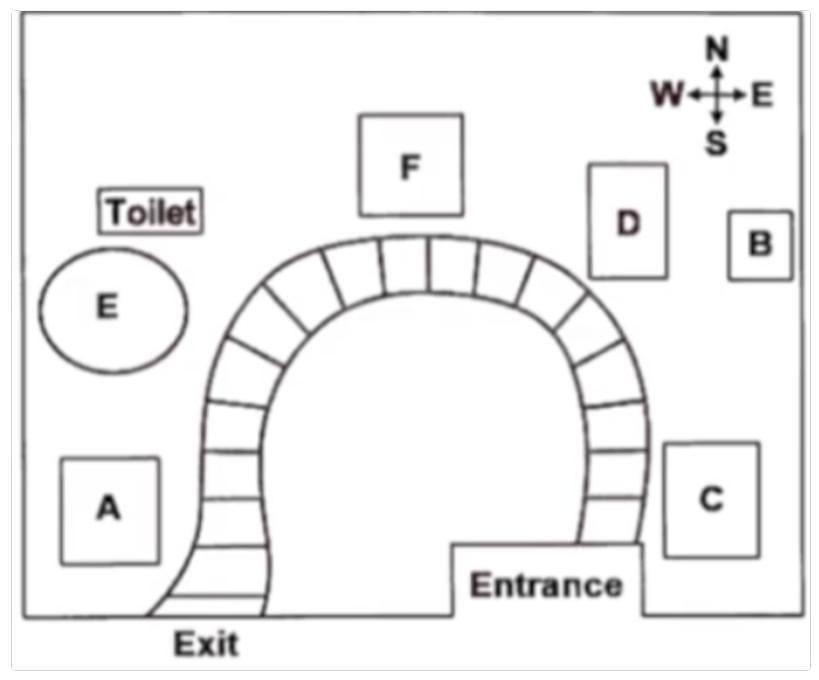
Now, let's take a look at other interesting places this site has to offer. Away from the
backyard, there is a gallery just at the right side of the road, a few feet from the entrance,
and there is usually a history exhibition every week. Halfway down the path to the east of
the toilet, we have the woodland, and the area is just beautiful. Barton decided to have it
just because he loved the view. If you keep walking down the path in front of you to the
west of the site, you will see a large gift shop beside the toilet. It has a large collection of
handicrafts.
These handicrafts are not actually made by Barton himself, but are imitations of his
artistic works.
As you have heard enough about this man, we would now proceed to see these things for
ourselves, and I'm very sure that you...
That is the end of part two. You now have forty-five seconds to check your answers to
part two.
---
Section three.
You'll hear a student called Paul talking to a tutor about a course he is thinking of doing.
First, you have some time to look at questions twenty-one to twenty-five on page five.
Now, listen carefully and answer questions twenty-one to twenty-five.
Good morning. Come in. You're Paul, are you?
Yes. I spoke to you on the phone.
Yes. Have a seat. You wanted to talk to me about the archeology course?
Yes. Uh, I've read the handbook, but I'd like to find out a few more details before I decide
whether to do it.
Right. Yes. What would you like to know?
Well, first of all, can I combine the archeology course with one in anthropology?
Yes, you can combine it with any other subject apart from classical history.
Hmm.
That's simply because there's some overlap in the lecture times for those two courses. We
weren't able to coordinate them.
Okay, fine. And could you tell me about the modules?
Well, in the first semester, there are three. All of them are compulsory. We don't offer
optional modules till next year.
Right.
The first one focuses on what can be learned from specific artifacts, such as pottery and
stone tools. It's called Object Matters, and it's taught by Dr. Morris.
Is that... How is the module presented? I mean, is it lectures?
We refer to the means of presentation as the learning method, and in this case, it's
lectures integrated with practical sessions, so it's a mixture.
What about the content? I suppose we'll be looking at different kinds of archeological
remains and how to date them and so on.
To some extent, but the module is basically about processes. First of all, recording
material, then classification, then interpretation of the data. That's how archeologists
draw conclusions about their findings. And finally, display. Is that okay?
I think so. Yes. Thanks. Uh, one other thing. How is the module assessed? Is there an
exam?
No, it's all based on coursework.
Before you hear the rest of the discussion, you have some time to look at questions
twenty-six to thirty on page six.
Now listen and answer questions twenty-six to thirty.
Okay.
And the second module, that's the one called Towns and Cities, is taught by our
department head, Professor Elliot. And as the name suggests, the module's about the
origins of built environments and how they developed.
That's mainly factual then, I suppose.
It is, really, and for that reason, the assessment's by examination. But you may be pleased
to know it's an oral rather than a written exam, and- [laughs]
It sounds a bit scary. [laughs]
Most of our students find they actually enjoy it, so don't worry too much.
Okay.
And then the title of the third module is Method and Science, and in that, Dr. Thompson
will be introducing you to the standard techniques used in archeological field work and
analysis, things like excavating and dating.
What about the learning method for this module? Are there any lectures, or is this all
laboratory work?
Oh, it's half lab work and half seminars. There aren't any lectures. Then right at the end of
the module, you'll take part in a site survey. The date for that is week beginning the tenth
of March, but I can't tell you the location yet. That'll be announced later, but I think you'll
find it very useful.
Yes, I know someone who went on that last-
That is the end of section three. You now have half a minute to check your answers.
---
You will hear a talk on a survey on improving the local hospital service.
First, you have some time to look at questions thirty-one to forty.
Now, listen carefully and answer questions thirty-one to forty.
Good morning. Today, I’d like to discuss the results of our patient survey. We have
reviewed the data collected in order to measure the strengths and weaknesses of our
hospital and to determine potential future plans for improvement.
The first question on the survey attempted to determine the main reason that patients
choose to come to our hospital for treatment rather than others in the vicinity. The data
showed that even though our hospital is not as centrally located as others, we offer a very
good transportation service that enables patients to travel here by bus or train free of
charge.
Despite there being other hospitals that are larger with more facilities than ours, we still
have higher patient numbers.
The second question on the survey asked what quality patients hoped for most when
visiting the hospital. There were five choice options, including short waiting times and
friendly service from nurses. However, the data collected showed that most patients
hoped that the hospital is clean when they visit it.
It seemed that patients were not concerned with the clarity of signs and notices in the
hospital, as this option got the smallest number of votes.
They were, however, very keen to be given prior information by the staff about hospital
treatments.
Using the data collected from our survey, we have developed a list of actions that will be
adopted within the next year. A main focus of these improvements is our website, which
is currently very outdated.
We will not only update our in-hospital service for the use of the medical staff, but also
our main service so that local residents can also benefit from it.
We hope that this new service will attract a large number of new patients.
It is clear from the feedback that many members of staff are unhelpful towards patients
and inefficient when carrying out their tasks.
We feel that some incentive is needed to boost motivation to perform better, and so we
are implementing a system whereby staff will be awarded an extra bonus for their success.
The member of staff who has received the most bonuses at the end of the year will be
announced as Staff Member of the Year.
We will continue to monitor progress on this issue through patient feedback forms so that
the opinions of our visitors will constantly be taken into consideration. Another issue that
the survey has brought to light is the long delays experienced by visitors awaiting
treatment, with some visitors reporting waiting times of up to five hours.
This is unacceptable. We need to improve the effectiveness of communication between
patients, doctors, and staff, so we have decided to implement a ticketing system. This
means that patients are seen on a first come, first served basis and will never have to wait
more than two hours to be seen by a doctor.
The final topic that I want to cover in the lecture is the recommendations that we have put
forward for future improvements to the hospital.
Firstly, we intend to be the first hospital in the country to build a new unit for those
suffering from sleep disturbance, which is a relatively common illness affecting up to six
percent of the population. Whilst we are a hospital primarily treating patients with
illnesses and injuries, we cannot ignore the significant income that those in need of
plastic surgery could bring to the hospital. We will, therefore, also be proposing a new
ward to give patients access to this increasingly popular treatment.
After much discussion about the quality and suitability of our equipment, we have
decided that it is advanced enough to cope with the treatments that we offer and that our
spending should be directed to other areas where it will have a more significant impact.
We feel that more effective planning is needed to improve the efficiency of the forms of
communication that patients have with us.
Therefore, patients who have received treatment will receive an email link to a survey
that they can fill out online. This will eradicate meaningless paperwork and will also
enable us to digitally monitor the data collected. Now, if anyone has any questions...
That is the end of part four. You now have forty-five seconds to check your answers to
part four.