About this set: compiled and lightly cleaned up from real test material that test-takers recalled. IELTS draws from a global question pool, so this material circulates worldwide. To give you a complete, sittable test, material reported around the same period is assembled together — so a set may combine content from several exam dates, not one single sitting. Any audio is a recreation for practice. Organized for study convenience. Based on test-taker recalls — not official IELTS material.
Show transcript
Part one.
You will hear a telephone conversation between a man who wants information about
bicycling holidays and a travel agent.
First, you have some time to look at questions one to five.
Now listen carefully and answer questions one to five.
Good morning. Thank you for calling Getaway Tours. I'm Sandra. How can I help you
today?
Hi, Sandra. I've got a lot of questions, but can you first tell me your office hours?
Sure. We're open from ten AM to seven PM.
Thanks, Sandra. I saw your article in my favorite magazine last month, and I'd like more
information about the different tours.
We have gotten a lot of calls about that article.
I'm not surprised. Is it true that if I book a tour, the prices start at only one thousand one
hundred dollars per person?
Yes. That's a special offer for this month. Normally, they're from one thousand four
hundred dollars going up to two thousand dollars, and it includes accommodation and
meals. This offer is for any of our thirty-six different bicycling tours.
Well, I am definitely interested in the bicycling tours, but I thought there were only thirty.
Are all of them for a week?
Most of them. If bicycling is not your thing, we also have walking tours to choose from.
That's a lot of options.
Are you aware that our trips all begin on Tuesday?
That's great. It would give me Monday to pack.
How do you suggest I choose from so many options?
[laughs] Yes, it is tough to make a choice.
I would love to hear about your most popular tours.
Before you hear the rest of the conversation, you have some time to look at questions six
to ten.
Now listen and answer questions six to ten.
I'll start with the bicycling tours since you said that was your main interest.
My wife and I are not in great shape for a hard ride. Do you have rides that are at the
beginner level?
Sure. There's our Florida trip. That's fourteen nights. But I'd recommend our holiday on
the East Coast of the US in an area known as the Autumn Route, which is just six nights.
With short, leisurely routes on trails by the riverside and through the forest, you have
plenty of time to explore the landscape during your holiday.
Wow. Seeing the changing colors of the leaves would be amazing.
Yes, that's right. You also have the option to stop at some outstanding homes and to see
their gardens. Whichever cycling holiday you choose, you usually spend two nights at
each hotel and always have plenty of time to explore, rest, and sightsee as you wish.
Could you tell me about one of your moderate rides? You never know, maybe my wife
and I will get into enough shape to be able to do one.
[laughs] Well, let me see. Oh, this trip is actually ten nights long. It travels through parts
of Southern California. The ride begins on a mountain trail and finally brings you down
to the coastal roads.
Oh, yes, I see that here on your website. Oh, that looks amazing. I like that we would
have the opportunity to try some of the local cuisine.
Yes. The cuisine in this area makes lavish use of colorful local produce.
And then, you know, the great weather of this region is a great feature by itself.
Do we stay in hotels on this trip?
You stay in hotels most of the way until the end, when you stay on a farm overlooking
the sea. That's always really popular.
Wow. Both trips sound fabulous. How far in advance do I have to make reservations?
That is the end of part one. You now have one minute to check your answers to part one.
---
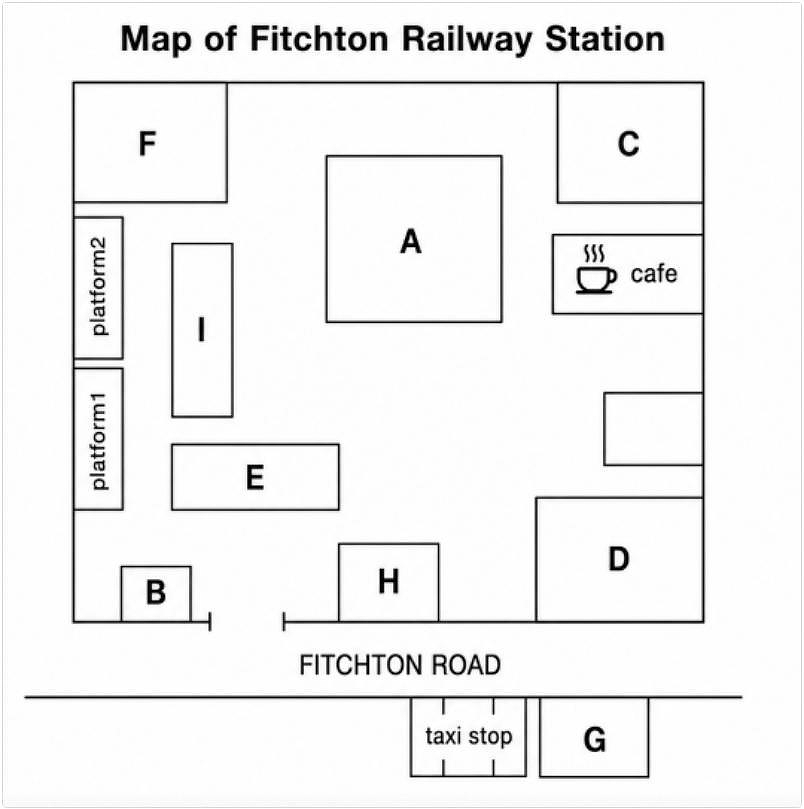
Part 2. You will hear a railway station staff member introducing the activities that
passengers can do while waiting for their trains.
First, you will have some time to look at questions eleven to fifteen.
Now listen carefully and answer questions eleven to fifteen.
Dear passengers, welcome to Fitchton Railway Station. I'm sorry to inform you that the
train to London is delayed. It will take off two hours later at eleven forty-five AM. Please
accept our apologies. In the meantime, allow me to introduce Fitchton Railway Station,
so you can make the most of your time while waiting for the train.
The main entrance of the station is on Fitchton Road. If you want to take a bike ride
around here, walk down Fitchton Road and pass the taxi stop. You can find a bike rack
on the right.
But if you just want to stay in the station, it's okay. You can find a luggage locker when
you enter the station. It's on the left. You can put your luggage there. If you don't feel
very well or you need to buy some medicine, there's a chemist in the farthest corner of
the station opposite to the cafe,
and you can have a cup of coffee at the cafe if you want. The big area near the cafe is the
waiting room, where you can have a seat and relax. If you want to use the toilet, make a
left when you enter the station, then turn right. Go straight until you walk past platform
two. It's right there at the end. The news agency is in the southeast corner of the station.
Before you hear the rest of the talk, you have some time to look at questions sixteen to
twenty.
Now listen and answer questions sixteen to twenty.
If you don't want to stay in the station, you can also have a look around the station, but
make sure to get back in time for the train. I'm sure you don't want to miss it. The
Fitchton College is within walking distance from the station. The view is quite good there.
The town library is also just down the road if you want to read. Oh, there's also an art
exhibition at the moment. You can go and check it out. The store across the street opens
throughout the day, and you can find all kinds of stuff there. You don't want to buy any
gifts for your friends there, though. Most items will be difficult to carry on a bike. But
our local food is something I recommend. It would be too late if you want them once you
are on the train. You can buy some at the Foodies shop, which is right next to the station.
If you're looking for anything to wear during the trip, you'd better go to the department
store, but I'm afraid there isn't enough time for that.
You can send some postcards with local pictures on them to your friends and family. You
can buy them in the community college, which is near the museum.
The old cinema behind the museum cannot compete against the new theater in the
shopping center, so the current owner plans to make it an accommodation block instead.
In the back of the train station, you can see a statue of Richard Travolt, a local
government minister who is famous for completing a lot of construction projects in our
city. Again, I'd like to remind you the train will leave at eleven forty-five. Please get back
in time, and I hope you enjoy your time at Fitchton.
That's the end of Section two. You now have half a minute to check your answers.
---
Section three. You will hear two primary school trainee teachers, called Stefan and
Magda, discussing their placements for science teaching.
First, you have some time to look at questions twenty-one to twenty-six on page six.
Now listen carefully and answer questions twenty-one to twenty-six.
Hi, Magda. How was your placement?
It went really well. The kids really enjoyed the science I did with them.
So did mine. I think they found it very motivating.
Yes. The program we had to teach was much better than the old style science experiments
we did at school.
Yes, though I don't understand why the children should have to build a model of a steam
engine. I tried it with the kids, but I couldn't get it to work.
Me neither, and it really shows it's hard to get any real results.
Yes. And it's usually the children's parents, rather than the kids themselves, who favor
that type of experiment.
So what experiments did you do?
Well, one day a discussion started in class about breakfast cereals, about which one was
best. One child then said that we should test them in class.
That's a nice idea.
Yes, and it wasn't expensive. We brought four different brands of cereal and had
everyone evaluate them for taste, appearance, and sogginess in milk.
And are you going to tell me which one won?
No, I'll let you do it yourself. It obviously isn't difficult to set up. Another experiment we
did, the sports teacher's idea actually, was to spend a morning seeing how high various
balls bounced. For example, do new tennis balls bounce higher than old ones? And do
basketballs that are fully inflated bounce better than flatter ones?
And I guess you got some interesting data?
We did, and they had to make a chart to plot the results. It really improved their grasp of
charts and graphs and calculation. Apparently, they'd had problems understanding the
point of graphs in the past.
Did all your experiments work out okay?
Well, we had one lesson on making paper from grass. The children made a terrible mess
in the classroom. Whatever they did didn't work, and it wasn't because it was difficult. I
think it was because it didn't engage them at all. It didn't seem to motivate them.
My tie-dying experiment went well. They had to get a piece of material and twist it into a
rope and then dye it. The children did end up with blue and green hands for a few days,
though.
But don't you need to spend more than one lesson on that?
Yes, we did it over three classes. The children really loved it, though, and one suggested
we make scarves from the result. I declined, as my sewing skills aren't up to much.
I guess the one experiment that everyone loved in my class was making glue from milk. I
thought it would be a complete failure, but in fact, it worked brilliantly. One reason I
suspect is that they got feedback straight away. Some children get really restless if they
have to wait for anything interesting to happen.
Yes, I think that's always a good idea. Really helps to make it a success.
Before you hear the rest of the discussion, you have some time to look at questions
twenty-seven to thirty on page seven.
Now listen and answer questions twenty-seven to thirty.
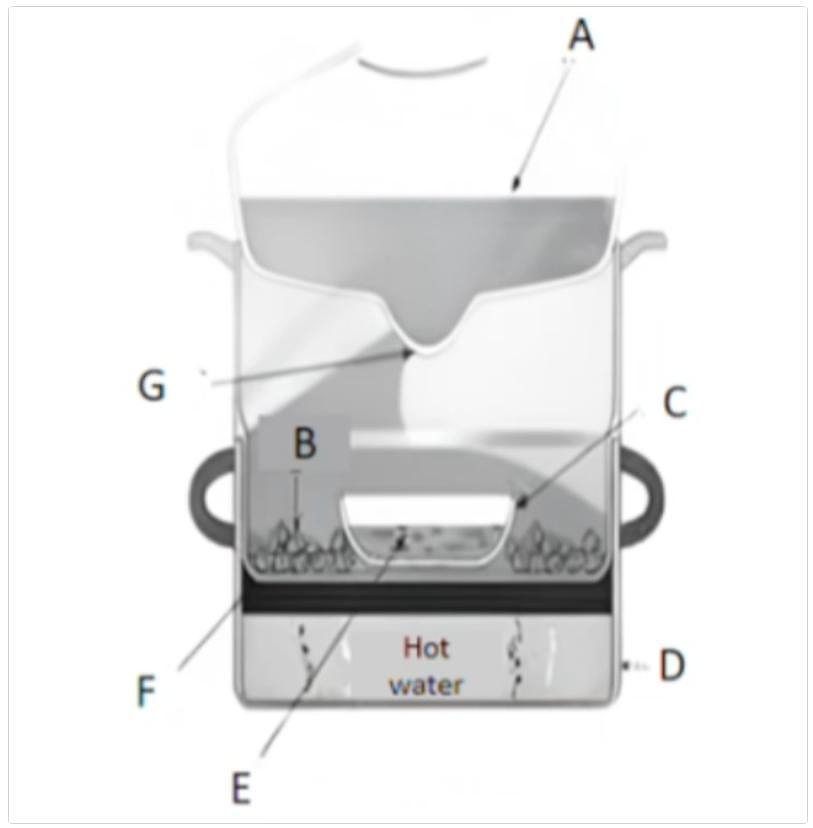
I see you've got a diagram there for one of your experiments.
Yes. It was an idea I got from the Internet. It was very easy and straightforward to set up.
The idea is to make a condenser to extract essences from plants. The large container's
made of metal.
Right, and that holds the hot water?
That's right, and it has a strainer which sits inside it. This is where you put the plant
matter. We use plants like rosemary, as the essence you can extract is quite strong.
So what's the container right at the top?
It's made of glass. It's where we put the ice. The glass container has a drip tip at the
bottom.
What's that for?
It's where the essence collects.
Where does the essence go then?
Into the dish at the bottom. It's made of pottery.
Sounds good. I might try it with my class.
That is the end of section three. You now have half a minute to check your answers.
---
Section four. You will hear a talk on the research of the behavior of chimpanzees. First,
you have some time to look at questions thirty-one to forty.
Now listen carefully and answer questions thirty-one to forty.
Welcome back to my series of short lectures on apes.
Today we will examine recent and historical breakthroughs on the behavior of
chimpanzees, otherwise known as chimps.
The word chimpanzee is an umbrella term for two different species of apes in the genus
Pan, which are the common chimpanzee, or Pan troglodytes, found in West and Central
Africa, and the bonobo, or Pan paniscus, which are found in the forests of the Democratic
Republic of the Congo.
Chimpanzees belong to the Hominidae family, together with gorillas, orangutans, and
indeed humans.
Current research tells us that the chimps broke away from the human branch of the
Hominidae family approximately six million years ago and remain the closest living
relative to humans to this day.
More modern researches into chimpanzees have centered on their behavioral
characteristics once all biological and genetic factors have been ruled out.
In this way, scientists have unearthed an unfathomable amount of similarities between
human and chimpanzee behavior.
Although much of this research has taken place through observation of captive chimps,
the results are widely seen as an authoritative reflection of chimps living in the wild.
Chimps live in large so-called communities comprised of many male and female
members, with the social hierarchy determined by an individual chimp's position and
influence.
Through such research, scientists have found that chimps learn and adapt through
observation of others' behavior.
Once in power, the alpha male is often seen to alter its body language in order to retain
power. For example, he might puff himself up in order to intimidate others,
while lower ranking chimps are noted to behave more submissively and holding out their
hands while grunting.
Female chimpanzees also have a distinct social hierarchy with high social standing
inherited by children.
It is not unheard of for dominant females within a community to unite and overthrow the
alpha male, backing another in his place.
James Diamond, in his book The Third Chimpanzee, suggests that chimps should now be
reclassified in the genus Homo instead of Pan, and there are many arguments still in favor
of this.
Male common chimpanzees are on average one point seven meters in height, weighing
seventy kilograms, with their female counterparts being somewhat smaller.
By comparison, the bonobo is slightly shorter and lighter, but with longer arms and legs.
However, both species walk on all fours and climb trees with great ease.
Jane Goodall made a groundbreaking discovery in 1960 when she observed the use of
tools among chimpanzees, including digging for termites with large sticks.
A recent study claimed to reveal that common chimpanzees in Senegal have been using
spears sharpened with their teeth to hunt. However, these reports remain unsubstantiated.
Researchers have witnessed such tools, namely rocks, being used by chimps to open
coconut shells and indeed crushing nuts with stone hammers.
As scientific technology has developed, so too has our knowledge of the sheer extent of
the chimp's intelligence.
Research has now shown that chimps have the capability to learn and use symbols and
understand aspects of the human language, including syntax as well as numerical
sequences.
As I mentioned earlier, the umbrella term chimpanzee is comprised of the common
chimpanzee and the bonobo.
These two subspecies are divided along the Congo River, with the common chimps living
on one side and the bonobos living on the opposite side of the river.
Over the past few decades, both of these subspecies have witnessed an alarming decrease
in population density, with animal activists now working harder than ever to protect those
remaining and encourage procreation.
In addition, next week's episode will focus more closely on how chimpanzees in captivity
are able to learn things through imitating the behavior of humans, as well as how
chimpanzees behaviors have developed over many generations.
Thank you very much for attending this evening's lecture. I hope you found it
intellectually stimulating, and I look forward to seeing you again next week. Good night.
That is the end of section four. You now have half a minute to check your answers.