Listening 2026-07 Test 1

Exam month: 2026-07

Rebuilt from test-taker recalls — not official IELTS material. Audio and passages are recreations for practice.

Recreated audio

Section 1: Accommodation on Po Shan Island

Complete the notes below. Write ONE WORD ONLY for each answer.

Accommodation on Po Shan Island
Hotel
Location: near the bank
Activities available:
1. • mornings: a free_____________
2. • afternoons:_____________
Nearby attractions:
• a large fish market
3. • a small_____________ factory
Each room:
4. • has a tiny_____________
Cost per person:
• $299 a night (low season)
Bed and breakfast
5. Location: near the_____________
Activities available:
6. • a walk around the island to look at local_____________
Nearby attractions: vegetarian restaurant
7. Each room: has free_____________ use
Cost per person: $249 a night
Youth hostel
Location: near the park
Activities available:
8. • mornings: a____________ lesson
9. • afternoons:_____________
Nearby attraction
10. • a new_____________
Cost per person: $120 a night

Section 2

Campsite Plan Labelling

Label the plan below. Choose the correct letter, A–H, next to questions 11–16.
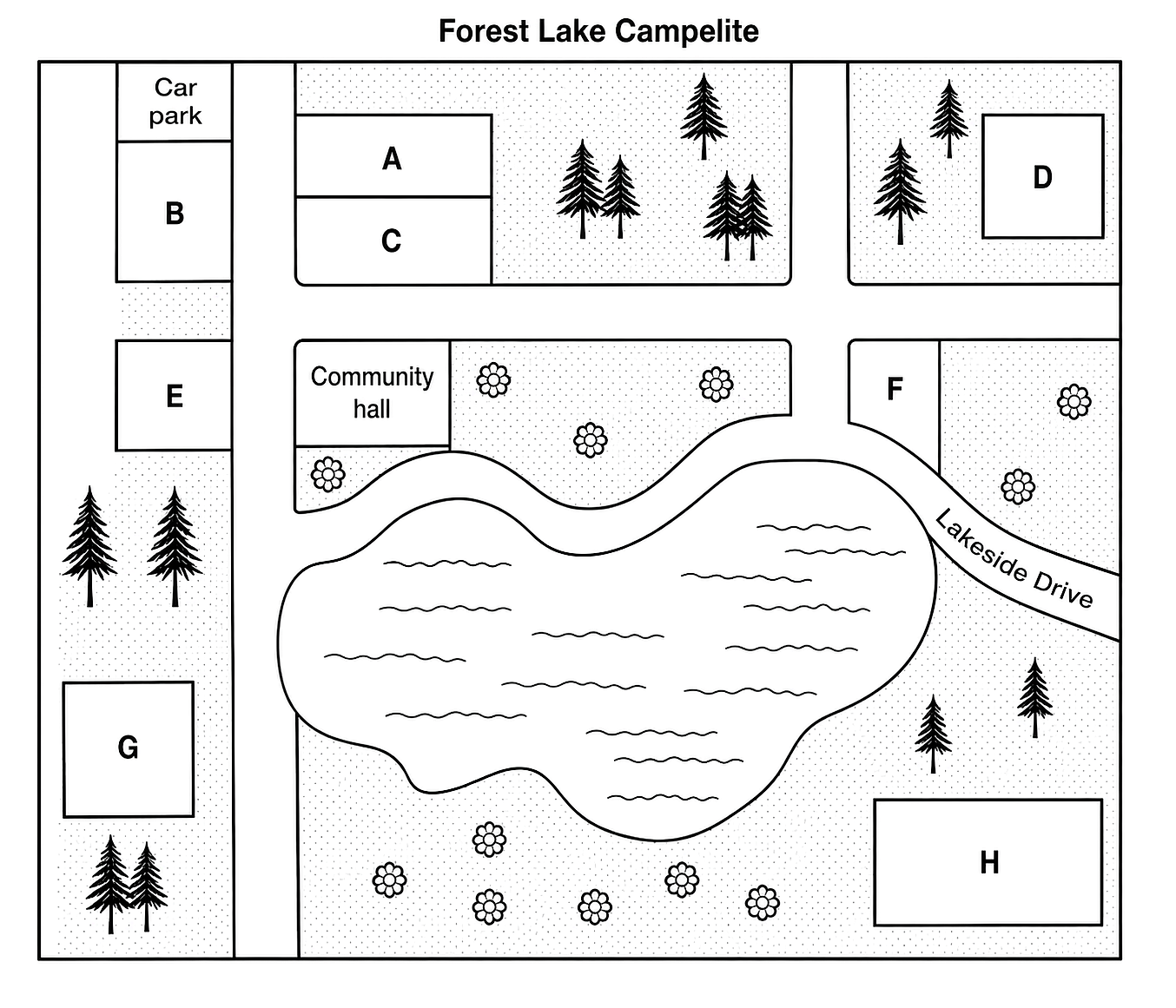
Recreated diagram for questions 11, 12, 13, 14, 15, 16
  1. 11

    Toilet block

  2. 12

    Shower block

  3. 13

    Tent site

  4. 14

    Cabins

  5. 15

    Barbecue area

  6. 16

    Bike trail

Recommended Items for Campers

Choose TWO letters, A-E. Which TWO items is it recommended that campers bring?

  1. 17

    Which TWO items is it recommended that campers bring?

    • A. earplugs
    • B. sunscreen
    • C. swimming toy
    • D. torch
    • E. boots
  2. 18

    Which TWO items is it recommended that campers bring?

Most Popular Concert Items

Choose TWO letters, A-E. Which does the organiser suggest are the TWO most popular concert items?

  1. 19

    Which does the organiser suggest are the TWO most popular concert items?

    • A. acting
    • B. dancing
    • C. poetry recital
    • D. singing
    • E. storytelling
  2. 20

    Which does the organiser suggest are the TWO most popular concert items?

Section 3

Environmental Change Discussion

Complete the notes below. Write NO MORE THAN TWO WORDS AND / OR A NUMBER for each answer.

Environmental Change Discussion
In Southeast Mexico, farmers did too much 21.................... so the environment has been destroyed.
According to Dick, vegetation problems caused 22....................
A back issue of a periodical reported interviews with 23....................
According to one of the articles in the periodical, land 24.................... it is very tough for plant growth there.
In the past ten years, almost 25.................... kilometres of forest has disappeared.
  1. 21

    In Southeast Mexico, farmers did too much 21.................... so the environment has been destroyed.

  2. 22

    According to Dick, vegetation problems caused 22....................

  3. 23

    A back issue of a periodical reported interviews with 23....................

  4. 24

    According to one of the articles in the periodical, land 24.................... it is very tough for plant growth there.

  5. 25

    In the past ten years, almost 25.................... kilometres of forest has disappeared.

Environmental Change Sentences

Complete the sentences below. Write ONE WORD AND / OR A NUMBER for each answer.

  1. 26

    "Growing Area" is about 26.................... kilometres.

  2. 27

    Scientists have taken 27.................... of the soil in the Yucatan.

  3. 28

    The university's own Geology Department has also analysed the 28.................... at the site.

  4. 29

    The 29.................... in Dr Horst's book are very useful and worth studying.

  5. 30

    The student needs a 30.................... to do the presentation.

Section 4: Sustainability

Complete the notes below. Write ONE WORD ONLY for each answer.

Sustainability
Sustainability: Term first used in 1987 by writers of United Nations report
Lecture aim: Analysis of the 31........... surrounding sustainability
Sustainable development: Development that will meet the needs of both present and future 32...................
Myth 1:
No mention of the 33................... in original definition
Original focus: poorer nations should have the same 34................... to natural resources as richer nations
This would help them achieve better 35 ................... conditions
Myth 2: 'Green' vs Sustainable
Key difference: unlike 'green', 'sustainable' is not always associated with things that are natural
For the sustainability lobby, the key problem is finding 36................... to develop technology
Sustainability lobby is prepared to 37................... nuclear energy
Myth 3: Role of technology
Introduction of battery stations on 38................... is an example of new business thinking, not new technology
Agriculture: some farmers plant crops like sunflowers which don't use much water, unlike 39.........................................
Greater use of water is a result of changes in our 40.........................................
  1. 31

    Lecture aim: Analysis of the 31........... surrounding sustainability

  2. 32

    Sustainable development: Development that will meet the needs of both present and future 32...................

  3. 33

    No mention of the 33................... in original definition

  4. 34

    Original focus: poorer nations should have the same 34................... to natural resources as richer nations

  5. 35

    This would help them achieve better 35 ................... conditions

  6. 36

    For the sustainability lobby, the key problem is finding 36................... to develop technology

  7. 37

    Sustainability lobby is prepared to 37................... nuclear energy

  8. 38

    Introduction of battery stations on 38................... is an example of new business thinking, not new technology

  9. 39

    Agriculture: some farmers plant crops like sunflowers which don't use much water, unlike 39.........................................

  10. 40

    Greater use of water is a result of changes in our 40.........................................

Answer sheet

Fill in as you go — checking is instant and local, and every miss lands in your mistake log with the lesson that fixes it.

  1. 1.
  2. 2.
  3. 3.
  4. 4.
  5. 5.
  6. 6.
  7. 7.
  8. 8.
  9. 9.
  10. 10.
  11. 11.
  12. 12.
  13. 13.
  14. 14.
  15. 15.
  16. 16.
  17. 17.
  18. 18.
  19. 19.
  20. 20.
  21. 21.
  22. 22.
  23. 23.
  24. 24.
  25. 25.
  26. 26.
  27. 27.
  28. 28.
  29. 29.
  30. 30.
  31. 31.
  32. 32.
  33. 33.
  34. 34.
  35. 35.
  36. 36.
  37. 37.
  38. 38.
  39. 39.
  40. 40.
Saved on this device — no account needed. Sign in on your progress page if you want it synced elsewhere.
Show transcript
==================== IELTS Listening Transcript ==================== PART 1 Speaker 0: Now listen carefully and answer questions one to four. Speaker 1: Hello. Tourist Association. Can I help you? Speaker 2: Yes. I'm going on vacation, and I've been looking at your website about accommodations on Poshan Island. I'm traveling on my own and noticed that there were several kinds of accommodations there. Can you give me some more information? Speaker 1: Sure. Well, there's a small hotel located near the bank. It's convenient and quite comfortable. Speaker 2: Yes. I saw that on the website. It looks very nice. Do they have any planned activities there? I think it mentioned that they have a lecture about the island every morning in the hotel. Speaker 1: Not a lecture, but they do run a tour of the island every morning after breakfast. It goes all around the island and it's free. And then in the afternoon, guests have the chance to go out sailing if they want. Speaker 2: And what kind of things are nearby? Things I might enjoy seeing? Isn't there a huge market of some sort? I seem to recall something like that, where they sell lots of fresh vegetables. Speaker 1: It's the fish market, actually, all straight off the boats. It's not far from the hotel. Everyone enjoys that, and I'm sure you would too. Oh, and there's also a pottery factory. Not very big, but they produce lovely items you can buy right there on the spot at a range of very reasonable prices. Speaker 2: And is it correct that all the rooms have a balcony? Speaker 1: Yes, they're very small, but some have beautiful sea views. You'd have to check if those are available. They do get booked up quickly. Speaker 2: I'm sure they do. And how much are the rooms at the hotel? Speaker 1: Well, in the high season, they're almost $400 per person a night. But you're lucky. We've just entered the low season, so they're $299. A good deal. Speaker 2: Yes. It does seem reasonable. Speaker 0: Before you hear the rest of the conversation, you have some time to look at questions five to 10. Now listen and answer questions five to 10. Speaker 2: But what about other types of accommodations like a bed and breakfast? Is there anything close to the beach? I understand it's quite beautiful. Speaker 1: That's where the island's only bed and breakfast is, and it makes it very popular indeed. The rooms are on the small side, but the location's fabulous. And of course, breakfast is included. And you'll be interested to know that every day the owner takes any guests that are interested on a walk around the island. He's an expert on the birds you find on the island, so it can be fascinating. Speaker 2: Is there anything in particular to do or see? Speaker 1: Well, it's a little isolated, but people who stay there rave about a vegetarian restaurant only about a mile away. I haven't been there myself, but even dedicated meat eaters seem to love it. Speaker 2: Anything else about the accommodations? Speaker 1: There isn't a television, if you require one of those. But even though they're a little off the beaten track, every room has an Internet connection as part of the cost, so guests find that very convenient. Speaker 2: And what's the room cost? Speaker 1: For one, that would be $249. I'm afraid they don't have off season rates. Still, that's pretty good. Speaker 2: What about the youth hostel? What if I wanted to stay there? Speaker 1: It can be a little noisy, especially at weekends, because it's very close to the park, and the local kids use that a lot during the day. But in the hostel, you meet lots of young people. And as for activities, every morning they even have a cookery class anyone can go to. The guests seem to really like that, and then they can apply what they learn to the meals they make for themselves at the hostel. Speaker 2: That sounds like fun, too! Speaker 1: Yes! And for an afternoon activity, you can go cycling. There's a shop nearby that rents everything you need at a very low rate. It's a great way of seeing the island. Speaker 2: Any chance of getting any other exercise, other than playing with the local kids? Speaker 1: Oh, there certainly is. There's a well equipped gym you are welcome to use. It was just finished a couple of months ago. The hostel staff can arrange for you to get a visitor's card. It's a great facility. Speaker 2: How much is a private room in the hostel, then? Speaker 1: They've got a number of those for just $120 a night. But again, if you're interested, I'd contact them as soon as possible. Speaker 2: Well, thanks very much for your help. Speaker 0: That is the end of part one. You now have one minute to check your answers to part one. PART 2 Speaker 0: Section two. You will hear the organizer of a family camp talking to a group of people who will be staying at a campsite. First, you have some time to look at questions 11 to 16 on page three. Now listen carefully and answer questions 11 to 16. Speaker 3: Hello, everyone, and welcome to this orientation session prior to our camp next week. Thank you for coming along to find out what you and your children will be doing on this year's camp. To start off with, let's tell you a bit about the campsite itself so that you'll be able to find your way around once you get there. Firstly, we'll be arriving by bus into the car park, which if you look at the plan you have in front of you, you'll see at the top of the picture on the left hand side. Now if you cross the road from the car park, the first building you'll come to is the toilet block. It's been recently upgraded, so it's very nice and clean in there now with plenty of facilities. And built onto that, so this is across the road from the community hall, is the new shower block. The hot water does run out occasionally, but usually there's enough to cope with a group your size. If you now move to the bottom left of your map, among the pine trees, there is a special flat site set up for pitching tents with power points and outdoor taps for water. Now let's go back and move along the top of your map. There's another area of Pine Forest, and then over on the far right hand side, there's a block of small cabins. Note that this is different from the main accommodation block, which doesn't appear on this map, but is further over again to the right. Now let's look down from there over the road, so we're moving clockwise round your map. Okay? In this next block beside the flower beds, we have a lovely place for barbecues where you can cook in the open air. What else to tell you about? Below the flower bed and across Lakeside Drive, you'll see a trail for mountain biking, which is always a popular activity. Moving on now, in the middle of the campsite, you'll see the lake where you can canoe, and above that, again, the community hall. So that completes your introduction to the campsite. I hope you found that useful. Speaker 0: Before you hear the rest of the talk, you have some time to look at questions 17 to 20 on page four. Now listen and answer questions 17 to 20. Speaker 3: Now let's think about what you need to bring with you. I'm sure you're all wondering what you need to pack. The lake is a bit cold for swimming at this time of year, so you can leave your togs out of the suitcase. While we're on the subject of weather too, usually, I recommend that campers bring sunblock with them. But I guess now that we're into April, that too can be left behind. Let me think. Some campers like a torch, but, actually, the days are still so long that it's light outside till quite late, and the blocks all have outside lighting now. So I'd say that a pair of earplugs are more useful, as in my experience, a lot of talking goes on after lights out. But in April, if it's wet, it can get muddy around the campsite, so to bring boots isn't a bad idea. Finally, can you all please prepare something for the final night concert? Bring your musical instruments or whatever else you need. You can't have a camp without a good sing along. That's our favorite activity. Maybe you could recite a poem, act out a skit or charades for us if you're brave enough to try that, or failing that, perhaps you can tell a joke or a funny story. But, actually, people much prefer to see some good dancing. I'll look forward to seeing you all perform next week. Speaker 0: That is the end of section two. You now have half a minute to check your answers. PART 3 Speaker 4: Section three. You will hear a student called Pete talking to his classmate Dave about the presentation that he will give on environmental science. First, you have some time to look at questions 21 to 25. Now listen carefully and answer questions 21 to 25. Speaker 5: Are you just leaving the library now? I saw you get there at 8 AM. Speaker 6: Yeah. I've been there all day. Speaker 5: What for? They hire a cute new librarian or something? Speaker 6: I wish. No. It's the presentation that I will give in environmental science the day after tomorrow. Speaker 5: What's it about? I heard you were really excited about the class. And doctor Schnee also calls you for the arcane questions as he calls them. Speaker 6: It's about environmental damage in the Yucatan. Speaker 5: Excuse me? What? Or is that where? Speaker 6: Yucatan. It's a state in Southeast Mexico. Speaker 5: So what's happening there? Speaker 6: Agriculture is having a really adverse impact on the environment. There are too many farmers doing too much farming. It's really destroying the forests and ruining the soil. Deforestation is a major problem there now. Speaker 5: How did you learn about this? I don't recall doctor Schnee saying anything about it in lecture. Speaker 6: Yes. But my brother went there last month. You know, to look at the old cities like the May Indians built. That's what first got me interested. Speaker 5: Your brother, Tom? No. Dick, Harry's twin. Speaker 6: Anyway, he told me how few trees there were now and how much empty ground that grows almost nothing. He said the place looked more like the desert than jungle in some parts. It brought environmental damage, so I started looking for materials in the library. Here, look at this magazine. Speaker 5: What's in it? Speaker 6: It's an old issue of National Geographic. It includes interviews with tourists who have been there in the past few years. It's pretty bad. See the photos? Speaker 5: I see the photos, but one or two photos don't prove anything. Speaker 6: Then read what the article says. Right there, the first thing it points out is how soil samples show it's hard for anything to grow there. It says how an area of 21,000 square kilometers has lost most of its forest in the past ten years. See, there are graphs. As the number of farmers increases, the acres of forest have decreased. It's an inverse relation. Speaker 4: Before you hear the rest of the talk, you have some time to look at questions 26 to 30. Now listen and answer questions 26 to 30. Speaker 5: So how big is that state? I'm sorry, but I've never really learned the metric system. Speaker 6: It's bigger than the state of Massachusetts. Speaker 5: That's shocking. Speaker 6: Anything else? Speaker 5: There's lots of else. Scientists say there's a growing area of about 10.5 square kilometers where nothing can grow at all. It's like the beginning of a desert. Oh, yes. What doctor Schnee called desertification. Speaker 6: But why can't anything grow there? Speaker 5: I've never really studied soil chemistry. I'm just starting to look into that subject, but my sister, Marie, is a geologist, and she says the problem is that the soil has too much saline with no plants helping to adjust the chemistry. Apparently, that's a common problem with soil types throughout the areas with rainforest. Once you lose the plant cover, it's difficult to bring it back. Reforestation is almost impossible even if the land is not being used for other purposes. Speaker 6: Wait a minute. What is saline? Speaker 5: Saline is salt dissolved in water. Scientists who have gone there have taken measurements. They do this by gathering a sample of the soil and running a simple test that shows the ionization of the solution. The geology department in our own university has reviewed the soil at the site too. They're right. It looks pretty bad. The level of salinity is going up, but the plants that would solve that problem can't be planted in soil like that. There is a narrow spectrum of salinity in which the plants will grow. And once you pass the threshold, there is no way to put the problem right? Speaker 6: Exactly. It's possible that no one could do anything to stop the trend now. Speaker 5: All because of human greed. Wait a second. How do you know these scientists can be trusted? What kind of reputation do they have? Are they reliable? Speaker 6: Oh, they're definitely reliable. They include four members of the faculty from the geology department right here at MIT. Here, study these photographs and check the damage yourself. That's what doctor Horst, who wrote the book here, did. He's newly appointed, but doctor Schneer said that he's brilliant. Speaker 5: So where are you going now? Speaker 6: I'm headed over to the geography department to borrow a map for my presentation. You know, this whole problem could have been avoided. The farmers there in the Yucatan. Speaker 5: Pete? What? Go take a break. Leave some studying for the rest of us. Speaker 4: That is the end of section three. You now have half a minute to check your answers. Now turn to section four. PART 4 Speaker 7: Section four. You will hear a lecturer talking on the topic of sustainability. First, you have some time to look at questions 31 to 40 on page seven. Now listen carefully and answer questions 31 to 40. Speaker 2: This week's lecture on a scientific topic of current general interest is on sustainability. The term sustainability is not new. It was first coined in 1987 in a report for the United Nations World Commission on Environment and Development. Since then, however, the term has been applied to everything from cars to agriculture and even economics. My specific focus, in fact, derives from this problem. I want to analyze what seems to me to be the confusion that surrounds sustainability. That UN document defined sustainable development as development that allows both the present and all future generations to meet their needs. Here is the first myth. Sustainability is not simply about the environment, which may come as a surprise to you. In fact, the original definition says nothing about it at all. Sustainability is not about protecting the world around us. The original focus was on finding ways to help poor nations catch up with richer nations, which primarily meant giving them similar rights to natural resources water, food, energy the things that many of us take for granted. The consequence and ultimate goal was improving living standards for all. Another myth is that sustainability is a synonym for green, as in green movement, green products, etcetera, although there is some overlap between the terms. Green suggests a preference for natural living, for example, when you go shopping. Products marketed as green imply the absence of high technology and mass manufacturing processes. Those groups who campaign for sustainability we can call them the lobby for sustainability acknowledge that the situation is desperate. The main problem they state correctly is time. With 6,000,000,000 people on the planet now and a billion more expected in the next thirty years, only technology will be able to provide everyone with an acceptable and safe lifestyle. Electric cars, wind turbines, and solar cells are key examples of this. They make great use of renewable resources while emitting fewer noxious chemicals. Nuclear power too is something the sustainability lobby has come to accept, unlike most greens. And here's the third myth. It concerns the role of technology. Technology is not rejected as evil, but we should not overemphasize the role of technology either. Take electric cars, for example. Researchers are currently working on plans to electrify the world's car fleet. New technology is currently being developed to make better batteries, giving longer performance. But a better way of thinking is perhaps to have battery stations for drivers to use on roads. When the battery is getting low, they simply swap the old one for a fully charged one. In other words, new business thinking, not new technology for a sustainable future. There are similarities in agriculture where knowledge can be more productive than new technology. Agriculture uses up about three quarters of the world's water. Some crops are very thirsty and require a lot of water. So many farmers who believe in sustainability are now planting crops like sunflowers and wheat instead of corn, which are happy with much less water. In terms of water consumption, one of the biggest problems is that our diet is changing. As countries develop and people become richer, they aspire to a diet with more meat. Now, admittedly, most of the new births that will take our population to over 6,000,000,000 are going to be born in countries with largely vegetarian diets. However, most of them will be born in the city, and this is where water consumption is highest. That introduces the topic for next week's lecture. Speaker 7: That is the end of section four. You now have half a minute to check your answers. That is the end of the listening test. You now have ten minutes to transfer your answers to the listening answer sheet.
Show answer key

Answer key

  1. 1. tour

    The answer is 'tour' because the speaker says, 'they do run a tour of the island every morning after breakfast. It goes all around the island and it's free.'

  2. 2. sailing

    The answer is 'sailing' because the speaker explains, 'in the afternoon, guests have the chance to go out sailing if they want.'

  3. 3. pottery

    The answer is 'pottery' because the speaker mentions, 'there's also a pottery factory. Not very big, but they produce lovely items you can buy right there.'

  4. 4. balcony

    The answer is 'balcony' because the speaker says, 'all the rooms have a balcony... they're very small, but some have beautiful sea views.'

  5. 5. beach

    The answer is 'beach' because the bed and breakfast is described as being 'where the island's only bed and breakfast is, and it makes it very popular indeed,' after the question about being close to the beach.

  6. 6. birds

    The answer is 'birds' because the owner 'takes any guests that are interested on a walk around the island. He's an expert on the birds you find on the island.'

  7. 7. internet

    The answer is 'internet' because 'every room has an Internet connection as part of the cost, so guests find that very convenient.'

  8. 8. cookery

    The answer is 'cookery' because 'every morning they even have a cookery class anyone can go to.'

  9. 9. cycling

    The answer is 'cycling' because 'for an afternoon activity, you can go cycling. There's a shop nearby that rents everything you need.'

  10. 10. gym

    The answer is 'gym' because 'there's a well equipped gym you are welcome to use. It was just finished a couple of months ago.'

  11. 11. A

    The answer is 'A' because the toilet block is described as 'the first building you'll come to' after crossing the road from the car park, which matches location A on the map.

  12. 12. C

    The answer is 'C' because the shower block is 'built onto' the toilet block, and this matches location C next to A on the map.

  13. 13. G

    The answer is 'G' because the tent site is 'at the bottom left of your map, among the pine trees,' which is location G.

  14. 14. D

    The answer is 'D' because the cabins are 'over on the far right hand side,' which matches D on the map.

  15. 15. F

    The answer is 'F' because the barbecue area is 'beside the flower beds,' which is location F.

  16. 16. H

    The answer is 'H' because the bike trail is 'below the flower bed and across Lakeside Drive,' which matches H on the map.

  17. 17. A / E

    The answers are 'A' (earplugs) and 'E' (boots) because the organiser says, 'a pair of earplugs are more useful' and 'to bring boots isn't a bad idea.' Options B (sunscreen), C (swimming toy), and D (torch) are not needed as the organiser says sunscreen and swimming gear can be left behind, and torches are not necessary due to outside lighting.

  18. 18. A / E

    Same as 17: 'A' (earplugs) and 'E' (boots) are recommended for the reasons above.

  19. 19. B / D

    The answers are 'B' (dancing) and 'D' (singing) because the organiser says, 'you can't have a camp without a good sing along. That's our favorite activity,' and 'people much prefer to see some good dancing.' Acting, poetry, and storytelling are mentioned but not as the most popular.

  20. 20. B / D

    Same as 19: 'B' (dancing) and 'D' (singing) are the most popular concert items.

  21. 21. farming

    The answer is 'farming' because Pete says, 'Agriculture is having a really adverse impact on the environment. There are too many farmers doing too much farming.'

  22. 22. environmental damage

    The answer is 'environmental damage' because Dick describes how the area 'looked more like the desert than jungle in some parts. It brought environmental damage.'

  23. 23. tourists

    The answer is 'tourists' because Pete says the magazine 'includes interviews with tourists who have been there in the past few years.'

  24. 24. samples

    The answer is 'samples' because the article 'points out is how soil samples show it's hard for anything to grow there.'

  25. 25. 21,000 square / 21000 square

    The answer is '21,000 square' because the article says 'an area of 21,000 square kilometers has lost most of its forest in the past ten years.'

  26. 26. 10.5 square

    The answer is '10.5 square' because Dave says, 'there's a growing area of about 10.5 square kilometers where nothing can grow at all.'

  27. 27. measurements

    The answer is 'measurements' because Dave says, 'Scientists who have gone there have taken measurements.'

  28. 28. soil

    The answer is 'soil' because 'the geology department in our own university has reviewed the soil at the site too.'

  29. 29. photos / photographs

    The answer is 'photos/photographs' because Pete says, 'Here, study these photographs and check the damage yourself. That's what doctor Horst... did.'

  30. 30. map

    The answer is 'map' because Pete says, 'I'm headed over to the geography department to borrow a map for my presentation.'

  31. 31. confusion

    The answer is 'confusion' because the lecturer says, 'I want to analyze what seems to me to be the confusion that surrounds sustainability.'

  32. 32. generations

    The answer is 'generations' because sustainable development is defined as 'development that allows both the present and all future generations to meet their needs.'

  33. 33. environment

    The answer is 'environment' because the lecturer says, 'the original definition says nothing about it [the environment] at all.'

  34. 34. right

    The answer is 'right' because the original focus was 'giving them similar rights to natural resources.'

  35. 35. living

    The answer is 'living' because the goal was 'improving living standards for all.'

  36. 36. time

    The answer is 'time' because 'the main problem they state correctly is time.'

  37. 37. accept

    The answer is 'accept' because 'Nuclear power too is something the sustainability lobby has come to accept, unlike most greens.'

  38. 38. roads

    The answer is 'roads' because 'a better way of thinking is perhaps to have battery stations for drivers to use on roads.'

  39. 39. corn

    The answer is 'corn' because 'many farmers... are now planting crops like sunflowers and wheat instead of corn, which are happy with much less water.'

  40. 40. diet

    The answer is 'diet' because 'one of the biggest problems is that our diet is changing... people aspire to a diet with more meat,' which increases water use.

Listening 2026-07 Test 1 — IELTS Listening Practice Test with Answers | Ieltsa