Rebuilt from test-taker recalls — not official IELTS material. Audio and passages are recreations for practice.
Recreated audio
Section 1
Questions 1–5
Complete the form below. Write NO MORE THAN THREE WORDS AND / OR A NUMBER for each answer.
- 1
Name: 1...............................
- 2
Address: 2...............................
- 3
E-mail: 3...............................
- 4
Postcode: 4...............................
- 5
Postcode: 4...............................
Questions 6–10
Complete the form below. Write NO MORE THAN TWO WORDS for each answer.
- 6
Newspaper: in a 6...............................
- 7
Nearest rubbish collection centre: On the East Side of 7...............................
- 8
Blue box: 8...............................
- 9
Rubbish that cannot be recycled: 9...............................
- 10
Name of a booklet: 10...............................
Section 2
Questions 11–15
Choose the correct letter, A, B or C.
- 11
What's the new improvement about the zoo this time?
- A. The zoo has built a new dog-walking area.
- B. The zoo has brought a new batch of animals.
- C. The zoo has expanded its exhibition area.
- 12
What is the change for the new regulation enacted in June?
- A. The zoo is not open during the weekdays.
- B. Visitors are allowed to feed the animals at night.
- C. Visitors are allowed to see the animals until the late night.
- 13
While visiting the kangaroo, which behaviour is forbidden?
- A. Photo-taking
- B. Shouting
- C. Feeding
- 14
Why is the pye-dog zone temporarily closed?
- A. Because the fence is broken.
- B. Because the pye-dogs are in hibernation.
- C. Because the pye-dog zone is under construction.
- 15
Where can the visitors buy the discounted ticket?
- A. Gift shop
- B. Photo shop
- C. Reception desk
Questions 16–20
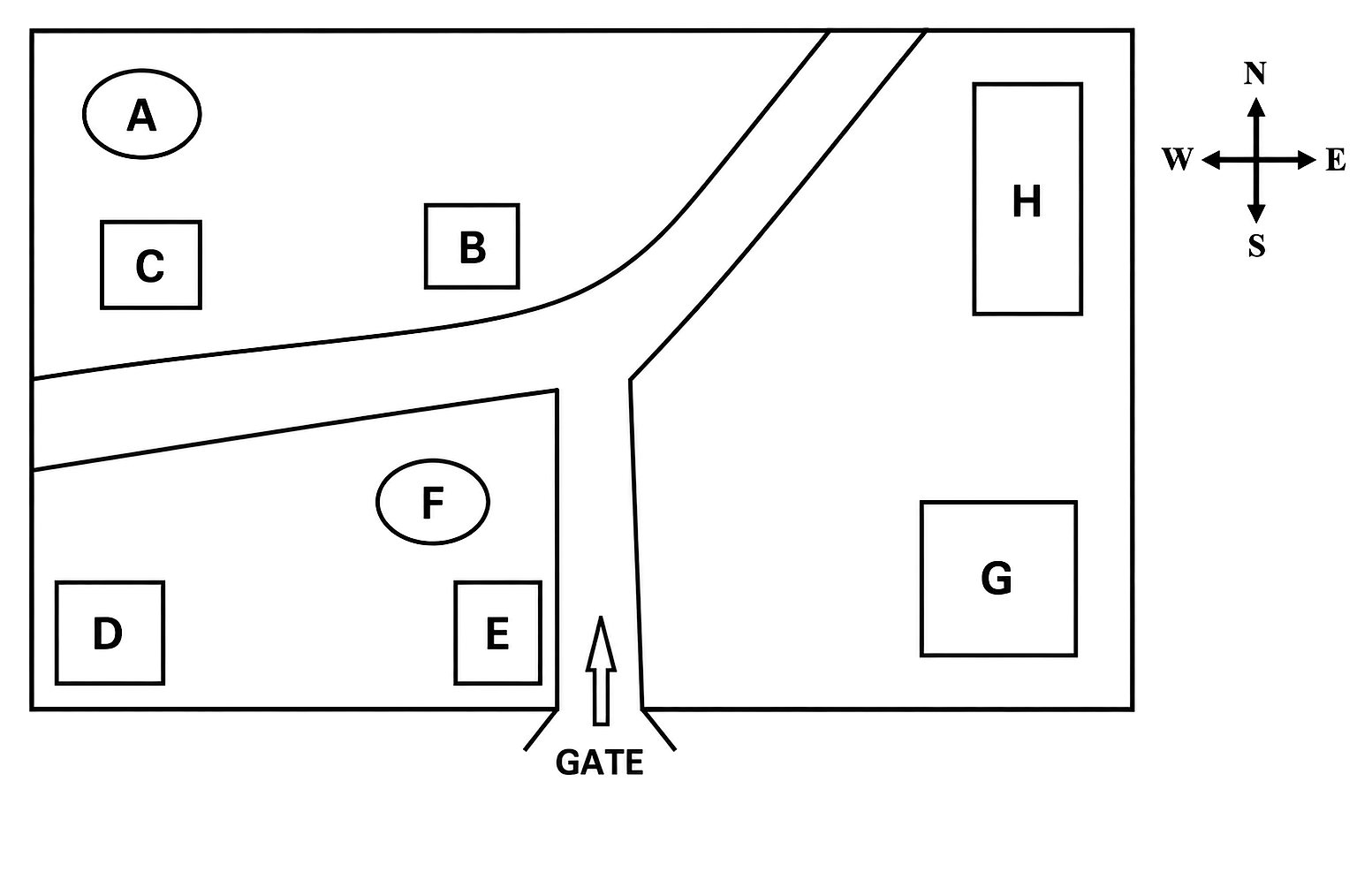
Label the map below. Write the correct letter, A-H, next to questions 16-20.
- 16
Bird hide
- 17
Pye-dog zone
- 18
Rest area
- 19
Kangaroo visiting site
- 20
Photo shop
Section 3
Questions 21–24
Choose the correct letter, A, B or C.
- 21
Jacob says that
- A. he needs to do more research.
- B. he read widely before writing the draft.
- C. he isn't confident about his main points.
- 22
The tutor thinks Jacob
- A. has presented both sides of the argument well.
- B. needs to do more work on the content.
- C. has organised the essay very well.
- 23
The ideas Jacob expresses in the essay
- A. should be re-ordered.
- B. are poorly presented.
- C. don't make sense.
- 24
The tutor suggests that Jacob
- A. look at the use of paragraphs in other pieces of writing.
- B. read one or two textbooks on writing skills.
- C. read widely to develop his vocabulary.
Questions 25–27
Complete the tutor's notes below. Write NO MORE THAN THREE WORDS for each answer.
- 25
Very natural use of 25........... Well done!
- 26
Try using higher level 26........... in your essays.
- 27
The sentences are sometimes too 27...........
Questions 28–30
Choose THREE letters, A-F. What does the tutor suggest?
- 28
What does the tutor suggest?
- A. Try some worksheets to practise formal writing.
- B. Check spelling carefully.
- C. Use more advanced vocabulary.
- D. Buy a thesaurus.
- E. Use some of the synonyms the tutor has suggested.
- F. Find alternative words to those that are underlined.
- 29
What does the tutor suggest?
- 30
What does the tutor suggest?
Section 4: Questions 31–40
Tracking the Migration of Pygmy Blue Whales
Complete the lecture notes below. Write NO MORE THAN TWO WORDS for each answer.
- 31
Before 1966 it is likely they were 31.............. with the Antarctic blue whales.
- 32
To find out more about their 32.............. and movements.
- 33
When the antenna communicates with a number of satellites, the whale's 33.............. can be identified.
- 34
Researchers access the results using the project 34..............
- 35
The whales travel from the 35.............. of Australia to breeding grounds in Indonesia during March and April, and return to Australian waters in 36..............
- 36
The whales travel from the west coast of Australia to breeding grounds in Indonesia during March and April, and return to Australian waters in 36..............
- 37
Pygmy whales do not go without 37.............. whilst they are in their breeding grounds.
- 38
The effect of 38.............. routes on communication between whales.
- 39
Conservation efforts can take place over a(n) 39.............. area now there is evidence that they migrate out of Australian waters.
- 40
To explore whether pygmy whales off the southern coast of Australia follow the same northerly migratory routes as those studied or whether they travel to a(n) 40.............. region to the south of Australia.
Answer sheet
Fill in as you go — checking is instant and local, and every miss lands in your mistake log with the lesson that fixes it.
- 1.
- 2.
- 3.
- 4.
- 5.
- 6.
- 7.
- 8.
- 9.
- 10.
- 11.
- 12.
- 13.
- 14.
- 15.
- 16.
- 17.
- 18.
- 19.
- 20.
- 21.
- 22.
- 23.
- 24.
- 25.
- 26.
- 27.
- 28.
- 29.
- 30.
- 31.
- 32.
- 33.
- 34.
- 35.
- 36.
- 37.
- 38.
- 39.
- 40.
Show transcript
Show answer key
Answer key
1. every other week
The man is told, 'we only do pickups every other week,' so the answer is 'every other week.'
2. Peter Wisrough
The man gives his name as 'Peter Wizrow,' and then spells his last name as 'W I S R O U G H,' confirming the answer is 'Peter Wisrough.'
3. 168 Bridge Road
Peter says his address is 'Number 168 Bridge Road,' so the answer is '168 Bridge Road.'
4. helpline@blackcat.com
The woman says their email address is 'helpline@blackcat.com,' so the answer is 'helpline@blackcat.com.'
5. BS97PU
Peter spells out his postcode as 'BS97PU,' so the answer is 'BS97PU.'
6. yellow
The woman confirms the yellow boxes are for recycled newspapers, so the answer is 'yellow.'
7. Central Park
The collection center is 'right on the East Side of Central Park,' so the answer is 'Central Park.'
8. metal
The woman says, 'The blue is for metal,' so the answer is 'metal.'
9. magazines
She says, 'magazines can't be recycled because of the material they're made of,' so the answer is 'magazines.'
10. Savvy
The booklet is called 'Savvy,' spelled out as 'S A V V Y,' so the answer is 'Savvy.'
11. B
The speaker says, 'the zoo would benefit most from introducing a new batch of animals,' so B is correct. A is wrong because they decided not to build a dog-walking area; C is wrong because the exhibition area was expanded in a previous renovation, not this one.
12. C
The speaker says, 'guests may also now visit the animals late at night,' so C is correct. A is wrong because the zoo is open during weekdays; B is wrong because feeding animals at night is not allowed.
13. C
Feeding the kangaroo is forbidden because 'some guests started feeding him hamburgers and chips, so we were forced to forbid visitors from feeding him.' A and B are wrong because photo-taking and shouting are allowed.
14. A
The pye-dog zone is 'closed temporarily as the result of a broken fence,' so A is correct. B is wrong because hibernation is only for winter, and C is wrong because it is not under construction.
15. B
Discounted tickets can be bought at the 'photo shop,' so B is correct. A and C are wrong because the gift shop and reception desk do not sell the discounted tickets.
16. G
The bird hide is 'out to the east, just across the grass,' matching position G on the map.
17. B
The pye-dog zone is 'up the path to the north,' matching position B on the map.
18. A
The rest area is 'at the northwest corner of the zoo,' matching position A on the map.
19. F
The kangaroo is 'in the circular shaped hut just up the path to the left,' matching position F on the map.
20. D
The photo shop is 'at the Southwest corner of the zoo,' matching position D on the map.
21. B
Jacob says, 'I spent hours in the library reading up on the subject,' so B is correct. A and C are wrong because he does not mention needing more research or lacking confidence in his main points.
22. A
The tutor says, 'you've given a very balanced argument,' so A is correct. B and C are wrong because the tutor is happy with the content and does not say the essay is well organized.
23. B
The tutor says, 'your ideas are in the right order, but I can't make the organization out very well because there aren't any paragraphs,' so B is correct (the ideas are poorly presented). A and C are wrong because the order is fine and the ideas make sense.
24. A
The tutor suggests Jacob should 'have a look at paragraphs in books, magazines, newspapers,' so A is correct. B and C are not mentioned.
25. set expressions
The tutor says, 'you've used lots of nice set expressions we'd expect to find,' so the answer is 'set expressions.'
26. sentence structures
The tutor suggests Jacob try 'experimenting more with advanced sentence structures,' so the answer is 'sentence structures.'
27. short
The tutor says, 'Yours tend to be on the short side,' so the answer is 'short.'
28. A
The tutor says, 'I'll give you one of our worksheets in a minute. You can take it away and work on it before you write your second draft,' so A is correct.
29. C
The tutor says Jacob should use 'more advanced synonyms,' so C is correct (use more advanced vocabulary).
30. F
The tutor says, 'I've underlined where I think you could make changes... Use your thesaurus to try and find some alternatives,' so F is correct (find alternative words to those that are underlined).
31. confused
Before 1966, pygmy blue whales 'were probably confused with the Antarctic or true blue whale,' so the answer is 'confused.'
32. populations / population
Scientists are interested in pygmy blue whales because 'very little is known about their movements and their populations,' so the answer is 'populations.'
33. location
When the antenna communicates with satellites, 'the location of the whale can be determined,' so the answer is 'location.'
34. website
Researchers receive the data 'via the project website,' so the answer is 'website.'
35. west coast
The whales travel from 'the West Coast of Australia to breeding grounds in Indonesia,' so the answer is 'west coast.'
36. September
They return to Australian waters 'in September,' so the answer is 'September.'
37. food / feeding
The passage says whales 'probably still have the opportunity to feed whilst they are in their breeding grounds,' so the answer is 'food.'
38. shopping
The migratory routes 'correspond closely with shipping routes,' so the answer is 'shipping.'
39. wider
Conservation efforts can take place over a 'wider area now there is evidence that they migrate out of Australian waters,' so the answer is 'wider.'
40. subtropical
Scientists want to know if whales travel to a 'subtropical region to the South of Australia,' so the answer is 'subtropical.'