Về bộ đề này: tổng hợp và chỉnh sửa nhẹ từ các đề thật mà thí sinh recall lại. IELTS lấy đề từ ngân hàng câu hỏi toàn cầu, nên tài liệu này được lưu hành rộng rãi. Để bạn có một đề hoàn chỉnh, các phần được báo cáo cùng thời điểm sẽ được ghép lại — vì vậy một bộ có thể gồm nội dung từ nhiều ngày thi, không chỉ một buổi. Audio nếu có cũng là bản tái hiện để luyện tập. Sắp xếp thuận tiện cho việc học. Dựa trên ký ức thí sinh — không phải tài liệu chính thức của IELTS.
Reading Passage 1: A Brief History of Tea
Reading Passage 1 has eight paragraphs, A-H. Choose the correct heading for each paragraph from the list of headings below. Write the correct number, i-xi, in boxes 1-8 on your answer sheet.Look at the following statements (Question 9-13) and the list of countries below. Match each statement with the correct country, A-G. Write the correct letter, A-G, in boxes 9-13 on your answer sheet.
- 1
Paragraph A
- i. Not enough tea to meet demand
- ii. Religious objections
- iii. in – and sometimes out of – fashion
- iv. A connection between tea and religion
- v. A luxury item
- vi. News of tea reaches another continent
- vii. Is tea a good or bad thing?
- viii. A chance discovery
- ix. The benefits for health
- x. Tea-making as a ritual
- xi. Difficulties in importing tea
- 2
Paragraph B
- 3
Paragraph C
- 4
Paragraph D
- 5
Paragraph E
- 6
Paragraph F
- 7
Paragraph G
- 8
Paragraph H
- 9
Claims that tea might be harmful failed to affect its popularity.
- A. China
- B. Japan
- C. Portugal
- D. Holland
- E. France
- F. England
- G. Russia
- 10
Tea lost favour to other drinks.
- 11
Special buildings were constructed in which to drink tea.
- 12
Animals were involved in importing tea.
- 13
A ruler’s specialist knowledge led to an interest in tea.
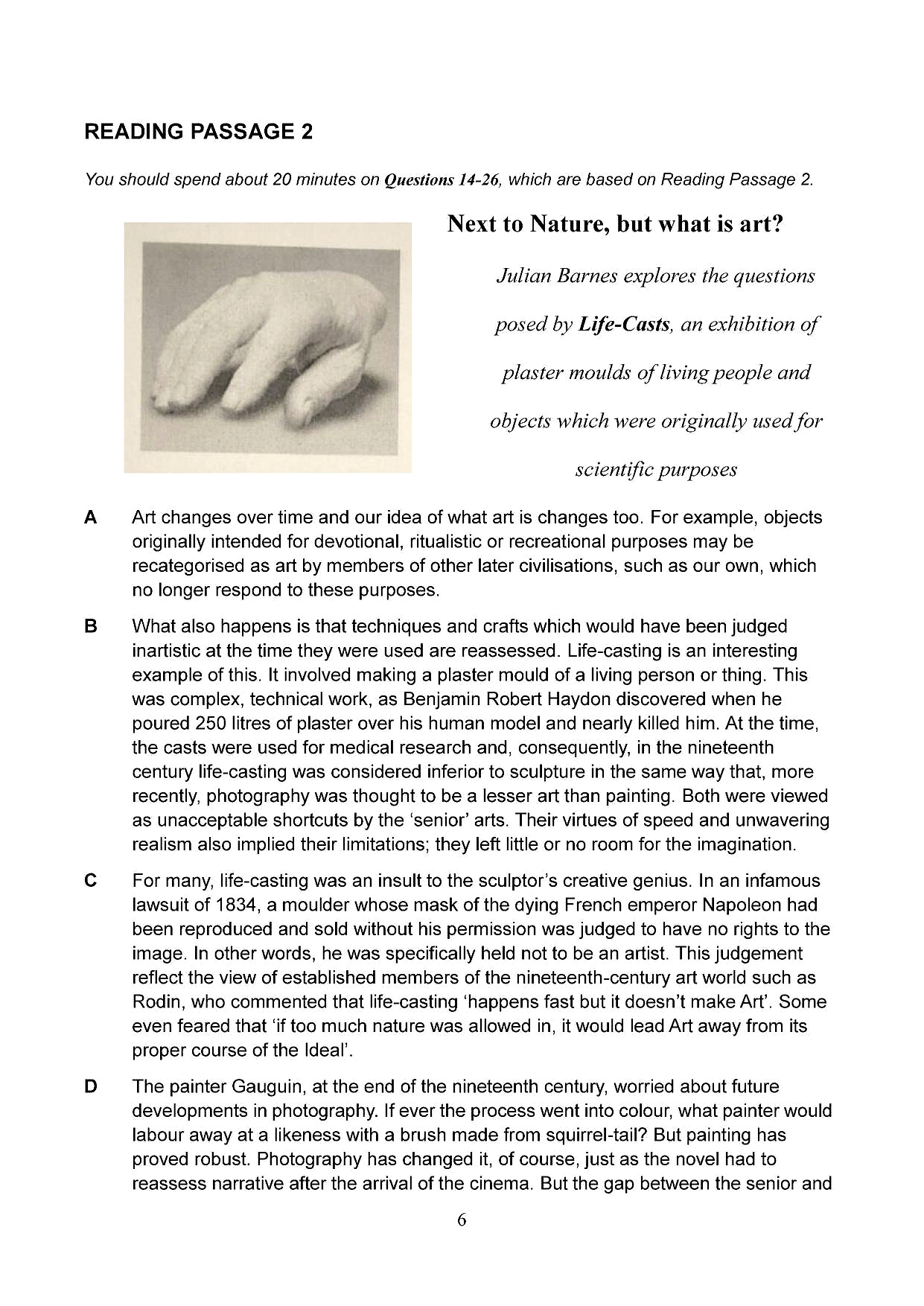
Reading Passage 2: Next to Nature, but what is art?
Questions 14-18 Reading Passage 2 has six paragraphs, A-F. Which paragraph contains the following information? Write the correct letter, A-F, in boxes 14-18 on your answer sheet. Questions 19-24 Do the following statements agree with the claims of the writer in Reading Passage 2? In boxes 19-24 on your answer sheet, write YES if the statement agrees with the claims of the writer NO if the statement contradicts the claims of the writer NOT GIVEN if it is impossible to say what the writer thinks about this Questions 25 and 26 Choose the correct letter, A, B, C or D. Write the correct letter in boxes 25 and 26 on your answer sheet.
- 14
an example of a craftsman’s unsuccessful claim to ownership of his work
- 15
an example of how trends in art can change attitudes to an earlier work
- 16
the original function of a particular type of art
- 17
ways of assessing whether or not an object is art
- 18
how artists deal with the less interesting aspects of their work
- 19
Nineteenth-century sculptors admired the speed and realism of life-casting.
- 20
Rodin believed the quality of the life-casting would improve if a slower process were used.
- 21
The importance of painting has decreased with the development of colour photography.
- 22
Life-casting requires more skill than sculpture does.
- 23
New art encourages us to look at earlier work in a fresh way.
- 24
The intended meaning of a work of art can get lost over time.
- 25
The most noticeable contrast in the cast of the giant’s hand is between the
- A. dirt and decoration
- B. size and realism
- C. choice and arrangement
- D. balance and texture
- 26
According to the writer, the importance of any artistic object lies in
- A. the artist's intentions
- B. the artist's beliefs
- C. the relevance it has to modern life
- D. the way we respond to it
Reading Passage 3: Decisions, decisions!
Questions 27 – 31 Choose the correct letter, A, B, C or D. Write the correct letter in boxes 27 – 31 on your answer sheet. Question 32 – 35 Complete the summary using the list of words A – I below. Write the correct letter, A – I, in boxes 32 – 35 on your answer sheet. Question 36 – 40 Do the following statements agree with the views of the writer in Reading Passage 3? In boxes 36 – 40 on your answer sheet, write YES if the statement agrees with the views of the writer NO if the statement contradicts the views of the writer NOT GIVEN if it is impossible to say what the writer thinks about this
- 27
The legend of the Gordian knot is used to illustrate the idea that
- A. anyone can solve a difficult problem
- B. difficult problems can have easy solutions
- C. the solution to any problem requires a lot of thought
- D. people who can solve complex problems make good leaders
- 28
The ‘conflict model’ of decision making proposed by Janis and Mann requires that
- A. opposing political parties be involved
- B. all important facts be considered
- C. people be encouraged to have different ideas
- D. previous similar situations be thoroughly examined
- 29
According to recent thinking reinforced by Malcolm Gladwell, the best decisions
- A. involve consultation
- B. involve complex thought
- C. are made very quickly
- D. are the most attractive option
- 30
Dijksterhuis and his colleagues claim in their article that
- A. our cognitive resources improve as tasks become more complex
- B. conscious decision making is negative affected by task complexity
- C. unconscious decision making is a popular approach
- D. deliberation without attention defines the way we make decisions
- 31
Dijksterhuis’s car study found that, in simple tasks, participants
- A. were involved in lengthy discussions
- B. found it impossible to make decisions quickly
- C. were unable to differentiate between the options
- D. could make a better choice when allowed to concentrate
- 32
People who spent 32 ......... time buying simple clothing items were more satisfied than those who had not.
- A. more
- B. counterintuitive
- C. simple
- D. better
- E. conscious
- F. obvious
- G. complex
- H. less
- I. worse
- 33
However, when buying furniture, shoppers made 33 ......... purchasing decisions if they didn’t think too hard.
- 34
From this, the researchers concluded that in other choices, perhaps more important than shopping, 34 ......... decisions are best made by the unconscious.
- 35
The writer comments that Dijksterhuis’s finding is apparently 35 ......... but nonetheless true.
- 36
Dijksterhuis’s findings agree with existing political and management theories.
- 37
Some political leaders seem to use deliberation without attention when making complex decisions.
- 38
All political decisions are complex ones.
- 39
We judge political errors according to our own political beliefs.
- 40
Social considerations must be taken into account for any examination of decision making to prove useful.
Phiếu trả lời
Điền đáp án khi làm bài — kiểm tra kết quả ngay lập tức và lưu cục bộ, mọi câu sai sẽ vào nhật ký lỗi cùng bài học khắc phục.
- 1.
- 2.
- 3.
- 4.
- 5.
- 6.
- 7.
- 8.
- 9.
- 10.
- 11.
- 12.
- 13.
- 14.
- 15.
- 16.
- 17.
- 18.
- 19.
- 20.
- 21.
- 22.
- 23.
- 24.
- 25.
- 26.
- 27.
- 28.
- 29.
- 30.
- 31.
- 32.
- 33.
- 34.
- 35.
- 36.
- 37.
- 38.
- 39.
- 40.
Hiện đáp án
Đáp án
1. viii
The answer is 'a chance discovery' because the passage describes how tea was discovered by accident, when leaves fell into boiling water.
2. iv
The answer is 'a connection between tea and religion' because the passage explains how tea was linked to religious practices and used by monks.
3. x
The answer is 'tea-making as a ritual' because the passage talks about the special way tea is prepared and served, showing it is a ritual.
4. vi
The answer is 'news of tea reaches another continent' because the passage describes how information about tea spread to other countries.
5. v
The answer is 'a luxury item' because the passage says tea was expensive and only rich people could afford it.
6. vii
The answer is 'is tea a good or bad thing?' because the passage discusses arguments about whether tea is healthy or harmful.
7. iii
The answer is 'in – and sometimes out of – fashion' because the passage explains how tea became popular and then less popular at different times.
8. xi
The answer is 'difficulties in importing tea' because the passage describes the problems and challenges of bringing tea from other countries.
9. D
The answer is 'D. Holland' because the passage says that even though people claimed tea might be harmful, it stayed popular in Holland. Other options are not mentioned in this context.
10. E
The answer is 'E. France' because the passage explains that tea lost popularity in France and people started drinking other drinks instead.
11. B
The answer is 'B. Japan' because the passage says special tea houses were built in Japan for drinking tea.
12. G
The answer is 'G. Russia' because the passage describes how animals, like camels, were used to transport tea into Russia.
13. A
The answer is 'A. China' because the passage mentions a Chinese ruler who was interested in tea because of his knowledge of plants.
14. C
The answer is 'C' because the passage gives an example of a craftsman who tried but failed to claim ownership of his work.
15. E
The answer is 'E' because the passage describes how new trends in art changed how people saw an earlier work.
16. B
The answer is 'B' because the passage explains what a certain type of art was originally made for.
17. F
The answer is 'F' because the passage discusses different ways to decide if something is art or not.
18. D
The answer is 'D' because the passage talks about how artists manage the boring or repetitive parts of their work.
19. NO
The answer is 'NO' because the passage says nineteenth-century sculptors did not admire life-casting for its speed and realism; they criticized it.
20. NO
The answer is 'NO' because Rodin did not think a slower process would make life-casting better; he had other views.
21. NO
The answer is 'NO' because the passage says painting is still important even after colour photography was invented.
22. NOT GIVEN
The answer is 'NOT GIVEN' because the passage does not compare the skill needed for life-casting and sculpture.
23. NO
The answer is 'NO' because the passage says new art does not always make us see old art in a new way.
24. YES
The answer is 'YES' because the passage explains that over time, people can forget or misunderstand what a work of art was meant to mean.
25. B
The answer is 'B. size and realism' because the passage says the giant's hand is very big but also looks very real. 'A. dirt and decoration' is tempting but the main contrast is about size and how real it looks.
26. D
The answer is 'D. the way we respond to it' because the passage says the importance of art depends on how people react to it, not just the artist's intentions or beliefs.
27. B
The answer is 'B. difficult problems can have easy solutions' because the passage uses the Gordian knot story to show that sometimes a simple action can solve a hard problem.
28. B
The answer is 'B. all important facts be considered' because the passage says the conflict model needs people to look at all the facts before deciding.
29. C
The answer is 'C. are made very quickly' because the passage explains that Gladwell says the best decisions are made fast, not after long thinking. 'B. involve complex thought' is tempting but the passage supports quick decisions.
30. B
The answer is 'B. conscious decision making is negatively affected by task complexity' because the passage says Dijksterhuis found that when tasks are complex, thinking too much makes decisions worse.
31. D
The answer is 'D. could make a better choice when allowed to concentrate' because the passage says for simple tasks, people chose better when they could focus.
32. A
The answer is 'A. more' because the passage says people who spent more time buying simple clothes were happier with their choices.
33. D
The answer is 'D. better' because the passage says people made better decisions about furniture when they did not think too much.
34. G
The answer is 'G. complex' because the passage concludes that for more complex choices, it is better to let the unconscious mind decide.
35. B
The answer is 'B. counterintuitive' because the writer says the finding seems strange or not what you would expect, but it is true.
36. NO
The answer is 'NO' because the passage says Dijksterhuis’s findings do not match existing political and management theories.
37. NOT GIVEN
The answer is 'NOT GIVEN' because the passage does not say if political leaders use deliberation without attention.
38. NOT GIVEN
The answer is 'NOT GIVEN' because the passage does not say if all political decisions are complex.
39. YES
The answer is 'YES' because the passage says people judge political mistakes based on their own political views.
40. YES
The answer is 'YES' because the passage says that to understand decision making, we must consider social factors.