Về bộ đề này: tổng hợp và chỉnh sửa nhẹ từ các đề thật mà thí sinh recall lại. IELTS lấy đề từ ngân hàng câu hỏi toàn cầu, nên tài liệu này được lưu hành rộng rãi. Để bạn có một đề hoàn chỉnh, các phần được báo cáo cùng thời điểm sẽ được ghép lại — vì vậy một bộ có thể gồm nội dung từ nhiều ngày thi, không chỉ một buổi. Audio nếu có cũng là bản tái hiện để luyện tập. Sắp xếp thuận tiện cho việc học. Dựa trên ký ức thí sinh — không phải tài liệu chính thức của IELTS.
Reading Passage 1: Termite Mounds
- 1
Paragraph A
- i. methods used to investigate termite mound formation
- ii. challenging our assumptions about the nature of life
- iii. reconsidering the termite's reputation
- iv. principal functions of the termite mound
- v. distribution of termite mounds in sub-Saharan Africa
- vi. some potential benefits of understanding termite architecture
- vii. the astonishing physical dimensions of the termite mound
- viii. termite mounds under threat from global climate change
- ix. a mutually beneficial relationship
- 2
Paragraph B
- 3
Paragraph C
- 4
Paragraph D
- 5
Paragraph E
- 6
Paragraph F
- 7
Paragraph G
- 8
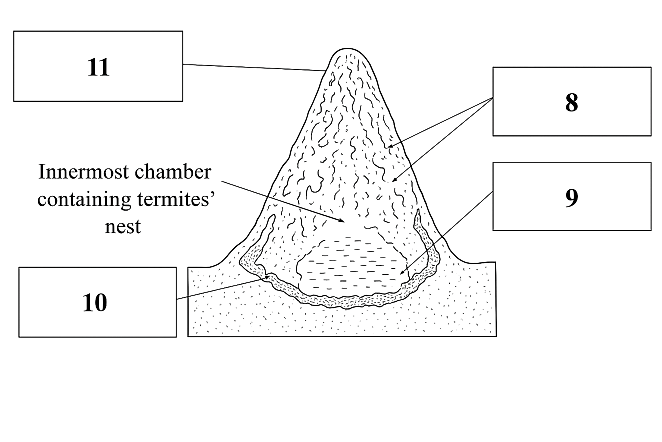
network of 8.............................. helps to give the termites a constant
- 9
supply and to maintain a limited temperature range
- 10
cellar to aid control of 10.............................. levels in mound
- 11
top of the mound permits 11..............................
- 12
The termite mound appears to process its refuse material internally.
- 13
Dr Soar's reconstruction involves scanning a single photograph of a complete mound into a computer.
- 14
New information about termite architecture could help people deal with future energy crises.
Reading Passage 2: Skyscraper Farming
- 15
Paragraph A
- i. Potential production capabilities of vertical farms
- ii. Opposition to new ideas about food production
- iii. A successful application of vertical-farming technology
- iv. The potential to provide urgent relief
- v. The original inspiration for vertical farming
- vi. Various environmental benefits of vertical farming
- vii. An increasing problem for farmers worldwide
- viii. A return to traditional farming methods
- ix. A rising demand for food
- 16
Paragraph B
- 17
Paragraph C
- 18
Paragraph D
- 19
Paragraph E
- 20
Paragraph F
- 21
A UK Government study found that __________ is a significant factor contributing to worldwide levels of soil degradation.
- 22
Disadvantages of vertical-farming projects include the expense of setting them up, as well as their high __________.
- 23
__________ could potentially be used to take vertical-farming facilities to areas where there is a critical food shortage.
- 24
Vertical farming can have financial benefits.
- A. Dickson Despommier
- B. Ted Yamanoko
- C. Natalie Jeremijenko
- 25
Traditional farming has had a negative effect on the natural world.
- 26
Vertical farming could dramatically increase world food production.
- 27
Traditional farms may benefit from wider use of vertical farming.
Reading Passage 3: Sea Change for Salinity
- 28
a prediction of the future risk of salt to water supplies.
- 29
the reason why technologies must be combined to be effective.
- 30
a reference to the recent improvements in the accuracy of airborne electromagnetics.
- 31
the organization of concerned farmers into an official body.
- 32
the estimated length of time salinity is likely to be a problem.
- 33
a summary of stages in a proposed plan of action to combat the salt problem.
- 34
the possibility that current re-vegetation practices are a waste of time.
- 35
Electromagnetic surveys
- A. can help farmers choose the best location for plants.
- B. can show the composition of the top layer of the ground.
- C. can detect how far below ground the salt is.
- D. can determine how old the salt is in a particular area.
- 36
Radiometric analysis
- 37
Airborne electromagnetics
- 38
What link does the writer make between salt and gold?
- A. They can both be found in the same locations.
- B. Both have been found to have an impact on the landscape.
- C. The same techniques can be used to find both.
- D. Neither is present in mountainous areas.
- 39
What is the 'process' referred to in Section B?
- A. the killing of vegetation by salt
- B. salt's ability to travel below ground
- C. the ability of trees to decrease salt levels
- D. the detection of salt by tracing other minerals
- 40
According to Angus Howell, one problem in the fight against salinity is that
- A. not enough farmers are concerned about the fight.
- B. farmers' requests for help have been ignored.
- C. some possible measures may cause farmers to lose income.
- D. the government has not provided farmers with sufficient financial support.
- 41
Which of the following best describes the writer's view of the salinity problem in Australia?
- A. Farmers are fighting an enemy that moves secretly and hides well.
- B. Farmers have been able to contain this enemy in a small area.
- C. Farmers have already had significant success in fighting this problem.
- D. Farmers need to form more organised groups to solve this problem.
Phiếu trả lời
Điền đáp án khi làm bài — kiểm tra kết quả ngay lập tức và lưu cục bộ, mọi câu sai sẽ vào nhật ký lỗi cùng bài học khắc phục.
- 1.
- 2.
- 3.
- 4.
- 5.
- 6.
- 7.
- 8.
- 9.
- 10.
- 11.
- 12.
- 13.
- 14.
- 15.
- 16.
- 17.
- 18.
- 19.
- 20.
- 21.
- 22.
- 23.
- 24.
- 25.
- 26.
- 27.
- 28.
- 29.
- 30.
- 31.
- 32.
- 33.
- 34.
- 35.
- 36.
- 37.
- 38.
- 39.
- 40.
- 41.