Về bộ đề này: tổng hợp và chỉnh sửa nhẹ từ các đề thật mà thí sinh recall lại. IELTS lấy đề từ ngân hàng câu hỏi toàn cầu, nên tài liệu này được lưu hành rộng rãi. Để bạn có một đề hoàn chỉnh, các phần được báo cáo cùng thời điểm sẽ được ghép lại — vì vậy một bộ có thể gồm nội dung từ nhiều ngày thi, không chỉ một buổi. Audio nếu có cũng là bản tái hiện để luyện tập. Sắp xếp thuận tiện cho việc học. Dựa trên ký ức thí sinh — không phải tài liệu chính thức của IELTS.
Reading Passage 1: Tunnelling under the Thames
- 1
In the early 19th century, the port of London was considered a safer destination than other ports.
- 2
London Bridge provided quick access for cargo being sent to southern Britain.
- 3
It was generally believed that a new river crossing would be profitable.
- 4
Building a second bridge crossing was initially considered to be the best solution.
- 5
It was believed that coal could be found under the River Thames.
- 6
The Thames Archway Company was the first group to try tunnelling below the Thames.
- 7
Some of Trevithick's men were injured during a mudslide at his tunnel.
- 8
The Thames Archway Company ran out of money to finance the tunnel project.
- 9
Marc Brunel's tunnel: Preparing to build the tunnel. Brunel noticed how a kind of ______ made its tunnels in wood.
- 10
Brunel planned to build a shallow tunnel so the earth would have a higher content of ______.
- 11
The miners suffered from ______ because of pollution in the tunnels.
- 12
Lighting problems led to several ______.
- 13
Brunel did not have enough money to repay his debt to the ______.
Reading Passage 2: Roller Coaster
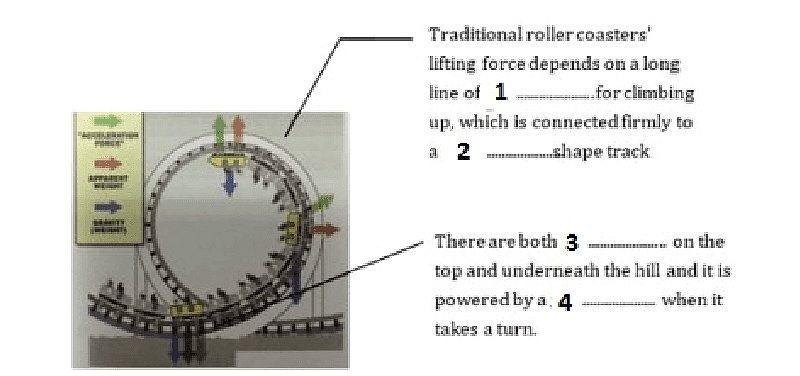
- 14
The first roller coaster perhaps originated from Russia which is wrapped up by ________, which was introduced into France, and it was modified to ________ because the temperature there would ________ the ice. This time ________ were installed on the board. In America, the first roller coaster was said to appear in Pennsylvania, it was actually a railroad that was designed to send ________ between two mountains. Josiah White turned it into a thrill ride, it was also called switch backtrack and a ________ there allowed riders to slide down back again.
- 15
The great depression affected amusement parks yet did not shake the significant role of the US roller coaster in the world.
- YES. YES
- NO. NO
- NOT GIVEN. NOT GIVEN
- 16
Switchback railways began to gain popularity since their first construction in New York.
- 17
French added more innovations to Russia's ice slide including both cars and tracks.
- 18
The most exciting roller-coaster in the world is in New Jersey.
- 19
The working mechanism of a roller-coaster is explained through the diagram. Choose NO MORE THAN TWO WORDS AND/OR A NUMBER from the passage for each answer: 27. ________ 28. ________ 29. ________ 30. ________
Reading Passage 3: 200 Years of Australian Landscapes at the Royal Academy in London
- 20
27. As expected, the artworks chosen for the exhibition reflect a narrow interpretation of landscape.
- 21
28. The Academy rejected Australian suggestions for the subject of the exhibition.
- 22
29. The colonial relationship meant that early Australian landscape painting followed the traditions of English landscape painting.
- 23
30. The exhibition reflects the fact that Australian art developed its own particular qualities.
- 24
31. Contemporary Australian artists have generally rejected British landscape traditions.
- 25
32. What is the writer’s main point in the second paragraph?
- A. Australian landscape painting derives from the British tradition.
- B. Australian landscape painting is more highly regarded than British.
- C. Britain is still imposing its principles on Australian art.
- D. British art cannot be compared to Australian art.
- 26
33. What does Joanna Mendelssohn find surprising?
- A. Modern Australian landscape painting has great variety.
- B. The guidelines for the choice of work were very traditional.
- C. Landscape painting remains a popular subject for British artists.
- D. The British find the Australian landscape unsuitable as a subject.
- 27
34. Shaun Gladwell’s work is included in the exhibition because
- A. it adopts a subjective approach to depicting the landscape.
- B. skateboarding is an inspiration to many Australian artists.
- C. storms are a significant feature in the Australian landscape.
- D. Bondi is an iconic Australian location.
- 28
35. What was the reason for Soriano including Aboriginal art in the exhibition?
- A. It is not well known in London art circles.
- B. Aboriginal landscape painting influenced Australian settlers.
- C. It is part of the Australian art tradition and not independent of it.
- D. Modern Aboriginal painting deals with changes to the landscape.
- 29
36. By referring to China, Mendelssohn is making the point that
- A. having an exhibition in London is not as important as it used to be.
- B. young artists in Britain are not interested in Australian art.
- C. art from Shanghai is more important than Australian art.
- D. New York is still a preferred destination for young artists.
- 30
37. In spite of its conservatism, the Royal Academy exhibition
- A. reflects the mood created by the natural environment.
- B. demonstrates that the dominant art form in Australia is landscape painting.
- C. demonstrates an understanding of the historical importance of the land.
- D. showcases a very small number of artists.
- E. demonstrates a strong European flavour.
- F. shows an acceptance of the unique qualities of Australian art.
- 31
38. Australian art of the early to mid-1800s
- 32
39. The modern work by Gladwell chosen for the exhibition
- 33
40. Including Aboriginal art in the exhibition
Phiếu trả lời
Điền đáp án khi làm bài — kiểm tra kết quả ngay lập tức và lưu cục bộ, mọi câu sai sẽ vào nhật ký lỗi cùng bài học khắc phục.
- 1.
- 2.
- 3.
- 4.
- 5.
- 6.
- 7.
- 8.
- 9.
- 10.
- 11.
- 12.
- 13.
- 14.
- 15.
- 16.
- 17.
- 18.
- 19.
- 20.
- 21.
- 22.
- 23.
- 24.
- 25.
- 26.
- 27.
- 28.
- 29.
- 30.
- 31.
- 32.
- 33.
Hiện đáp án
Đáp án
1. NOT GIVEN
There is no information in the passage about whether the port of London was safer than other ports in the early 19th century.
2. FALSE
The passage says London Bridge was a bottleneck and did not provide quick access for cargo to southern Britain, so the answer is FALSE.
3. TRUE
It is stated that many people believed a new river crossing would be profitable, so the answer is TRUE.
4. FALSE
The passage explains that building a second bridge was not seen as the best solution at first, so the answer is FALSE.
5. NOT GIVEN
There is no mention in the passage about coal being found under the River Thames.
6. TRUE
The passage says the Thames Archway Company was the first to try tunnelling below the Thames, so the answer is TRUE.
7. NOT GIVEN
There is no information about Trevithick's men being injured during a mudslide at his tunnel.
8. TRUE
It is stated that the Thames Archway Company ran out of money to continue the tunnel project, so the answer is TRUE.
9. worm
Brunel noticed how a kind of worm made its tunnels in wood, so the answer is 'worm'.
10. clay
Brunel planned a shallow tunnel so the earth would have a higher content of clay, so the answer is 'clay'.
11. headaches
The miners suffered from headaches because of pollution in the tunnels, so the answer is 'headaches'.
12. accidents
Lighting problems led to several accidents, so the answer is 'accidents'.
13. government
Brunel did not have enough money to repay his debt to the government, so the answer is 'government'.
14. ICE / WAXED SLIDES / MELT / WHEELS / COAL / STEAM ENGINE
The first roller coaster in Russia used ice, in France it was changed to waxed slides because the temperature would melt the ice, wheels were installed, in America it was used to send coal, and a steam engine allowed riders to slide back again. So the answers are: ICE / WAXED SLIDES / MELT / WHEELS / COAL / STEAM ENGINE.
15. NO
The passage says the Great Depression affected amusement parks and the US roller coaster's role, so the answer is NO because its role was shaken.
16. YES
Switchback railways became popular after their first construction in New York, so the answer is YES.
17. YES
The French added both cars and tracks to Russia's ice slide, so the answer is YES.
18. NOT GIVEN
There is no information about the most exciting roller-coaster being in New Jersey, so the answer is NOT GIVEN.
19. CHAIN / LOOP / GEAR / MOTOR
The diagram shows the working mechanism of a roller-coaster: chain, loop, gear, and motor are mentioned in the passage.
20. NO
The artworks chosen for the exhibition do not reflect a narrow interpretation of landscape, so the answer is NO.
21. NOT GIVEN
There is no information about the Academy rejecting Australian suggestions for the exhibition, so the answer is NOT GIVEN.
22. YES
The passage says early Australian landscape painting followed English traditions because of the colonial relationship, so the answer is YES.
23. YES
The exhibition shows that Australian art developed its own qualities, so the answer is YES.
24. NO
Contemporary Australian artists have not generally rejected British landscape traditions, so the answer is NO.
25. C
The main point in the second paragraph is that Britain is still imposing its principles on Australian art, so the answer is C.
26. B
Joanna Mendelssohn is surprised that the guidelines for choosing works were very traditional, so the answer is B.
27. A
Shaun Gladwell’s work is included because it adopts a subjective approach to depicting the landscape, so the answer is A.
28. C
Soriano included Aboriginal art because it is part of the Australian art tradition and not independent of it, so the answer is C.
29. A
By referring to China, Mendelssohn means that having an exhibition in London is not as important as before, so the answer is A.
30. F
Despite its conservatism, the exhibition shows an acceptance of the unique qualities of Australian art, so the answer is F.
31. E
Australian art of the early to mid-1800s demonstrates a strong European flavour, so the answer is E.
32. A
The modern work by Gladwell reflects the mood created by the natural environment, so the answer is A.
33. C
Including Aboriginal art in the exhibition demonstrates an understanding of the historical importance of the land, so the answer is C.