Về bộ đề này: tổng hợp và chỉnh sửa nhẹ từ các đề thật mà thí sinh recall lại. IELTS lấy đề từ ngân hàng câu hỏi toàn cầu, nên tài liệu này được lưu hành rộng rãi. Để bạn có một đề hoàn chỉnh, các phần được báo cáo cùng thời điểm sẽ được ghép lại — vì vậy một bộ có thể gồm nội dung từ nhiều ngày thi, không chỉ một buổi. Audio nếu có cũng là bản tái hiện để luyện tập. Sắp xếp thuận tiện cho việc học. Dựa trên ký ức thí sinh — không phải tài liệu chính thức của IELTS.
Reading Passage 1: Australia's Airborne Dentists
Questions 1–7
Do the following statements agree with the information given in Reading Passage 1?
In boxes 1–7 on your answer sheet, write
TRUE if the statement agrees with the information
FALSE if the statement contradicts the information
NOT GIVEN if there is no information on this
- 1
Many of the RFDS doctors work as volunteers.
- A. TRUE
- B. FALSE
- C. NOT GIVEN
- 2
RFDS dentists make trips to outback communities each month.
- 3
RFDS dentists are accompanied on their journeys to remote areas by a dental nurse.
- 4
RFDS dentists must provide a wide range of dental services.
- 5
Rural dental patients are more informed about oral hygiene than urban patients.
- 6
RFDS dentists educate patients about good eating habits.
- 7
Urban Australians generally have better teeth because their water is treated.
Questions 8–13
Complete the notes below.
Choose ONE WORD ONLY from the passage for each answer.
Write your answers in boxes 8–13 on your answer sheet.
Reading Passage 2: Animal Minds: Parrot Alex
Questions 14–19
Do the following statements agree with the information given in Reading Passage 2?
In boxes 14–19 on your answer sheet, write
TRUE if the statement agrees with the information
FALSE if the statement contradicts the information
NOT GIVEN if there is no information on this
14. Firstly, Alex has grasped quite a lot of vocabulary.
- A. TRUE
- B. FALSE
- C. NOT GIVEN
15. At the beginning of study, Alex felt frightened in the presence of humans.
16. Previously, many scientists realized that animals possess the ability of thinking.
17. It has taken a long time before people get to know cognition existing in animals.
18. As Alex could approximately imitate the sounds of English words, he was capable of roughly answering Irene’s questions regarding the world.
19. By breaking in other parrots as well as producing the incorrect answers, he tried to be focused.
Questions 20–23
Complete the summary below.
Choose NO MORE THAN TWO WORDS AND/OR A NUMBER from the passage for each answer.
Write your answers in boxes 20–23 on your answer sheet.
Questions 24–26
Answer the questions below.
Choose NO MORE THAN TWO WORDS from the passage for each answer.
Write your answers in boxes 24–26 on your answer sheet.
24. What did Alex reply regarding the similarity of the subjects showed to him?
25. What is the problem of the young parrots except Alex?
26. To some extent, through the way he behaved what we can call him?
Reading Passage 3: Elephant Communication V2
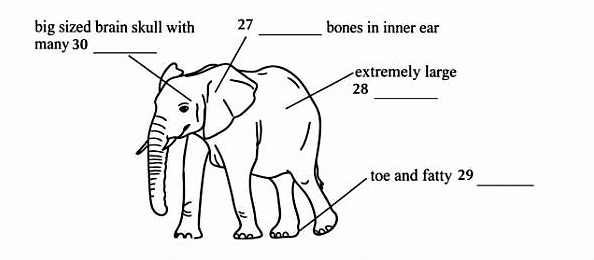
Questions 27–30
Label the diagram below.
Choose NO MORE THAN TWO WORDS from the passage for each answer.
Write your answers in boxes 27–30 on your answer sheet.
Questions 31–38
Complete the summary below.
Choose NO MORE THAN THREE WORDS from the passage for each answer.
Write your answers in boxes 31–38 on your answer sheet.
Questions 39–40
Choose the correct letter, A, B, C or D.
Write the correct letter in boxes 39–40 on your answer sheet.
39. According to the passage, it is determined that an elephant needs to communicate over long distances for its survival.
- A. when a threatening predator appears.
- B. when young elephants meet humans.
- C. when older members of the herd want to flee from the group.
- D. when a female elephant is in estrus.
40. What is the author’s attitude toward the experiment using three different recordings in the last paragraph?
- A. The outcome is definitely out of the original expectation.
- B. The data cannot be very clearly obtained.
- C. The result can be somewhat undecided or inaccurate.
- D. The result can be unfamiliar to the public.
Phiếu trả lời
Điền đáp án khi làm bài — kiểm tra kết quả ngay lập tức và lưu cục bộ, mọi câu sai sẽ vào nhật ký lỗi cùng bài học khắc phục.
- 1.
- 2.
- 3.
- 4.
- 5.
- 6.
- 7.
- 8.
- 9.
- 10.
- 11.
- 12.
- 13.
- 14.
- 15.
- 16.
- 17.
- 18.
- 19.
- 20.
- 21.
- 22.
- 23.
- 24.
- 25.
- 26.
- 27.
- 28.
- 29.
- 30.
- 31.
- 32.
- 33.
- 34.
- 35.
- 36.
- 37.
- 38.
- 39.
- 40.
Hiện đáp án
Đáp án
1. C
Đoạn văn không đề cập đến việc bác sĩ RFDS có làm tình nguyện hay không, nên đáp án là NOT GIVEN.
2. B
Đoạn văn nói rằng nha sĩ RFDS có thể chỉ đến thăm cộng đồng vài tháng một lần hoặc thậm chí một lần mỗi năm, nên nói họ đi mỗi tháng là SAI.
3. C
Đoạn văn không có thông tin về việc nha sĩ RFDS có đi cùng y tá nha khoa hay không, nên đáp án là NOT GIVEN.
4. A
Đoạn văn nói nha sĩ RFDS cần là 'người toàn diện' và có thể thực hiện mọi loại thủ thuật nha khoa, nên họ phải cung cấp nhiều dịch vụ nha khoa.
5. B
Đoạn văn nói người ở vùng xa nhận được ít giáo dục về vệ sinh răng miệng hơn so với người thành phố, nên nói bệnh nhân nha khoa nông thôn hiểu biết hơn là SAI.
6. C
Đoạn văn không đề cập đến việc nha sĩ RFDS giáo dục bệnh nhân về thói quen ăn uống tốt, nên đáp án là NOT GIVEN.
7. A
Đoạn văn giải thích rằng người thành phố dùng nước có flo và tỷ lệ sâu răng thấp hơn, nên người Úc ở đô thị thường có răng tốt hơn vì nước được xử lý.
8. computers
9. space
10. dentures
11. toothpaste
12. toothbrushes
13. mouthguards / mouth guards
14. C
Đoạn văn không nói rõ Alex đã học được bao nhiêu từ vựng, nên đáp án là NOT GIVEN.
15. C
Không có thông tin về việc Alex cảm thấy sợ hãi khi bắt đầu học, nên đáp án là NOT GIVEN.
16. B
Đoạn văn nói nhiều nhà khoa học tin rằng động vật không có khả năng suy nghĩ, nên nói họ nhận ra động vật biết suy nghĩ là SAI.
17. A
Đoạn văn nói phải mất nhiều thời gian và nghiên cứu để chứng minh động vật có thể suy nghĩ, nên đáp án là TRUE.
18. A
Đoạn văn giải thích vì Alex có thể bắt chước từ tiếng Anh nên Pepperberg có thể hỏi về kiến thức của nó, nên đáp án là TRUE.
19. B
Đoạn văn nói Alex ngắt lời hoặc trả lời sai vì nó chán, không phải để tập trung, nên đáp án là SAI.
20. 100 English words / one hundred English words / 100 / one hundred
21. chimpanzees
22. avian cognition
23. particularly chosen
24. Color
Khi được hỏi 'What’s same?', Alex trả lời 'Color', nên đáp án là Color.
25. wrong pronunciation
Đoạn văn nói những con vẹt non nói sai phát âm, nên đáp án là wrong pronunciation.
26. teenager
Đoạn văn nói Alex giống như một thiếu niên vì nó thất thường và khó đoán, nên đáp án là teenager.
27. hammer
28. body
29. pad
30. sinus cavities
31. trunks and feet
32. infrasonic
33. ecology
34. seismic signals
35. male planthopper
36. auditory communication
37. mate
38. ground
39. A
Đoạn văn nói đàn sinh sản dùng âm thanh tần số thấp để cảnh báo khi có thú săn mồi và tụ lại bảo vệ con non trước khi chạy, nên đáp án là A. when a threatening predator appears.
40. A
Tác giả nói kết quả rõ ràng hơn mong đợi và tiếng gọi chống thú săn mồi từ Kenya gây phản ứng mạnh, nên đáp án là A. Kết quả thực sự vượt ngoài mong đợi ban đầu.