Đề thi thật IELTS Listening — tháng 5/2026 Test 302

Tháng thi: 2026-05

Về bộ đề này: tổng hợp và chỉnh sửa nhẹ từ các đề thật mà thí sinh recall lại. IELTS lấy đề từ ngân hàng câu hỏi toàn cầu, nên tài liệu này được lưu hành rộng rãi. Để bạn có một đề hoàn chỉnh, các phần được báo cáo cùng thời điểm sẽ được ghép lại — vì vậy một bộ có thể gồm nội dung từ nhiều ngày thi, không chỉ một buổi. Audio nếu có cũng là bản tái hiện để luyện tập. Sắp xếp thuận tiện cho việc học. Dựa trên ký ức thí sinh — không phải tài liệu chính thức của IELTS.

Audio tái hiện

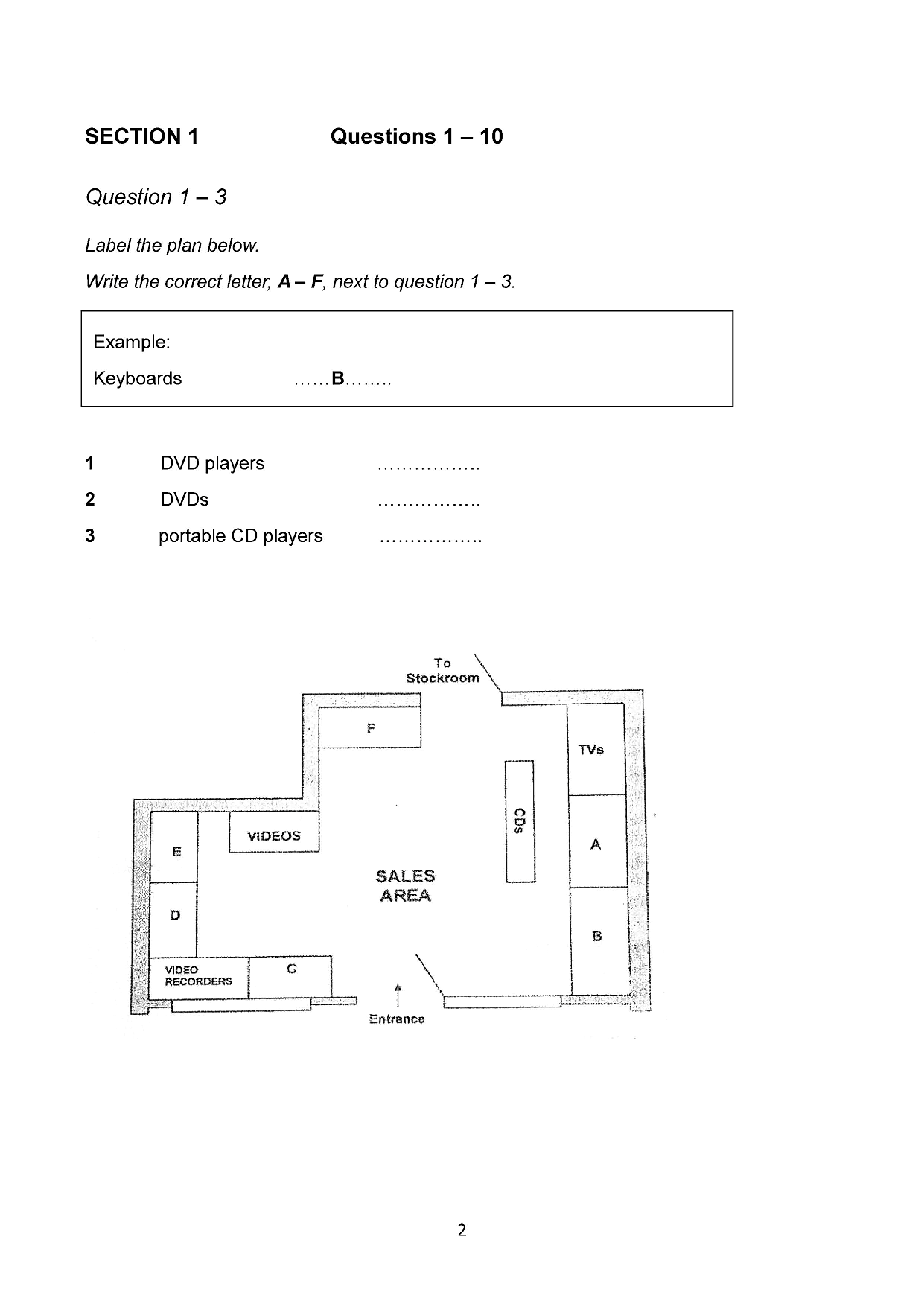
Section 1 — Shop floor plan and DVD decisions

Label the plan below. Write the correct letter, A–F, next to question 1–3.

1. DVD players ………………
  • A. A
  • B. B
  • C. C
  • D. D
  • E. E
  • F. F
2. DVDs ………………
  • A. A
  • B. B
  • C. C
  • D. D
  • E. E
  • F. F
3. portable CD players ………………
  • A. A
  • B. B
  • C. C
  • D. D
  • E. E
  • F. F
Shop floor plan for a DVD/video store: a central 'SALES AREA' with lettered zones A–F around the walls (F, Videos, E, D, Video Recorders, C on the left; TVs, A, B on the right; CDs on a freestanding shelf in the middle), 'To Stockroom' at the top and 'Entrance' at the bottom.
  1. 4

    Move 4 …………………… cassette players into stockroom.

  2. 5

    Make sure the stock is 5 ……………………… .

  3. 6

    Make the 6 ……………………… for special offers.

  4. 7

    general films

    • A. price of each item reduced
    • B. prices reduced for buying a certain number
    • C. prices kept at current level
  5. 8

    foreign language films

  6. 9

    classical music

  7. 10

    comedy

Section 2 — Organising a group tour

What does the organiser tell the members about who should do each of the following tasks? Write the correct letter, A, B or C, next to questions 11–16.

  1. 11

    Taking tents

    • A. All the members must do it.
    • B. Members have the option of doing it.
    • C. The organiser is responsible for doing it.
  2. 12

    Booking campsites

  3. 13

    Taking bicycles

  4. 14

    Buying train tickets

  5. 15

    Buying tickets for a football match

  6. 16

    Collecting information about the area of the tour

  7. 17

    Westbury

    • A. farming museum
    • B. horseriding
    • C. locally produced food
    • D. market selling clothes
    • E. old ruins
    • F. steam railway
    • G. transport museum
    • H. water sports
  8. 18

    Cluny

  9. 19

    Pennerley

  10. 20

    Farlow

Section 3 — Assignment feedback and study plans

Complete the notes below Write ONE WORD ONLY for each answer. Answer the questions below. Write NO MORE THAN FOUR WORDS AND/OR A NUMBER for each answer. Choose THREE letters, A–H.

Assignment notes
Things to do:
hand in book reports with next assignment
check accuracy of the 21 …………………… in the last section
try to give more 22 ……………………
need to expand ideas to improve grade
23. When will Karen give her presentation? ……………………
24. What must she do during the presentation? ……………………
25. By which date must she submit an abstract? ……………………
26. Where will the presentation take place? ……………………
27. Who will grade her presentation? ……………………
Which THREE modules will Karen study next year?
  1. 21

    check accuracy of the 21 …………………… in the last section

  2. 22

    try to give more 22 ……………………

  3. 28

    Which THREE modules will Karen study next year?

    • A. Communication Skills
    • B. Data Collection
    • C. Discourse Analysis
    • D. Language and Society
    • E. Phonology
    • F. Psycholinguistics
    • G. Research Methodology
    • H. Social Interaction
  4. 29

    Which THREE modules will Karen study next year?

  5. 30

    Which THREE modules will Karen study next year?

Section 4 — Extinction of Species

Complete the notes below. Write ONE WORD ONLY for each answer.

Extinction of Species
Recent problems in Australia:
a species of parrot is under threat due to the production of wind energy
several species of 31 ………………… are at risk because of increased housing
loss of food source due to pesticides is affecting many animals, especially 32 …………………
Production of single crops like 33 ………………… is harming wildlife
Attitude to endangered animals:
Can be influenced by the 34 ………………… (e.g. the panda)
People are less concerned about smaller animals, e.g. 35 …………………
Some animals are ignored because they are viewed:
a) with 36 …………………
b) as our 37 ………………… in terms of food
c) with disgust
Reasons for preventing extinction:
to improve our knowledge of the ecosystem
the ecosystem needs to be 38 ………………… to be stable
some types of 39 ………………… can help to signal environmental problems
animals can help in medicine, e.g.:
a) improved well-being for people from having a pet
b) cobwebs help with medical disorders related to 40 …………………
  1. 31

    several species of 31 ………………… are at risk because of increased housing

  2. 32

    especially 32 …………………

  3. 33

    Production of single crops like 33 ………………… is harming wildlife

  4. 34

    Can be influenced by the 34 ………………… (e.g. the panda)

  5. 35

    People are less concerned about smaller animals, e.g. 35 …………………

  6. 36

    Some animals are ignored because they are viewed: a) with 36 …………………

  7. 37

    b) as our 37 ………………… in terms of food

  8. 38

    the ecosystem needs to be 38 ………………… to be stable

  9. 39

    some types of 39 ………………… can help to signal environmental problems

  10. 40

    cobwebs help with medical disorders related to 40 …………………

Phiếu trả lời

Điền đáp án khi làm bài — kiểm tra kết quả ngay lập tức và lưu cục bộ, mọi câu sai sẽ vào nhật ký lỗi cùng bài học khắc phục.

  1. 1.
  2. 2.
  3. 3.
  4. 4.
  5. 5.
  6. 6.
  7. 7.
  8. 8.
  9. 9.
  10. 10.
  11. 11.
  12. 12.
  13. 13.
  14. 14.
  15. 15.
  16. 16.
  17. 17.
  18. 18.
  19. 19.
  20. 20.
  21. 21.
  22. 22.
  23. 23.
  24. 24.
  25. 25.
  26. 26.
  27. 27.
  28. 28.
  29. 29.
  30. 30.
  31. 31.
  32. 32.
  33. 33.
  34. 34.
  35. 35.
  36. 36.
  37. 37.
  38. 38.
  39. 39.
  40. 40.
Lưu trên thiết bị này — không cần tài khoản. Đăng nhập ở trang tiến trình nếu muốn đồng bộ sang nơi khác.
Hiện transcript
Narrator: Section 1. Woman: Right, Bob. Uh, I'm sorry this isn't the normal way to start a new job, but as I told you over the phone, I wanted you to come in this evening to help get the shop reorganized before tomorrow. Man: No problem. Woman: You'd better take down a few notes of what I'd like you to do. Man: OK. Woman: Now, if you come over here to the entrance from the street you can get the complete picture. As you can see we sell the usual range of electronic goods like televisions and video recorders, and also CDs, DVDs, etc. but we gonna start selling keyboards too. Man: There doesn't seem to be any room at all. Woman: There certainly isn't much so we need to make space for them. They can go to the right of this door on those shelves against the wall but not beside the CDs. They will be by the window so people will be able to see them from the street. Man: Right. Woman: Then I want all the DVDs, videos and the equipment for them close together. Let's put the DVD players right here next to the video recorders. If they're against the front window they'll be visible from the street. That should attract a few more potential customers into the shop. Man: And where shall I put the DVDs? Woman: They can go beside the videos. Man: Against the sidewall? Woman: Yeah, well try them out in that position and see if it affects sales. Man: Right. Woman: And I’d like the portable CD players in a more prominent position as they’re selling very well. Man: How about by the CDs? Woman: That might be an idea, but it's gonna get too crowded in that corner. I want to attract people to the back of the sales area, so could you put them on the shelves facing the entrance please? Man: Right. Woman: Good. Then, when all that's been moved there are a few other jobs to do. First the cassette players, sales of those are falling so I don’t want so many on display. There are eleven at the moment, and we really only need three so the other eight can go into the stock room. Man: Right. Woman: Oh, and quite a lot of stock looks dusty to me so a rather boring job I'm afraid, we need to get everything clean. Man: Alright. Woman: And we’re going to run special offers on some DVDs so could you create some signs please? You said you did quite a lot in college? Man: Yes, it's something I enjoy doing. Which items are going to have in the offers? Woman: Let me try and remember what I worked out. General films are selling strongly with a big rise last month. I don't think we need to do anything about them. Man: OK. Woman: But foreign language films are a different matter. Sales are creeping up very slowly so I want to encourage them. We'll run a three for the price of two promotion for a month and see what happens. Man: Right. What about classical music DVDs? Woman: Sales certainly aren't too healthy. They're falling by two or three percent a month. I’d like to give the category a boost so we'll bring all prices down by five pounds this month. Man: OK. Woman: Then there are the TV programs. Comedy isn't doing very well, last month sales were ten percent below the level of last year. I’m inclined to leave it alone. I don't think it’s worth doing anything until some new really popular comedy programs are released on DVD. Narrator: Section 2. Leader: Right. Now, let me bring you up to date with arrangements for our cycling tour next month. Leader: First of all there's the question of tents. As you know, the original idea was that I arrange to borrow some tents that belong to the college, but it turns out that the mountaineering club will be using them at the same time, so I'm afraid you will have to bring your own. Leader: So, could you let me know whether you will be using a single tent or sharing, please? I'll need to know how many tents there’ll be for when I make the reservation at the various campsites. Leader: Last time some of you said you would like to hire bikes and pick them up when you arrive rather than taking your own with you. Well, I've enquired about bike hiring in Westbury, the town where we'll be arriving, and unfortunately there aren't any shops that hire them out so I'm afraid it means taking your own. Leader: I'll book them on the train when I book the train tickets, which reminds me, I'll need to know the final number of people going so I can get a group discount on the train fare. Leader: Something else that'll need to be booked is tickets for the football match we discussed last time. I’ve enquired about availability and there are only a few seats left so anyone who wants to go will need to get tickets very soon, ideally today or tomorrow. Leader: At our next meeting I'll be able to give you all individual packs with the final program and something about the area we'll be cycling through and places we'll be visiting. I’m afraid I haven’t had the time to do that yet. Leader: Now, I'll tell you briefly about some of the attractions in the places we'll be staying at. As I said, we'll be taking the train to Westbury which has one or two very good restaurants. Leader: One thing that's definitely worth visiting there is the site where the original town was constructed nearly one thousand years ago. There's not much of the original buildings left but there's still plenty to see. The site is being excavated and you'll be able to help out if you want to. Leader: Our next overnight stop will be in the village of Cluny. There are several old barns here that have been converted into a museum showing the importance of sheep in the area over the centuries. The wool used to be sold for cloth and it made the district quite rich. There are plenty of photographs showing how agricultural workers used to live too. Leader: From there we'll go on to Pennerley. Pennerley is famous for its museum of village life but that's being refurbished at the moment and isn't likely to re-open by the time we go there. But there's an open air farmers market every day selling fruits, vegetables, cheese and meat all grown or processed within a few miles of the town and sold by the farmers themselves. It's definitely worth a visit. Leader: In Farlow, which is one of the oldest towns in the area, there’s a museum that shows how horses used to be the most common way of travelling around and how they were gradually replaced by steam train and later, of course, diesel and electric trains, buses, cars and bicycles. Leader: Right, now, I'll pass around this sheet of paper... Narrator: Section 3. Tutor: Oh, Karen, hi. Come in, sit down. I want to talk to you about this assignment you've given me. I'll give it back to you with my comments but there are several things I wanted to run over. You know, pointers for next time. When you hand in your next assignment, can you check that you've dealt with these? Karen: Yeah, OK. Tutor: Now, the first thing is some of your literature discussion was a bit thin so I would actually like to see your book reports to get your complete view, so can you submit those with the next assignment? Then I can see which bits you've chosen to leave out. Karen: Uh, yes, sorry, I didn't realize you needed them. Tutor: And I've found some errors, just small ones where you had quoted people but not recorded the information properly at the end. Don't forget to go through and make sure that your references are accurate. The actual quotes were very relevant but the references just need tidying up, OK? Karen: Yes, I'll remember to check that. Tutor: Now, you make some good points but it might be helpful if you could see if you can include a few extra examples, just to really hammer the point home. Don't start writing more paragraphs, just slot them in at the end of what you've already written. Now the thing you have to do, if you really want to get better marks, is to expand the ideas you're presenting, then your argument becomes more convincing. Karen: OK, fine. Can I talk to you about this presentation I've got to do? Tutor: Yes, of course. Karen: Am I doing it next term? I can't remember what we said. Tutor: Well, the thing is, Marco couldn't do it so you agreed to do it at the next seminar, didn't you? So, how can I help? Karen: Well, I was wondering what you consider to be the core part of the presentation. I mean, what should I focus on? Tutor: Good question. Well, you have very little time really, so it's absolutely essential for you to explain the experiment. Of course you'll have a summary in the handouts you give out but you need to go through it carefully when you do the presentation. Karen: And do I have to give you the abstract first or shall I just email it to all the students? Tutor: No, I do need to see it first. We'll get some printouts done. Now, they'll need to be done by the 3rd of December so I'll need to see it by the 26th of November if that's OK? Karen: Yes, fine. Tutor: Oh, and I need to talk to you about where it will be. We've had problems with the rooms because we'll need something bigger than usual. In our faculty the only room free is the computer room, which is far from suitable, so we'll have to go across the road and do it in the chemistry lab. They've got all the proper overhead equipment in there as well. Karen: OK, right. And I get a grade for this, don't I? Tutor: Yes, your first one is graded by your tutor but this one will be assessed by the professor. But don't be worried, it will be fine. Karen: Oh, and I've sorted out my modules for next year. You asked me to tell you my choices. Tutor: Yes, what've you decided? Karen: Oh, it was really difficult to decide. I've already done the data collection once so that wasn't really a choice. I couldn't make up my mind between language and society and communication skills. I read the syllabuses but they sound more or less the same to me. Anyway, I went for communication skills in the end because I know the lecturer. Actually, social interactions seems to cover much the same ground so I didn't bother with that either. I thought this course analysis looked really interesting and, in fact, they cover a little bit of research methodology in it so I thought I'd do that rather than the full methodology course. Kill two birds with one stone as it were. And then I fancied something completely different so I thought Psycholinguistics would be interesting, unless you think it'll be more worthwhile for me to do the phonology course? Tutor: No. I think you've made sensible choices. I'm glad you're organized. OK, let's meet again in a couple of weeks to see how you're getting on. Karen: OK, thank you. See you then. Narrator: Section 4. Lecturer: Good afternoon. From my work as curator at the Brisbane Zoo, it is becoming increasingly obvious to me that the animal world is a highly endangered one. Lecturer: It sometimes seems as though a new species is added to the endangered list every day and a great deal of this is due to human activity. Lecturer: You may have read about the orange-bellied parrot colonies in South Australia, these are under threat from wind farms. So even our attempts to save energy can have a negative impact. Lecturer: A further example is provided by the expansion of our cities. Here in Australia many species of frog are losing their habitat as a direct result of this urban development. Lecturer: What's more, thanks to the increasing use of pesticides, fewer insects are surviving. Many species depend upon these as a food source, birds in particular, and so their numbers are declining as well. Lecturer: So, even in rural areas we are having a damaging effect on species. In fact, when our farmers choose to grow large amounts of one staple crop each year, corn is a perfect example. This often results in a greater need for chemicals and fertilizers which has a devastating effect on local wildlife. Lecturer: Clearly something needs to be done about this, however, very little can be achieved without full public support and our general attitude is not always a positive one. Lecturer: Of course, it is easy to get people interested in animals such as the Panda. Thanks to the attention it has given in the media, people are very aware of its plight and so are willing to give a great deal of support. Lecturer: However, it is not so easy to attract sympathy for those essential, smaller species such as insects. They may seem insignificant, but these tiny creatures have an enormous effect on our ecosystem. And it isn't only size that is a problem when it comes to our attitude towards animals. Lecturer: There are certain animals that we prefer to simply ignore for various reasons. Firstly, we might do this because of fear, that is a normal reaction when people see a shark or a snake, for example. Lecturer: Another reason might be that we believe certain animals are rivals when it comes to food, locusts and even mice could come into this category. Lecturer: Then there are animals that we view with disgust because of how they look or feel, the many different parasites for example. Lecturer: You may well ask what does it matter if any of these species dies. Extinction is a fact of life after all. I would argue that there are several reasons to be concerned about the extinction of any species. Lecturer: Each species helps us to understand more about how our ecosystem works, one species can be linked to many others in the food chain, for example. And inevitably they all lead back to us in some way. Lecturer: We now know that the more complex the ecosystem is, the more stable it is. When this is the case, large numbers of one animal are quickly controlled by outbreaks of its predators. Lecturer: We've also begun to realize that the presence or absence of certain plants can alert us to changes in our environment. One type of plant might indicate the presence of rich mineral deposits, another might alert us to toxic water. Lecturer: And so even seemingly insignificant species can be helpful and beneficial to us. This is especially true in the area of medicine, there are many well documented cases of the health benefits of pet ownership, especially with the ill or the handicapped. Lecturer: But not many people know that spiders are also being used in medicine. The cobwebs they make can be used to assist with certain blood disorders, it actually helps blood to clot. Lecturer: Imagine how much more there is for us still to discover from plants and animals but we can only do this if we can save these creatures from extinction. Perhaps, in the end, it is our self-interest that will save the animals.
Hiện đáp án

Đáp án

  1. 1. C

    The woman says, 'Let's put the DVD players right here next to the video recorders. If they're against the front window they'll be visible from the street.' This matches option C.

  2. 2. E

    She says, 'And where shall I put the DVDs?' and the answer is 'They can go beside the videos... against the sidewall.' This matches option E.

  3. 3. F

    She says, 'I want to attract people to the back of the sales area, so could you put [the portable CD players] on the shelves facing the entrance please?' This matches option F.

  4. 4. eight / 8

    She says, 'There are eleven [cassette players] at the moment, and we really only need three so the other eight can go into the stock room.'

  5. 5. clean

    She says, 'quite a lot of stock looks dusty to me so... we need to get everything clean.'

  6. 6. signs

    She says, 'we’re going to run special offers on some DVDs so could you create some signs please?'

  7. 7. C

    She says, 'General films are selling strongly... I don't think we need to do anything about them.' So, prices are kept at the current level (option C). Option A and B are wrong because she says no change is needed.

  8. 8. B

    She says, 'foreign language films... we'll run a three for the price of two promotion.' This means prices are reduced for buying a certain number (option B).

  9. 9. A

    She says, 'classical music DVDs... we'll bring all prices down by five pounds this month.' This means the price of each item is reduced (option A).

  10. 10. C

    She says, 'Comedy isn't doing very well... I’m inclined to leave it alone. I don't think it’s worth doing anything.' So, prices are kept at the current level (option C).

  11. 11. A

    The leader says, 'I'm afraid you will have to bring your own [tent].' So, all members must do it (option A).

  12. 12. C

    The leader says, 'I'll need to know how many tents there’ll be for when I make the reservation at the various campsites.' So, the organiser is responsible (option C).

  13. 13. A

    The leader says, 'there aren't any shops that hire them out so I'm afraid it means taking your own [bicycle].' So, all members must do it (option A).

  14. 14. C

    The leader says, 'I'll book them on the train when I book the train tickets.' So, the organiser is responsible (option C).

  15. 15. B

    The leader says, 'anyone who wants to go will need to get tickets very soon.' So, members have the option (option B).

  16. 16. C

    The leader says, 'I'll be able to give you all individual packs with the final program and something about the area.' So, the organiser is responsible (option C).

  17. 17. E

    The leader says, 'One thing that's definitely worth visiting there is the site where the original town was constructed nearly one thousand years ago.' This matches 'old ruins' (option E).

  18. 18. A

    The leader says, 'old barns here that have been converted into a museum showing the importance of sheep.' This matches 'farming museum' (option A).

  19. 19. C

    The leader says, 'there's an open air farmers market every day selling fruits, vegetables, cheese and meat all grown or processed within a few miles.' This matches 'locally produced food' (option C).

  20. 20. G

    The leader says, 'there’s a museum that shows how horses used to be the most common way of travelling around and how they were gradually replaced...' This matches 'transport museum' (option G).

  21. 21. references

    The tutor says, 'Don't forget to go through and make sure that your references are accurate.'

  22. 22. examples

    The tutor says, 'it might be helpful if you could see if you can include a few extra examples.'

  23. 23. at next seminar

    The tutor says, 'you agreed to do it at the next seminar, didn't you?'

  24. 24. explain the experiment

    The tutor says, 'it's absolutely essential for you to explain the experiment.'

  25. 25. 26th of November

    The tutor says, 'they'll need to be done by the 3rd of December so I'll need to see it by the 26th of November.'

  26. 26. chemistry lab

    The tutor says, 'so we'll have to go across the road and do it in the chemistry lab.'

  27. 27. professor

    The tutor says, 'this one will be assessed by the professor.'

  28. 28. A

    Karen says, 'I went for communication skills in the end because I know the lecturer.'

  29. 29. C

    Karen says, 'I thought this course analysis looked really interesting...' This matches Discourse Analysis.

  30. 30. F

    Karen says, 'I thought Psycholinguistics would be interesting...'

  31. 31. frog

    The lecturer says, 'many species of frog are losing their habitat as a direct result of this urban development.'

  32. 32. birds

    The lecturer says, 'Many species depend upon these as a food source, birds in particular, and so their numbers are declining as well.'

  33. 33. corn

    The lecturer says, 'farmers choose to grow large amounts of one staple crop each year, corn is a perfect example.'

  34. 34. media

    The lecturer says, 'it is easy to get people interested in animals such as the Panda. Thanks to the attention it has given in the media...'

  35. 35. insects

    The lecturer says, 'it is not so easy to attract sympathy for those essential, smaller species such as insects.'

  36. 36. fear

    The lecturer says, 'we might do this because of fear, that is a normal reaction when people see a shark or a snake.'

  37. 37. rivals

    The lecturer says, 'we believe certain animals are rivals when it comes to food, locusts and even mice could come into this category.'

  38. 38. complex

    The lecturer says, 'the more complex the ecosystem is, the more stable it is.'

  39. 39. plants

    The lecturer says, 'the presence or absence of certain plants can alert us to changes in our environment.'

  40. 40. blood

    The lecturer says, 'The cobwebs they make can be used to assist with certain blood disorders, it actually helps blood to clot.'

Listening 2026-05 Test 10 — IELTS Listening Practice Test with Answers | Ieltsa