Về bộ đề này: tổng hợp và chỉnh sửa nhẹ từ các đề thật mà thí sinh recall lại. IELTS lấy đề từ ngân hàng câu hỏi toàn cầu, nên tài liệu này được lưu hành rộng rãi. Để bạn có một đề hoàn chỉnh, các phần được báo cáo cùng thời điểm sẽ được ghép lại — vì vậy một bộ có thể gồm nội dung từ nhiều ngày thi, không chỉ một buổi. Audio nếu có cũng là bản tái hiện để luyện tập. Sắp xếp thuận tiện cho việc học. Dựa trên ký ức thí sinh — không phải tài liệu chính thức của IELTS.
Hiện transcript
Part one. You will hear a woman phoning a rental agency property manager to make
inquiries about renting a house. First, you have some time to look at questions one to six.
Now listen carefully and answer questions one to six.
Hello. Thank you for calling Iris Rentals. How can I help you?
Yes. Hello there. I'm ringing just to make inquiries about renting a new property, and I
came across a listing on your website that I'm interested in.
Oh, yes.
I'd like to find out a few more details, if I may.
Yes, of course. Can I take your name?
It's Mary Collins.
Okay, Mary. I'm just searching our system for the property details. Is there any
information in particular that you were wanting?
Does the house have a gym?
No, the house doesn't have a gym. However, the house has a large swimming pool, which
will be great for exercise and really refreshing during the summer.
Oh, wow. That sounds lovely. What is the general layout of the house?
This house is rather unusual as the living room is located upstairs with the bedrooms, and
downstairs at the ground floor is the dining room, which has a lovely view out over the
swimming pool.
Does the house come with a car parking space on the street?
Oh, there's no need for that. The house comes with a big garage where you can park your
cars, and there's also a lot of room for storage. It's attached to the house through a door in
the kitchen.
Oh, that's perfect. It'll make it far easier to carry my food shopping into the house.
Oh, yes, absolutely. You actually don't even need to take your car to do the shopping as
the local supermarket is just down the street. You can walk the distance easily.
Really? How convenient. Is there anywhere near to the house where I can take my
children to play?
Unfortunately, there aren't any playgrounds nearby, but there is a park near the
supermarket that would be great for taking your children for a walk. It would also be a
great place for you to meet your neighbors.
Yes, that's true. I love taking long walks in the park. I'm sure there will be a playground
at the local school anyway.
Yes, absolutely. The community has its own primary school, and there is a secondary
school in the neighboring community, so there are plenty of resources nearby for your
children's education.
Before you hear the rest of the conversation, you have some time to look at questions
seven to ten.
Now listen and answer questions seven to ten.
Okay, great. What are the rental costs for the property?
The monthly rent is nine hundred and eighty dollars, which is very reasonable
considering the size of the house and the amenities that it has to offer.
Does that figure include maintenance fees and bills?
The bills are not included in that figure, but it does include any maintenance fees for the
garden.
That sounds like a very reasonable price. We were hoping to move on the twentieth of
April. Will the house be vacant for that date?
The current tenants of the property are due to leave on the twentieth, but the cleaners will
need a few days to make sure that the house is clean and tidy. This would make the house
officially available on the twenty-third of April.
Well, everything about the house sounds perfect. Exactly what I'm looking for. What date
would it be possible to view the property?
I have arranged for the tenant to leave the property on Friday, so I can show the house to
prospective renters. Would you be able to make that day?
Yes, I'm sure I could come on my lunch break. Would one o'clock be okay?
I'm afraid that I have a meeting at twelve thirty, so I won't be able to make that time. I
have available appointments at ten fifteen and three.
Okay. In that case, can we schedule the appointment for ten fifteen?
No problem. I'll book it into my schedule. If you wouldn't mind arriving five minutes
early, that would be great, just so we can get started on time.
Sure. What is the address?
The postcode is GA five eight ER, and the house is number eight on Spring Street.
It's the second right off of Bath Street.
Okay. That's great.
Do you have any more questions?
No. Thank you for your help.
No problem. See you on Friday. Bye.
That is the end of part one. You now have one minute to check your answers to part one.
---
Part two. You will hear a real estate agent giving information to a couple who want to
buy a house. First, you will have some time to look at questions eleven to thirteen.
Now listen carefully and answer questions eleven to thirteen.
Hello, Mr. and Mrs. Clark. I believe you are doing well. I am Tom, the sales manager of
Housed Inc, and I got your mail requesting for a house that would suit your specifications.
I have been able to do some work and have come up with two options that I think should
fit what you are looking for. The first house is situated on Allen Street, and the owner
told me that he bought the house largely because of where it is located. The house was
decorated a few years ago, but I think it still looks new to a large extent. Anyways, you
might dislike the old-fashioned design of the house, which was modeled to the original
owner's taste. Of course, you can arrange decorations of your own. I just have to inform
you beforehand. I looked through your profile, and it said that you have a large family of
six. I felt this house could be more appropriate for you with children than just young
couples, as it has eight rooms, including four bedrooms. According to your budget,
although the house is a bit pricey, the price hasn't exceeded your limit yet. It's very
reasonable, though, for a house on Allen Street. The owner had initially fixed every
afternoon for potential buyers to visit. Then he shifted it to all weekends. But by
yesterday, he informed me that he would be allowing only Wednesdays during lunchtime
for visits. So it means we have to go either tomorrow or next week.
Before you hear the rest of the talk, you have some time to look at questions fourteen to
twenty.
Now listen and answer questions fourteen to twenty.
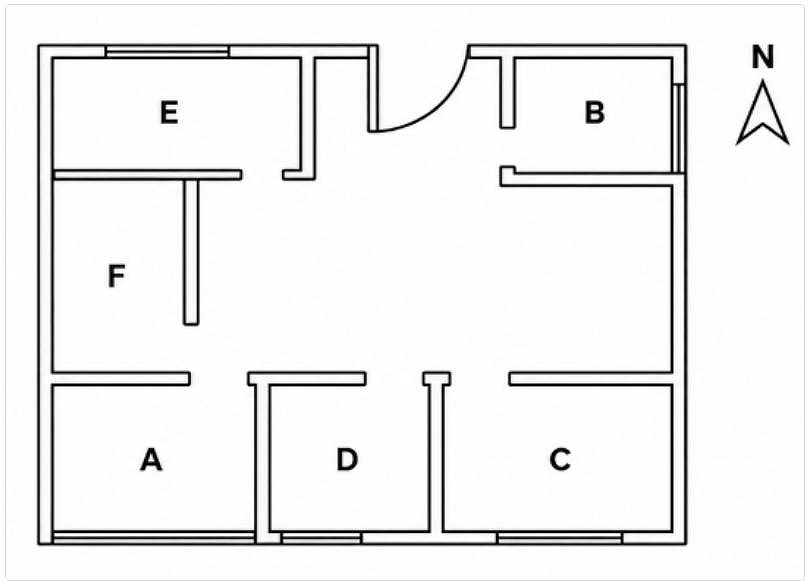
Okay, on to the next house. I was able to get the layout of this building to help you
understand it better. The house is situated on Pearl Street, just around the corner. It is a
well-planned and designed house. In the southeast of the house, you can see the master
room, whereas the dining room is in the northwestern corner. There is a bathroom in the
southwestern corner of the house that is modern and well-equipped. It provides adequate
storage for the whole family.
As for the bedroom, which is kept especially for visitors, it is in the direct south of the
house, just between the bathroom and the master room. You will see the kitchen to your
left when you just step in the house. Of course, I should give as much information as I
can so as to help you in the decision-making process. The second house has both
advantages and disadvantages, and you should know well about them. First, the premises
are quite lovely, and there is a small garden just behind the main building. Also, you do
not have to manage space with other neighbors since there is a big parking lot, unlike the
first house. As you can see, north of the house, you have a lot of banks, and to the east
and west, there are a good number of companies and malls. It is very compact and easily
accessible due to its central location. Again, in contrast to the first house, there are only
two bedrooms, and this would have been good for a young couple with a small family
size. However, for a family size like yours, I really am not sure. But if necessary, perhaps
you could turn the storeroom into a bedroom. Then there will be three bedrooms. The last
problem is that it lacks a garage, which is a very important feature for residents here, as
every household has at least one car, and there are few public car parks in this area. This
is all I have for now, and...
That is the end of part two. You now have forty-five seconds to check your answers to
part two.
---
Part three. You will hear two students, called Shona and Peter, discussing their internship
options. First, you have some time to look at questions twenty-one to twenty-five.
Now listen carefully and answer questions twenty-one to twenty-five.
Hi, Shona.
Hi, Peter. Have you made up your mind about which internship program to apply for?
Yes, pretty much.
I'm entirely at a loss. I mean, there are so many good ones. Can you give me some tips?
Sure.
What is your top priority when weighing up these programs?
Well, I guess I'd go for ones that can help me with the skill set I lack for my future career.
I still need a lot of practical training in dealing with statistics. But keep in mind that you
don't want to set your goal too grand, like drawing up a business plan. You might end up
nowhere.
I see. So I want to learn how to organize ideas and present them.
Good. Now you've nailed step one.
Now what?
You must also consider your strengths for a suitable internship program. Otherwise, you
might get rejected or end up with one that you are incapable of doing.
But I have no idea what I'm good at.
Communicate with people around you or whom you've worked with. That's what I did. I
thought I was a good team leader, but many people I've worked with for various projects
mentioned something else. They admire that I could work around the clock to finish
projects on time. And indeed, I'm more focused and perform better when I'm pushed for
time.
Good point. So what do you plan to do next?
I'll visit the careers officer to help me with the school application form. You know, the
one we have to submit before applying to companies.
But it is unnecessary to fill it in. It's only optional.
Really? I'm glad I heard from you. Then I'll ask the careers officer to look at my personal
statement and to give me some tips on polishing it up.
Don't you need help with your CV?
No, I'm good. I have already learned to write it in class.
That's good. So what kind of company did you choose?
I've decided to apply for an IT company.
Why is that?
Well, even though I've learned how the IT industry developed in the past from different
lectures, I know nothing about its latest trends. I'm prepared to work in an IT company
and fill in the information gap.
I see. What do you plan to do next term?
I think I'll stick to most of the optional modules I've chosen. But regarding the language
sessions, I'm doing poorly in Japanese. I'd better drop it before wasting more time. I think
I'll learn Spanish instead.
Oh, I learned Spanish for a year. I think you'll find it interesting.
Before you hear the rest of the conversation, you have some time to look at questions
twenty-six to thirty.
Now listen and answer questions twenty-six to thirty.
Do you know what job opportunities these companies offer interns?
I've searched online and browsed some of the schemes. Do you know Psyche?
Yes. I heard they offer internship positions dealing with customer interaction
management, but I'm not quite sure what that means.
Well, the position offers the chance to become fully aware of customer value and keep in
touch with customers to keep them highly engaged and satisfied. These include activities
such as PR, communications, marketing, and customer service.
Sounds like loads of work to do. What about Gemini Technologies?
It's an IT consulting company. Although many employees say it's stressful working there,
I want to apply for this one.
Why is that?
Actually, the company provides service to improve software architecture, but that's pretty
demanding as a team of software engineers has to provide detailed analysis and
suggestions for required changes before the deadline. As an observer and participant of a
particular project, an intern can learn how to work to a strict deadline.
That's not my area of expertise, but I'm sure you'll excel at this.
I certainly do hope so. Have you checked out Deloitte?
Of course. That's a renowned accounting firm, and thus its internships offer excellent
learning experiences in this regard. You know, things like examining a company's
financial statements, the income statement, balance sheet, and cash flow statement. I want
to give it a try, but I might get rejected, so I need a backup plan. Have you read anything
about Kearney?
Yes. It is another consulting firm. It provides opportunities to reach out to other business
partners and pay attention to networking.
Well, that sounds interesting.
I'm thinking about Vortex, but I haven't got anything useful from its website.
I worked there last summer. It's an international company with headquarters in Spain, so
most of the managers here speak Spanish. Thanks to the internship experience, I became
fluent in it.
Right. That's not for me.
That is the end of part three. You now have half a minute to check your answers to part
three.
---
Part four. You will hear a lecture about ancient techniques for producing paint. First, you
have some time to look at questions thirty-one to forty.
Now listen carefully and answer questions thirty-one to forty.
[chime] Good morning, everyone. Today, we're looking at the history of paint. As you're
about to see, there's a lot to be said about it. So today, I'm just going to focus on ancient
techniques for producing paint. We'll deal with prehistoric times to about the end of the
Roman Empire.
So let's start with the prehistoric era. As I'm sure you're all aware, it's impossible to
determine exactly when colors were first used by humans in art. But what we do know is
what those first colors were made of and how they were applied.
Researchers have determined that the first colors came from clay, which was most likely
used to create marks on the face. Of course, the art from this paint, as we'll call it, wasn't
permanent, so it's difficult for us to know much more about what it was used for or who
used it.
However, some evidence of ancient paint has been found in Australia. There, scientists
have discovered early forms of paint in drawings inside caves. Of course, as you'd expect,
the colors used in these drawings are simple, earthy colors, and people would have had to
make them from naturally occurring materials around them, such as charcoal from their
fires.
One of the problems with the ancient paint was that it didn't last long. It was only
temporary because it faded easily or got blown away by the wind or washed off in rain. It
wasn't until people introduced other elements, such as animal fats, to the paint that this
problem was solved. In studying this ancient paint, scientists have determined that
another popular additive, something that you wouldn't have expected at all, was honey.
Surprising perhaps, but there you go. It worked well enough for us to be able to enjoy
their artwork today. With the advent of more permanent colors, paints could be
transported long distances. This is important because there is evidence to suggest that
colors were valuable and may have been used at one time or another as a type of money
in some of these early societies.
The next important stage in paint history was in the time of the ancient Egyptian Empire.
With wealth and power, monuments were constructed and decorated, and also a large
number of temples. This led to the development of a wider range of paint. Interestingly,
we now know that one of the problems with much of the paint used at that time, and
actually for centuries after, was that it was toxic, though it is unlikely that the artists of
the time were aware of that.
The Egyptian era saw the introduction of many new colors. Egyptian blue is one of the
best-known colors of that time. It is thought to be the first paint color made by man.
It is not a color that exists in nature. Craftsmen of the time had perfected the art of
making this unusual dark blue color, and it's a color that historians strongly identify with
Egyptian culture at this time. The color Egyptian blue was produced by crushing up blue
glass very finely. This color was very popular in Egypt, and it was common for the
wealthy to use it as decoration on their tombs.
Red earth, another paint color that emerged at that time, was also created by a crushing
process. This color was produced when minerals that were red in color were ground into
a very fine powder.
The Roman Empire also contributed a lot to the expanding range of paint colors available
to artists. They extracted all sorts of colors from a wide variety of plants. But perhaps the
most interesting color of Roman times was a paint pigment called dragon's blood. As its
name suggests, it was a red-colored pigment. It was incredibly popular at the time, most
likely due to the belief that the paint was a mixture of the blood from fights between
dragons, which people really believed in then, and elephants. At the time, the idea of
dragons was very exotic and exciting, and the color was much sought after. However, of
course, the paint color was not actually from any animal at all. It came from the tree
trunks of a species of tree from Southeast Asia, or more specifically, the gum from the
trunks of those trees. Not nearly as exciting as dragons, sadly. Now we'll st-
That is the end of part four. You now have forty-five seconds to check your answers to
part four.