Về bộ đề này: tổng hợp và chỉnh sửa nhẹ từ các đề thật mà thí sinh recall lại. IELTS lấy đề từ ngân hàng câu hỏi toàn cầu, nên tài liệu này được lưu hành rộng rãi. Để bạn có một đề hoàn chỉnh, các phần được báo cáo cùng thời điểm sẽ được ghép lại — vì vậy một bộ có thể gồm nội dung từ nhiều ngày thi, không chỉ một buổi. Audio nếu có cũng là bản tái hiện để luyện tập. Sắp xếp thuận tiện cho việc học. Dựa trên ký ức thí sinh — không phải tài liệu chính thức của IELTS.
Hiện transcript
Part one. You will hear a man inquiring about summer holiday job vacancies at a resort.
First, you have some time to look at questions one to six.
Now listen carefully and answer questions one to six.
Hello. I saw an advert for holiday staff on the notice board, and I'm very interested. Can
you tell me something about the resort?
Let me see. Yes, those jobs are at the Sandy Shores Resort. You may have heard of it as
it's quite well known in the area.
I'm not sure. Where exactly is it?
It's on Jameson Island.
I haven't heard of that one. Uh, how do you spell it?
J-A-M-I-E-S-O-N. It was named after a famous explorer.
Oh, sounds interesting.
Yes, it's a beautiful place, and as it's a large resort, they have vacancies in a few different
areas.
When would they want someone to start?
It looks like the applications close by the twelfth of May, and they would need you to
begin from the eleventh of July.
Oh, that's perfect. My exams finish on the fifth of July. Can you tell me something about
the jobs?
Well, first of all, there is a vacancy in the Calypso Bistro. That's for a waiter. The work is
quite easy, taking orders and serving meals. You don't need any experience as they will
train you.
That's good.
They've also got a few vacancies in what is called the guest liaison department. They are
involved with the entertainment in the resort, especially the daily music shows and
parades. They definitely need people who can sing. What's your voice like?
Ugh. It's shocking. Uh, but I can play piano. Would that be useful?
I don't think so. They already have a band.
Okay. So what else is there?
Among the most popular things for guests are the games and water sports activities,
which take place on the beach that belongs to the resort. They are always looking for fit
young people to help out with things like volleyball, surfing, and cricket, but they
definitely need people who have worked with children for that vacancy.
Well, I coach junior basketball.
Sounds great. Finally, there are vacancies in the reception area. You'd work as part of the
concierge department, carrying bags to and from rooms. A requirement for this role is
that you can drive. That might seem strange, but some of the villas are quite far away
from the resort hub, so they have little golf buggies to take the bags over to them.
Before you hear the rest of the conversation, you have some time to look at questions
seven to ten on page two.
Now listen and answer questions seven to ten.
I expect you'd like to know a bit more about the general benefits for staff.
Yes, please. Do they provide free accommodation for staff?
It looks like they only provide it to permanent employees, but staff don't have to pay for
transport to and from the island, so you'd have to stay in Port Thomas, but there are
plenty of cheap places there.
What about meals?
Yes, they're provided when you're on duty, so you would save money on groceries. If you
are interested, we can set up an interview for you. I know the resort personnel manager
wants interviews on Wednesday, Thursday, and Friday here at the college. Which day
would suit you?
Can we do it on Thursday as I work on Wednesdays?
Fine. Is two o'clock okay?
Perfect.
Okay. I've booked you in for then.
Is there anything I need to take to the interview?
Let me see.
Yes, you need to bring a CV giving details of your work experience and qualifications,
and because they are planning on interviewing a lot of people, they've asked everyone to
provide a photo as well so they can remember who is who. Do you have any questions?
That is the end of part one. You now have one minute to check your answers to part one.
---
Part two. You will hear a talk given by a tour guide at a museum. First, you will have
some time to look at questions eleven to fourteen.
Now listen carefully and answer questions eleven to fourteen.
Welcome to the tour of our gym, Nothing But Fitness. No doubt you know a little of what
our gym has to give in terms of fitness, but as you'll discover, we have much more than
just running machines and weights on offer.
The gym's open from five thirty AM, nice and early in the morning, to ten PM at night.
So these hours give you plenty of time to fit in your workouts in our weights and cardio
rooms or with your personal trainers. Now obviously, reception is open whenever the
gym is. We have a childcare center on site for moms and dads wanting to fit a workout
into your busy day, but it's only open in the mornings, so you'll need to plan your
workout around that.
For those of you too busy to eat properly at home, there's a cafe on site offering healthy
and delicious meals that starts serving as soon as the gym opens and doesn't shut until we
close at night. Of course, to work out comfortably, you need suitable clothing. We have a
shop here for those of you who'd like to pick up some new shoes or workout gear. The
staff there will be happy to kit you out from midday onwards, so do have a look at what's
on offer.
We're a modern gym, and we're always updating our facilities. Actually, the gym's just
replaced all our treadmills with the latest models. So if you're a runner, try them out.
After you finish your run, you might want to improve your flexibility by taking one of
our yoga classes in the comfortable yoga studio or relax in the traditional sauna.
You'll notice the change rooms when you enter the gym.
They've just been renovated and are now very luxurious and spacious.
As the gym's in the center of the city, parking's always a problem, even with our free
passes for members. You'll be glad to hear that an overhaul of the car park's planned for
next year.
Before you hear the rest of the talk, you have some time to look at questions fifteen to
twenty.
Now listen carefully and answer questions fifteen to twenty.
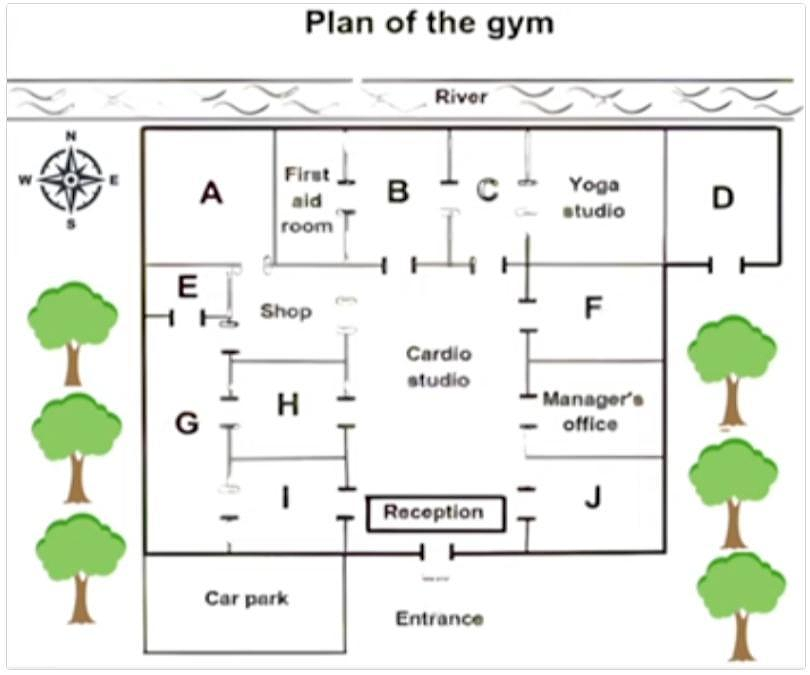
Now, let's talk about where things are.
We're standing in the entrance to the building. Some of you have meetings with your
personal trainers today. To find them, walk past the right side of reception and enter the
cardio studio. Their office is on the right, just after you go past the manager's office.
It's a warm day, so why not head to the pool? The easiest way to get there is from the
entrance, go around the left side of reception and enter the cardio studio, and then you'll
see that the third door on the left is the way into the shop.
Go into the shop, and you'll see there are two more doors. You want the one opposite you
as you walk in. Go through that door, and you'll see the pool, which runs along the west
side of the building.
Stretching after exercise is essential, so you'll need the stretch area. To find it, from the
entrance, head to the back of the cardio studio.
You'll see two doors facing you, and it's the one on the right.
As we've only got men here today, I'll point out only where your change rooms are.
From the entrance, go up the left side of the cardio studio, and you want the middle door.
That's the room just before you reach the shop.
If you're looking to bulk up, the weights room will be important. It's easy to find. From
the entrance, walk past the left side of reception and through the cardio studio to the back
of the building. The weights room is through the door on the left. The first aid room is
beside it, although hopefully you won't need to go in there.
After this, you might want to have a drink in our cafe.
Go to the shop, and this time take the door to your right, not the one opposite, and this
leads to the cafe with a nice view of the river.
That is the end of part two. You now have forty-five seconds to check your answers to
part two.
---
Section three. You will hear two trainee teachers called Dean and Hannah talking about
their recent teaching practice in an elementary school.
First, you have some time to look at questions twenty-one to twenty-four on page five.
Now listen carefully and answer questions twenty-one to twenty-four.
Hi, Dean. Did you have a good weekend?
Yes. It was good to relax after a whole week of teaching practice. I really enjoyed the
experience, though.
Yes, so did I, and I think it went well. Anyway, are you okay to talk about the report
we've got to write on the geography lesson we taught together? I was thinking we could
make notes now and then divide the actual writing up between us.
Sure. Good idea. Let's begin with our lesson aims, shall we?
Right. Well, I know the main one was getting the class to think about how people in
different parts of the world are connected to each other through the things they buy and
sell.
Yes. We took that from the syllabus for grade four, and then we decided to use pencils as
our example because they're relatively simple in design and everyone's used a pencil at
some time or other. We should include that information too.
Right. And we also wanted to get the class thinking about how things are moved around
the world in different ways. From the farms and the mines to the factories and then the
stores. That wasn't in the core syllabus. I think we added that ourselves.
Yes, I think you're right.
Okay. Then the last section of the report contains a post-lesson analysis.
We have to mention any problems we identified in our lesson when we taught it. So any
ideas?
Well, I know we were really satisfied with our handouts and worksheets. We both
thought they'd been at just the right level for the class, and I don't know about you, but I
think we worked well as a team.
Absolutely. Neither of us was too dominant, and we supported each other. Personally, the
thing I think we didn't get right was the way we paced things. Some things seemed to be
rushed, and others seemed to drag out too long. I don't know how you feel about that.
Hmm, the same as you. If we did the same lesson again, I'd want to make some
adjustments to that but keep the same basic lesson plan.
Okay, we see eye to eye on that. But there's one other thing. At the time, I seem to
remember we both thought that organizing the children in sets of six didn't work very
well and that pairs would have been better for certain tasks so that the shyer kids got
more chance to contribute.
Yes, I remember that too, and we should put it into our report as well.
Before you hear the rest of the discussion, you have some time to look at questions
twenty-five to thirty on page six.
Now listen and answer questions twenty-five to thirty.
Now, should we go over our lesson plan together before we write the report? It seems
ages ago now.
Fine. Well, the whole lesson was based on the production and distribution of pencils.
First, we gave out the pencils and got the students to decide what they're made of. Then,
when they'd come up with all five of the component materials, we talked about which
countries produce most of these materials.
Oh, yes. And we got volunteers to come to the front and mark the location of those on a
map of the world. I remember they were really keen to volunteer. We had to stop them
from calling the answers out loud.
[laughs] Right. Then we brainstormed all the different ways of getting goods from one
place to another and what the advantages and disadvantages of each one would be. I
remember one girl talking about using horses.
That's right. She seemed to be a bit stuck in the past. It was hard not to smile.
[laughs] Yes. After that, uh, we put them in small groups, and each group represented
each of the countries on the map. They had to use their atlases to decide an itinerary for
sending their raw materials to the USA, specifying the different ports and places on the
way there.
That's right. And by the time they'd done that, it was break time.
And after the break, they had to imagine they were pencil manufacturers in Chicago and
fill in details on a worksheet about how they dispatch their pencils to different parts of the
country.
Oh, yes. Okay.
And then we had a class discussion about whether people will still be using pencils in
twenty fifty and whether the design of pencils is likely to change. And to round the lesson
off, the kids had to spend ten minutes planning a short presentation for another class
about possible developments, and that was it.
Good. So I'll write up that part, and you-
That is the end of section three. You now have half a minute to check your answers.
---
Part 4. You will hear a geography professor telling his class about an upcoming field trip
to the far north of Quebec in Canada.
First, you have some time to look at questions thirty-one to forty.
Listen
carefully and answer questions thirty-one to forty.
Good morning. Next week is the Geography three thirty-one field trip to the far north of
Quebec. Today, I'll discuss your trip and your tasks.
As you know, you will be close to the Arctic Circle. You're going to travel up the James
Bay Road through a region that is very remote and uninhabited, yet very beautiful. The
highway is six hundred and twenty kilometers long, but it's fully paved for the entire
length.
Where the highway begins, there is a roadside office where you must stop. The road is
remote, so your registration is very important in case of an emergency. The office is
staffed twenty-four hours per day, seven days per week. You have to sign in to go up the
road and sign out upon your return. For additional safety, at different places along the
highway, telephones have been installed which connect with staff in the office.
Remember, there is no mobile service in this remote area.
The first work of your field trip is at the end of the James Bay Road in Radisson, a small
town of only three hundred inhabitants. You will stay at Radisson Research Center,
which works with various universities and Hydro-Quebec to carry out studies into the
ecology of the region.
Because the research center and the road exist as a result of the development of
hydroelectricity complexes in northern Quebec, Hydro-Quebec is responsible for all
emergency assistance and security of all visitors. Your first few days at the center will be
spent attending lectures about their past research. You will hear that they have paid
particular attention to any disturbance to the land caused by insects. After that, you will
visit the various outpost stations. There are three of them, and when you visit them, you'll
be able to observe how data on the varying patterns of the climate is collected and
published for scientific research.
The second part of your field trip is back down the James Bay Road to the Trans-Taiga
Road, which is the northernmost continuous unpaved road in eastern North America. In
fact, it's very uneven gravel, so drivers have to be very careful. Hydro-Quebec cautions
that driving over rocks on the rough road may cause severe damage to the car. Any
breakdown is serious as repairs are costly. Along the way, you will be stopping at two
hydroelectric generating stations, each on a different river. There you will meet with
engineers who will explain and demonstrate how rainfall has an impact on producing
electric energy.
Your last two days of the trip will be spent camping out in the taiga on the Canadian
Shield. Taiga is the Russian term for a type of forest.
You will find the region is relatively poor in the number of plant species, yet there is a
great variety of wildlife that can be seen.
You'll go to an area that once had forest fires, and you'll see how the landscape has
naturally small rocky hills which confine the lower wetlands.
These low-lying areas are called muskeg, which is made up of slowly decomposing
plants. It is not safe to walk on it as it has pools that are not easily seen. So keep to the
rocks.
The muskeg is home to many small birds and waterfowl. In fact, there are at least sixty
varieties. So keep your waterproof digital cameras handy so you can take plenty of
pictures. Then we will have documentation of the existing waterfowl as some are
becoming extinct.
Water is a problem in this area, so you'll also be collecting test tubes of water to bring
back to our research lab for analysis. It needs to be monitored for pollution that may be
caused by rainfall coming from the south.
That is the end of part four. You now have forty-five seconds to check your answers to
part four.