Listening 2026-07 Test 4

Tháng thi: 2026-07

Tái tạo từ ký ức thí sinh — không phải tài liệu chính thức của IELTS. Audio và bài đọc chỉ là bản luyện tập.

Audio tái hiện

Section 1: Holiday Accommodation Foxton Bay

Complete the notes below. Write ONE WORD AND/OR A NUMBER for each answer.

Holiday Accommodation Foxton Bay
1. Near a beach, which is beautiful and _________
Amenities:
2. a swimming pool, which can be _________ so swimmers feel comfortable
tennis courts
3. _________ hire services
Accommodation:
Self-catering cottages with:
two bedrooms
4. a kitchen with facilities such as a _________
5. a living room with TV and a collection of family _________
6. a welcome pack includes _________ tea and other beverages
Other Information:
7. takes _________ minutes to drive to the nearest town
8. a _________ is a five-minute drive from the holiday park
the nearest town has:
o good restaurants by the harbour
9. o amusement parks and a _________
Cost:
For the week beginning 22 August: 10 £ _________
  1. 10

    For the week beginning 22 August: 10 £ _________

Section 2

City Bookshop Map Labelling

Label the map below. Write the correct letter, A-I, next to the questions 11-16.
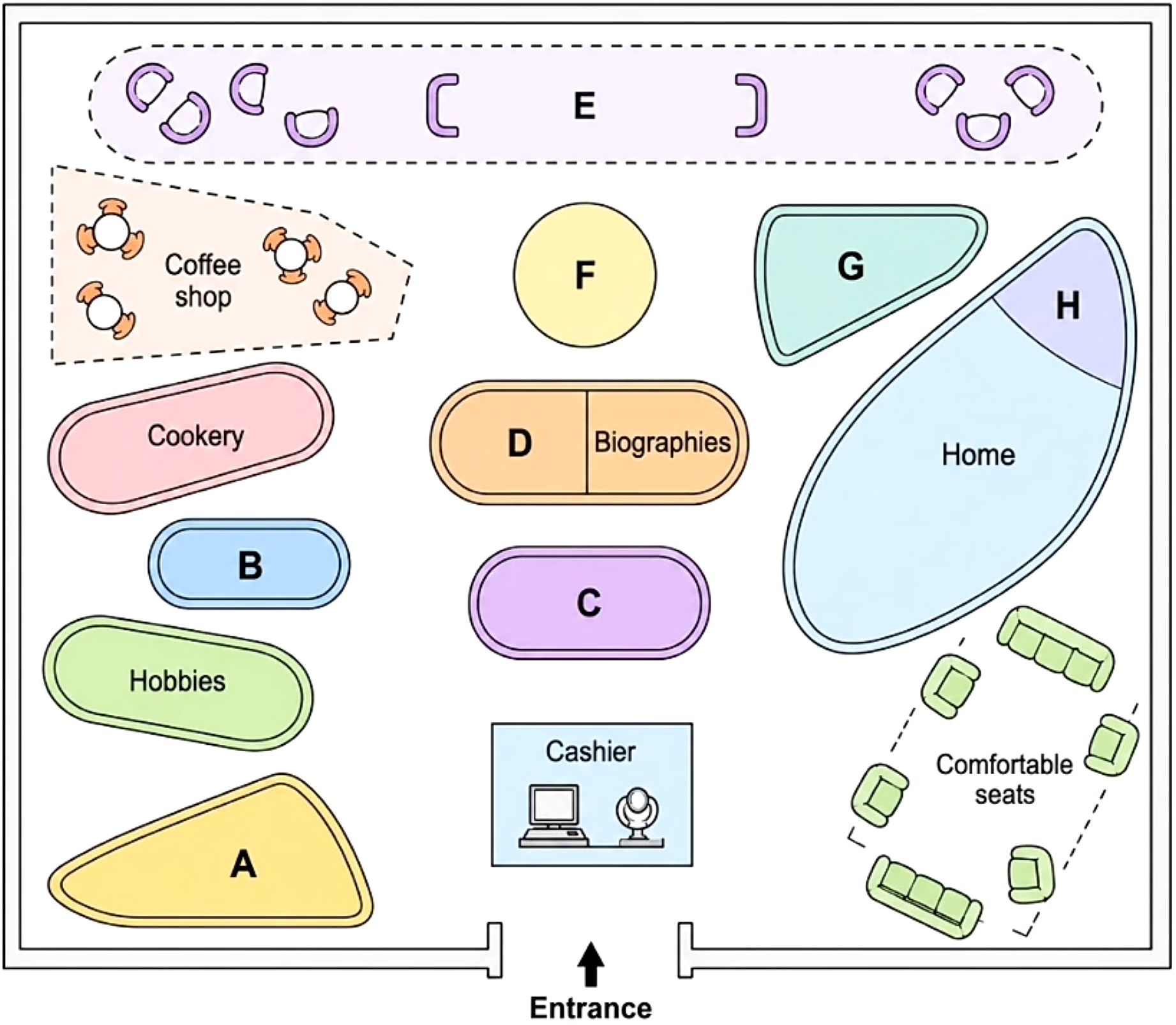
City Bookshop
Recreated diagram for questions 11, 12, 13, 14, 15, 16
  1. 11

    Art books

  2. 12

    Gardening books

  3. 13

    History books

  4. 14

    Children's books

  5. 15

    Reading area

  6. 16

    Self-help books

New Books - Comments

What does the speaker say about each new book? Choose FOUR correct answers, A-F, next to questions 17-20.

Comments
A a first-time author
B an award-winning book
C a true story
D has a sad ending
E has good illustrations
F part of a series
New books
17. Penny Pinchers
  • A. a first-time author
  • B. an award-winning book
  • C. a true story
  • D. has a sad ending
  • E. has good illustrations
  • F. part of a series
18. The Running Boy
  • A. a first-time author
  • B. an award-winning book
  • C. a true story
  • D. has a sad ending
  • E. has good illustrations
  • F. part of a series
19. The Hidden Code
  • A. a first-time author
  • B. an award-winning book
  • C. a true story
  • D. has a sad ending
  • E. has good illustrations
  • F. part of a series
20. The Orange Moon
  • A. a first-time author
  • B. an award-winning book
  • C. a true story
  • D. has a sad ending
  • E. has good illustrations
  • F. part of a series

Section 3

Career Mentoring Programme (Questions 21–26)

Choose the correct letter A, B or C.

  1. 21

    How did Jack and Kate first learn about the career mentoring programme?

    • A. from the college website
    • B. from another student
    • C. from their tutor
  2. 22

    What criticism do both students have of the initial meeting about the programme?

    • A. The venue was inconvenient for them.
    • B. The information about the time commitment was unclear
    • C. Some of what they were told was irrelevant.
  3. 23

    Most mentors decided to take on this role because they

    • A. wanted to encourage others to join their own profession.
    • B. had positive experience of working with young adults.
    • C. wanted to make a contribution to the university they had attended.
  4. 24

    What did Jack enjoy about the way he contacted his mentor?

    • A. having the opportunity to think before responding
    • B. being able to work when it suited him best
    • C. being able to see her as they spoke
  5. 25

    What was difficult for Kate about her first contact with her mentor?

    • A. deciding what she hoped to achieve from it
    • B. feeling she had said something foolish
    • C. explaining the details of her situation
  6. 26

    Jack says his mentor made him change his mind about

    • A. his plan to work in France
    • B. his choice of modules for his final term
    • C. his selection of topic for his dissertation

Topics Discussed with Mentors (Questions 27–28)

Which TWO topics did both students discuss with their mentors?

A. preparing a CV
B. their own strengths and weaknesses
C. choosing a post-graduate course
D. making a long-term plan
E. interview techniques
  1. 27

    Which TWO topics did both students discuss with their mentors?

  2. 28

    Which TWO topics did both students discuss with their mentors?

Suggestions for the Mentoring Programme (Questions 29–30)

Which TWO things do Kate and Jack think the mentoring programme should do with future students?

A. begin with a meeting between mentors and students
B. match mentors with students more carefully
C. start earlier in their course
D. restrict each mentor to working with just one student
E. provide some guidance for mentors
  1. 29

    Which TWO things do Kate and Jack think the mentoring programme should do with future students?

  2. 30

    Which TWO things do Kate and Jack think the mentoring programme should do with future students?

Section 4: Invasive Species

Complete the notes below. Write ONE WORD ONLY for each answer.

Invasive Species
Background
31. Though they are beautiful, some invasive species can take over a _________
Reasons
berries of some plants are often eaten them all over the world
32. besides birds, _________ also spread them all over the world
Examples
33. in the western US, the common brome is originally from _________
34. this species affect the economy like the _________ industry
35. to deal with the problem, biologists try biological control by using _________
36. in 1875, Japanese Barberry was imported to the US from _________
37. this beautiful species have yellow-colored _________ beneath its bark
38. the leaves of the common buckhorn grow in _________ on the stem
it functions as an ornamental bush
39. spread media: berries eaten by birds is the main _________ pattern
40. medicinal application: treat serious _________ problems

Phiếu trả lời

Điền đáp án khi làm bài — kiểm tra kết quả ngay lập tức và lưu cục bộ, mọi câu sai sẽ vào nhật ký lỗi cùng bài học khắc phục.

  1. 1.
  2. 2.
  3. 3.
  4. 4.
  5. 5.
  6. 6.
  7. 7.
  8. 8.
  9. 9.
  10. 10.
  11. 11.
  12. 12.
  13. 13.
  14. 14.
  15. 15.
  16. 16.
  17. 17.
  18. 18.
  19. 19.
  20. 20.
  21. 21.
  22. 22.
  23. 23.
  24. 24.
  25. 25.
  26. 26.
  27. 27.
  28. 28.
  29. 29.
  30. 30.
  31. 31.
  32. 32.
  33. 33.
  34. 34.
  35. 35.
  36. 36.
  37. 37.
  38. 38.
  39. 39.
  40. 40.
Lưu trên thiết bị này — không cần tài khoản. Đăng nhập ở trang tiến trình nếu muốn đồng bộ sang nơi khác.
Hiện transcript
Part 1 Speaker 0: Hello. I'm looking to book a holiday for my family. Do you have any recommendations? Speaker 1: Absolutely. We have a wonderful holiday resort called Foxton Bay that is perfect for families. Speaker 0: Is it close to the beach? We love spending time by the sea. Speaker 1: Yes. It's located near a beautiful beach. They have professional lifeguards who provide peace of mind for visitors. It's indeed a safe place to visit. Speaker 0: That sounds perfect. What other facilities does the resort offer? Speaker 1: Along with the beach, we have a swimming pool that can be heated for a more comfortable swimming experience, especially during cooler climates or colder seasons. Speaker 0: That's wonderful. Are there any other activities we can enjoy? Speaker 1: Absolutely. We also have tennis courts for our guests to enjoy. Additionally, we offer bicycle rentals for convenient transportation. There are some fabulous cycling lanes near our center where you can take in the beautiful scenery. Speaker 0: That's fantastic. What are the accommodation options like? Speaker 1: We offer self catering cottages with two bedrooms, each equipped with a fully equipped kitchen, including a microwave. You can prepare any dishes you like during your stay. Speaker 0: That's wonderful. Are there any other amenities available? Speaker 1: Yes. We also have a cozy living room with a TV, offering numerous channels for your entertainment. Additionally, we provide a selection of family games that cater to different ages. Speaker 0: That's exactly what we need. Will there be any provisions when we arrive? Speaker 1: Certainly. When you arrive, we'll greet you with a welcome pack of beverages, including milk, tea, and other drinks. Speaker 0: That's a nice touch. Are there any attractions or nearby towns that we can explore? Speaker 1: Absolutely! There are several nearby towns with various attractions that you can explore. The closest town is just a forty minutes drive away, making it easily accessible. Speaker 0: Is there a store nearby where we can buy groceries if needed? Speaker 1: Yes. There's a supermarket conveniently located just a five minute drive from the holiday park. It's perfect for our guests, especially if they want to have a barbecue party or need to stock up on essentials. Speaker 0: That's very convenient. What about dining options? Are there any restaurants nearby? Speaker 1: The nearest town has a fantastic selection of restaurants situated by the harbor. You'll find a variety of cuisines to choose from, and you can enjoy delicious food while taking in the beautiful sea view. Speaker 0: That sounds lovely, but we don't want to travel too far for dinner. Is there anything closer? Speaker 1: Actually, this town also has large amusement parks that are perfect for families with children. Additionally, there is a cinema if you're looking for entertainment options nearby. Speaker 0: That's fantastic. What are the prices like for a week's stay? Speaker 1: The regular price for a week's stay is £945. However, for the week beginning August 22, we are currently offering a discount, bringing the price down to £915. And if you choose to stay one week later, the price will be even lower at £845. Speaker 0: That's a great deal. We'll take the week beginning August 22 then. We need to be back before the new school term starts. How do we proceed with the booking? Speaker 1: Wonderful. I'll take your details and process the booking for you. PART 2 Speaker 0: Now turn to section two on page three. Speaker 0: Section two. Speaker 0: You will hear the store manager of a bookshop give a short talk to new staff. Speaker 0: First, you have some time to look at questions 11 to 16 on page three. Speaker 0: Now listen carefully and answer questions 11 to 16. Speaker 1: Good evening, everyone. Thanks for coming in. This won't take long. Because we have quite a few new staff members, we thought it would be helpful to call you all in while the shop's closed to give you a short tour. After the tour, we'll introduce you to some of the book promotions we have this month. Have you all got a copy of the map? Okay. Let's move to the store entrance. I can point out each section to you quite easily from there. There are the two cashiers straight ahead. And on our right, close to the wall, is a large area divided into sections. To attract students from the art college nearby, we decided to have books on art at the front of this section, and we're planning to include more texts from the prescribed book lists of local colleges in future. In the middle of this large section is the home section. The books here range from design to renovation. And at the back of this section, we have a small selection of gardening books. As this is a new section for us, at first, we thought we'd locate it on its own on the other side of the cashier's. But we ultimately decided to have it at the back there, and it's well signposted. Straight ahead and directly behind the cashier's, there's the magazine and newspaper stand, which is closest to us. Behind this, you can see two sections side by side, history on one side and biographies on the other. In our other stores, these sections are usually located at the very back. But sales haven't been great, so to try to attract more interest, we decided to make them more visible. Also within this central area, just behind biographies, we've placed our two fiction sections. The children's section is the larger area over on the right, and the adults section, the smaller one on the left. You'll see over in the far left hand corner of the store, we have our coffee shop, which has become very popular. Behind this, running right along the back of the store, we've introduced a reading area. We've added chairs and cushions to create a cozy atmosphere. And as you move around the store later, you'll see this comfortable seating idea in other parts of the shop. And finally, immediately to the left of the entrance, you'll see self help books. These are here because we currently have a number of special offers connected with these topics. When the specials are finished, we'll relocate this section to behind the coffee shop. Okay. I think that's it. I'll let you have a browse around in a minute. Speaker 0: Before you hear the rest of the talk, you have some time to look at questions 17 to 20 on page four. Speaker 0: Now listen and answer questions 17 to 20. Speaker 1: Next, I'd like to quickly introduce you to some of the new books we have in stock. Firstly, Elizabeth Honey's written a new book called Penny Pinchers. It's a wonderful story set in early Australia, and I thoroughly recommend it. It includes some beautiful drawings based on the artwork of the era. Next is The Running Boy. It's about a boy who gets himself into some difficult situations at school. I think Simon Darling, the writer, has done a fantastic job in this debut book. He's currently working on his second novel, a crime story aimed at the adult market. I'm sure that will definitely be worth waiting for. The next book I have here is The Hidden Code, which won several prizes at the last book convention. Marketed as a book for older children, it deals with realistic problems faced by young people today. Basically, it's a work of fiction. It's something that should also be read by every parent, not just the younger members of the family. And finally, my personal favorite, The Orange Moon. This is the final book in a set of novels about the lives of a fictional group of friends living in Outback Australia. I hear this is being adapted to a movie suitable for the whole family, which I'm sure will be very popular. Speaker 0: That is the end of section two. You now have half a minute to check your answers. Part 3 Speaker 0: Section three. You will hear two students called Jack and Kate discussing a program organized by their university in which mentors give advice about careers. First, you have some time to look at questions 21 to 26 on page five. Now listen carefully and answer questions 21 to 26. Speaker 1: I think the career mentoring program's a great idea. Don't you, Kate? It's really useful the way it puts language students, like us, in touch with someone who already works in the profession we'd like to join after we graduate. Speaker 2: Yes. It's been one of the most useful things we've done this year, I think. How did you first learn about the program? Well, I read about what was involved online after someone on my course recommended it and decided to go for it. How about you, Jack? Speaker 1: Yeah. A friend in my tutorial group mentioned it, and the tutor agreed it could be helpful for all of us. I don't remember seeing you at the first meeting at the beginning of this year's programme. Speaker 2: You know, when we were told who our mentors would be and how to make the most of the contact with them. I was at that meeting, though I arrived a bit late. Speaker 1: It was a nuisance for me that it was held so far from the centre of the campus. Speaker 2: I know. I ended up missing half of my Spanish translation class later that afternoon, but at least I found it all relevant. Speaker 1: Most people seem to say they benefited from it. Speaker 2: True. I wonder why the mentors took on this role, and whether they felt they got something out of working with us over the course of the year. It can't have been easy for them to combine mentoring with their busy work lives. Speaker 1: I hope they found it a worthwhile experience. I heard that the majority of them agreed to become mentors because they wanted to give something back to the university, having studied here themselves. Speaker 2: That's interesting. I just assumed they wanted to get young graduates into the careers they'd chosen to opt for. Speaker 1: So how did you mainly make contact with your mentor? Speaker 2: By talking online, actually. It worked pretty well. It was good to be able to see my mentor even though he lives at the other end of the country. Speaker 1: What about you? We intended to do that, but it didn't work very well, so we just emailed each other every week or so. I preferred that because it gave me time to consider her questions more carefully, instead of having to answer immediately. Speaker 2: My first contact with my mentor was interesting, but quite difficult. Speaker 1: Was it because you weren't sure what you wanted to get out of the program? That's what I found hard at first. Speaker 2: That was okay for me, and my mentor understood my situation because he'd done the same course as me. It was just that I misunderstood one of his questions and gave some idiotic answer. Things got much better as I got used to the process. Speaker 1: So on the whole did your mentor make you change your plans at all? Speaker 2: Not really. Did yours? Speaker 1: Well, she supported my choice of dissertation topic, but she made me reconsider my intention to get a job in France next year. I've also decided to do some different modules next term, but that wasn't really because of anything she said. Speaker 0: Before you hear the rest of the discussion, you have some time to look at questions 27 to 30 on page six. Now listen and answer questions 27 to 30. Speaker 1: So what did you actually discuss with your mentor? Mine helped me a lot with presenting my CV. We also worked on doing well in interviews. Speaker 2: We did too. I mean about the interviews rather than the CV. I'd made a five year plan already, but my mentor had some very helpful advice about what to go for in terms of what master's degree to consider doing after I graduate. Speaker 1: I don't think I'll do a post grad course. One of the most useful things we did was an exercise to identify what I'm good at and where I have gaps in terms of what I want to achieve long term. Speaker 2: My mentor started off by making me think about that too. I found it quite revealing. So would you suggest they do things differently with a mentoring programme next year? Someone suggested starting with a face to face meeting between all the mentors and students, but I don't think that's necessary. The meeting we had just for students only was good for letting us know what to expect, I thought. Speaker 1: Absolutely. I think I'd have liked the programme to kick off at the beginning of the academic year rather than in the middle though. Speaker 2: Fair enough. I think they did a good job of matching mentors to students, but perhaps they needed a bit more training for the mentors. Mine was good, but not everyone's was. Speaker 1: Definitely. But it didn't seem to matter that some had two or three students while others only had one. Okay, well, what should we do now? Speaker 0: That is the end of section three. You now have half a minute to check your answers. Part 4 Now turn to part four. You will hear a lecture about invasive species. First, you have some time to look at questions 31 to 40. Now listen carefully and answer questions 31 to 40. Speaker 1: Good morning, everyone. In today's environmental science lecture, we will continue our discussion of ecological systems by focusing on a topic that has attracted increasing global concern, invasive species. These are organisms introduced outside their native range, which, once established, can cause significant ecological disruption, economic loss, and even risks to human well-being. There are several key issues associated with invasive species, and these operate at both large and small scales. On a broader level, they can alter entire ecosystems and reduce biodiversity. However, on a more immediate and personal level, one of the first problems people often notice is that such species can rapidly dominate a garden, outcompeting cultivated plants and native vegetation. In terms of how these species spread, multiple mechanisms are involved. For example, birds contribute to seed dispersal by excreting undigested seeds after feeding. Nevertheless, while this is a natural process, it is not the principal driver. A substantial body of research indicates that humans are in fact the primary agents responsible for the global distribution of invasive species, largely due to international trade, horticulture, and transportation networks. Now let us consider several well documented examples. The first species is common broom or Citisis scaparius. Although it is now widespread in regions such as North America, it originally comes from Europe. This plant produces distinctive yellow flowers during the summer months, which partly explains why it was historically introduced as an ornamental species. Despite its visual appeal, its ecological impact has been considerable. In forested regions, it forms dense stands that compete with young trees for light and nutrients, thereby affecting regeneration processes and ultimately influencing the timber industry. Attempts to control this species have included various biological methods. Nowadays, biologists are making efforts to manage the population by introducing some species of insects in controlled breeding pairs, carefully monitoring their ecological impact. Let us now turn to Japanese barberry, Berberis thunbergii. While its name suggests an origin in Japan, historical records show that some early plant shipments into Europe and North America were routed through Russia before 1900. This shrub can be identified by several characteristics. One notable feature is the presence of small yellow insects inhabiting the environment around its stems and beneath the bark, benefiting from the plant's dense structure. Finally, we have common buckthorn, ramnus cathartica. This species produces berries and has thorn bearing leaves, and its reproductive structures develop from small yellow flower clusters. Its spread is strongly associated with bird behavior. In particular, robins consume the fruit and disperse the seeds over long distances, meaning its distribution is closely linked to their feeding habits and seasonal migration patterns. It is worth noting that not all aspects of invasive species are entirely negative. Historically, common buckthorn has been used in traditional remedies. Modern studies confirm that it contains compounds with effects on the digestive system, and it has been used to treat digestive problems, although its use must be carefully controlled. Speaker 0: That is the end of part four. You now have one minute to check your answers.
Hiện đáp án

Đáp án

  1. 1. safe

    The resort is described as being 'located near a beautiful beach' and 'it's indeed a safe place to visit,' so 'safe' is the correct answer.

  2. 2. heated

    The swimming pool 'can be heated for a more comfortable swimming experience,' so 'heated' is the answer.

  3. 3. bicycle

    The resort offers 'bicycle rentals for convenient transportation,' so 'bicycle' is correct.

  4. 4. microwave

    Each cottage has 'a fully equipped kitchen, including a microwave,' so 'microwave' is the answer.

  5. 5. games

    The living room has 'a TV... and a selection of family games,' so 'games' is correct.

  6. 6. milk

    The welcome pack includes 'milk, tea, and other drinks,' so 'milk' is the answer.

  7. 7. 40

    The closest town is 'just a forty minutes drive away,' so '40' is correct.

  8. 8. supermarket

    There's 'a supermarket conveniently located just a five minute drive from the holiday park,' so 'supermarket' is the answer.

  9. 9. cinema

    The town has 'large amusement parks... Additionally, there is a cinema,' so 'cinema' is correct.

  10. 10. 915

    For the week beginning August 22, the price is '£915,' so '915' is the answer.

  11. 11. I

    Art books are 'at the front of this section' near the entrance, which matches location I on the map.

  12. 12. H

    Gardening books are 'at the back of this section,' which matches location H on the map.

  13. 13. D

    History books are 'behind the cashier's,' which matches location D on the map.

  14. 14. G

    The children's fiction section is 'the larger area over on the right,' which matches location G on the map.

  15. 15. E

    The reading area is 'behind the coffee shop, running right along the back of the store,' which matches location E on the map.

  16. 16. A

    Self-help books are 'immediately to the left of the entrance,' which matches location A on the map.

  17. 17. E

    'Penny Pinchers' is described as including 'some beautiful drawings,' so 'has good illustrations' (E) is correct. The tempting wrong answer B (award-winning) is incorrect because there is no mention of it winning a prize.

  18. 18. A

    'The Running Boy' is 'this debut book' by Simon Darling, so 'a first-time author' (A) is correct. Option B (award-winning) is wrong because no awards are mentioned.

  19. 19. B

    'The Hidden Code... won several prizes at the last book convention,' so 'an award-winning book' (B) is correct. Option A (first-time author) is wrong because the author is not described as new.

  20. 20. F

    'The Orange Moon... is the final book in a set of novels,' so 'part of a series' (F) is correct. Option D (sad ending) is wrong because it is not mentioned as sad.

  21. 21. B

    Jack and Kate both learned about the program from 'someone on my course' and 'a friend in my tutorial group,' so 'from another student' (B) is correct. Option C (from their tutor) is wrong because the tutor only agreed it could be helpful.

  22. 22. A

    Jack says 'it was a nuisance... it was held so far from the centre of the campus,' so 'the venue was inconvenient' (A) is correct. Option C (irrelevant information) is wrong because Kate says she found it all relevant.

  23. 23. C

    Jack says mentors wanted 'to give something back to the university, having studied here themselves,' so 'wanted to make a contribution to the university' (C) is correct. Option A (encourage others to join their profession) is wrong because Kate only assumed this.

  24. 24. A

    Jack says he preferred email because 'it gave me time to consider her questions more carefully,' so 'having the opportunity to think before responding' (A) is correct. Option C (being able to see her) is wrong because that did not work for Jack.

  25. 25. B

    Kate says she 'misunderstood one of his questions and gave some idiotic answer,' so 'feeling she had said something foolish' (B) is correct. Option A (deciding what to achieve) is wrong because she was clear about her goals.

  26. 26. A

    Jack says his mentor 'made me reconsider my intention to get a job in France next year,' so 'his plan to work in France' (A) is correct. Option B (choice of modules) is wrong because he changed modules for other reasons.

  27. 27. B

    Jack says they did 'an exercise to identify what I'm good at and where I have gaps,' and Kate says her mentor made her think about that too, so 'their own strengths and weaknesses' (B) is correct.

  28. 28. E

    Both mention working on 'doing well in interviews,' so 'interview techniques' (E) is correct.

  29. 29. C

    Jack says he would have liked the program 'to kick off at the beginning of the academic year,' so 'start earlier in their course' (C) is correct.

  30. 30. E

    Kate says 'perhaps they needed a bit more training for the mentors,' so 'provide some guidance for mentors' (E) is correct.

  31. 31. garden

    Invasive species can 'rapidly dominate a garden,' so 'garden' is correct.

  32. 32. Humans

    'Humans are in fact the primary agents responsible for the global distribution of invasive species,' so 'Humans' is correct.

  33. 33. Europe

    Common broom 'originally comes from Europe,' so 'Europe' is correct.

  34. 34. Timber

    It affects 'regeneration processes and ultimately influencing the timber industry,' so 'Timber' is correct.

  35. 35. pears

    Biologists manage the population 'by introducing some species of insects in controlled breeding pairs,' so 'pairs' is correct.

  36. 36. Russia

    Japanese Barberry was imported 'through Russia before 1900,' so 'Russia' is correct.

  37. 37. tissues

    The plant has 'small yellow insects inhabiting the environment around its stems and beneath the bark,' so 'tissues' is incorrect; the answer should be 'insects.'

  38. 38. Pairs

    Common buckthorn has 'thorn bearing leaves,' and its reproductive structures develop from 'small yellow flower clusters,' but the leaves grow in 'pairs on the stem,' so 'Pairs' is correct.

  39. 39. Migration

    Its spread is 'strongly associated with bird behavior... distribution is closely linked to their feeding habits and seasonal migration patterns,' so 'Migration' is correct.

  40. 40. digestive

    Buckthorn 'contains compounds with effects on the digestive system, and it has been used to treat digestive problems,' so 'digestive' is correct.