Tái tạo từ ký ức thí sinh — không phải tài liệu chính thức của IELTS. Audio và bài đọc chỉ là bản luyện tập.
Hiện transcript
Section 1
Interviewer: Excuse me?
Lee: Yes?
Interviewer: I was wondering if you could spare a few minutes to do a questionnaire on your residency here in the north. It won't take long.
Lee: No, that's fine.
Interviewer: Lovely. First of all, may I get some information about yourself? OK, may I know your name and age?
Lee: My name's Lee and I'm 19 years old now.
Interviewer: Great. And could I ask what your job is? Are you a student?
Lee: Actually, I'm going to continue my study in business management next month, but at the moment I'm a salesman by profession.
Interviewer: Right. And how long have you been living here in the north?
Lee: Well, I've been in this city since I was three years old, but my family and I had lived in the east for seven years at first. Now I'm 19, so I've spent about nine years living
here till now.
Interviewer: Great. Which part of the northern area do you live in?
Lee: I live in Spring Park. Have you heard of it?
Interviewer: Yes, of course. So what about your accommodation? Do you live in a house or a flat or something similar?
Lee: I used to live with my family in a big house, and now I'm living in an apartment with two of my friends who are my colleagues as well.
Interviewer: All right. And one more question: what means of transport will you take when you need to go somewhere?
Lee: Um, if it's not too far away, I prefer to go on foot or by bicycle. If there is a long way to go, I take the train or sometimes a cab. I rarely take buses because I think the
most important things to keep in mind are time and comfort.
Interviewer: Great, thanks.
Interviewer: Now let's go to the second part of my questionnaire. I'd like you to tell me how often do you dine out? Is it once a week or several times a year?
Lee: I'm afraid neither of those options agree with me. I don't often go out for dinner. Maybe once a month. Every week just seems too often for me.
Interviewer: OK. Then where do you usually go for recreation?
Lee: I often go to places that other people go to. I sometimes go clubbing after work. You know, there are some fantastic clubs nearby.
Interviewer: And if you do not have to work during the day, will you go for a show or something?
Lee: You know, there is a newly built theater that opened last month in Spring Park, but I rarely go there because it's too expensive. I prefer to go to the cinema to see some of
the latest movies.
Interviewer: Do you like doing sports and what is your main form of exercise?
Lee: I like swimming and I go to the gym occasionally, but I spend most of my spare time sailing.
Interviewer: Alright. Last question: have you taken any part-time courses?
Lee: Yes, because I'm really keen on cartoons, I'm doing a Japanese course during the weekends, but I'm still a beginner.
Interviewer: Wow, what a special language! Most people I know would like to learn Spanish or Latin. You must be brilliant! Well, thank you very much for your time.
Lee: No problem. Bye.
Section 2
Tour Guide: Welcome to the museum. Before we go inside, I'd like to remind you of one or two things. Firstly, you'll be pleased to know that admission is free to all visitors, so explore at your leisure. And if you can't take it all in today, you can come back again and again without any charge at all.
Opening hours are from 10 AM to 5:30 PM most days, but the museum closes a little later on Thursday and Friday evenings.
There are new multimedia guides available in ten languages. They can be picked up from the desk in the covered courtyard for £4.50, and you can have it with you all day from opening time in the morning until half an hour before closing. But you will need to produce ID—a passport, driver's license or national identity card are all acceptable.
These multimedia guides have audio commentary as well as images and an interactive map for easy navigation. They're simple to operate and you will get a more detailed insight into many of the objects in the various galleries.
As a security measure, apart from your camera and a purse, wallet or small handbag, your other belongings such as large bags, coats and umbrellas will have to be left at the cloakroom.
Please note that the museum has recently revised the regulations for the size of bags and parcels that it will accept in its cloakrooms. I think the maximum size is 40 by 40 by 50 centimeters with a maximum weight of 8 kilograms. The only exception to this is prams and pushchairs.
There is a charge of £1 per item. The main cloakroom is to the left of the main entrance, and there is another one at the north entrance.
It may seem obvious, but may I remind you also that you should set your mobile phone to silent or turn it off altogether while you're in the museum. And do not carry or consume any food or drink in the exhibition halls.
If you are hungry, there is an excellent restaurant where you can purchase a light lunch or a full meal. If it's just a hot beverage you want, then I can recommend taking a break at the Gallery Café.
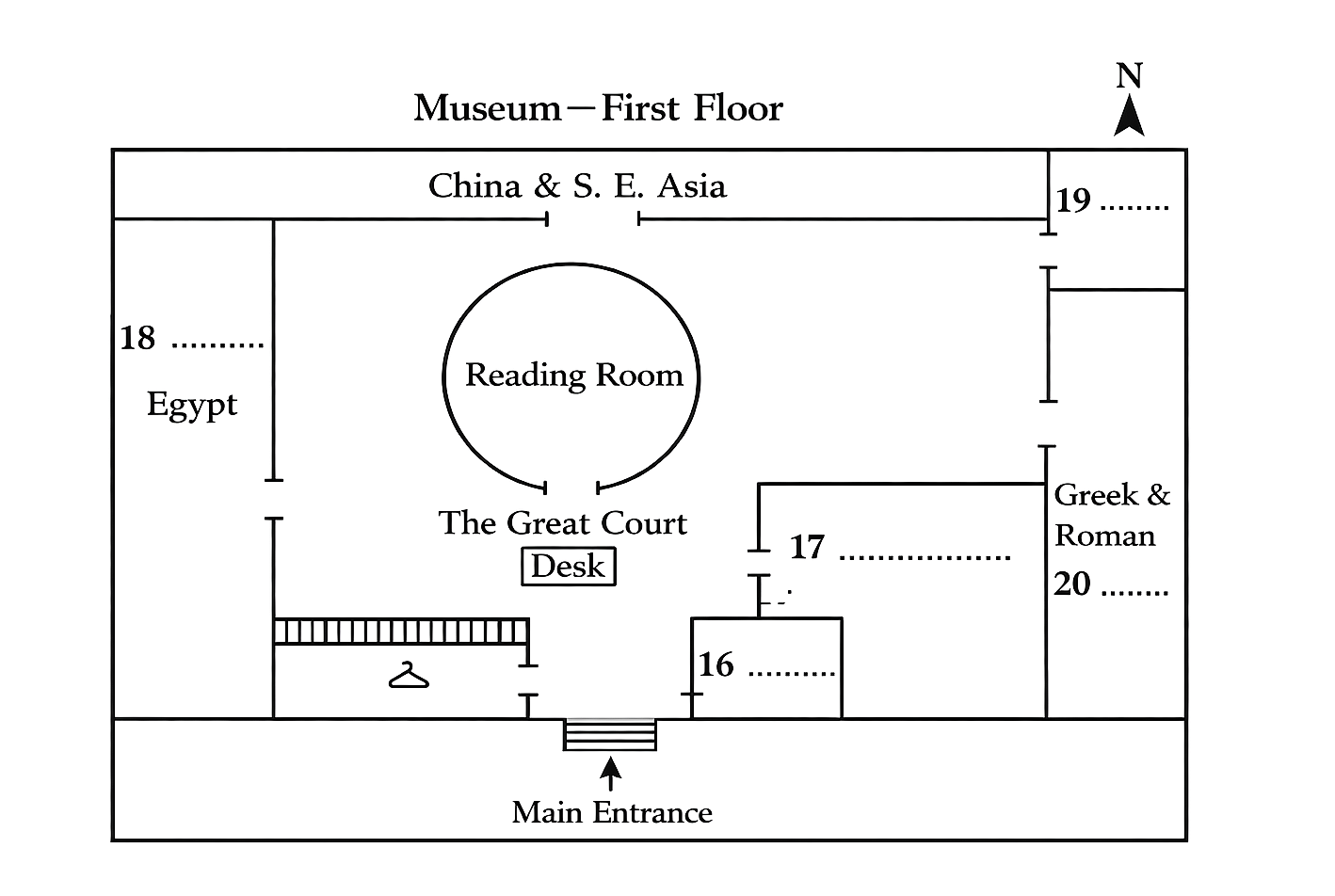
Tour Guide: As we enter the museum from the south by going through the main entrance, as I said before, you'll find the cloakroom immediately on your left, and on your right is the museum shop. They have an outstanding range of postcards and souvenirs in there, and it's well worth a visit, but perhaps best left until on your way out, then you know exactly what you want.
The big room to the right of the entrance behind the shop is the reference library. Straight ahead of you, east, the huge circular room is the main reading room. If you decide to go in there, please keep noise to a minimum out of respect for the writers and scholars who use it for their research.
The reading room is surrounded by what is known as the Great Court. Indeed, it used to be an open courtyard, but you will see that it is now completely covered by a magnificent glass and steel structure.
If you walk around the Great Court in a clockwise direction, on the west side you see the entrance to the long hall of Ancient Egypt, which has an amazing collection of Egyptian antiquities.
The gallery behind the reading room, directly opposite the entrance, is devoted to China and Southeast Asia. Here you see Chinese civilization explored chronologically from the Neolithic period through to the twenty-first century.
The restrooms for both men and women are located in the northeast corner of this floor, but don't worry, there are others available on the floors above.
Another huge gallery extends along the eastern side of the courtyard, and this is given over to Greece and Rome. The sculptures in this section are absolutely spellbinding. Take your time looking at all the exhibits, and when you're ready to view what's on the next floor, take the magnificent marble staircase by the entrance.
Section 3
Garret: So Garret, we need to organize the findings from our survey of music students for the final presentation.
Luna: Yes, Luna. I think we've got some very interesting results. Obviously, we need to start by saying that we interviewed all the thirty students doing a music degree, and state
the objective of our research project: that is, to find out about their attitudes to performing. And then we should talk about the students' musical backgrounds before coming to
university. The most important points to make are that although most people had actually composed music during the course, that wasn't the case when they arrived. And the other
thing they had in common was the piano.
Garret: Well, they had access to a piano at some point, but not all had studied it formally.
Luna: I thought the most interesting finding was that before coming here, almost everyone was involved in a chamber orchestra, or band, or singing in a choir, and playing in front
of live audiences, but varying enormously in size. Some had only played in tiny venues. I think it's worth saying that.
Garret: OK. And as you might expect from people wanting to study music, they all had a degree of proficiency in at least two instruments, but in most cases, one of the instruments was dominant.
Luna: Right. We need to talk about attitudes to music practice. The most striking thing here is that even students who you'd expect to practice for hours every day until they get it perfect say it's being terrified of failing that really makes them practice.
Garret: I know, I'm the same.
Luna: Me too. It's interesting what was said about practicing alone. Some people preferred that because they could focus more on their weak points, but that wasn't the majority
view. What most of them agree on is that there's nothing more rewarding than mastering something that's really hard to learn.
Garret: That's right.
Garret: OK, after that we should talk a bit about the pieces that students select for assessed performances. There wasn't quite so much consensus on this, was there?
Luna: A few people prefer to do pieces which are relatively unknown, while others choose the ones they think will show off their technical ability, but they were in the minority.
Garret: Hmm, I think the first thing to say is that a high percentage said they would always try to learn their pieces by heart, because it's too easy to get lost if you're trying
to read and play when you're nervous.
Luna: OK. And quite a lot of them said it helps to listen to other people playing your chosen piece privately—recordings, but even just other students.
Garret: So finally, we need to look at the findings for students' attitudes to performing. We should point out that this includes informal and formal public performances as well as assessed ones.
Luna: Yes, that's important. I expected to find that performing solo would make students very nervous, but in fact that isn't the case. They do find it hugely challenging to start with, but they appreciate the challenge and find it stimulating.
Garret: Right. I was surprised by what students said about deciding which pieces to perform. I thought they'd say this was easy for me. It's always been quite straightforward: which
pieces do I like best and which pieces can I play well? And my repertoire is quite limited anyway. But the most commonly cited answer was that it took them ages to make their minds up.
Luna: I suppose it's because there are so many factors involved. You need to consider your audience, the venue, the time available to learn the piece, especially if it's
complicated. You need to think about all these things and you can't do that in a hurry.
Garret: That's true. Then there's performing with musicians from a different genre, like a classical musician playing with a jazz group. That can really be fun, but most of the music students had never even considered it.
Luna: Right. For performing with musicians who play the same instrument, almost everyone put the same thing.
Garret: Yes, they all said it was incredibly helpful and not at all intimidating, which says a lot for the department's ethos.
Luna: Yes, that's a good point.
Garret: OK, what I think we should sort out now...
Section 4
Professor: Hello everyone. Before we continue with our lectures on the history of music and art, we'll be listening to Michael's presentation on how music and art are being used to
help with the healing process in the twenty-first century. Michael, are you ready to begin?
Michael: Yes, I think so. Thanks, Professor.
Professor: Right.
Michael: Uh, good morning, all. As Professor McInley just stated, I've been doing some research into the healing powers of art and music, and I'd like to present my findings to you today. I intend to demonstrate the positive effects of music and art on patients' emotional, social, as well as physical well-being.
Let's begin by going back in time to the most famous of nurses, Florence Nightingale. Way back in 1860, Florence Nightingale wrote in her Notes on Nursing that brightly coloured flowers and art helped her patients to recover more quickly. Although her comments were viewed with skepticism at the time, she was, we believe, the first of many health professionals to state this.
Over the following years, there were many other studies that tried to prove that a link between art, music and health exists, but very few of them were strictly controlled, so the results were variable and therefore unreliable.
However, one American study was different. In the 1980s, some research took place into the effect of architecture on the recovery time of forty-six patients who were in hospital for a gall bladder operation. Half of the patients were kept in hospital wards with windows overlooking some trees. The other half were left in rooms that faced onto a brick wall. It was found that the ones with a nice view left hospital a day earlier and needed fewer painkillers. This study was groundbreaking as it was the first that used controlled conditions that could be measured statistically and without bias.
Now I'd like to bring you up to date and take a closer comparative look at three research projects on three very different types of patient.
The first monitored the health of unborn babies. In the study, which took place at a hospital in London, babies were played live music and their heart rates were monitored. A healthy baby's heart would beat around 110 to 160 times a minute, but researchers found that their heart rate increased by up to 15 beats a minute on average, without the mother's
pulse changing. This is a good sign that the baby is healthy. In addition, the mothers that took part in the survey also said they felt more relaxed.
Another study looked at cancer patients who were visiting as day patients to receive their chemotherapy treatments. They were treated in a room that had artistic pictures hanging on the wall. The pictures were changed each week, so that the patients would not have to look at the same ones week after week. When questioned afterwards, patients said that they felt less pain because the images helped take their mind off the treatment they were receiving. They also noted general improvements in their well-being.
Finally, the last study analyzed the treatment of a group of elderly patients who were in hospital to have a hip replacement operation, and so they needed to stay for around ten to fourteen days. The researchers played them thirty-minute tracks of soothing classical music, but not every day, and then monitored their progress using a questionnaire. When asked to rate how they felt both with and without music, the patients consistently stated that they felt less anxious on the days when they had the music playing.
There was a second unexpected, but completely understandable result from the research: the staff liked the music so much that they said they too felt happier, and that they would be less likely to leave the hospital for a job elsewhere, if it were to continue. Now that has to be a good thing, which will also have a positive effect on the quality of the treatment patients receive.
In conclusion, I'd like to bring to...
第一节
采访者: 打扰一下?
李: 是的?
采访者: 我想知道您能否抽出几分钟时间,做一个关于您在北部居住情况的问卷调查。不会花太长时间。
李: 没问题,可以。
采访者: 太好了。首先,我能了解一些关于您的信息吗?好的,能告诉我您的姓名和年龄吗?
李: 我叫李,现在19岁。
采访者: 好的。能问一下您的工作吗?您是学生吗?
李: 实际上,我下个月要继续学习商业管理,但目前我的职业是销售员。
采访者: 好的。您在北部这里住了多久了?
李: 嗯,我从三岁起就住在这个城市了,但一开始我和家人在东部住了七年。现在我19岁了,所以到目前为止我在这里住了大约九年。
采访者: 好的。您住在北部地区的哪个地方?
李: 我住在春天公园。您听说过吗?
采访者: 是的,当然听说过。那您的住宿情况呢?您住在房子、公寓还是类似的地方?
李: 我以前和家人住在一栋大房子里,现在我和两个朋友住在一起,他们也是我的同事。
采访者: 好的。还有一个问题:当您需要去某个地方时,您会乘坐什么交通工具?
李: 嗯,如果不太远的话,我更喜欢步行或骑自行车。如果路程较远,我会坐火车,有时坐出租车。我很少坐公交车,因为我认为最重要的是时间和舒适度。
采访者: 好的,谢谢。
采访者: 现在让我们进入问卷的第二部分。我想知道您多久外出就餐一次?是一周一次还是一年几次?
李: 恐怕这两个选项都不符合我的情况。我不经常外出就餐。大概一个月一次。每周一次对我来说太频繁了。
采访者: 好的。那您通常去哪里休闲娱乐?
李: 我经常去其他人去的地方。我有时下班后去俱乐部。你知道,附近有一些很棒的俱乐部。
采访者: 如果您白天不用工作,您会去看演出之类的吗?
李: 你知道,春天公园上个月新建了一个剧院,但我很少去那里,因为太贵了。我更喜欢去电影院看一些最新上映的电影。
采访者: 您喜欢做运动吗?您的主要锻炼方式是什么?
李: 我喜欢游泳,偶尔去健身房,但我大部分业余时间都在航海。
采访者: 好的。最后一个问题:您参加过任何兼职课程吗?
李: 是的,因为我很喜欢卡通,我周末在上日语课,但我还是个初学者。
采访者: 哇,多么特别的语言!我认识的大多数人都想学西班牙语或拉丁语。您一定很聪明!好的,非常感谢您抽出时间。
李: 不客气。再见。
第二节
导游: 欢迎来到博物馆。在我们进去之前,我想提醒你们一两件事。首先,你们会很高兴得知所有游客免费入场,所以请随意参观。如果你们今天无法全部看完,可以一次又一次地回来,完全免费。
开放时间是大多数日子上午10点到下午5点半,但周四和周五晚上博物馆关门稍晚一些。
有新的多媒体导览,提供十种语言。可以在有顶庭院的服务台领取,价格为4.50英镑,你可以从早上开放时间一直使用到关门前半小时。但你需要出示身份证件——护照、驾照或国民身份证都可以。
这些多媒体导览有音频解说、图像和互动地图,便于导航。操作简单,你会对各个展厅中的许多展品有更深入的了解。
作为一项安全措施,除了相机和钱包、手袋或小手提包外,你的其他物品如大包、外套和雨伞必须存放在衣帽间。
请注意,博物馆最近修订了衣帽间接受包裹和袋子的尺寸规定。我认为最大尺寸是40×40×50厘米,最大重量为8公斤。唯一的例外是婴儿车和手推车。
每件物品收费1英镑。主衣帽间在主入口左侧,北入口还有一个。
这似乎是显而易见的,但请允许我提醒你们,在博物馆内应将手机调至静音或完全关闭。请勿在展厅内携带或食用任何食物或饮料。
如果你饿了,有一家很棒的餐厅,你可以购买轻食午餐或正餐。如果你只是想喝杯热饮,我建议你在画廊咖啡厅休息一下。
导游: 当我们从南部通过主入口进入博物馆时,正如我之前所说,你会立即在左侧找到衣帽间,右侧是博物馆商店。那里有各种各样的明信片和纪念品,非常值得一逛,但或许最好等到你出去的时候再去,这样你就知道确切想要什么。
入口右侧商店后面的大房间是参考图书馆。正前方,东边,那个巨大的圆形房间是主阅览室。如果你决定进去,请保持安静,以尊重在那里进行研究的作家和学者。
阅览室被所谓的"大庭院"环绕。事实上,它曾经是一个露天庭院,但你会看到它现在被一个宏伟的玻璃和钢结构完全覆盖。
如果你顺时针方向绕着大庭院走,在西侧你会看到古埃及长厅的入口,那里收藏了令人惊叹的埃及古物。
阅览室后面,入口正对面的展厅专门展示中国和东南亚。在这里,你可以按时间顺序探索中国文明,从新石器时代一直到二十一世纪。
男女洗手间位于这一层的东北角,但别担心,楼上还有其他洗手间。
另一个巨大的展厅沿着庭院的东侧延伸,专门展示希腊和罗马。这一部分的雕塑绝对令人着迷。慢慢欣赏所有展品,当你准备好看下一层楼的展品时,请走入口处的宏伟大理石楼梯。
第三节
加雷特: 那么加雷特,我们需要为最终演示整理我们对音乐学生调查的结果。
卢娜: 是的,卢娜。我认为我们得到了一些非常有趣的结果。显然,我们需要首先说明我们采访了所有三十名攻读音乐学位的学生,并说明我们研究项目的目标:即了解他们对表演的态度。然后我们应该谈谈学生在来大学之前的音乐背景。需要强调的最重要的一点是,虽然大多数人在课程期间确实创作过音乐,但他们刚来时可并非如此。他们的另一个共同点是钢琴。
加雷特: 嗯,他们在某个时候有机会接触钢琴,但并非所有人都正式学习过。
卢娜: 我认为最有趣的发现是,在来这里之前,几乎每个人都参与过室内乐团、乐队或合唱团,并在现场观众面前表演过,但规模差异极大。有些人只在很小的场地表演过。我认为这一点值得一提。
加雷特: 好的。正如你对想学音乐的人所期望的那样,他们在至少两种乐器上都有一定的熟练程度,但在大多数情况下,其中一种乐器是主导的。
卢娜: 对。我们需要谈谈对音乐练习的态度。这里最引人注目的是,即使是那些你期望每天练习数小时直到完美的学生也说,真正促使他们练习的是对失败的恐惧。
加雷特: 我知道,我也是这样。
卢娜: 我也是。关于独自练习的说法很有趣。有些人更喜欢这样,因为他们可以更专注于自己的弱点,但这不是多数人的观点。大多数人一致认为,没有什么比掌握真正难学的东西更有成就感了。
加雷特: 没错。
加雷特: 好的,之后我们应该谈谈学生为考核表演选择的曲目。关于这一点,大家的共识不是那么多,对吧?
卢娜: 少数人更喜欢演奏相对不为人知的曲目,而另一些人选择他们认为能展示技术能力的曲目,但他们只占少数。
加雷特: 嗯,我认为首先要说的是,很高比例的学生表示他们总是尝试背谱演奏,因为当你紧张时试图边看边演奏太容易出错了。
卢娜: 好的。相当多的人表示,私下听其他人演奏你选择的曲目很有帮助——录音,甚至只是其他学生的演奏。
加雷特: 那么最后,我们需要看看学生对表演态度的调查结果。我们应该指出,这包括非正式和正式的公开表演以及考核表演。
卢娜: 是的,这很重要。我原以为独奏会让学生非常紧张,但事实并非如此。他们一开始确实觉得极具挑战性,但他们欣赏这种挑战并觉得它很有激励作用。
加雷特: 对。学生们关于决定表演哪些曲目的说法让我惊讶。我以为他们会说这对我来说很容易。我一直觉得很简单:我最喜欢哪些曲目,哪些曲目我演奏得好?而且我的曲目库相当有限。但最常见的回答是,他们需要很长时间才能下定决心。
卢娜: 我想是因为涉及的因素太多了。你需要考虑观众、场地、学习曲目的可用时间,特别是如果曲目很复杂的话。你需要考虑所有这些因素,不能匆忙决定。
加雷特: 没错。还有与不同流派的音乐家一起表演,比如古典音乐家与爵士乐队合作。那真的很有趣,但大多数音乐学生甚至从未考虑过。
卢娜: 对。对于与演奏相同乐器的音乐家一起表演,几乎每个人的回答都一样。
加雷特: 是的,他们都说这非常有帮助,而且一点也不令人生畏,这充分说明了系里的氛围。
卢娜: 是的,说得好。
加雷特: 好的,我想我们现在应该整理一下...
第四节
教授: 大家好。在我们继续关于音乐和艺术史的讲座之前,我们将听取迈克尔关于音乐和艺术如何在二十一世纪被用于帮助治疗过程的演讲。迈克尔,你准备好开始了吗?
迈克尔: 是的,我想准备好了。谢谢教授。
教授: 好的。
迈克尔: 呃,大家早上好。正如麦克因利教授刚才所说,我一直在研究艺术和音乐的治愈力量,今天我想向你们展示我的发现。我打算展示音乐和艺术对患者情感、社交以及身体健康的积极影响。
让我们回到最著名的护士弗洛伦斯·南丁格尔的时代。早在1860年,弗洛伦斯·南丁格尔在她的《护理笔记》中写道,色彩鲜艳的花朵和艺术帮助她的患者更快康复。尽管她的评论在当时受到怀疑,但我们相信她是众多健康专业人士中第一个提出这一观点的人。
在接下来的几年里,有许多其他研究试图证明艺术、音乐和健康之间存在联系,但很少有严格控制的,因此结果多变且不可靠。
然而,一项美国研究有所不同。在1980年代,进行了一项关于建筑对四十六名胆囊手术患者康复时间影响的研究。一半患者住在窗外能看到树木的病房,另一半住在面向砖墙的房间。结果发现,能看到美景的患者早一天出院,需要的止痛药也更少。这项研究具有开创性,因为它是第一个使用可以统计测量且无偏见的控制条件的研究。
现在我想让你们了解最新情况,并仔细比较三个针对不同类型患者的研究项目。
第一个监测了未出生婴儿的健康。这项研究在伦敦的一家医院进行,给婴儿播放现场音乐并监测他们的心率。健康婴儿的心率约为每分钟110到160次,但研究人员发现他们的心率平均增加了多达15次,而母亲的脉搏没有变化。这是婴儿健康的良好迹象。此外,参与调查的母亲也表示她们感到更加放松。
另一项研究观察了作为日间患者来接受化疗的癌症患者。他们在墙上挂着艺术画的房间里接受治疗。每周更换画作,这样患者就不必每周都看同样的画。事后询问时,患者表示他们感到疼痛减轻,因为图像帮助他们分散了对正在接受治疗的注意力。
他们还注意到整体健康状况有所改善。
最后,最后一项研究分析了一组接受髋关节置换手术的老年患者的治疗情况,因此他们需要住院大约十到十四天。研究人员给他们播放三十分钟的舒缓古典音乐,但不是每天都播放,然后使用问卷监测他们的进展。当被要求评价有音乐和没有音乐时的感受时,患者一致表示,在有音乐播放的日子里他们感到不那么焦虑。
研究还有第二个意外但完全可以理解的结果:工作人员非常喜欢这些音乐,他们说他们也感到更快乐,如果音乐继续播放,他们就不太可能离开医院去别处工作。这肯定是件好事,也会对患者接受的治疗质量产生积极影响。
总之,我想提出...