Tái tạo từ ký ức thí sinh — không phải tài liệu chính thức của IELTS. Audio và bài đọc chỉ là bản luyện tập.
Hiện transcript
====================
IELTS Listening Transcript
====================
PART 1
Speaker 0: You will hear a number of different recordings, and you will have to answer questions on what you hear. There will be time for you to read the instructions and questions, and you will have a chance to check your work after each section. All the recordings will be played once only. The test is in four sections. Write all your answers on the listening question booklet. At the end of the real test, you will be given ten minutes to transfer your answers from the question booklet to an answer sheet. You should be prepared to do this with the practices. Now turn to section one. Section one.
Speaker 1: Hello. How can I help you today?
Speaker 2: Ah, yes. Hello. I'm just phoning you as I have seen an advertisement on your website for a property that I'm interested in renting.
Speaker 1: If possible, I'd like to find out some more information before I organize a viewing. No problem at all. What is the address of the property that you'd like to inquire about?
Speaker 1: It's 21 North Avenue. Okay. What is it that you'd like to know?
Speaker 2: First of all, I'd like to know what facilities the office has as I need to make sure that it'll be suitable for my advertising company.
Speaker 1: I see. The office contains a large open plan space with a wide frontage onto a busy street with lots of passersby. So your business would have a really good street presence. There is also a toilet and newly refurbished kitchen equipped with a dishwasher and oven.
Speaker 2: Wow. That sounds great. I'd definitely like to register my interest.
Speaker 1: Okay. Perfect. I just need to take some details from you, if that's okay. What is your full name?
Speaker 2: Jonathan Smith.
Speaker 1: And what position do you hold in your company, Jonathan?
Speaker 2: Until recently, I was sales manager. However, I've recently been promoted to regional manager, so I'll be in charge of running our new office.
Speaker 2: Can I ask where the office is located?
Speaker 1: Yes, of course. It's located downtown, just around the corner from Royal Square Shopping Centre.
Speaker 2: That's a bit too far out of the centre for my liking. I'd much prefer to be located in close proximity to the station. Do you have any property located in that vicinity? It would help me to narrow down the results if you could tell me how many employees you intend to have working in the office.
Speaker 2: Our branch is made up of 30 employees, and we'd like some extra space for meetings and presentations.
Speaker 1: Most average office spaces are around 8,000 square feet, but it sounds like you would need more space than that. I think that 10,000 square feet would be more suitable for your needs. Now let's see. We have 10 properties that match those criteria, so let's try and narrow it down.
Speaker 3: Before you hear the rest of the conversation, you have some time to look at questions five to 10. Now listen and answer questions five to 10.
Speaker 1: Do you have any other requirements?
Speaker 2: Well, we'll need access to the office twelve hours a day, but security should be twenty-four hour. We don't hold any money on the premises, but it's crucial that we protect our customer information against theft. Okay. Anything else?
Speaker 2: Yes. Ideally, I would prefer the new office to be split over two levels so that the working office area is kept separate from street level. That will enable us to locate a reception at Ground Floor level to welcome customers when they arrive.
Speaker 2: And are there any particular facilities that you need? Our employees work very hard throughout the day, and I want to make sure that they're well nourished. It would therefore be ideal if I could provide them with a kitchen to cook hot meals at lunchtime.
Speaker 1: Would you want the kitchen to be located at first floor level with the office?
Speaker 2: No. I don't want the office to be filled with the smell of food. It would be better if the new office had a basement where we could locate the kitchen and staff room area to keep it at arm's length from the workspace.
Speaker 1: Okay. I have now narrowed the search to two available properties. Do you have any other requirements that could narrow our search down to one result?
Speaker 2: All of our office staff will be working at desktop computers, so I'll need the office to be equipped with at least 40 power sockets if possible.
Speaker 2: Anything else? Studies have shown that exercise is very important for maintaining happiness and healthy brain function. In an office environment, it's very difficult to get sufficient daily exercise, so it would be great if they had access to a nearby exercise area.
Speaker 1: One of the available offices is located next door to a gym. Would this be suitable?
Speaker 2: Yes. Absolutely. A gym is exactly what I was thinking of. Brilliant.
Speaker 1: Do you need the office to be furnished?
Speaker 2: I don't think so. I already have some furniture, so I would prefer to bring this myself.
Speaker 1: That's no problem at all.
Speaker 2: And before I forget, we will definitely require Wi-Fi access as much of our work and customer recruitment is carried out online.
Speaker 1: No problem. It sounds like the property will suit your needs perfectly. I've taken the liberty of booking you a viewing at 3 PM on Thursday, so you can see it for yourself. Is there anything else I can help you with today?
Speaker 2: No. I think that's all the information I need. Thanks very much for your help.
Speaker 1: No problem. It's been my pleasure to be of assistance. Goodbye.
Speaker 3: That is the end of section one. You now have half a minute to check your answers. Now turn to section two.
PART 2
Speaker 4: Section two. You will hear the manager of a new sports center talking to potential customers about the facilities there. First, you have some time to look at questions 11 to 16 on page four. Now listen carefully and answer questions 11 to 16.
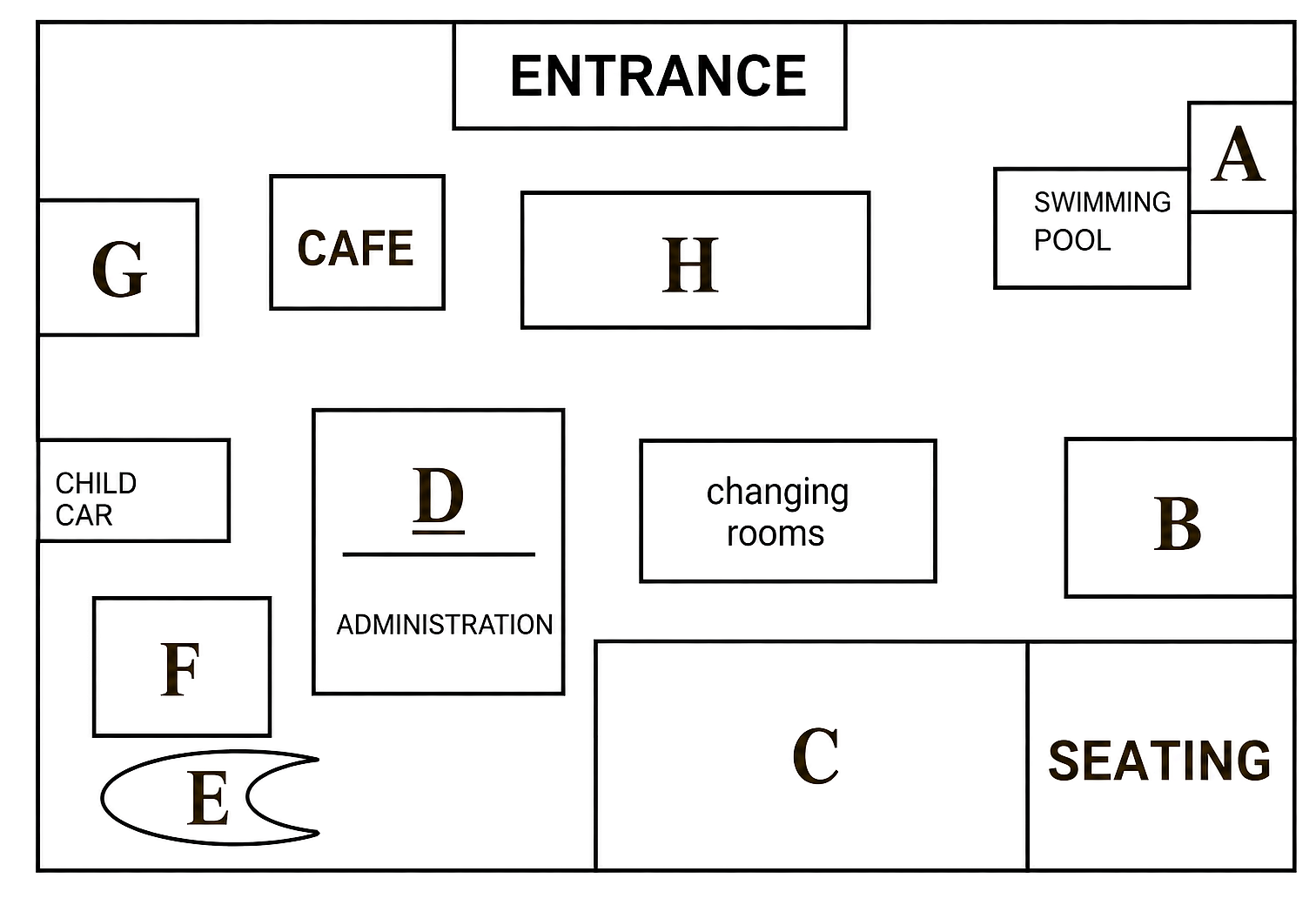
Speaker 5: Good evening, and welcome to Carrara's brand new Sports and Leisure Centre. First, I'll tell you about our facilities, then feel free to wander around the centre. Now as you can see from the map I've given you, we're sitting in our cafe, which we hope will be a favorite place to visit after exercising. To one side of us and right in front of you as you enter the complex is the shop. Be sure to have a look in there later as we've got some great opening specials on footwear. On the other side of the cafe, and ideally situated between the cafe and the child minding facilities, we have the playground. You can sit and relax there while your kids have a great time on the equipment. And our child care facilities are available to anyone using the centre. Let's talk a little bit about our heated swimming pool, which is also near the entrance, on the other side from the cafe. It has a five meter water slide, which will be very popular with kids of all ages. And in the corner, nearest the changing rooms, we have a high-tech hot spa. The water is heated to 38 degrees centigrade, which is the ideal temperature to relax tired muscles after a workout. So where can you do these workouts? Well, we have a large weights room located at the cafe end of the administration block. In the weights room, you'll find all the latest equipment. We also have trainers there who can put a program together for you. Another place to get a good workout is in the gym, which is shown on the map to the right of the changing rooms. There will be all sorts of classes offered there. Our aim is to provide all your exercise and recovery needs. So as well as the spa to help aching bodies, we also have a special area for massage. It's in the funny shaped room close to the administration area. Its distinctive shape has already led to the nickname of the Bullet Room. We'll be offering Swedish and Chinese massage there, and we'll offer physiotherapy in the future.
Speaker 4: Before you hear the rest of the talk, you have some time to look at questions 17 to 20 on page five. Now listen and answer questions 17 to 20.
Speaker 5: Now let me tell you something about our different memberships. Firstly, we offer different types of membership to cater for different needs. If you are a fitness freak, then choose our all in membership. This gives you access to everything in the center, all the classes and sports. It's usually our most expensive option. But for a short time, we're offering twelve months for the price of 9, which is a huge saving. If you prefer just the gym classes, you may want to consider the gym and weights package. It works out at $10 a week, which is good value. If you just want to swim, then we recommend getting a swim plus membership. With this, you have unlimited use of the pool and spa. The other package we've reduced for this month only is the off peak. This is aimed at people who are happy to come at less busy times. And finally, we have the family pack. We believe in keeping the whole family fit and healthy, so this package works out cheaper than buying it separately. Your flyer has details of all the prices. So anyone who signs up for a new membership tonight will receive two fantastic presents from us. We wanted to make these rewards something different from the norm. We could have just chosen a towel for you to use in the gym or some clothing from the shop, but we wanted to show our appreciation by giving you something special. So not only are we going to give you a voucher for a session in our massage center, a great way to unwind after your workout, but you'll also get this great device that measures your heart rate. And finally, just for turning up tonight, we'd like to give everyone here a drink bottle to take away with them. That's all I wanted to say.
Speaker 4: That is the end of section two. You now have half a minute to check your answers.
PART 3
Speaker 6: Section three. You will hear two psychology students called Katie and Daniel discussing how taking a walk can affect people's creativity and physical well-being. First, you have some time to look at questions 21 to 26 on page five. Now listen carefully and answer questions 21 to 26.
Speaker 7: Hi, Daniel.
Speaker 8: Katie, you look as if you're off somewhere. Yes. I was just heading out for a walk. Funny. I was just reading an article about some research that's been done on the effects of walking on creativity.
Speaker 7: Sounds interesting.
Speaker 8: I've always found walking helped me think, but this article confirms that everybody can benefit.
Speaker 7: Oh, tell me more. Okay. But I may even do some more research on it at some point, so don't pinch my idea. Promise.
Speaker 8: Well, in the experiments, the researchers tested participants' creativity by comparing how many ideas they thought of while they were walking compared to while they were doing other activities.
Speaker 7: What? Like listening to music? Nothing like that. But they did analyze the ideas participants came up with when sitting, both outdoors and inside. What I found surprising was that they didn't compare walking to other forms of exercise, like running, for example. Right.
Speaker 8: So what was the difference between the experiments?
Speaker 7: Well, in each one, the activities were put together in different ways. Several of the experiments specifically focused on the ability of participants to come up with new ideas. Then the final experiment was a control test of sorts. Oh, right. In one experiment, participants had to think of unusual uses for three everyday objects within a time limit. Okay. And then there was an experiment with words.
Speaker 8: What did they ask them to do? Compare words in unusual ways. For example, the word sweet. If participants simply said sweet as sugar, that wasn't creative. But an answer like sweet as a cat with honey on its paws was. Okay.
Speaker 7: I can see why they'd ask them to do that. Really? I just don't see how the experiment is fair. Why? Because the conclusions are based only on the researcher's opinion. I think it's more that anyone who'd studied language would be at an advantage.
Speaker 8: Okay. Was there an experiment about focused thinking?
Speaker 7: Yeah. There was. It aimed to find out if walking helped focused thinking, though I wasn't sure that I agreed with their findings. They decided that walking doesn't help this type of thinking.
Speaker 8: What evidence did they have? Well, that's it. I don't think there was enough evidence to support their conclusions even if their methods were sound.
Speaker 7: Well, I'd certainly hesitate before making such a bold statement.
Speaker 8: Still, it's a first step, isn't it? I suppose to move forward with this, they'll need to test other ways people keep fit, like swimming.
Speaker 7: That would be useful. But personally, I'd like to know more about the fundamental reason for the effect on people's creativity.
Speaker 8: That would be good. Then it could be applied more widely in work, for example. Again, that's secondary, really.
Speaker 6: Before you hear the rest of the discussion, you have some time to look at questions 27 to 30 on page six. Now listen and answer questions 27 to 30.
Speaker 7: But how would you test walking if you wanted to assess its physical benefits?
Speaker 8: Well, firstly, I'd like to know more about the benefits of different situations.
Speaker 7: What about the effect of footwear? Hadn't thought of that. Well, I've read that shoes with thinner soles were found to be better for people's joints. It even made the skeletal structure tougher.
Speaker 8: Interesting. Was that because they lost weight? Not as far as I'm aware.
Speaker 7: And then there's walking in the mountains.
Speaker 8: Walking in the mountains. I think I've read something about that. Doesn't altitude help people regulate their sleep patterns?
Speaker 7: It's more that it improves your vision. It must be those breathtaking views. Yeah.
Speaker 8: And what about the effect that walking has for elderly people? Better balance by any chance? More than that. It had a positive effect by helping them maintain their body clock's natural rhythm, both when going to bed and waking up. Right.
Speaker 7: And what about the effect of walking long distances?
Speaker 8: Well, a person needs to find the balance between their optimum speed and their natural breathing pattern. Once they're synchronized, they can just keep on going for much longer periods than they could before.
Speaker 7: I can see how that would work. But anyway, you
Speaker 6: That is the end of section three. You now have half a minute to check your answers. Now turn to section four on page seven.
PART 4
Speaker 3: Section four. You will hear part of a lecture about time measurement. First, you have some time to look at questions 31 to 40.
Speaker 3: Good morning, everyone. Today I'm going to talk about the research project I've been involved in on time measurement. Do you know how time is measured? Consider how we measure length and how, with time, we encounter a difficulty. Before we could grasp it, it would slip through our fingers. In fact, as we can see, we are forced to have the resource to measure something else. The movement of something in space or a set of movements in space. All the methods that have been employed so far really measure time by a motion in space. The measurement of time is no easy matter, a scientific unit only arrived at after much thought and reflection. As the most primitive form of measurement, the sun seems to be natural. Ever since man first noticed the regular movements of the sun and stars, we have wondered about the passage of time. Prehistoric people first recorded time according to the sun's position. To start off, let us take noon, which is when the sun is on the meridian at the highest point of its course across the heavens, and when it casts the shortest shadow. But this measurement, which was regarded as a major one in ancient times, was less important than the natural events that occurred. The earliest natural events that had been recognized were in the heavens, but during the course of the year, there were many other events that indicated significant changes in the environment. Seasonal winds and rains, the flooding of rivers, the flowering of trees and plants, and the breeding cycles or migration of animals all led to natural divisions of the year, and the further observation and local customs led to the recognition of the season. Years later, precise measurements were invented because the passage of time was extremely important for astronomers and priests who were responsible for determining the exact hour for daily rituals and for important religious festivals. Apart from the connection with religion, accurate time measurement was also related to the government since they divided the day or the night into different periods in order to regulate work and various events. For thousands of years, devices had been used to measure and keep track of time. The current sexagesimal system of time measurement dates back to approximately 2,000 BCE from the Sumerians. It was found that the earliest ancient timekeepers were mainly invented and used in Mesopotamia, where the water clock was introduced from, as well as in North Africa, especially in the area of ancient Egypt. So now I'd like to introduce you to some of the most well known ancient timekeepers as well as the disadvantages of them for which they were replaced by various new forms of clocks that were used afterwards. A sundial is a device that tells the time of day by the apparent positioning of the sun in the sky. In the narrowest sense of the word, it consists of a flat plate and a nomen, which casts a shadow onto the dial. As the sun appears to move across the sky, the shadow aligns with different hour lines, which are marked on the dial to indicate the time of day. However, it was quickly noted that the length of the day varied at different times of the year. Therefore, there could have been a difference between clock time and sundial time. In addition, the sundial was of no use at night, so a water clock was invented. The water clock, or klepsydra, appeared to have been invented around 1500 BCE and was a device which relied on the steady flow of water from or into a container. Measurements could be marked on the container or on a receptacle for the water. It was reliable, but the water flow still depended on the variation of pressure and temperature from the top of water in the container. As the technology of glassblowing developed, from sometime in the fourteenth century, it became possible to make sand glasses. Originally, they were used as a measurement for periods of time like lamps or candles. But as clocks became more accurate, they were calibrated to measure specific periods of time. The drawback, however, as you can imagine, was the limited length of time they could measure. The last timekeeper to be introduced is the fire candle clock. Candle clocks took advantage of a simple concept: the slow and consistent nature of a burning wax candle. By utilizing this process, our ancestors were able to keep steady track of the time. The clocks were created by engraving the length of the candle with evenly spaced markings. Each marking represented a single unit of time, and as the wax burned down, each hour would disappear. However, the drafts and the variable quality of the wax mainly influenced the time of burning. Like oil lamps, candles were used to mark the passage of time from one event to another rather than tell the time of day.
Speaker 3: That is the end of section four. You now have half a minute to check your answers.