Tái tạo từ ký ức thí sinh — không phải tài liệu chính thức của IELTS. Audio và bài đọc chỉ là bản luyện tập.
Audio tái hiện
Section 1
Renfrew Activity Centre
Complete the table below. Write NO MORE THAN TWO WORDS for each answer.
- 1
Rock climbing £60 (for a group using the 1Centre grounds ............... of twelve)
- 2
Rock climbing £60 (for a group using the 1Centre grounds ............... of twelve) 2 ...............
- 3
Mountain biking doing 3 ............ in the mountains checks services of a 4£70 ...............
- 4
Mountain biking doing 3 ............ in the mountains checks services of a 4£70 ...............
- 5
Wild camping in the 5 ............... finding out about plants Accommodation £50 in tents
- 6
in the National Hill walking Park 6 ............ skills 7£90 ...............
- 7
in the National Hill walking Park 6 ............ skills 7£90 ...............
Group Booking Notes
Complete the notes below. Write NO MORE THAN TWO WORDS AND/OR A NUMBER for each answer.
- 8
Deposit for group booking: 8 ......................... of full amount
- 9
Must bring suitable 9 .........................
- 10
Name of contact: Gordon 10 .................................
Section 2
Museum Collections
What does the speaker say about each of the following collections? Choose SIX answers from the box and write the correct letter, A-G, next to Questions 11-16.
- A. was given by one person
- B. was recently publicised in the media
- C. includes some items given by members of the public
- D. includes some items given by the artists
- E. includes the most popular exhibits in the museum
- F. is the largest of its kind in the country
- G. has had some of its contents relocated
- A. was given by one person
- B. was recently publicised in the media
- C. includes some items given by members of the public
- D. includes some items given by the artists
- E. includes the most popular exhibits in the museum
- F. is the largest of its kind in the country
- G. has had some of its contents relocated
- A. was given by one person
- B. was recently publicised in the media
- C. includes some items given by members of the public
- D. includes some items given by the artists
- E. includes the most popular exhibits in the museum
- F. is the largest of its kind in the country
- G. has had some of its contents relocated
- A. was given by one person
- B. was recently publicised in the media
- C. includes some items given by members of the public
- D. includes some items given by the artists
- E. includes the most popular exhibits in the museum
- F. is the largest of its kind in the country
- G. has had some of its contents relocated
- A. was given by one person
- B. was recently publicised in the media
- C. includes some items given by members of the public
- D. includes some items given by the artists
- E. includes the most popular exhibits in the museum
- F. is the largest of its kind in the country
- G. has had some of its contents relocated
- A. was given by one person
- B. was recently publicised in the media
- C. includes some items given by members of the public
- D. includes some items given by the artists
- E. includes the most popular exhibits in the museum
- F. is the largest of its kind in the country
- G. has had some of its contents relocated
Basement of Museum Plan
Label the plan below. Write the correct letter, A-H, next to Questions 17-20.
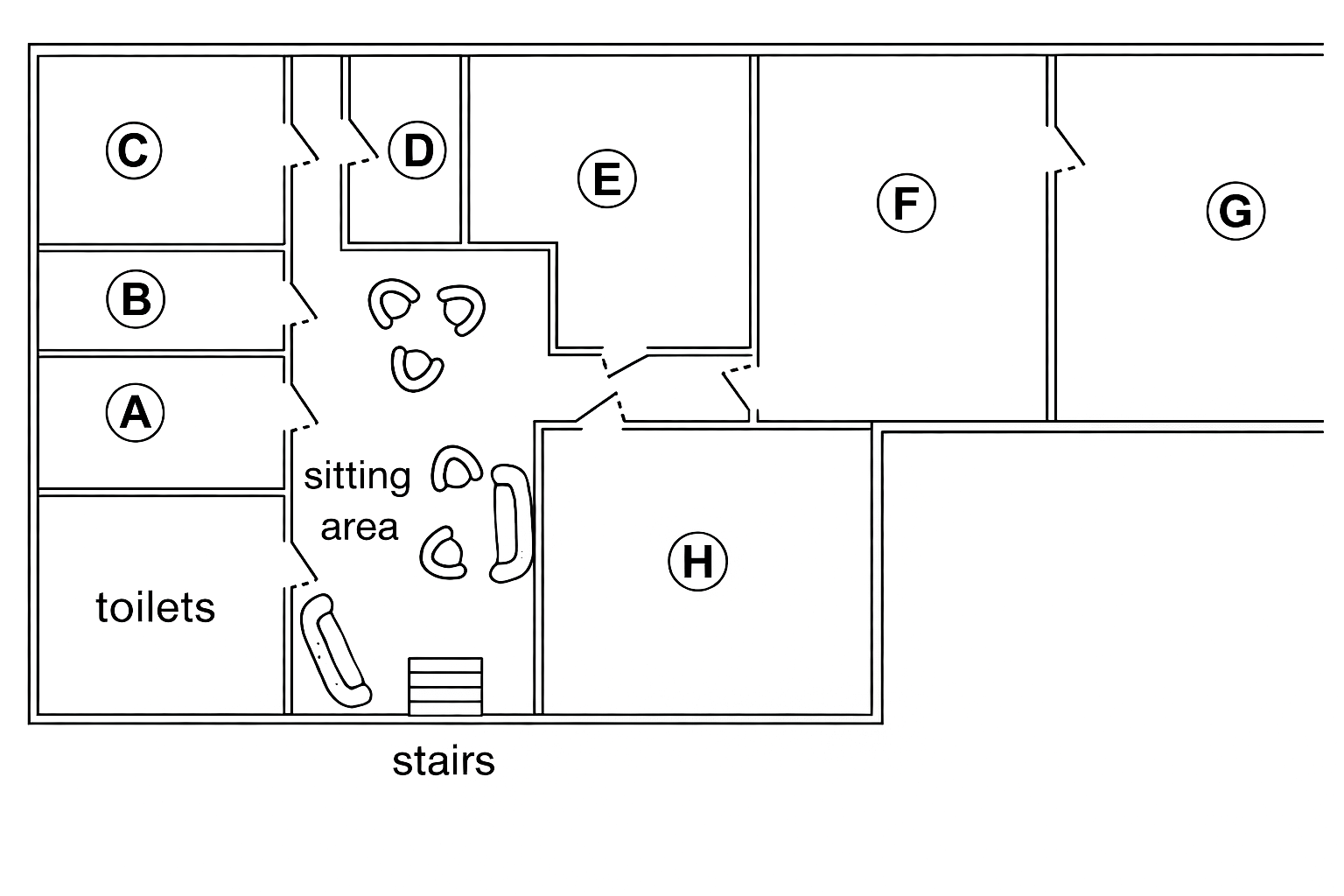
Section 3
Pacific Tapa Cloth
Choose the correct letter, A, B or C.
- 21
Pacific tapa cloth is different from other types of tapa cloth because it is
- A. the only tapa made today
- B. better quality than others
- C. put to a wider range of uses
- 22
What does Helen say about the paper mulberry tree?
- A. It is also a source of food
- B. It is not native to the Pacific
- C. It can grow in any environment
- 23
Why did the Maori people of New Zealand stop making tapa?
- A. They could not find the right trees in New Zealand
- B. They were introduced to other fabrics by the Europeans
- C. They found a better material for making fabric
- 24
Large pieces of tapa are made from smaller pieces which are
- A. stuck together
- B. woven together
- C. sewn together
Tapa Cloth Functions by Country
According to the speakers, what function has tapa cloth played in the following countries? Write the correct letter, A, B, C or D, next to questions 25 - 30.
- A. recreational
- B. practical
- C. spiritual
- D. commercial
- A. recreational
- B. practical
- C. spiritual
- D. commercial
- A. recreational
- B. practical
- C. spiritual
- D. commercial
- A. recreational
- B. practical
- C. spiritual
- D. commercial
- A. recreational
- B. practical
- C. spiritual
- D. commercial
- A. recreational
- B. practical
- C. spiritual
- D. commercial
Section 4: Plant Behavior
Complete the notes below. Write ONE WORD ONLY for each answer.
- 31
Scientists once thought of plants as being 31. _______ organisms
- 32
Great Lakes Sea rocket Found on 32. _______
- 33
When near other plants, it normally produces extra 33. _______ to compete for nutrients.
- 34
Sagebrush and Thom apple Recognize surrounding plants by the type of34. _______ that they reflect
- 35
Identification is possible because all plants have a particular 35. _______
- 36
Dodder plant Is unable to produce 36. _______
- 37
Affects farmers' crops e.g. alfalfa, 37. _______ and citrus
- 38
Identifies suitable 'hosts' by detecting the 38. _______ they give off
- 39
Moves in a 39. _______ most suitable host to check the environment, then grows towards the most suitable host
- 40
Use of modern 40. _______ provides evidence of plant behavior
Phiếu trả lời
Điền đáp án khi làm bài — kiểm tra kết quả ngay lập tức và lưu cục bộ, mọi câu sai sẽ vào nhật ký lỗi cùng bài học khắc phục.
- 1.
- 2.
- 3.
- 4.
- 5.
- 6.
- 7.
- 8.
- 9.
- 10.
- 11.
- 12.
- 13.
- 14.
- 15.
- 16.
- 17.
- 18.
- 19.
- 20.
- 21.
- 22.
- 23.
- 24.
- 25.
- 26.
- 27.
- 28.
- 29.
- 30.
- 31.
- 32.
- 33.
- 34.
- 35.
- 36.
- 37.
- 38.
- 39.
- 40.
Hiện transcript
Hiện đáp án
Đáp án
1. Ropes
The main technique taught for rock climbing is 'rope work', as the speaker says, 'the main technique I would learn would be rope work.'
2. equipment
The cost includes the equipment, as the speaker says, 'it does include the equipment.'
3. safety
Participants learn to do 'safety checks' on their bikes, as the speaker confirms, 'you learn to do safety checks on our bikes.'
4. guide
The £70 fee includes help from a 'guide', as the speaker says, 'includes all the help you need from our guide.'
5. forest
Wild camping takes place 'in the forest', as the woman says, 'It's in the forest, the website said.'
6. navigation
Hill walking includes learning 'navigation' skills, as the speaker says, 'we teach you some navigation skills.'
7. lunch
Lunch is included in the hill walking activity, as the speaker says, 'but lunch is included.'
8. 20 percent
The deposit for group booking is '20 percent' of the full amount, as the speaker says, 'for a group, then it'll be 20% of the total cost.'
9. shoes
You must bring suitable 'shoes', as the speaker says, 'The most important thing is to have the right shoes, so you'll need to bring those.'
10. Arkwright
The contact name is 'Arkwright', as the speaker spells out, 'My name's Gordon, Gordon Arkwright. That's A R K W R I G H T.'
11. E
The 20th- and 21st-century paintings 'include the most popular exhibits', as the speaker says, 'This is the gallery that attracts the largest number of visitors.' Option D is tempting but fails because it refers to the 19th-century paintings.
12. D
The 19th-century paintings 'include some items given by the artists', as the speaker says, 'several of the artists each donated one work to get the museum started.'
13. G
Some sculptures have 'had some of its contents relocated', as the speaker says, 'a number of the sculptures have been moved to other parts of the museum.'
14. B
The 'Around the World' exhibition 'was recently publicised in the media', as the speaker says, 'You've probably seen something about it on TV or in the newspapers.'
15. C
The coin collection 'includes some items given by members of the public', as the speaker says, 'many of them were discovered by ordinary people... and donated to the museum.'
16. A
The porcelain and glass collection 'was given by one person', as the speaker says, 'was left to the museum by its founder when he died in 1878.'
17. F
The restaurant is reached by going straight ahead, then right into the corridor, and it's facing you, matching option F.
18. H
The café is immediately on the right after turning into the corridor, matching option H.
19. C
The baby-changing facilities are along the corridor on the left, and on the left-hand side, matching option C.
20. B
The cloakroom is on the left side of the sitting area, through the last door before the corridor, matching option B.
21. C
Pacific tapa cloth is different because of 'the incredible variety of roles it's played in this region', so it is put to a wider range of uses.
22. B
Helen says the paper mulberry tree 'wasn't originally found in the islands, but was carried in their canoes by the first migrants', so it is not native to the Pacific.
23. C
The Maori stopped making tapa because they found flax, 'which is superior to tapa because it makes a stronger fabric', so they found a better material.
24. A
Large pieces of tapa are 'glued together using an adhesive paste', so they are stuck together.
25. C
In Samoa, siapo robes are worn at 'the most profound events in life such as births, funerals, weddings, and the investiture of chiefs', showing a spiritual use.
26. B
In Tonga, tapa is 'suitable for all sorts of everyday functions around the house', so it is practical.
27. C
In the Cook Islands, thick cloth was 'used to mark the entrances to places of worship', showing a spiritual use.
28. D
In Fiji, tapa was 'used as a currency', so it had a commercial use.
29. A
In Tahiti, people enjoy wearing bright robes 'especially for dancing and competitive games, and do it just for fun', so it is recreational.
30. B
In Tikopia, 'it's commonplace to see people wearing clothes made of tapa cloth', even when working, so it is practical.
31. passive
Scientists once thought of plants as 'essentially passive' organisms.
32. beaches
The Great Lakes Sea rocket is 'a wild plant which grows on beaches.'
33. roots
When near other plants, it 'quickly grows additional roots' to compete for nutrients.
34. light
Sagebrush and thorn apple recognize surrounding plants by 'sensing properties of the light that is reflected from them.'
35. signature
Each plant species has 'its own signature' in the way it reflects light.
36. sugar
The dodder plant 'doesn't have the ability to make sugar by converting nutrients from the soil.'
37. potatoes
Dodder is particularly damaging to 'alfalfa, as well as to potatoes and different varieties of citrus.'
38. chemicals
Dodder identifies suitable hosts by 'sensing the chemicals that other plants release into the soil and air.'
39. circle
Dodder rotates in a 'circle' to check the environment before growing towards the host.
40. equipment
Use of modern 'equipment' provides evidence of plant behavior, as the lecturer says, 'using up to date equipment.'