Reading 2026-02 Test 6

Exam month: 2026-02

Rebuilt from test-taker recalls — not official IELTS material. Audio and passages are recreations for practice.

Reading Passage 1 — The Tuatara of New Zealand

You should spend about 20 minutes on Questions 1-13, which are based on Reading Passage 1 below.

Tuatara are lizard-like reptiles found only in New Zealand. They are representatives of ancient life-forms: tuatara are the only living members of an ancient order of reptiles called Sphenodontia, which is over 250 million years old. Because tuatara so closely resemble fossils of reptiles that lived in the age of dinosaurs, they are often called "living fossils." Today only two species survive, both confined to New Zealand. One is the Brothers Island tuatara, which—until recent reintroductions to wildlife sanctuaries—survived only on North Brother Island. The other species is the common tuatara, which persists on many other offshore islands. Although the two species look similar, they show clear genetic differences. Tuatara bones have been found in many parts of New Zealand; where dated, they are usually a few hundred to 5,000 years old. It is not known whether these remains belong to the two extant species or to now-extinct relatives. Several anatomical features distinguish tuatara from all other living reptiles—for example, a distinctive pattern of openings in the skull, a unique form of haemoglobin, and (in males) the absence of an external reproductive organ. Adults range from 30 to 75 centimetres in length and weigh between 250 and 1,200 grams. Males are larger than females and have more prominent spines along the crest of the neck, back, and tail. A male tuatara courts a female by approaching her with a proud, stiff-legged walk. Mating occurs in late summer, and the female usually lays 6–10 eggs the following spring in a shallow ground-level nest. She may guard the nest for a few nights before returning to her underground burrow. The eggs incubate for about a year, so hatchlings emerge just as the next season's eggs are being laid. Evidence shows that hatchling sex is influenced by both genetics and temperature: warmer nests tend to produce males, while cooler nests produce females. The young receive no parental care and must find their own food. Tuatara are long-lived, reaching sexual maturity at about 15 years and breeding for many decades thereafter. Although their maximum lifespan is uncertain, many individuals remain vigorous at 80 years old. Tuatara live in underground burrows and are chiefly nocturnal, though they bask in sunlight by day. Both sexes are territorial; males defend their areas with threat displays and, if necessary, fights—powerful jaws and sharp teeth can inflict serious injuries. They are carnivorous, preying on invertebrates, lizards, and even the chicks of seabirds that share their burrows. Tuatara were once widespread and abundant on the New Zealand mainland, but Polynesian settlers (c. 1250–1300 AD) introduced Pacific rats that preyed on tuatara and their eggs. By the time Europeans arrived in the 1840s, tuatara were almost extinct on the mainland. Island refuges offered temporary sanctuary, yet many were later invaded by rats and other predators, leaving tuatara confined to 32 near-shore islands—some as small as one hectare. A few larger refuges, such as the Poor Knights Islands off the north-eastern coast and Stephens Island in Cook Strait, escaped rat invasion and retained tuatara populations. The common tuatara survives on islands off the north-east and in Cook Strait, while the Brothers Island tuatara persisted only on North Brother Island in Cook Strait. Conservationists have since established new populations on Titi Island in the Marlborough Sounds and on Somes Island in Wellington Harbour. Tuatara can occur at remarkably high densities. Most tuatara islands support 50–100 animals per hectare, so a 10-hectare island may hold several hundred individuals. The richest habitats—large islands with abundant seabirds and invertebrates—support still higher densities. The largest known population is on Stephens Island, where numbers reach up to 2,500 tuatara per hectare in some areas and total at least 30,000 individuals. Overall, the combined tuatara population is estimated at 50,000–100,000. Legal protection for tuatara and their islands was enacted in 1895, yet the reptiles continued to decline. Active conservation management since the mid-1980s—including the development of techniques to eradicate rats from islands—has reversed that trend, allowing new populations to become established on predator-free islands. Rats have now been eliminated from almost all tuatara islands, making them safe havens for many threatened native species. Conservationists also collect eggs for incubation, breed tuatara in captivity, and translocate juveniles to rat-free islands. These measures have raised the number of islands inhabited by tuatara to 37, and further releases are planned for additional predator-free islands and mainland reserves.

    Questions 1–6: True/False/Not Given

    Do the following statements agree with the information given in Reading Passage 1? In boxes 1-6 on your answer sheet, write TRUE if the statement agrees with the information, FALSE if the statement contradicts the information, NOT GIVEN if there is no information on this.

    1. 1

      The two living species of tuatara look alike.

    2. 2

      Many tuatara bones that have been discovered are millions of years old.

    3. 3

      The tails of male tuatara are a different colour from those of female tuatara.

    4. 4

      The female tuatara lays her eggs in a burrow.

    5. 5

      There are more female hatchlings than male hatchlings.

    6. 6

      Once they have hatched, young tuatara have to look after themselves.

    Questions 7–13: Note Completion

    Complete the notes below. Choose ONE WORD ONLY from the passage for each answer. Write your answers in boxes 7–13 on your answer sheet.

    Lifespan maximum lifespan unknown many live to at least 7 _______ years Behaviour eat young 9 _______ that share the same burrows, as well as invertebrates and abundant until rats were introduced by 10 _______ people by the 1840s, hardly any tuatara were found on the 11 _______ islands off the north-eastern coast and in Cook Strait are now home to the Brothers Island tuatara found only on North Brother Island density of tuatara on Stephens Island is up to 13 _______ per hectare
    1. 7

      many live to at least 7 _______ years

    2. 8

      eat young 9 _______ that share the same burrows, as well as invertebrates and

    3. 9

      eat young 9 _______ that share the same burrows, as well as invertebrates and

    4. 10

      abundant until rats were introduced by 10 _______ people

    5. 11

      by the 1840s, hardly any tuatara were found on the 11 _______

    6. 12

      density of tuatara on Stephens Island is up to 13 _______ per hectare

    Reading Passage 2 — Stadium Australia

    You should spend about 20 minutes on Questions 14-26, which are based on Reading Passage 2 below.

    A. You might ask, why be concerned about the architecture of a stadium? Surely, as long as the action is entertaining and the building is safe and reasonably comfortable, why should the aesthetics matter? This one question has dominated my professional life, and its answer is one I find myself continually rehearsing. If one accepts that sporting endeavour is as important an outlet for human expression as, say, the theatre or cinema, fine art or music, why shouldn’t the buildings in which we celebrate this outlet be as grand and as inspirational as those we would expect, and demand, in those other areas of cultural life? Indeed, one could argue that because stadiums are, in many instances, far more popular than theatres or art galleries, we should actually devote more, and not less, attention to their form. Stadiums have frequently been referred to as ‘cathedrals’. Football has often been dubbed ‘the opera of the people’. What better way, therefore, to raise the general public’s awareness and appreciation of quality design than to offer them the very best buildings in the one area of life that seems to touch the most? Could it even be that better stadiums might just make for better citizens? B. But then maybe, as my detractors have labelled me in the past, I am a snob. Maybe I should just accept that sport, and its associated accoutrements and products, is an essentially tacky and ephemeral business, while stadium design is all too often driven by pragmatists and penny-pinchers. Certainly, when I first started writing about stadium architecture, one of the first and most uncomfortable truths that I had to confront was that some of the most popular stadiums in the world were also amongst the least attractive or innovative in architectural terms. ‘Worthy and predictable’ has usually won more votes than ‘daring and different’. Old Trafford football ground in Manchester, the Yankee Stadium in New York, Ellis Park in Johannesburg. The list is long and is not intended to suggest that these are necessarily poor buildings. Rather, that each has derived its reputation more from the events that it has staged, from its associations, than from the actual form it takes. Equally, those stadiums whose forms have been revered – such as the Maracana in Rio, or the San Siro in Milan – have turned out to be rather poorly designed in several respects. Once one analyses them not as icons but as functioning ‘public assembly facilities’ (to use the current jargon). Finding the balance between beauty and practicality has never been easy. C. Homebush Bay was the site of the main Olympic Games complex for the Sydney Olympics of 2000. To put it politely, I am no great admirer of the Olympics as an event, or, rather, of the insane pressures its past bidding procedures have placed upon candidate cities. Nor, as a spectator, do I much enjoy the bloated Games programme and the consequent demands this places upon the designers of stadiums. Yet in my calmer moments, it would be churlish to deny that, if approached sensibly and imaginatively, the opportunity to stage the Games can yield enormous benefits in the long term (as well they should, considering the expenditure involved), if not for sport then at least for the cause of urban regeneration. Following in Barcelona’s footsteps, Sydney undoubtedly set about its urban regeneration in a wholly impressive way. To an outsider, the 760-hectare site at Homebush Bay, once the home of an abattoir, a racecourse, a brickwork, and light industrial units, seemed miles from anywhere. It was actually fifteen kilometres from the centre of Sydney and pretty much in the heart of the city’s extensive conurbation. Some £1.3 billion worth of construction and reclamation had been commissioned, all of it, crucially, with an eye to post-Olympic usage. Strict guidelines, studiously monitored by Greenpeace, ensured that the 2000 games would be the most environmentally friendly ever. What’s more, much of the work was good-looking, distinctive and lively. ‘That’s a reflection of the Australian spirit,’ I had told. D. At the centre of Homebush lay the main venue for the Olympics, Stadium Australia. It had been funded by means of a BOOT (Build, Own, Operate and Transfer) contract, which meant that the Stadium Australia consortium, led by the contractors Multiplex and the financiers Hambros, bore the bulk of the construction costs. In return for which it was allowed to operate the facility for thirty years, and thus, it hopes, recoups its outlay, before handing the whole building over to the New South Wales government in the year 2030. E. Stadium Australia was the most environmentally friendly Olympic stadium ever built. Every single product and material used had to meet strict guidelines, even if it turned out to be more expensive. All the timber had either been recycled or derived from renewable sources. In order to reduce energy costs, the design allowed for natural lighting in as many public areas as possible, supplemented by solar-powered units. Rainwater collected from the roof ran off into storage tanks, where it could be tapped for pitch irrigation. The stormwater run-off was collected for toilet flushing. Wherever possible, passive ventilation was used instead of mechanical air-conditioning. Even the steel and concrete from the two end stands due to be demolished at the end of the Olympics was to be recycled. Furthermore, no private cars were allowed on the Homebush site. Instead, every spectator was to arrive by public transport, and quite right too. If ever there was a stadium to persuade a sceptic like me that the Olympic Games do, after all, have a useful function in at least setting design and planning trends, this was the one. I was, and still am, I freely confess, quite knocked out by Stadium Australia.

      Questions 14–18: Matching Headings

      Choose the correct heading for each paragraph from the list of headings below. Write the correct number i—x in boxes 14—18 on your answer sheet. List of Headings i. A Strange Combination ii. An Overall Requirement iii. A Controversial Decision iv. A Strong Contrast v. A Special Set-up vi. A Promising Beginning vii. A Shift in Attitudes viii. A Strongly Held Belief ix. A Change of Plan x. A Simple Choice

      1. 14

        Paragraph A

        • i. A Strange Combination
        • ii. An Overall Requirement
        • iii. A Controversial Decision
        • iv. A Strong Contrast
        • v. A Special Set-up
        • vi. A Promising Beginning
        • vii. A Shift in Attitudes
        • viii. A Strongly Held Belief
        • ix. A Change of Plan
        • x. A Simple Choice
      2. 15

        Paragraph B

        • i. A Strange Combination
        • ii. An Overall Requirement
        • iii. A Controversial Decision
        • iv. A Strong Contrast
        • v. A Special Set-up
        • vi. A Promising Beginning
        • vii. A Shift in Attitudes
        • viii. A Strongly Held Belief
        • ix. A Change of Plan
        • x. A Simple Choice
      3. 16

        Paragraph C

        • i. A Strange Combination
        • ii. An Overall Requirement
        • iii. A Controversial Decision
        • iv. A Strong Contrast
        • v. A Special Set-up
        • vi. A Promising Beginning
        • vii. A Shift in Attitudes
        • viii. A Strongly Held Belief
        • ix. A Change of Plan
        • x. A Simple Choice
      4. 17

        Paragraph D

        • i. A Strange Combination
        • ii. An Overall Requirement
        • iii. A Controversial Decision
        • iv. A Strong Contrast
        • v. A Special Set-up
        • vi. A Promising Beginning
        • vii. A Shift in Attitudes
        • viii. A Strongly Held Belief
        • ix. A Change of Plan
        • x. A Simple Choice
      5. 18

        Paragraph E

        • i. A Strange Combination
        • ii. An Overall Requirement
        • iii. A Controversial Decision
        • iv. A Strong Contrast
        • v. A Special Set-up
        • vi. A Promising Beginning
        • vii. A Shift in Attitudes
        • viii. A Strongly Held Belief
        • ix. A Change of Plan
        • x. A Simple Choice

      Questions 19–22: True/False/Not Given

      Do the following statements agree with the information given in Reading Passage 2? In boxes 19-22 on your answer sheet write TRUE if the statement agrees with the information, FALSE if the statement contradicts the information, NOT GIVEN if there is no information on this.

      1. 19

        The public has been demanding a better quality of stadium design.

      2. 20

        It is possible that stadium design has an effect on people’s behaviour in life in general.

      3. 21

        Some stadiums have come in for a lot more criticism than others.

      4. 22

        Designers of previous Olympic stadiums could easily have produced far better designs.

      Questions 23–26: Summary Completion

      Choose NO MORE THAN THREE WORDS from the reading passage for each answer.
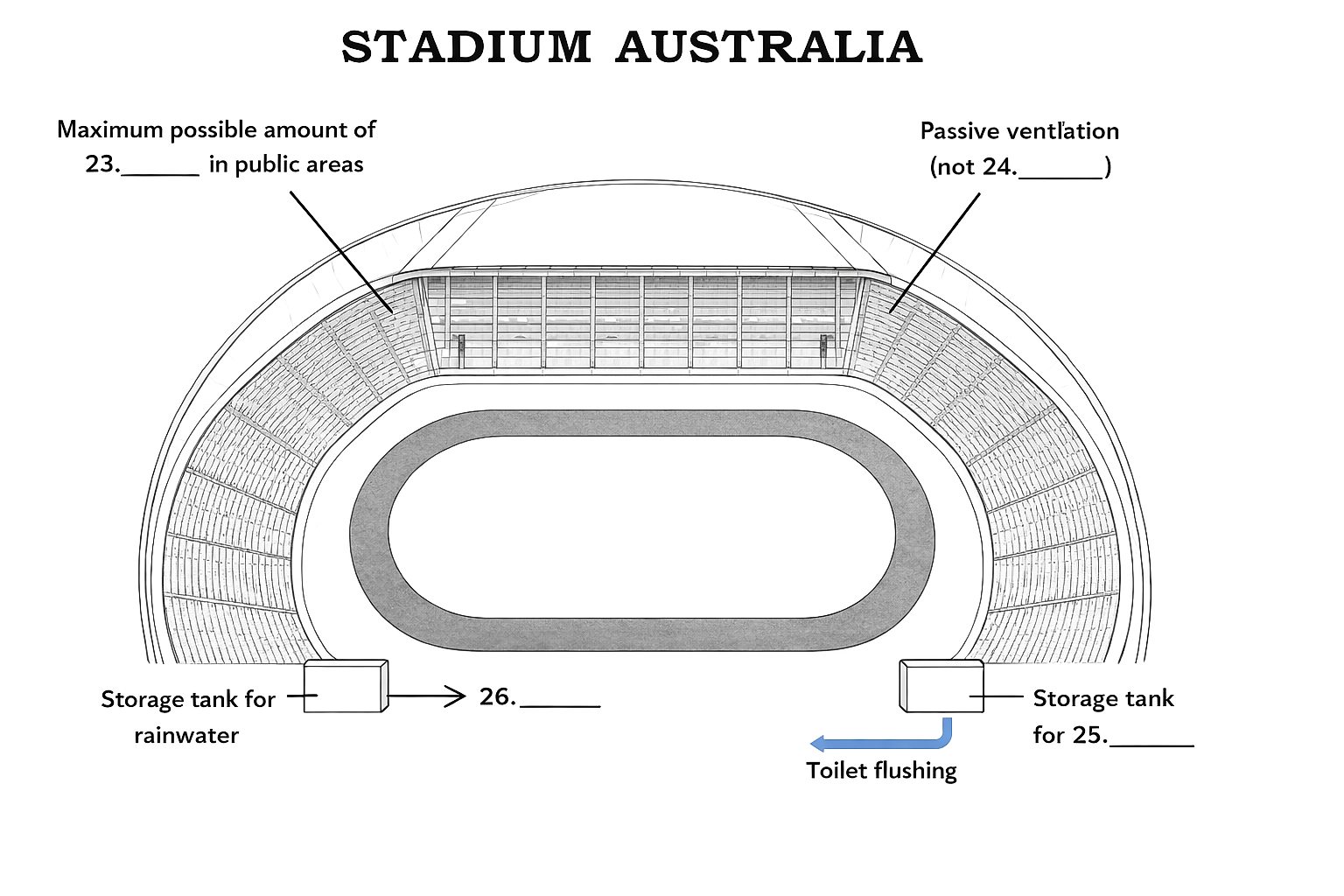
      Every single product and material used had to meet strict guidelines, even if it turned out to be more expensive. All the timber had either been recycled or derived from renewable sources. In order to reduce energy costs, the design allowed for 23 _______ in as many public areas as possible, supplemented by solar-powered units. Rainwater collected from the roof ran off into storage tanks, where it could be tapped for 26 _______. The stormwater run-off was collected for 25 _______. Wherever possible, passive ventilation was used instead of 24 _______.
      Recreated diagram for questions 23, 24, 25, 26
      1. 23

        the design allowed for 23 _______ in as many public areas as possible

      2. 24

        passive ventilation was used instead of 24 _______

      3. 25

        The stormwater run-off was collected for 25 _______

      4. 26

        Rainwater collected from the roof ran off into storage tanks, where it could be tapped for 26 _______

      Reading Passage 3 — Tattoo on Tikopia

      You should spend about 20 minutes on Questions 27-40, which are based on Reading Passage 3 below.

      A. There are still debates about the origins of Polynesian culture, but one thing we can ensure is that Polynesia is not a single tribe but a complex one. Polynesians which include Marquesans, Samoans, Niueans, Tongans, Cook Islanders, Hawaiians, Tahitians, and Maori, are genetically linked to indigenous peoples of parts of Southeast Asia. It’s a sub-region of Oceania, comprising of a large grouping of over 1,000 islands scattered over the central and southern Pacific Ocean, within a triangle that has New Zealand, Hawaii and Easter Island as its corners. B. Polynesian history has fascinated the western world since Pacific cultures were first contacted by European explorers in the late 18th century. The small island of Tikopia, for many people – even for many Solomon Islanders – is so far away that it seems like a mythical land; a place like Narnia, that magical land in C. S. Lewis’ classic, ‘The Chronicles of Narnia.’ Maybe because of it – Tikopia, its people, and their cultures have long fascinated scholars, travelers, and casual observers. Like the pioneers Peter Dillion, Dumont D’Urville and John Coleridge Patterson who visit and write about the island in the 1800s, Raymond Firth is one of those people captured by the alluring attraction of Tikopia. As a result, he had made a number of trips to the island since the 1920s and recorded his experiences, observations, and reflections on Tikopia, its people, cultures and the changes that have occurred. C. While engaged in the study of the kinship and religious life of the people of Tikopia, Firth made a few observations on their tattooing. Brief though these notes are they may be worth putting on record as an indication of the sociological setting of the practice in this primitive Polynesian community. The origin of the English word ‘tattoo’ actually comes from the Tikopia word ‘tatau’. The word for tattoo marks, in general, is tau, and the operation of tattooing is known as ta tau, ta being the generic term for the act of striking. D. The technique of tattooing was similar throughout Polynesia. Traditional tattoo artists create their indelible tattoos using pigment made from the candlenut or kukui nut. First, they burn the nut inside a bowl made of half a coconut shell. They then scrape out the soot and use a pestle to mix it with liquid. Bluing is sometimes added to counteract the reddish hue of the carbon-based pigment. It also makes the outline of the inscribed designs bolder on the dark skin of tattooing subjects. E. For the instruments used when tattooing, specialists used a range of chisels made from albatross wing bone which were hafted onto a handle which was made from the heart wood of the bush and struck with a mallet. The tattooer began by sketching with charcoal a design on the supine subject, whose skin at that location was stretched taut by one or more apprentices. The tattooer then dipped the appropriate points – either a single one or a whole comb – into the ink (usually contained in a coconut-shell cup) and tapped it into the subject’s skin, holding the blade handle in one hand and tapping it with the other. The blood that usually trickled from the punctures was wiped away either by the tattooer or his apprentice, the latter having also inevitably painful – a test of fortitude that tattooers sought to shorten by working as fast as possible. In fact, tattoos nearly always festered and often led to sickness – and in some cases death. F. In ancient Polynesian society, nearly everyone was tattooed. It was an integral part of ancient culture and was much more than a body ornament. Tattooing indicated ones’ genealogy and/or rank in society. It was a sign of wealth, of strength and of the ability to endure pain. Those who went without them were seen as persons of lower social status. As such, chiefs and warriors generally had the most elaborate tattoos. Tattooing was generally begun at adolescence, and would often not be completed for a number of years. Receiving tattoos constituted an important milestone between childhood and adulthood, and was accompanied by many rites and rituals. Apart from signaling status and rank, another reason for the practice in traditional times was to make a person more attractive to the opposite sex. G. The male facial tattoo is generally divided into eight sections of the face. The center of the forehead designated a person’s general rank. The area around the brows designated his position. The area around the eyes and the nose designated his hapu, or sub-tribe rank. The area around the temples served to details his signature. This signature was once memorized by tribal chiefs who used it when buying property, signing deeds, and officiating orders. The cheek area designated the nature of the person’s work. The chin area showed the person’s mana. Lastly, the jaw area designated a person’s birth status. H. A person’s ancestry is indicated on each side of the face. The left side is generally the father’s side, and the right side was the mother’s. The manutahi design is worked on the men’s back. It consists of two vertical lines drawn down the spine, with short vertical lines between them. When a man had the manutahi on his back, he took pride in himself. At gatherings of the people he could stand forth in their midst and display his tattoo designs with songs. And rows of triangles design on the men’s chest indicate his bravery. I. Tattoo was a way delivering information of its owner. It’s also a traditional method to fetch spiritual power, protection and strength. The Polynesians use this as a sign of character, position and levels in a hierarchy. Polynesian peoples believe that a person’s mana, their spiritual power or life force, is displayed through their tattoo.

        Questions 27–30: Yes/No/Not Given

        Do the following statements agree with the information given in Reading Passage 3? YES if the statement is true, NO if the statement is false, NOT GIVEN if the information is not given in the passage.

        1. 27

          Scientists like to do research in Tikopia because this tiny place is of great remoteness.

        2. 28

          Firth was the first scholar to study on Tikopia.

        3. 29

          Firth studied the culture differences on Tikopia as well as on some other islands of Pacific.

        4. 30

          The English word ‘tattoo’ is evolved from the local language of the island.

        Questions 31–35: Short Answer

        Choose NO MORE THAN TWO WORDS from Reading Passage for each answer.
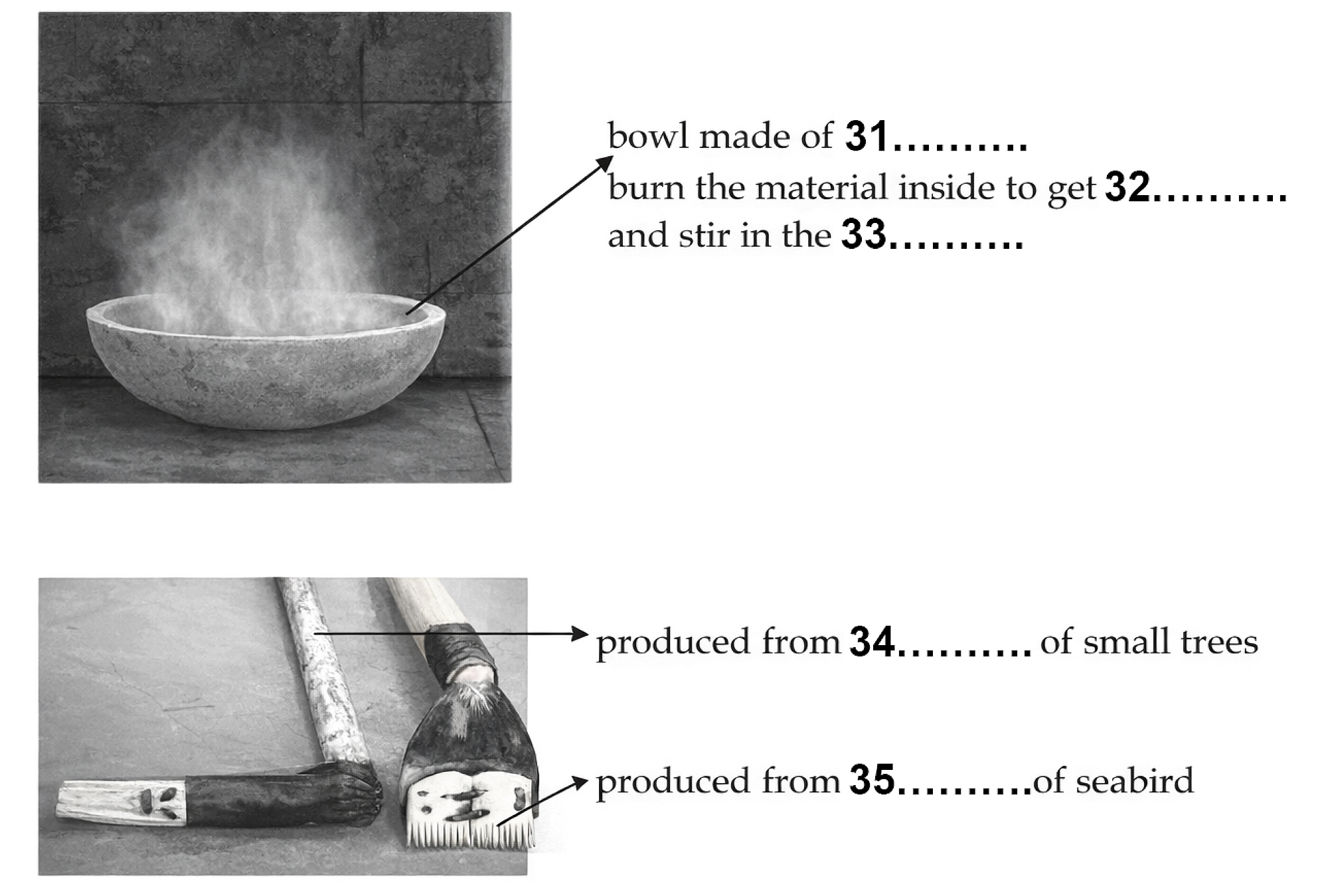
        Recreated diagram for questions 31, 32, 33, 34, 35
        1. 31

          First, they burn the nut inside a bowl made of half a _______

        2. 32

          They then scrape out the _______ and use a pestle to mix it with liquid.

        3. 33

          Bluing is sometimes added to counteract the reddish hue of the carbon-based pigment. It also makes the outline of the inscribed designs bolder on the dark skin of tattooing subjects. The pigment is mixed with _______.

        4. 34

          Specialists used a range of chisels made from albatross wing bone which were hafted onto a handle which was made from the _______ of the bush.

        5. 35

          Specialists used a range of chisels made from _______ which were hafted onto a handle.

        Questions 36–40: Table Completion

        Choose NO MORE THAN TWO WORDS from the passage for each answer.

        Location On The Body | Significance | Geometric Patterns 36 _______ of male face | general rank | general rank 37 _______ of male face | prestige | prestige Female’s right side of the face | 38 _______ male back | general rank | 39 _______ male chest | bravery | 40 _______
        1. 36

          _______ of male face | general rank | general rank

        2. 37

          _______ of male face | prestige | prestige

        3. 38

          Female’s right side of the face | _______

        4. 39

          male back | general rank | _______

        5. 40

          male chest | bravery | _______

        Show answer key

        Answer key

        1. 1. TRUE

          The answer is TRUE because the passage says, 'Although the two species look similar, they show clear genetic differences,' showing they look alike but are genetically different.

        2. 2. FALSE

          The answer is FALSE because the passage says tuatara bones found are 'usually a few hundred to 5,000 years old,' not millions of years old.

        3. 3. NOT GIVEN

          The answer is NOT GIVEN because the passage does not mention anything about the colour of male and female tuatara tails.

        4. 4. FALSE

          The answer is FALSE because the passage says the female 'lays 6-10 eggs the following spring in a shallow ground-level nest,' not in a burrow.

        5. 5. NOT GIVEN

          The answer is NOT GIVEN because the passage only says warmer nests tend to produce males and cooler nests produce females, but does not say which is more common overall.

        6. 6. TRUE

          The answer is TRUE because the passage says, 'The young receive no parental care and must find their own food.'

        7. 7. 80

          The answer is 80 because the passage says, 'many individuals remain vigorous at 80 years old.'

        8. 8. teeth

          The answer is teeth because the passage says, 'powerful jaws and sharp teeth can inflict serious injuries.'

        9. 9. seabirds

          The answer is seabirds because the passage says tuatara prey on 'the chicks of seabirds that share their burrows.'

        10. 10. Plolynesian

          The answer is Polynesian because the passage says, 'Polynesian settlers... introduced Pacific rats that preyed on tuatara and their eggs.'

        11. 11. mainland

          The answer is mainland because the passage says, 'By the time Europeans arrived in the 1840s, tuatara were almost extinct on the mainland.'

        12. 12. 2,500

          The answer is 2,500 because the passage says, 'the largest known population is on Stephens Island, where numbers reach up to 2,500 tuatara per hectare.'

        13. 14. VIII

          The answer is VIII (A Strongly Held Belief) because the paragraph discusses the writer's belief that stadiums should be as grand as other cultural buildings.

        14. 15. IV

          The answer is IV (A Strong Contrast) because the paragraph contrasts popular but unattractive stadiums with beautiful but impractical ones.

        15. 16. VI

          The answer is VI (A Promising Beginning) because the paragraph describes the impressive start of Sydney's urban regeneration for the Olympics.

        16. 17. V

          The answer is V (A Special Set-up) because the paragraph explains the unique BOOT contract used to fund Stadium Australia.

        17. 18. II

          The answer is II (An Overall Requirement) because the paragraph describes the strict environmental guidelines for all materials and design choices.

        18. 19. NOT GIVEN

          The answer is NOT GIVEN because the passage does not mention whether the public has demanded better stadium design.

        19. 20. TRUE

          The answer is TRUE because the passage asks, 'Could it even be that better stadiums might just make for better citizens?' suggesting stadium design could affect people's behaviour.

        20. 21. NOT GIVEN

          The answer is NOT GIVEN because the passage does not compare the amount of criticism different stadiums have received.

        21. 22. FALSE

          The answer is FALSE because the passage says Olympic stadium design is difficult due to 'insane pressures' and 'demands,' not that designers could have easily done better.

        22. 23. natural lighting

          The answer is natural lighting because the passage says, 'the design allowed for natural lighting in as many public areas as possible.'

        23. 24. mechanical air-conditioning

          The answer is mechanical air-conditioning because the passage says, 'passive ventilation was used instead of mechanical air-conditioning.'

        24. 25. storm water

          The answer is toilet flushing because the passage says, 'The stormwater run-off was collected for toilet flushing.'

        25. 26. pitch irrigation

          The answer is pitch irrigation because the passage says, 'Rainwater collected from the roof ran off into storage tanks, where it could be tapped for pitch irrigation.'

        26. 27. YES

          The answer is YES because the passage says Tikopia 'is so far away that it seems like a mythical land,' which fascinates scholars.

        27. 28. NO

          The answer is NO because the passage mentions earlier visitors and writers before Firth, such as Peter Dillion and others.

        28. 29. NOT GIVEN

          The answer is NOT GIVEN because the passage only says Firth studied Tikopia, not other Pacific islands.

        29. 30. YES

          The answer is YES because the passage says, 'The origin of the English word 'tattoo' actually comes from the Tikopia word 'tatau'.'

        30. 31. coconut shell

          The answer is coconut shell because the passage says, 'they burn the nut inside a bowl made of half a coconut shell.'

        31. 32. soot

          The answer is soot because the passage says, 'They then scrape out the soot and use a pestle to mix it with liquid.'

        32. 33. liquid

          The answer is liquid because the passage says, 'use a pestle to mix it with liquid.'

        33. 34. heart wood

          The answer is heart wood because the passage says, 'a handle which was made from the heart wood of the bush.'

        34. 35. wing bone

          The answer is wing bone because the passage says, 'a range of chisels made from albatross wing bone.'

        35. 36. (the) forehead

          The answer is (the) forehead because the passage says, 'The center of the forehead designated a person's general rank.'

        36. 37. chin (area)

          The answer is chin (area) because the passage says, 'The chin area showed the person's mana.'

        37. 38. mother'sancestry

          The answer is mother's ancestry because the passage says, 'the right side was the mother's.'

        38. 39. vertical lines

          The answer is vertical lines because the passage says, 'It consists of two vertical lines drawn down the spine.'

        39. 40. triangles

          The answer is triangles because the passage says, 'rows of triangles design on the men's chest indicate his bravery.'