基于考生回忆投稿及材料收集整理 — 非官方 IELTS 资料。
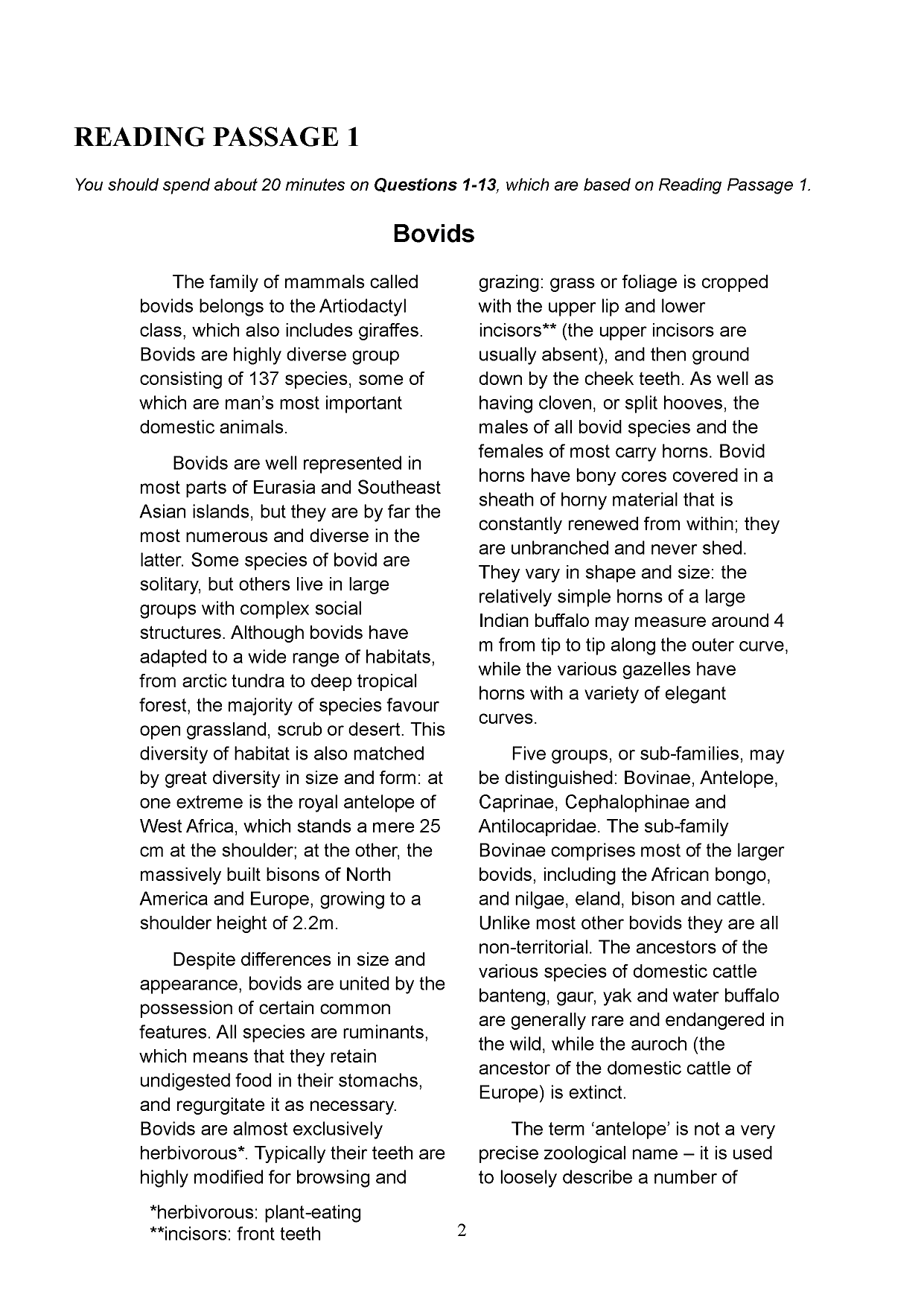
Reading Passage 1: Bovids
Choose the correct letter, A, B, C or D. Write the correct letter in boxes 1-3 on your answer sheet. Look at the following characteristics (Question 4-8) and the list of sub-families below. Match each characteristic with the correct sub-family, A, B, C or D. Write the correct letter, A, B, C or D, in boxes 4-8 on your answer sheet. NB You may use any letter more than once. Answer the questions below. Choose NO MORE THAN THREE WORDS from the passage for each answer. Write your answers in boxes 9-13 on your answer sheet.
- 1
In which region is the biggest range of bovids to be found?
- A. Africa
- B. Eurasia
- C. North America
- D. South-east Asia
- 2
Most bovids have a preference for living in
- A. isolation
- B. small groups
- C. tropical forest
- D. wide open spaces
- 3
Which of the following features do all bovids have in common?
- A. Their horns are short
- B. They have upper incisors
- C. They store food in the body
- D. Their hooves are undivided
- 4
can endure very harsh environments
- A. Antelope
- B. Bovinae
- C. Caprinae
- D. Cephalophinae
- 5
includes the ox and the cow
- 6
may supplement its diet with meat
- 7
can usually move at speed
- 8
does not defend a particular area of land
- 9
What is the smallest species of Bovid called?
- 10
Which species of Bovinae has now died out?
- 11
What facilitates the movement of the sitatunga over wetland?
- 12
What sort of terrain do barbary sheep live in?
- 13
What is the only living member of the Antilocapridae sub-family?
Reading Passage 2: Photovoltaics on the rooftop: A natural choice for powering the family home
Reading Passage 2 has nine paragraphs A–I. Which paragraph contains the following information? Write the correct letter A–I in boxes 14–19 on your answer sheet. NB You may use any letter more than once. Do the following statements agree with the information given in Reading Passage 2? In boxes 20–26 on your answer sheet, write TRUE if the statement agrees with the information, FALSE if the statement contradicts the information, NOT GIVEN if there is no information on this.
- 14
examples of countries where electricity use is greater during the day than at night
- 15
a detailed description of an experiment that led to photovoltaics being promoted throughout the country
- 16
the negative effects of using conventional means of generating electricity
- 17
an explanation of the photovoltaics system
- 18
the long-term benefits of using photovoltaics
- 19
a reference to wealthy countries being prepared to help less wealthy countries have access to photovoltaics
- 20
Photovoltaics are used to store electricity.
- TRUE. if the statement agrees with the information
- FALSE. if the statement contradicts the information
- NOT GIVEN. if there is no information on this
- 21
Since the 1970s, the US government has provided continuous support for the use of photovoltaics on homes.
- 22
The solar-powered houses on Rokko Island are uninhabited.
- 23
In 1994, the Japanese government was providing half the money required for installing photovoltaics on homes.
- 24
Germany, Italy, the Netherlands and Australia all have strict goals with regard to greenhouse gas emissions.
- 25
Residential electricity use is the major source of greenhouse gas emission.
- 26
Energy-saving measures must now be included in the design of all new homes and improvements to buildings.
Reading Passage 3: How should reading be taught?
Reading Passage 3 has six sections, A–F. Choose the correct heading for sections B–F from the list of headings below. Write the correct number, i–ix, in boxes 27–31 on your answer sheet. Do the following statements agree with the information given in Reading Passage 3? In boxes 32–36 on your answer sheet, write TRUE if the statement agrees with the information, FALSE if the statement contradicts the information, NOT GIVEN if there is no information on this. Complete the summary of sections E and F using the list of words, A–G, below. Write the correct letter, A–G, in boxes 37–40 on your answer sheet.
- 27
Section B
- i. Disagreement about the reading process
- ii. The roots of the debate
- iii. A combined approach
- iv. Methods of teaching reading
- v. A controversial approach
- vi. Inconclusive research
- vii. Research with learners
- viii. Allowing teachers more control
- ix. A debate amongst educators
- 28
Section C
- 29
Section D
- 30
Section E
- 31
Section F
- 32
The whole-language approach relates letters to sounds.
- TRUE. if the statement agrees with the information
- FALSE. if the statement contradicts the information
- NOT GIVEN. if there is no information on this
- 33
Many educators believe the whole-language approach to be the most interesting way to teach children to read.
- 34
Research supports the theory that we read without linking words to sounds.
- 35
Research has shown that the whole-word approach is less effective than the whole-language approach.
- 36
Research has shown that phonics is more successful than both the whole-word and whole-language approaches.
- 37
In the teaching community, 37 ……………… question the usefulness of research into methods of teaching reading. These critics believe that 38 ……………… is incompatible with student-centred learning. In the future, teachers need to be aware of 39 ……………… so that they understand the importance of phonics. They should not, however, ignore the ideas of 40 ……………… which make reading enjoyable for learners.
- A. the phonics method
- B. the whole-word method
- C. the whole-language method
- D. traditionalists
- E. progressives
- F. linguistics
- G. research studies
- 38
These critics believe that 38 ………………… is incompatible with student-centred learning.
- 39
In the future, teachers need to be aware of 39 ………………… so that they understand the importance of phonics.
- 40
They should not, however, ignore the ideas of 40 ………………… which make reading enjoyable for learners.
答题卡
边做边填 — 即时本地判分,所有错题自动记录到错题本,并附带对应讲解。
- 1.
- 2.
- 3.
- 4.
- 5.
- 6.
- 7.
- 8.
- 9.
- 10.
- 11.
- 12.
- 13.
- 14.
- 15.
- 16.
- 17.
- 18.
- 19.
- 20.
- 21.
- 22.
- 23.
- 24.
- 25.
- 26.
- 27.
- 28.
- 29.
- 30.
- 31.
- 32.
- 33.
- 34.
- 35.
- 36.
- 37.
- 38.
- 39.
- 40.
显示答案
答案
1. D
The answer is D (South-east Asia) because the passage says the biggest range of bovids is found in South-east Asia. Africa is tempting, but the passage says Africa has many, not the biggest range.
2. D
The answer is D (wide open spaces) because the passage says most bovids prefer to live in open grasslands or plains, not in isolation, small groups, or tropical forests.
3. C
The answer is C (They store food in the body) because the passage explains all bovids are ruminants, which means they store food in their stomachs to digest it later. The other options are not true for all bovids.
4. C
The answer is C (Caprinae) because the passage states that members of the Caprinae subfamily, like goats and sheep, can survive in very harsh environments.
5. B
The answer is B (Bovinae) because the passage says ox and cow are examples of the Bovinae subfamily.
6. D
The answer is D (Cephalophinae) because the passage mentions that some Cephalophinae, like duikers, may eat meat as well as plants.
7. A
The answer is A (Antelope) because the passage says antelopes are usually fast-moving animals. The other groups are not described as being fast.
8. B
The answer is B (Bovinae) because the passage says Bovinae do not defend a particular territory, while other groups may do so.
9. royal antelope
The answer is 'royal antelope' because the passage states that the royal antelope is the smallest species of bovid.
10. the auroch
The answer is 'the auroch' because the passage says the auroch, a member of Bovinae, has now died out.
11. long, splayed hooves
The answer is 'long, splayed hooves' because the passage explains that the sitatunga's long, splayed hooves help it move over wetlands.
12. arid deserts
The answer is 'arid deserts' because the passage says barbary sheep live in dry, desert areas.
13. pronghorn
The answer is 'pronghorn' because the passage says the pronghorn is the only living member of the Antilocapridae sub-family.
14. B
The answer is B because the passage gives examples of countries where electricity use is higher during the day than at night.
15. D
The answer is D because the passage describes an experiment in detail that led to the promotion of photovoltaics across the country.
16. H
The answer is H because the passage discusses the negative effects, like pollution, of using traditional ways to generate electricity.
17. B
The answer is B because the passage explains how the photovoltaics system works.
18. I
The answer is I because the passage talks about the long-term benefits of using photovoltaics, such as saving money and reducing pollution.
19. G
The answer is G because the passage mentions that rich countries are willing to help poorer countries get access to photovoltaics.
20. FALSE
The answer is FALSE because the passage says photovoltaics generate electricity, but does not say they are used to store it.
21. FALSE
The answer is FALSE because the passage says US government support for photovoltaics has not been continuous since the 1970s.
22. TRUE
The answer is TRUE because the passage states that the solar-powered houses on Rokko Island are not lived in.
23. TRUE
The answer is TRUE because the passage says in 1994, the Japanese government paid half the cost of installing photovoltaics on homes.
24. NOT GIVEN
The answer is NOT GIVEN because the passage does not say if all these countries have strict goals about greenhouse gas emissions.
25. NOT GIVEN
The answer is NOT GIVEN because the passage does not say residential electricity use is the main source of greenhouse gas emissions.
26. FALSE
The answer is FALSE because the passage does not say energy-saving measures must be included in all new homes and building improvements.
27. iv
The answer is iv (Methods of teaching reading) because Section B describes different ways to teach reading.
28. i
The answer is i (Disagreement about the reading process) because Section C discusses how people disagree about how reading works.
29. vii
The answer is vii (Research with learners) because Section D talks about studies and research done with students.
30. ii
The answer is ii (The roots of the debate) because Section E explains where the debate about reading methods started.
31. iii
The answer is iii (A combined approach) because Section F discusses using a mix of different teaching methods.
32. FALSE
The answer is FALSE because the whole-language approach does not focus on linking letters to sounds.
33. TRUE
The answer is TRUE because the passage says many educators think the whole-language approach is the most interesting for children.
34. FALSE
The answer is FALSE because research does not support the idea that we read without connecting words to sounds.
35. NOT GIVEN
The answer is NOT GIVEN because the passage does not compare the effectiveness of the whole-word and whole-language approaches.
36. TRUE
The answer is TRUE because research has shown phonics is more successful than the other two approaches.
37. E
The answer is E (progressives) because the passage says some in the teaching community, called progressives, question the value of research into reading methods.
38. A
The answer is A (the phonics method) because these critics believe the phonics method does not fit with student-centred learning.
39. G
The answer is G (research studies) because teachers need to know about research studies to understand why phonics is important.
40. C
The answer is C (the whole-language method) because teachers should not ignore the whole-language method, which makes reading fun for students.