基于考生回忆投稿及材料收集整理 — 非官方 IELTS 资料。
Reading Passage 1: Sydney Opera House
- 1
Utzon was famous for his work before he designed the Opera House.
- 2
Utzon's design was favoured by the four judges of the competition from the beginning.
- 3
Utzon's knowledge of boats gave him the idea for parts of the Opera House.
- 4
Utzon was impressed by the opera houses he had seen in Mexico.
- 5
Utzon changed his designs in the 1960s after construction began.
- 6
Seidler defended Utzon's role as architect.
- 7
Utzon went back to Australia in 1973 for the opening of the Opera House.
- 8
Final cost:
- 9
Over a million tiles from
- 10
[Material] from Australia covering the outside walls
- 11
[Number of] performing arts companies have their home base at the Opera House
- 12
A large [space] at the foot of a wide staircase
- 13
Openings made the [feature] visible from foyers
Reading Passage 2: The Dingo Debate
- 14
a description of a barrier designed to stop dingoes, which also divides two kinds of non-natives animals
- 15
how dingoes ensure that rival species do not dominate
- 16
a reference to a widespread non-native species that other animals feed on
- 17
a mention of the dingo’s arrival in Australia
- 18
research which has proved that dingoes have resorted to eating young livestock
- 19
a description of a method used to kill dingoes
- 20
the way that the structure of dingo groups affects how quickly their numbers grow
- 21
Dingoes tend to hunt native animals rather than hunting other non-native predators.
- A. Stuart McKechnie
- B. Chris Johnson
- C. Lee Allen
- D. Mark Clifford
- 22
The presence of dingoes puts the income of some people at risk.
- 23
Dingoes have had little impact on the dying out of animal species in Australia.
- 24
The dingo replaced the ______ as the main predatory animal in Australia.
- 25
Foxes and cats are more likely to hunt native animals when there are fewer ______.
- 26
Australian animals reproduce at a slow rate as a natural way of avoiding ______.
Reading Passage 3: Termite Mounds
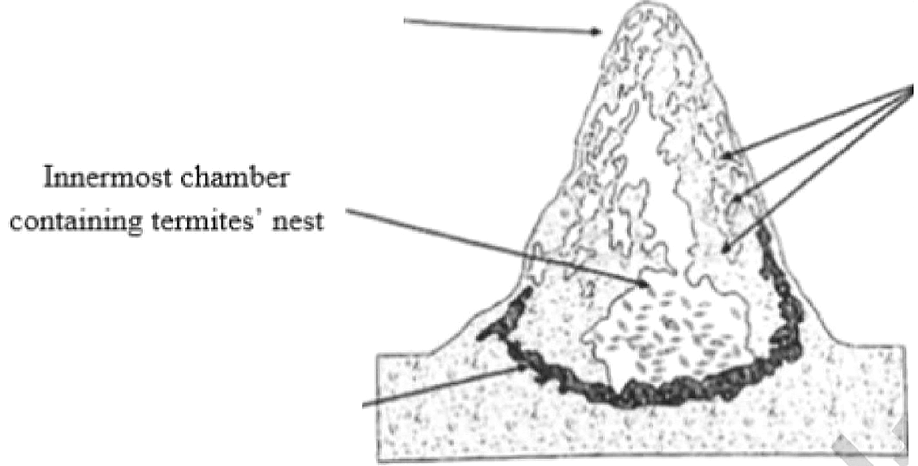
- 27
Paragraph A
- i. methods used to investigate termite mound formation
- ii. challenging our assumptions about the nature of life
- iii. reconsidering the termite’s reputation
- iv. principal functions of the termite mound
- v. distribution of termite mounds in sub-Saharan Africa
- vi. some potential benefits of understanding termite architecture
- vii. the astonishing physical dimensions of the termite mound
- viii. termite mounds under threat from global climate change
- ix. a mutually beneficial relationship
- 28
Paragraph B
- 29
Paragraph C
- 30
Paragraph D
- 31
Paragraph E
- 32
Paragraph F
- 33
Paragraph G
- 34
network of ______
- 35
helps to give the termites a constant ______ supply and to maintain a limited temperature range
- 36
cellar to aid control of ______ levels in mound
- 37
top of the mound permits ______
- 38
The termite mound appears to process its refuse material internally.
- YES. YES
- NO. NO
- NOT GIVEN. NOT GIVEN
- 39
Dr Soar’s reconstruction involves scanning a single photograph of a complete mound into a computer.
- 40
New information about termite architecture could help people deal with future energy crises.
答题卡
边做边填 — 即时本地判分,所有错题自动记录到错题本,并附带对应讲解。
- 1.
- 2.
- 3.
- 4.
- 5.
- 6.
- 7.
- 8.
- 9.
- 10.
- 11.
- 12.
- 13.
- 14.
- 15.
- 16.
- 17.
- 18.
- 19.
- 20.
- 21.
- 22.
- 23.
- 24.
- 25.
- 26.
- 27.
- 28.
- 29.
- 30.
- 31.
- 32.
- 33.
- 34.
- 35.
- 36.
- 37.
- 38.
- 39.
- 40.
显示答案
答案
1. FALSE
The passage says Utzon was 'little known' before the Opera House, so he was not famous for his work before this project.
2. FALSE
It is stated that only one of the four judges supported Utzon's design at first, so not all judges favoured it from the beginning.
3. TRUE
Utzon’s knowledge of boats inspired the design of the Opera House’s roof, as mentioned in the passage.
4. FALSE
The passage says Utzon was not impressed by the opera houses he saw in Mexico, so this statement is false.
5. TRUE
The passage explains that Utzon changed his designs in the 1960s after construction had already started.
6. TRUE
Seidler is mentioned as someone who defended Utzon’s role as the architect, supporting him publicly.
7. FALSE
It is stated that Utzon did not return to Australia for the opening of the Opera House in 1973.
8. 102 million
The final cost is given as 102 million in the passage.
9. Sweden
The passage says over a million tiles came from Sweden.
10. granite
Granite from Australia is mentioned as the material covering the outside walls.
11. four
Four performing arts companies are listed as having their home base at the Opera House.
12. forecourt
A large forecourt at the foot of a wide staircase is described in the passage.
13. harbour
Openings made the harbour visible from the foyers, as stated in the passage.
14. E
Section E describes a barrier (the dingo fence) that stops dingoes and divides two kinds of non-native animals.
15. D
Section D explains how dingoes keep rival species from dominating by controlling their numbers.
16. C
Section C mentions rabbits, a widespread non-native species, that other animals feed on.
17. B
Section B refers to when the dingo arrived in Australia.
18. F
Section F provides research showing dingoes have eaten young livestock.
19. A
Section A describes a method (poisoning) used to kill dingoes.
20. D
Section D discusses how the social structure of dingo groups affects how quickly their numbers grow.
21. D
Mark Clifford (D) says dingoes tend to hunt native animals rather than other non-native predators. The tempting wrong answer, Lee Allen (C), discusses hunting but not this specific point.
22. A
Stuart McKechnie (A) mentions that dingoes threaten the income of some people, such as farmers.
23. B
Chris Johnson (B) states that dingoes have had little impact on the extinction of animal species in Australia.
24. Tasmanian tiger
The passage says the dingo replaced the Tasmanian tiger as the main predatory animal.
25. rabbits
It is stated that foxes and cats are more likely to hunt native animals when there are fewer rabbits.
26. overpopulation
Australian animals reproduce slowly as a natural way to avoid overpopulation.
27. iii
Paragraph A is about reconsidering the termite’s reputation, as it challenges the usual negative view of termites.
28. vii
Paragraph B describes the astonishing physical dimensions of termite mounds.
29. iv
Paragraph C explains the principal functions of the termite mound.
30. ix
Paragraph D discusses a mutually beneficial relationship between termites and other organisms.
31. ii
Paragraph E challenges our assumptions about the nature of life, as it questions what we consider living.
32. i
Paragraph F describes methods used to investigate termite mound formation.
33. vi
Paragraph G mentions some potential benefits of understanding termite architecture.
34. tunnels
The passage mentions a network of 34 tunnels inside the mound.
35. air
The tunnels help give termites a constant air supply and maintain temperature.
36. moisture
A cellar is used to control moisture levels in the mound.
37. evaporation
The top of the mound allows evaporation to occur.
38. YES
The passage says the termite mound processes its refuse material internally, so the answer is YES.
39. NO
Dr Soar’s reconstruction does not involve scanning a single photograph, so the answer is NO.
40. YES
The passage states that new information about termite architecture could help people with future energy crises, so the answer is YES.