基于考生回忆重建 — 非官方 IELTS 资料。音频和原文均为练习用途的重现版本。
Reading Passage 1 — Radiocarbon Dating: The Profile of Nancy Athfield
Questions 1-7: True/False/Not Given
Do the following statements agree with the information given in Reading Passage? In boxes 1-7 on your answer sheet, write TRUE if the statement agrees with the information FALSE if the statement contradicts with the information NOT GIVEN if there is no information on this
- 1
Nancy Athfield first discovered the ancient remains in Cambodia.
- 2
The remains found in the Cambodia were in good condition.
- 3
Nancy took some time off from her regular work to do research in Cambodia.
- 4
The Cambodian government asked Nancy to radiocarbon the remains.
- 5
The filmmakers aimed to find out how the Angkor was rebuilt.
- 6
Nancy initially doubted whether the royal family was hidden in Cambodia.
- 7
Nancy disproved the possibility that the remains belonged to the Angkor royal family.
Questions 8-13: Flow Chart Completion
Complete the flowchart below. Choose ONE WORD ONLY from the passage for each answer.
Reading Passage 2 — Introduction to a Book about the Assessment of Carbon Footprints
Questions 14–19: Matching Information to Paragraphs
The text has seven paragraphs, A-G. Which paragraph contains the following information? NB you may choose any paragraph more than once.
- 14
reference to an award-winning formula
- A. Paragraph A
- B. Paragraph B
- C. Paragraph C
- D. Paragraph D
- E. Paragraph E
- F. Paragraph F
- G. Paragraph G
- 15
an acknowledgement of the general shortcomings of carbon footprint calculations
- 16
mention of a working partnership
- 17
reference to the demanding nature of one way of calculating carbon footprints
- 18
the advantage of combining two different methods
- 19
a comparison between goods from home and abroad
Questions 20–21: Multiple Choice (Process-based life-cycle analysis)
Choose TWO correct answers. The list below describes some of the possible features of process-based life-cycle analysis. Which TWO of these features are mentioned by the writer of the passage?
- 20
Which TWO of these features are mentioned by the writer of the passage?
- A. It is more complicated than it sounds.
- B. It usually produces exaggerated results.
- C. It is a frequently used procedure.
- D. Its faults are widely recognised.
- E. It was first developed in the UK.
Questions 22–23: Multiple Choice (Environmental input-output analysis)
Choose TWO correct answers. The list below describes some of the possible features of environmental input-output analysis. Which TWO of these features are mentioned by the writer of the passage?
- 22
Which TWO of these features are mentioned by the writer of the passage?
- A. It is often the basis of national guidelines.
- B. Its starting point is the manufacturing process.
- C. It is comprehensive in scope.
- D. It is a relatively new method of calculation.
- E. It can use prices to get approximate carbon footprints.
Questions 24–26: Summary Completion
Complete the summary. Write ONE WORD ONLY from the text for each answer.
Reading Passage 3 — Nature works Polylactic acid
Questions 27–30: Matching (Nature Works PLA and Ingeo)
Write the letters A-F in boxes 27-30 on your answer sheet.
- 27
scientists manage to
- A. make things like clothes
- B. produce plastic from plant
- C. selling plastic in market
- D. fermentation process
- E. drape fabrics
- F. wrapping products
- 28
Cargill needs to have contacts with
- 29
Nature work is used for
- 30
Ingeo is used to
Questions 31–34: Summary Completion
Complete the following summary of the paragraphs of Reading Passage. Using NO MORE THAN TWO WORDS from the Reading Passage for each answer.
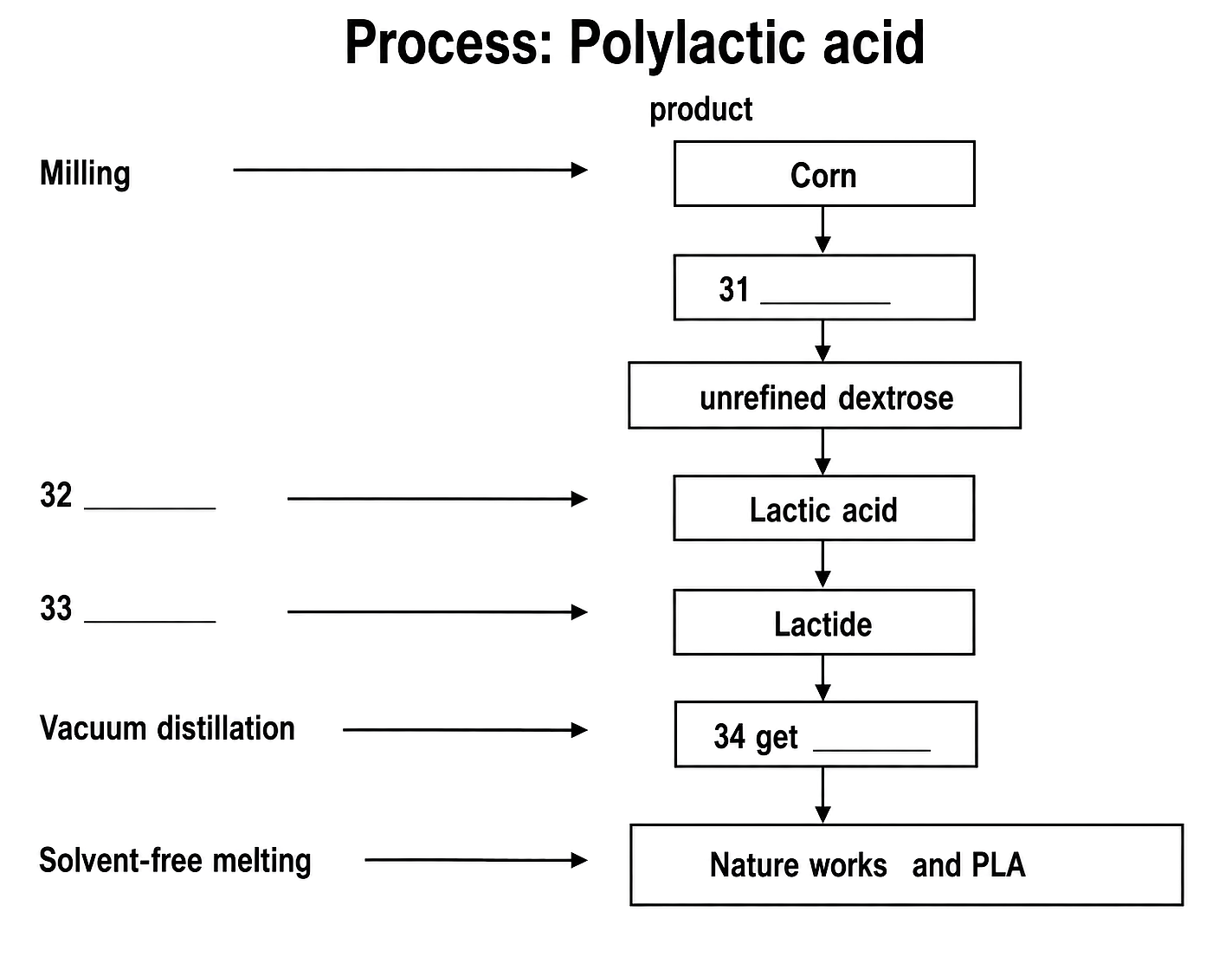
- 31
__________
- 32
__________
- 33
__________
- 34
__________
Questions 35–36: Multiple Choice
Choose the correct letter, A, B, C or D.
- 35
Why did choose the PLA as material for food packaging?
- A. It smells good
- B. It can save food freshness
- C. It can be used on other materials
- D. Some other things need to be revised about it.
- 36
What is PLA packaging is used for?
- A. absorbing moisture
- B. composting facilities
- C. Packaging fresh food.
- D. manufacturing
Questions 37–38: Multiple Choice (Features of PLA)
Which TWO features of PLA are correct?
- 37
Which TWO features of PLA are correct?
- A. It takes in moisture of skin
- B. It is waterproof
- C. comfortable sportswear
- D. It’s fading under the sun
- E. It is only made in deep color
Questions 39–40: Multiple Choice (Features of PLA)
Which TWO features of PLA are correct?
- 39
Which TWO features of PLA are correct?
- A. It is made of renewable raw materials
- B. It involves the removal of carbon dioxide
- C. It is no use of fossil fuel product
- D. It uses renewable raw resources
- E. It is sustenance which can absorb the CO2 in the atmosphere
答题卡
边做边填 — 即时本地判分,所有错题自动记录到错题本,并附带对应讲解。
- 1.
- 2.
- 3.
- 4.
- 5.
- 6.
- 7.
- 8.
- 9.
- 10.
- 11.
- 12.
- 13.
- 14.
- 15.
- 16.
- 17.
- 18.
- 19.
- 20.
- 22.
- 24.
- 25.
- 26.
- 27.
- 28.
- 29.
- 30.
- 31.
- 32.
- 33.
- 34.
- 35.
- 36.
- 37.
- 39.
显示答案
答案
1. False
False is correct because the passage says that 'Many prehistoric remains were discovered by the local people of Cambodia,' not by Nancy Athfield herself.
2. Not Given
Not Given is correct because the passage does not mention the condition of the remains found in Cambodia.
3. Not Given
Not Given is correct because there is no information about Nancy taking time off from her regular work to do research in Cambodia.
4. False
False is correct because the passage says Nancy was interested in the remains and used modern methods, but there is no mention that the Cambodian government asked her to do radiocarbon dating.
5. False
False is correct because the filmmakers aimed to find evidence about the royal family of Angkor, not about how Angkor was rebuilt.
6. Not Given
Not Given is correct because the passage does not say whether Nancy doubted the royal family was hidden in Cambodia.
7. True
True is correct because Nancy's research found the remains were much older than the royal family, which 'cast a lot of doubt as to the status of the ancient remains,' disproving they belonged to the royal family.
8. university
The answer is 'university' because the passage says Nancy was doubtful of her own qualifications but applied and was accepted by the school after her friend suggested she attend a nearby university.
9. rat
The answer is 'rat' because the passage says Nancy completed her studies on a kind of rat in New Zealand for her PhD.
10. diet
The answer is 'diet' because her research showed that the subject’s diet led to the fault in earlier research.
11. archaeologist
The answer is 'archaeologist' because the passage says Nancy became a well-qualified archaeologist before returning to Cambodia in 2003.
12. funding
The answer is 'funding' because the passage says her research was often delayed by lack of funding and government paperwork.
13. database
The answer is 'database' because Nancy completed a database for the materials found in Cambodia using radiocarbon dating.
14. E
E is correct because Paragraph E mentions 'a piece of ingenious maths (for which a man called Wassily Leontief got a Nobel Prize),' which is an award-winning formula.
15. B
B is correct because Paragraph B says, 'Measuring carbon footprints is a long way from being an exact process... All my numbers are best estimates and nothing more,' acknowledging the shortcomings.
16. F
F is correct because Paragraph F describes a model developed at Small World Consulting in collaboration with Lancaster University, showing a working partnership.
17. D
D is correct because Paragraph D says process-based life-cycle analysis is 'back-breaking work,' showing it is demanding.
18. G
G is correct because Paragraph G explains that using both life-cycle and input-output analysis together gives a better understanding, showing the advantage of combining methods.
19. F
F is correct because Paragraph F says the model 'treats imported products as though they had the same carbon intensity as products from within the UK,' comparing goods from home and abroad.
20. A / C
A and C are correct because the passage says process-based life-cycle analysis 'may sound simple, but it is not at all' (A), and it is 'the most common approach to carbon footprint calculations' (C). B is tempting but the passage says it usually underestimates, not exaggerates.
22. C / E
C and E are correct because Paragraph E says input-output analysis is 'one hundred per cent complete' (comprehensive in scope) and 'if you know how much something costs, you can get an instant crude estimate of its carbon footprint' (uses prices).
24. government
The answer is 'government' because Paragraph F says the model draws mainly on data obtained from government sources about the UK economy in 2007.
25. weakness
The answer is 'weakness' because Paragraph F says, 'A key weakness, which I sometimes adjust for, is that it treats imported products as though they had the same carbon intensity as products from within the UK.'
26. products
The answer is 'products' because the passage says the model does not distinguish between products of different origin.
27. B
B is correct because the passage says scientists at Cargill succeeded in making plastic from lactic acid made from corn, which is producing plastic from plants.
28. C
C is correct because the passage says Cargill needed a partner with access to plastics markets, which means selling plastic in the market.
29. F
F is correct because the passage says Nature Works PLA is used for packaging, which means wrapping products.
30. A
A is correct because Ingeo is described as a family of polymers for fibers, and the passage says it reaches consumers in clothes.
31. starch
The answer is 'starch' because the process for making Nature Works PLA begins when corn is milled, separating starch from the raw material.
32. fermentation
The answer is 'fermentation' because Cargill Dow turns unrefined dextrose into lactic acid using a fermentation process.
33. condensation
The answer is 'condensation' because the passage says, 'Through a special condensation process, a lactide is formed.'
34. polymer
The answer is 'polymer' because the lactide is purified and becomes a polymer, which is the base for Natureworks PLA.
35. B
B is correct because the passage says Nature Works PLA is more oil- and grease-resistant and provides a better flavor and aroma barrier, which helps keep food fresh.
36. C
C is correct because the passage says grocery retailers are using this packaging for their fresh foods.
37. A / D
A and D are correct because the passage says PLA has an inherent ability to take moisture away from the skin (A) and its resistance to ultraviolet light reduces fading (D).
39. A / C
A and C are correct because the passage says PLA is made from renewable resources (A) and its production uses 20%-50% less fossil fuel than petroleum-based plastic (C).