显示原文
Part one.
You will hear a telephone conversation between a woman who is planning to move to
Australia and a relocation agent who is helping her with the arrangements.
1st, you have some time to look at questions one to 6.
Now listen carefully and answer questions one to 6.
Hello, Australian Overseas Relocation Agency. This is Jason here.
Oh, hello. Yes, I'm calling from London. My husband has just got a new job in Australia,
and his company recommended you to help us.
Great. I'll get some details from you. Let's start with your name, shall we?
Oh, yes. It's Helen Green.
Thank you. And what's your current address?
It's a London address, 42 Station Road, Kew. It's just near the Botanical Gardens.
Oh, that sounds nice. And in case I need to contact you, could I have a telephone number?
Yes, it's O207 9460385.
Got it. Now, Helen, whereabouts in Australia are you relocating to?
Brisbane.
And is your husband's company paying for the move?
Yes, it's a company called Kirkby Technology.
I think we've worked with them before. And how soon do you need to move?
Well, they want my husband to start work in 2 weeks, at the start of the month, but school
doesn't finish here until the end of July, so we can't possibly move until then.
Shall we say the beginning of August then?
That sounds more realistic. June is nearly over, and I have so much to do before we move.
Let's start with the accommodation you need. Would you prefer a house or an apartment?
Well, we live in a big house with a garden now, which we love, but I think that initially
we'd be happy with an apartment that's fairly central, just until we get to know the city a
little better and can find a house we love.
Sounds like a good idea. And what about location? There are some beautiful
developments along the Brisbane River. It runs right through the city. The views are
spectacular, and you wouldn't need to worry about transport.
Well, actually, as we won't have our own garden, I'd prefer something close to a park.
That's more important than a view for us.
Okay, I'll make a note of that.
Brisbane's a lovely green city, so that won't be hard. Is there anything else I can organize?
Oh, yes, furniture. We were planning to ship our own, but we've decided it isn't really
worth it.
Okay. Well, we can hire some for you for the 1st few months.
That would be great.
Before you hear the rest of the conversation, you have some time to look at questions 7 to
10.
Now listen and answer questions 7 to 10.
Now, Helen, what else would you like us to help you with?
Well, we have a son, a teenager, who will be coming with us, so we'll need to find a
school for him.
Sure. What grade will he be in?
He's just turned 13, so he should be going into grade 9, but we've decided it would be
better if he repeats grade 8.
Right, so you'll need a high school. Now, do you have any preferences regarding the
school?
Well, he's at a state school at the moment, but the company is prepared to pay his school
fees, so we would probably go for private school if possible. It doesn't matter if it's mixed
or single-sex.
Sure. I'll make some inquiries, and I'll send you a shortlist of possibilities.
That would be wonderful.
Oh, can you send me a copy of your son's report? The latest one, if possible. The schools
will want to know something about him as a student. You can fax or scan it to me.
Okay, fine.
Now, is there anything else I can help you with today?
Yes, there is one other thing. We'd like some information to help us settle into the
community and make friends. My son isn't really into sport, but he's a keen chess player.
He'd like to continue playing when we move to Brisbane. Could you find out about a club
for him?
Certainly. I'll make inquiries for you.
And I play the flute, so I'd like to find a band that I could join, if possible.
Music is very popular here, so that should be easy.
Thank you for all your help, Jason.
My pleasure. I'll be in touch soon.
That is the end of Part one. You now have one minute to check your answers to Part one.
---
Part two.
You will hear the manager of a bookshop called Bibliostack talking to a group of young
people about the way the bookshop is organized.
First, you have some time to look at questions eleven to fifteen. Now listen carefully and
answer questions eleven to fifteen.
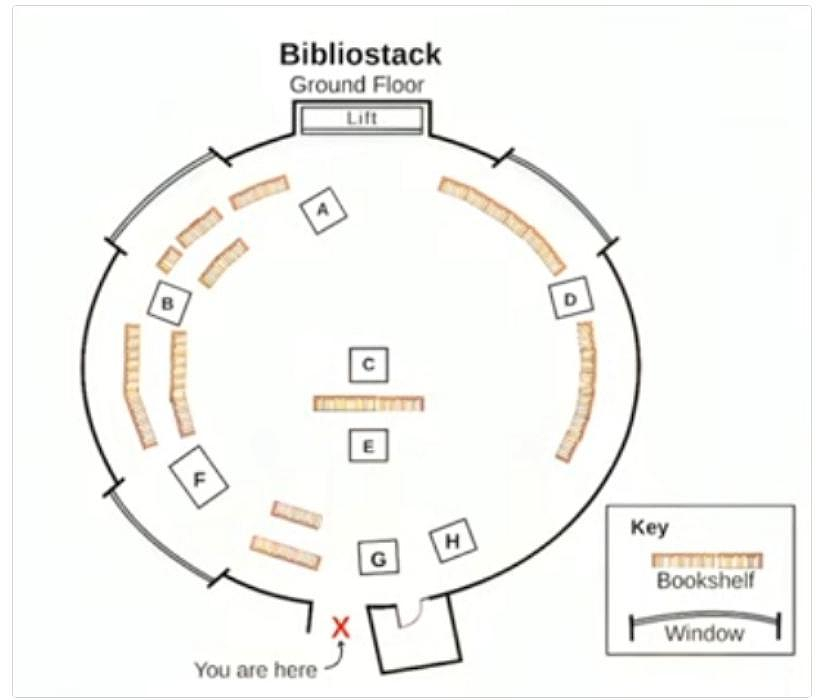
Good morning, everyone, and a big welcome to Bibliostack. Firstly, I'll explain the plan
of the store to you. The building is on seven floors and is circular, as you can see, and
we're here on the ground floor in its entrance hall. Right in the center of this floor, but
behind the bookshelf, so you can't see it very well from here, is our main seating area,
where people are encouraged to sit and read for as long as they like. But they're under no
pressure to buy what they're reading. That's not how we operate. And if you look to your
immediate left, past the first double row of shelves, you'll see piles of colored cushions in
front of the window there. We provide those so that people can sit wherever they want.
Lots of people like to sit close to the bookshelves, and if they want to sit on the floor
there, we want them to be as comfortable as possible. On your right, between the two
larger bookshelves, you'll see the computer bench, where our visitors can search through
our entire catalog. We pride ourselves in being the largest bookshop in the country, so
our sales assistants can't possibly know all the available titles.
Although the room in front of you is dominated by the bookshelves, at the far end, just in
front of the lift, you'll see that we provide a small café bar here, too. And just to your
right, there's a door to the cloakroom, where people can leave their coats. Then after that,
there's a stand where we keep a selection of local and national newspapers. Customers are
welcome to browse through them, and we also have some for sale. We really want people
to feel as though they're browsing through books in the comfort of their own home.
Before you hear the rest of the talk, you have some time to look at questions sixteen to
twenty.
Now listen and answer questions sixteen to twenty.
Right. Now, I suggest we walk slowly up through the building, and I'll give you more
information as we go. We're open twelve hours a day. We don't mind if people spend the
whole day here, but leave without buying anything. Of course, we hope they'll buy
something, but our purpose is to draw people in, to provide the kind of environment
which makes them want to stay and read. Look at how busy each floor is, but how quiet.
You may be wondering whether there are any children in the building. We debated about
locating children's books on the ground floor or halfway up the building, like the third or
fourth floor, but in the end, we decided to put them on the very top level, and I can assure
you, it's not the least bit quiet up there. Of course, many parents would prefer to spend
time on other floors, and so we provide a supervised area for children under two in the
basement, so parents can wander around the shop for a few hours and not worry. But they
do have to pay for this service, because although we thought about using some of our
own assistants, we decided to employ qualified nursery staff for parents' complete peace
of mind.
Now, we're just passing the fiction section, and you've probably noticed a small crowd of
people beginning to gather. That's because a well-known author is going to read from her
latest novel. We try to hold events like this at least once or twice a week, and as you can
imagine, they're very popular. We don't make a charge for people to attend, but we
obviously hope that some of them will want to purchase the book after listening to part of
it being read aloud. Other events which are proving to be very popular are our workshops.
Last week, we held a poetry workshop, and people came along with poems that they'd
written. One of the country's best-known poets ran the workshop, and the participants
read their poems aloud to him. He was kind and encouraging, and many people felt
inspired by his advice. It's extremely difficult to earn your living as a professional poet,
and even published poets have other jobs.
Now we're going to take a look at our section on audiobooks.
That is the end of part two. You now have thirty seconds to check your answers to part
two.
---
You will hear two engineering students, called Ray and Adele, discussing an article they
have read about making building bricks from waste materials.
First, you have some time to look at questions twenty-one to twenty-six on page five.
Now listen carefully and answer questions twenty-one to twenty-six.
Hi, Adele. What are you reading?
Oh, hi, Ray. It's one of the articles on the reading list. It's about bricks made from waste.
Is that the one about Bitu-Blocks?
Yes, that's right. Apparently, they're used as an alternative to concrete blocks. They
combine waste ash and crushed glass with a substance called bitumen.
Yeah, I read it a couple of weeks ago. Really interesting. It's going to be really useful for
our next assignment.
Yes, but I'm not doing that option. Actually, my tutor asked me to do a summary of the
article for next week's seminar. I really enjoyed it, and think I might even look into the
topic for my dissertation. Before I read it, I'd been getting rather bored of all these green
innovations in building.
Hmm.
Using all manner of waste materials.
Yeah.
But what's really new about this method is that they use bitumen to bind all the waste
material, and there's no need for a chemical reaction. It's not as simple as it sounds, of
course, but it's a great idea.
Yeah, and the quality is pretty good. Of course, I knew that because of the way they're
made, they're extremely stable, and the early tests indicate that they're as good as
concrete blocks in terms of their weight. But I didn't expect them to do so well on water
absorption tests.
Yeah.
And there were some interesting points about their manufacture, weren't there?
Yeah. They use materials from a variety of sources, some from local factories, some from
further afield, and they haven't had to develop any new methods of manufacture.
Yeah. They essentially use existing ones.
Mm.
Which is great because that means they won't require massive amounts of new
investment.
Right. By the way, what do you think about the section in the article on the building of
the new hospital?
It really helped me understand the broad issues in the UK, that so much more material is
used by builders than by other industries, which means the construction industry has a big
and growing responsibility to use green materials.
Okay.
Yeah.
I thought the reason why they included the hospital in the article was to show that there
are already quite high levels of recycling going on in the building industry. I think it said
seventeen to eighteen percent by value. I know that sounds pretty poor, but it's a good
foundation to start making improvements on, don't you think?
Maybe.
Before you hear the rest of the discussion, you have some time to look at questions
twenty-seven to thirty on page six.
Now listen and answer questions twenty-seven to thirty.
What did you think about the rival to Bitu-Blocks, Vegi-Blocks?
Yeah. Bricks made out of waste cooking oil. Interesting. But it did say they could be
quite smelly, you know.
Okay. That's one of the drawbacks Bitu-Blocks don't have. But the article said Vegi-
Blocks were very popular with certain architects.
I presume because of cost?
You'd think so, but actually, Vegi-Blocks come out at the same price, and they take
longer to make. The thing is, they look prettier.
No.
[chuckles] Bitu-Blocks are dark brown, which means they normally have to be covered
with a lighter facing, whereas the Vegi-Blocks come out as a pleasant light beige, so they
don't need covering.
Oh.
So there are advantages and disadvantages with both types.
Yeah. So how do you think these innovations will change practices in the construction
industry?
Well, I think Bitu-Blocks have the potential to make a huge difference.
I have my doubts. Basically, builders are always going to be cautious.
Maybe. Architects are a different matter. They like to experiment with new ideas.
Yes, you're right. What about Vegi-Blocks? Did architects cooperate in their trials?
There was a bit of interest there, but not significant. I get the impression Vegi-Blocks
won't catch on as well as Bitu-Blocks.
I'm not sure. I think the key to commercial success will be things like tax breaks for any
companies producing materials incorporating recycled materials.
Yes, that's true.
It'll be interesting to see what happens anyway. So what do you know about-
That is the end of section three. You now have half a minute to check your answers.
---
Part four. You will hear part of a biology lecture about an animal called the African
clawed frog. First, you have some time to look at questions thirty-one to forty.
Now listen carefully and answer questions thirty-one to forty.
Today, I'd like to look at another type of amphibian, the African clawed frog, whose
Latin name is Xenopus laevis. Its name is derived from the three short claws on each hind
foot, which it uses to tear apart its food. The Latin word Xenopus means strange foot, and
laevis means smooth.
I'll start with a general description. The African clawed frog is a species of frog that can
be commonly found in the eastern and southern parts of Africa. They have a flattened
head and body, but no tongue or external ears. As the Latin name suggests, African
clawed frogs have smooth skin, unlike the toad, whose skin always has a rough texture.
The body of African clawed frogs is covered with mucus, which can give their sensitive
skin protection, thus playing an indispensable role in their survival.
Male and female African clawed frogs can be easily distinguished through several
characteristics, and the major one is their size. Generally, male frogs are about half as big
as females. Specifically, female frogs are usually four point five inches long, weighing
around seven ounces, while males are generally two point five inches long and two
ounces heavy.
Then let's turn to their habitats. African clawed frogs are entirely aquatic frogs, so they
live in water all their life, whether they are tadpoles or adult frogs. Although they can live
in a wide range of freshwater environments, they particularly like still water instead of
fast-flowing streams. During the summer, African clawed frogs are mainly found in
warm rivers, and during the rainy season, they tend to move into flooded forests.
In the wild, African clawed frogs are highly adaptable to changes in the environment
around them, whether in oases or glacier-covered lakes. Besides, they can even survive in
water with high salt levels. It is because African clawed frogs have a unique
physiological mechanism in their body that could automatically regulate the balance of
water inside and outside their body. In dry weather, African clawed frogs always burrow
themselves into mud, where they can survive for more than a year. They are incredibly
hardy and long-lived, with an average lifespan of five to fifteen years. Some are even
recorded to have lived for twenty to twenty-five years. However, African clawed frogs
are susceptible to the pollution of the water, even though they are not listed as
endangered species.
Now let's talk about the diet of African clawed frogs. They are carnivores that like
hunting insects, spiders, worms, fish, etc.
African clawed frogs depend on the sense of smell to detect their prey. They first use the
claws on their hind feet to tear pieces of ample food. Then the front feet, which are not
webbed, play an important role in feeding. African clawed frogs use their front feet to
push food into their mouths, and meanwhile, a distinctive pump system is used to draw or
suck food in their mouths.
So we can see African clawed frogs are voracious predators and can quickly adapt to
many habitats. Therefore, in some parts of the world, African clawed frogs act like
invasive species, which will negatively affect other species in the freshwater ecosystems.
The evidence shows that they have devastated the populations of native frogs and other
creatures by eating their young. As a result, African clawed frogs are illegal to own,
transport, or sell without any permit in some states of America, like California,
Washington, Arizona, etc.,
where African clawed frogs have been seen as a type of pest. However, it's legal to own
African clawed frogs in Canada.
But not many people know that African clawed frogs are also used in medicine. As we
mentioned before, the skin of African clawed frogs is covered with mucus, which has
properties of antibiotic. This chemical can help kill bacteria and cure the infection and is
widely used by both the medical profession and the general public. So we shouldn't
ignore the medical value of African clawed frogs.
That is the end of part four. You now have one minute to check your answers to part four.