显示原文
Part one. You will hear a man phoning an insurance company to make a claim for
damage to his house. First, you have some time to look at questions one to four.
Now listen carefully and answer questions one to four.
[phone ringing] Good morning, Star Insurance. How can I help?
Oh, good morning. I'm calling to make an insurance claim. It's for damage to my house.
All right. I'm just going to get a few details down first. What's your name, please?
It's Greg Williams.
Okay, thank you. And what's your policy reference, please?
Is that the long number with the letters in the middle?
That's right.
It's oh five double four three
C-H-I double seven one.
Okay. Right, yes. I've got your details on the computer now. So can I confirm your
address? According to our records, you live at a hundred and two Market Street in
Northbridge. Is that right?
That's correct.
All right, good. And the last thing I need to check, what's the best phone number to get
you on? Is it the number you're calling on now?
No, I'm calling from work. Let me give you my mobile phone number. It's oh one eight
double six nine nine two five.
Thanks. So can you give me a description of the damage? When did the incident occur?
Sunday the seventeenth of June.
I see. And what was the cause of the incident? How did the damage happen?
Right. No one was home at the time, which was fortunate, I suppose. There was a big
storm, and I guess it blew down one of the trees at the back of our garden, and it smashed
through the window in our daughter's bedroom.
Yes, a, a good thing you were all out. So have you got the window fixed?
Not yet.
Before you hear the rest of the conversation, you have some time to look at questions five
to ten.
Now listen and answer questions five to ten.
All right. And so apart from the window, what are you claiming for?
Okay. Like I said, it was my young daughter's room. Anyway, right below the window is
her desk. That's all right, but she left her glasses on it, and they got really badly scratched.
She'll need a new pair.
Luckily, she hadn't left her headphones there like she normally does.
Is there anything else?
Yes. Because the window was broken, the rain got in. And what's really annoying is that,
when was it? Just last month, we'd gone shopping and bought a carpet. We'd only had it
for a couple of weeks, and it got soaked. We had to remove it.
Oh, dear. Are there any other items you'd like to claim for?
Yes. I suppose we should be grateful that the rain didn't reach her computer, but when the
tree came through the window, it tore a hole through the curtain that was hanging there.
Okay. I'm making a note of all this.
And one more thing I need to claim for.
Yes, go on.
We've had some repairs done already for a door we can't open.
To the back of the house?
Uh, no, it's for the garage. The tree hit that as well.
Okay. So have you contacted a professional builder yet?
Yes. It's the same builder we always use. Do you want his name?
Yes, please.
Okay. It's Steven Honeywell. H-O-N-E-Y-W-E-L-L.
All right. Now, apart from damage to the house itself, what else do you think the builder
will be looking at? Because we're going to need photographs.
Oh, yes. Well, he'll be putting up a fence for us between our house and the neighbor's
because the one we've got now was smashed by the tree. So I'll take some pictures before
he does the work.
Please do that. And then you can send them in with your claim.
That is the end of part one. You now have one minute to check your answers to part one.
---
Part two. You will hear the supervisor of a home improvement store giving a tour of the
store to some new staff.
First, you will have some time to look at questions eleven to fifteen.
Now listen carefully and answer questions eleven to fifteen.
Welcome to today's staff orientation at the home improvement store. My name is John. I
look after new staff, and I'll be with you here in the training room all morning.
We are the biggest hardware store in the country, and as home improvement is now so
popular, hundreds of customers visit our store each week to buy products to improve
every part of their house, inside or out. First, let me introduce you to the most popular
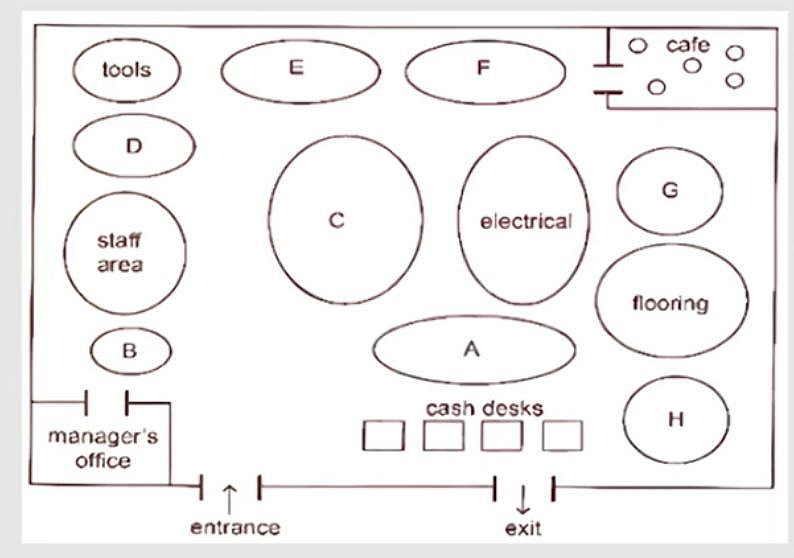
sections of our superstore. Can you all take a look at the store plan you have in front of
you?
We stock every kind of flooring, including carpets, wooden flooring, and tiling. Our paint
department is next to flooring. Um, that's it in the bottom right-hand corner of the map.
We offer advice to customers on color combinations for inside or outside before they
purchase.
We've become well-known in the last few years for selling the latest kitchen designs for
all budgets, and we also stock quality appliances recommended by top chefs. These
products can be found right in the middle of the store, just next to electrical goods. You
may not be aware that one reason we are such a popular store is our great cafe, which
serves cheap, nutritious lunches. That's in the top right of your map. Staff should also
make customers aware of the children's play area, which is between the cafe and flooring,
so mom and dad can get something to eat or drink or even continue their shopping while
the kids are safe with our trained childcare workers.
Now, what else should I mention? Ah, yes. We recently moved our stock of showers and
baths from the left side of the store to the area along the back wall next to the tool section.
We offer practical advice to customers about their bathrooms before they buy, such as
where to locate a new toilet or shower.
I have left my favorite area till last, gardens. It's marked on the left side of the map after
the staff area and before the tool section. There you'll find our extensive range of plants,
flowers, and related products for inside or outside. If you get to work there, I'm sure
you'll find it a very pleasant section to work in. Right. Well, that's it for the store plan.
Before you hear the rest of the talk, you have some time to look at questions sixteen to
twenty on page five.
Now listen and answer questions sixteen to twenty.
Now, there is some other general information I need to give you before you start your
specific training. The first thing staff need to know is what makes us different to our
competitors. Our main advantage, due to our size, is that we can cut our costs and offer
the best deals. Of course, we are proud of the great service we provide to our customers,
especially through our help desk.
We also have an excellent choice of goods so that we can provide plenty of options to our
customers. But of course, that isn't unique to us. The Home Improvement Store has sixty
stores nationwide, and we promote our stores and products in a range of different ways.
First, there's our catalog, which lists all our items. It's been around for years, but we still
have a policy of staff use only. The most important marketing material, and the one you
want to ensure is given to every customer, is our store magazine, showing the latest
products, workshops, and offers. The website is being redeveloped at the moment, so
customers can't access it right now.
The Home Improvement Store is a great place to work. Like most of the staff, I'm sure
you'll appreciate the fact that you can choose your hours to fit your lifestyle, family, or
study. We hope you'll find that there's a nice atmosphere here. We are thinking of
introducing a staff discount on our products, so that would be a real benefit to all staff.
Every weekend, we offer workshops to help customers carry out their own home
improvements. Workshops range from indoor painting to outdoor gardening and plant
ideas. This coming weekend, there'll be one on mending a broken fence. Please remind
customers of the workshops, especially if there is one related to your section.
Finally, I wanted to let you know about a special deal for people renovating their kitchen.
As you know, we sell all products and appliances connected to the kitchen, and we also
have a delivery service. If customers buy one of our total kitchen designs, we will install
it free of charge. So, let's take a short break, and then we'll start...
That is the end of section two. You now have half a minute to check your answers.
---
You will hear a conversation between a student and her professor discussing an
assignment. First, you have some time to look at questions twenty-one to twenty-five.
Now, listen carefully and answer questions twenty-one to twenty-five.
Excuse me, Dr. Thompson, may I speak to you for a minute?
Of course. Please come in.
I’m Alexandra Jones. I’m studying business here at the university, and for my assignment,
I have to carry out a survey of people who own their own organizations. I heard that you
are the founder of your own company, and I was wondering if I could ask you some
questions about it.
Yes, of course. Please fire away.
Okay, great. We’ll get started. Did you encounter any problems whilst you were starting
your company?
Actually, it was not as hard as I anticipated. I started out with very clear objectives, so I
knew exactly what I wanted my corporate identity to be.
It was very difficult to find the correct premises, as the property market in London is so
competitive, but eventually I found the perfect site.
The hardest part was structuring the business, as I had no formal template, so I had to
create it myself.
Yes, that is very impressive. Was it difficult dealing with staff?
It’s always tricky trying to satisfy a group of people with varying interests. However, I
didn’t encounter many problems. I found it very important to make the staff feel
appreciated, so I hosted a staff day where we could all introduce ourselves and get to
know each other as individuals.
I was also able to talk to them about the type of work that they would be doing and gave
them the opportunity to share with me the issues they had with the allocation of the work.
Okay. Did you hire a management team, or did you take on the role of the manager?
Oh, no. I already had enough tasks to take care of.
I employed someone else to take on the role of the manager. However, he never
consulted me before making decisions, so I was forced to let him go and hire someone
else.
And what did the other staff think of the new manager?
They had a great deal of respect for him. It definitely helped that I consulted with them
before hiring him. They were surprised that he has been so successful in his role at the
company, despite the longer meeting hours.
Since the company opened, has it had any great achievements?
There are many aspects of the company that I am pleased with. However, there is one
achievement of which I am particularly proud. I wanted a mural painted to brighten up
our entrance area, so I decided it would be a great idea to invite the local primary school
to create one for us. The youngsters had a great time, and I know they were thrilled to be
included.
Oh, that’s lovely.
Before you hear the rest of the conversation, you have some time to look at questions
twenty-six to thirty.
Now listen and answer questions twenty-six to thirty.
Have you encountered any major problems since you opened the company?
Yes, we are always encountering issues with employment because it is very hard to find
people who are qualified for the roles that we are offering. But unfortunately, there is no
solution to this.
One of our administrators also recently left to go on maternity leave, which put us in a
tricky situation. However, we have managed to find a temporary replacement for her.
It’s also now approaching the period when we must carry out our financial training, so I
need to find a venue with enough space to hold everyone.
It will be interesting trying to organize that event.
Oh, gosh, I can imagine. I find it hard enough to organize myself.
Organization is a difficult thing to master, but it is also essential for success. Whilst I was
learning how to stay organized, I realized that the role of motivation is essential.
Okay, that’s great.
I also suggest that you visit the library, as there is a section on culture that will have some
very valuable material on how to develop your organization skills.
Okay. I’ll head to the library when we’re finished.
I think you will find it very useful. They also have a collection of documentaries on the
subject of personal organization, and I suggest that you look up the literature on
management of change. I personally found these sources incredibly useful. Articles are
also a valuable resource, and we have a whole collection of them in our university library.
I advise that you look at section two, where you will find articles on the nature of
volunteering.
That’s great. Thank you so much for your help.
No problem.
That is the end of section three. You now have half a minute to check your answers.
---
Section four. You will hear an introduction of the exhibition named Two Centuries of the
Bike. First, you have some time to look at questions thirty-one to forty.
Now listen carefully and answer questions thirty-one to forty.
Good afternoon, ladies and gentlemen. I’d like to take this opportunity to welcome you to
our exhibition, Two Centuries of the Bike. Let’s stroll around the exhibition, shall we?
Although there were a few early efforts back in the 1700s, you didn’t really see many
bikes till, say, the 1830s in England. Bikes were a response to the rapid growth of cities
early in the nineteenth century. Cities like London were getting too big to walk across.
The early bike let people travel with less effort than walking. Plus, a bike was a lot
cheaper than a horse. Think of it. No one invented a bike for, what, five thousand years of
human history. Why did people do it then? Probably because this was the start of the
machine age. People wanted machines to do all the work. There were some drawbacks,
however. For one thing, there were no pedals. You simply pushed yourself along using
your feet, kind of like today’s skateboard. That meant you went fairly slow, and uphill
you actually worked harder pushing that two-wheeler. Plus, the wheels were made of
wood covered with metal, as you can see from this model. So the downside was that the
ride was quite uncomfortable on most roads. Only a few gadget lovers had or used them.
By the 1860s, though, improvements were being made. As you can see from this
specimen, metal frames had become the rule. They’re more durable than wood, and they
don’t warp in the rain. The biggest improvement, however, was the development of the
chain and sprocket system. They are connected. This meant you did not push the bike.
You used pedals just like today. You had to try harder to balance, so it took some practice
to figure out how to use the pedals. But it made the ride so much easier. As a result, the
good thing was that you could ride a lot more smoothly and with very little effort. By the
1880s, another big change was the use of rubber wheels. These became pretty common at
that time. Though the first ones were solid rubber, the ride was a good deal more
comfortable than the old iron and wood system. This is a big consideration because the
faster you go, the more you feel every bump. Air-filled tyres, pneumatic tyres, didn’t
really come into use till around the year 1900, as you can see from this exhibition over
here. That made the ride even more comfortable. So by 1890 or so, people were going a
lot faster and a lot more smoothly. There was one problem when you were going quickly
and comfortably: Oh no! How do I stop? Yes, we all laugh now, but for a long time, the
only way to stop was to drag your feet. That didn’t work very well, and it would be
dangerous if you were going fast. In the crowded cities of those years, New York,
Chicago, and so on, you’d get killed if you couldn’t stop for, say, a streetcar. Plus, look at
this bike. The front wheel is nearly a meter and two-thirds tall. They made them that way
so you could see over people in wagons, but you couldn’t drag your feet. This model is
called the velocipede, a speed pedal. Another characteristic of the bike in this period is
that it has two equal-sized wheels, which signaled a big change in bikes. For with the
velocipede, brakes appeared. If you wanted to stop, you just pushed the pedal backwards.
Doing that stopped the back wheel of the bike. This technique worked a lot better than
dragging your feet or jumping off the high seat there. This meant that bikes became a
great deal safer. It would have been safer if people wore helmets, but the first bicycle
helmet wasn’t invented until years later, and even then, it was little more than a leather
ball cap. It really wasn’t until the 1970s that the bike helmet was modified to provide
some real protection.
Before continuing on to look at developments since the 1890s, let’s say a word more
about safety. Everyone knows if you’re going downhill, you can get going dangerously
fast. To go more than a hundred kilometers an hour isn’t all that difficult. But even on
level ground, it’s easy to go too quickly. On a city street, today’s bicycles can be ridden
at a speed of over forty miles an hour over a short distance. That’s about sixty-four
kilometers an hour. Remember, you’re on a bike, not in a car. There’s nothing to protect
you. People are killed in single bicycle accidents every day just from hitting the road. A
good rule to remember is if you’re going faster than the cars, slow down, and please wear
a helmet. Nearly one-quarter of the epilepsy cases come from head injuries in accidents
on bikes and motorcycles. I don’t mean to scare you, but safety is everyone’s business.
What? Now that’s a good question. Why are today’s bikes so much faster? Well, it’s not
just that today’s athletes are faster. The answer is partly mechanical. If you look closely
here at the back wheel, you’ll see a number of gears. Changing gears is what makes those
fast speeds possible. You can shift gears depending on the terrain and how hard you wish
to pedal. So you can put it on a higher gear for downhill and a lower gear for uphill travel
to make it easier to climb that slope. You’ll notice this gear-shifting mechanism is
attached to the back wheel, and when the rider shifts on the handlebar gear shifter, the
chain moves to the appropriate sprocket. And speaking of changing gears, let’s look over
here at our Tour de France exhibit.
That is the end of Section 4. You now have half a minute to check your answers.