显示原文
Part one. You will hear two friends called Greg and Jenny talking about a horseback
riding trip that Jenny is planning to do. First, you have some time to look at questions one
to six.
Now listen carefully and answer questions one to six.
Hi, Greg. Great to see you. And thanks for emailing me with the details of the horseback
riding trip you went on. I looked at the website, and it looks great.
Yeah. I went on the two-day mini break. Is that what you're thinking about?
Yes, that's the one. Do you think they'd have places now in July, or will it be full?
If you can, hang on till September. That's when I went, and it was a really great time to
go. It's not so hot, for a start.
That'd suit me better anyway.
And also, at one point when we stopped for a picnic, I was lying in a field looking up and
saw a huge flock of birds. They were obviously migrating. That's another reason why it's
a good time to go.
Oh, great.
Oh, and another thing, you don't stay in a hotel. You stay in a tent, so you don't have to
come back to town in the evening.
I'm up for that.
So where do you go on the first day?
Through some amazing wooded valleys full of chestnut and beech trees, but that's just the
morning. Where you're really heading for is the mountains, and when you set out, you
can only see them in the far distance. You don't actually get there until sunset.
Is it hard work riding all day?
No. The pace is easy, and there are plenty of breaks built in for picnics and even a snooze.
But on that first evening, when you've been riding all day, you get the opportunity to go
for a swim, and you really enjoy that. So relaxing.
And what's on day two? You said something about the national park.
No. Day two, you go up this incredible valley. At the end of it, there's a waterfall. It's an
amazing place to stop for lunch. We even spotted an eagle while we were sitting there.
And in the afternoon, there's a trip that goes to a cave. You can even ride into it.
Wow, that sounds great. I can't wait.
Before you hear the rest of the conversation, you have some time to look at questions
seven to ten.
Now listen and answer questions seven to ten.
Okay, so what are your tips for a horseback riding weekend?
Well, I'd had a sore knee before I went, and I was pretty worried about that. It was okay,
actually, but what you've got to watch for is that you don't have any trouble with your
back. Riding can really aggravate that.
No problem there. And comfortable clothes, I guess.
Yeah. But another thing I hadn't realized is that you actually walk the horses down some
pretty steep and uneven paths. So make sure you have walking boots, not just normal
riding boots. And even if you're going in the autumn, make sure you don't get sunburned.
Even if it looks cloudy, take sunscreen, lots of it.
I think you've convinced me to sign up. When I was looking at the website, I saw that if I
register online, I can get a discount. Did you do that or go through a travel agency?
I registered online, of course.
I just have to let my boss know when I want to take time off. And then the other
important thing I read was that you have to make sure that your insurance company know
that you're going on an adventure trip to make sure that you're covered in case anything
happens.
I'm sure it won't, but better be safe than sorry.
That is the end of part one. You now have one minute to check your answers to part one.
---
Part two.
You will hear a supervisor at Holly's Supermarket talking to a group of new employees.
First, you have some time to look at questions eleven to fourteen.
Now listen carefully and answer questions eleven to fourteen.
Welcome to Holly's Supermarket. I'm sure you'll all enjoy working in our dedicated team
here. So, what will you be doing? Well, we're open Monday through Sunday, so you'll
need to be able to work weekends as well as irregular weekday shifts. These sometimes
start at five AM or finish at eleven PM. Your duties will include checking and unpacking
lorry deliveries, as well as working on the shop floor, stocking shelves and so on. But
you'll only be required to do manual lifting if the goods are light.
When the store is very busy, you'll also have to assess changing priorities. For example,
if there's a queue at the tills, you'll jump on a spare one to help. If you notice something's
been spilt and the surface is a little bit wet, you'll get a mop to clean it up. No need to
check with a manager first. Similarly, if bakery items are selling quickly, you'll help cook
some more. And if a customer can't find, say, the apples, you'll instantly leave what
you're doing and show them. But you'll still get time off to relax too, of course.
We pride ourselves on a positive attitude here. A little small talk shows you're interested
in the customers and are providing excellent service, just as long as you don't overdo it
and keep another customer waiting. And always smile. It forces you to stay positive, and
being generally upbeat makes your whole team happy too.
This increases efficiency and gives a good impression to customers.
If it's quiet, help someone pack their bags. Customers really appreciate it, especially
when they've bought more than they expected to. Staying calm is also a necessity. If a
customer's unhappy for any reason, keep cool and call for a supervisor to help diffuse the
situation if things are getting out of hand.
Occasionally, when working tills, you'll find yourself waiting for someone to extract their
wallet from the bottom of a cluttered bag while a long queue of annoyed customers builds
up. You have to make sure, however hard it might be, that you remain composed.
Before you hear the rest of the talk, you have some time to look at questions fifteen to
twenty.
Now listen and answer questions fifteen to twenty.
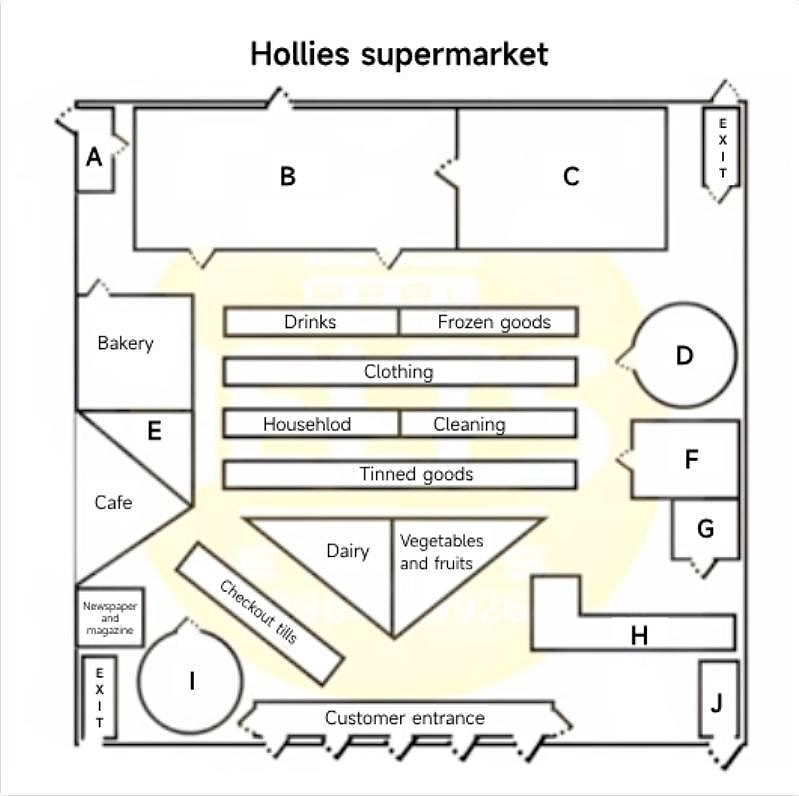
So now let's look at the plan of the supermarket. Have you all got your plans? Okay, good.
We'll start with the staff entrance. Today, you came in through the customer entrance,
clearly marked on the bottom of your plan. But in future, you'll enter through the door in
the top left-hand corner of the diagram. Please don't confuse this with the emergency
exits in the top right-hand corner and bottom left. It's very important that these are kept
clear at all times.
Regarding the manager's office, some of you may have attended interviews here when it
was next to the newspaper and magazine sales area. However, it's recently been moved
and is now the circular space marked on the right of your plans. When the manager's not
on the shop floor, that's where you'll find her.
The storage and unpacking area, you may be asked to help out here both before and after
opening hours. This is represented by the largest of the four rectangles in the top section
of the plan. It tends to get very busy there at times, so please be careful on entering and
leaving this area. There's a kitchen on site where food and drinks are prepared for
customers. It has specialist staff, but some of you may have to fill in occasionally.
On the plan, it's shown by the triangular shape to the left of the tinned goods aisle.
It's very busy as many customers like to take a break in the cafe and read a newspaper
before or after doing their shopping.
Cleaning equipment is stored in a cupboard. It's the smaller of the two squares marked
near the vegetable and fruit section and can come in very handy. You'd be surprised how
often we have to mop up squashed tomatoes or grapes.
Finally, you'll be pleased to know there's a separate staff relaxation area. This is at the top
of your plan between the frozen goods section and the exit. As well as comfortable chairs,
there's also a microwave for heating up snacks and a drinks dispenser. So let's go there
now.
That is the end of part two. You now have thirty seconds to check your answers to part
two.
---
Part three.
You will hear two students called Charlie and Delia discussing a joint assignment for
their human geography course.
First, you have some time to look at questions twenty-one to twenty-six on page five.
Now listen carefully and answer questions twenty-one to twenty-six.
Hi, Delia. Shall we get down to planning our assignment? We haven't got long now
before the deadline.
Hmm. I know. And it's quite open-ended, isn't it? Just research and analyze data about
energy consumption in a given region.
Yes, and all we've done so far is check out a few likely websites. Shall we exchange ideas
about those first?
Hmm, good idea. Let me look at my notes. Okay. I had a preliminary look at one or two
websites. There was National Geographic. The thing there that struck me was a facility
for creating tailor-made maps. We might like to use that when it comes to presenting our
findings.
Right. That would make some types of data instantly clear, I guess.
Also, I checked out the United Nations website. That one had masses of useful stuff, only
I couldn't get at it.
I know. It was for subscribers only, right? And we don't wanna get into that sort of thing.
After all, it's not a major piece of work we're doing.
Yes. I agree.
I looked at the website of an agency called the Energy Information Administration. There
were some population statistics there that we could use, but there didn't seem to be any
figures for energy use, so that site would only be suitable to a limited extent for our
purposes.
Uh, I thought the British Petroleum website might be a good place to get information
about energy use.
Oh, good thinking.
There was lots of data, actually. Uh, the only thing is it went into more depth than was
necessary for our assignment, and we'd have to collate a lot of the figures to arrive at an
overview. So I didn't think it was quite what we were looking for.
I also looked on the Central Intelligence Agency website.
Hmm, I never had thought of that.
Something worth noting, it seemed to be the only place I looked at that had data for this
current year.
Oh, right. I'm not sure about the websites I looked at. I didn't look carefully enough, I
guess.
And I also found stuff on the World Bank site, and that had figures going back quite a
long way.
Okay.
Before you hear the rest of the discussion, you have some time to look at questions
twenty-seven to thirty on page six.
Now listen and answer questions twenty-seven to thirty.
Fine. We know roughly what we're doing, but have you got any more definite thoughts
about what our subject matter should be?
I think one thing we've got to be careful about is biting off more than we can chew.
Yes, especially as it doesn't count towards our final assessment anyway.
So shall we just limit it to data about population size and energy consumption?
How about if we add in one other factor, carbon emissions? I think it'd be interesting to
see what the interaction between those three factors is like.
Okay. But in that case, we originally planned to stick to countries in North and South
America. But what if we narrowed it down further?
I'd be happy with that. How about, let's say, twenty countries in all, the top ten consumers
of energy in the region and also the bottom ten?
Hmm. Sounds good. And we can calculate per capita consumption and per capita
emissions to allow valid comparisons.
Actually, it would be interesting to look at a breakdown of the types of energy each of
those countries uses. You know, how much coal, how much wind power, how much
nuclear power, and so on.
But we did just agree to restrict our data.
I know. And then what about the way we present our data? Our tutor said that's one of the
things she'll be looking at in particular, especially our graphics. Don't you think a bar
chart would be more effective than a set of tables with figures?
It might, but I've got another idea. I'm keen to display our data on a map instead. We can
easily find a software program to do that.
Brilliant.
Thanks. One last thing, Charlie, and then we better go away and get started. Who's going
to do what?
Your math is better than mine, so I'll volunteer to search out all of the raw data we need if
you're prepared to do the necessary number crunching.
Okay. But can you get them to me as soon as possible?
I'll do it tonight.
Okay. And I tell you what, since the graphics were my idea, I'll take those on. But do you
mind doing the text? You've got a better way with words than I have.
That's okay with me, as long as you'll agree to look over everything and give it the
finishing touches before we hand it in.
It's a deal. Shall we meet at the same time tomorrow, or do you have...
That is the end of part three. You now have thirty seconds to check your answers to part
three.
---
Part four. You will hear a lecture tracking the historical evolution and changing
functionality of bags and purses from ancient times to the late twentieth century. First,
you have some time to look at questions thirty-one to forty.
Now listen carefully and answer questions thirty-one to forty.
The oldest bag preserved in the history is from the Tyrolean Iceman. This nickname was
given to a well-preserved natural mummy. The man reportedly lived between 3400
and 3100 BC.
In the fourteenth and fifteenth centuries, bags were called purses, exclusively carried
coins. These purses were essential as pockets in clothing were not developed just yet. In
the fourteenth century, and without pockets in clothing, a purse was attached to the
strings from the waist. From the sixteenth century onward, priests often wore their purses,
a hook with chains to which small things could be attached, such as keys, knife cases,
scissors, and sewing tools. Since purses were often crafted from precious metals, they
were also considered as a symbol of status. The design and accessories evolved in the
course of centuries, but it wasn't until the beginning of the twentieth century that the
handbag finally replaced it. Bags and purses came in a variety of designs for a number of
purposes, such as bags with clasps, leather pouches. These were all worn attached to the
belt. The introduction of pockets towards the end of the sixteenth century meant that
men's bags slowly disappeared in the course of seventeenth century. From then on, bags
belonged to almost exclusively to the women's domain. In the seventeenth and eighteenth
century, women's clothing was so large that one or two bags or pockets could easily be
hidden underneath the skirt. Such pockets were usually worn in pairs, one hanging from
each hip. Hence the name thigh pockets. Thigh pockets remained fashionable for most of
the nineteenth century. The dark times of the medieval age gave way to manufacturing a
curious portraits on purses. Medieval purses were not only used as coin purse, they also
were closely connected with marriage. As a result, they commonly showed love stories.
Interestingly enough, this connection is deduced from connection between the handbag
and fertility.
Bags altered to serve their uses to optimize their wearer's way of life. At least such was
the case with sweetie bags, which are the bags that filled with sweet-smelling material. In
a time when personal hygiene was poor, sweet bags were stuffed with sweet-smelling
spices to get rid of bad smelling. For example, lavenders or perfumed balls of cotton. In
the long run, sweet bags were also stored with clothes and linens used for aromatherapy.
The bag continued to be highly functional and had many different nicknames and uses.
Purses were often used as decorative package for gifts such as money, perfume, or jewels.
Notably, towards the end of the century, purses became more sophisticated, evolving
from simple drawstring design to more innovative shapes with dynamic materials.
Seemingly, texture and manufacturing attributes were the only details left to be stylized.
For instance, the 1930s saw the Art Deco style arrival. This particular style specifically
highlighted abstraction, just like any time period which experiences new industrial
materials. The bag integrates them as well as within its design. In this particular case,
plastic and zippers were introduced to the bag.
Once the 1960s began, the bag experienced a self-expression as if being dynamic and
versatile wasn't already be part of bag's characteristics. The bag experienced a brave
awakening, specifically colorful patterns, and flower power introduced energy into the
fabric of the bag. The end of the 1960s saw the shoulder bag return, and with it came lots
of buckles, all of which indicated that women and their bags were ultimately fit and ready
for the beginning age of feminism.
All in all, the 1980s saw an expansion in active consumption. The bag quickly changed to
accommodate purchasing power, providing logos to indicate the priorities of the owner.
For instance, sports bags such as Nike bags matched athletic shoes were most popular at
this time. As a result, book bags and even the briefcase specifically featured a pocket
which were exclusively created to hold this new invention.
That is the end of part four. You now have forty-five seconds to check your answers to
part four.