显示原文
Section 1. You will hear an Englishman called Steve phoning a friend called Susie about his trip to Arizona in the United States. First you have some time to look at questions 1 to 4 on page 2.
You will see that there is an example that has been done for you. On this occasion only, the conversation relating to this will be played first. Hello?
Hi, Susie. It's Steve. Steve, hi!
How are you doing? I'm fine, thanks. Actually, I've got to attend a conference in July in Tucson, Arizona, and I was hoping you could give me a few tips.
You're from around there, aren't you? I sure am. Tucson's not my hometown, though, but it's definitely worth seeing.
What's the weather like around then? Is it true it's about 40 degrees centigrade in the daytime? That's right, and not less than 25 at night.
A bit different from England in July. The temperature during the day will be 40 degrees, so 40 has been written in the space. Now we shall begin.
You should answer the questions as you listen because you will not hear the recording a second time. Listen carefully and answer questions 1 to 4. Hello?
Hi, Susie. It's Steve. Steve, hi!
How are you doing? I'm fine, thanks. Actually, I've got to attend a conference in July in Tucson, Arizona, and I was hoping you could give me a few tips.
You're from around there, aren't you? I sure am. Tucson's not my hometown, though, but it's definitely worth seeing.
What's the weather like around then? Is it true it's about 40 degrees centigrade in the daytime? That's right, and not less than 25 at night. a bit different from england in july true i was wondering what to take with me i won't need warm clothes then will i well you'll find that everywhere is air conditioned and it can feel quite cold sometimes so a jacket would be a good idea you might need an umbrella as well as we sometimes have thunderstorms during the day but you can always pick one up when you get there my conference is only for a couple of days so i was wondering what i could do in tucson well it's a beautiful position i'd hire a car in tucson and then follow the trails in the desert okay i'm writing all this down any other tips museums and stuff well there are lots of museums the usual thing like wildlife and history but i think the most interesting is the space museum so my advice would be to go there hmm what else well there are plenty of walks you can do the town itself is great and there are plenty of places you can eat and drink when you get too hot and tired.
Any chance of a game of golf? Oh, absolutely. There are loads of courses around Tucson.
Before you hear the rest of the conversation, you have some time to look at questions 5 to 10 on page 2. Now listen and answer questions 5 to 10. If you've got time, why don't you visit my parents?
They'd love to see you. Great. Can you give me their address?
Sure. They live in the town of Williams at 6073 Fearnley Drive. OK.
How do you spell that? F-E-A-R-N-L-E-I-G-H. 6073 Fearnley Drive OK, got that The town's in northern Arizona and it's named after a hunter in the area in the early 1800s He used to make a living shooting animals around there for their skins Sounds interesting So is it full of old buildings? Well, the post office is the oldest as it was built in 1881, but there was a big fire in 1901 and most of the town was burnt down.
But it didn't take them long to rebuild. Oh, and the famous Route 66 goes through the town. That was built in 1926.
So when exactly are you going? The conference is from the 1st to the 2nd of July. Will your parents be at home after that?
Oh yes, they wouldn't miss the 4th of July, Independence Day. Ah, okay, so lots of fireworks. As soon as the sun goes down.
People come from miles around to see them. Why don't you give my parents a call? They're on 928-635-2271.
I'm sure they'd love to have you. OK, I'll do that tonight. And really, you shouldn't be in Arizona without taking a trip to the Grand Canyon for a few days.
Hold on, I've got a leaflet here. I took a friend there last summer. She had a great time.
Okay, it says here that there are a lot of tours you can take when you get there. Someone told me you could take a helicopter. Can I do that?
Sure That tour takes about one and a half hours and there are seven a day to choose from The last is 5 You get a really good idea of the huge size of the canyon from up there Sounds good Any chance I can get down to the river I quite good in a canoe Yes, you can do that too. Let's see. Ah, yes, there's an all-day trip.
They provide you with waterproof clothes, but they recommend you bring sun cream. You'll really need it down on the river. Well, that should keep me busy for a few days.
Thanks, Susie. That's terrific. I'll ring you again just before I go.
That is the end of
Section 1.
You now have half a minute to check your answers.
Section 2 You'll hear a radio talk by Peter Gentle, the organizer of an annual walk called the Tavy Point Walk. First you have some time to look at questions 11 to 15 on page 3. Now listen carefully and answer questions 11 to 15.
Today we're pleased to welcome Peter Gentle, who is organising this year's famous Tavie Point Walk. Can you tell us about the walk, Peter? Well, it's an organised group walk which takes place every year on one day in October, across some of the most beautiful scenery in the country.
Just about anyone with normal fitness can do it, but we have lots of volunteer stewards who are posted at regular intervals along the way to offer help if needed. The walk is mainly aimed at families. We want to help people to walk with their children.
It's healthy exercise and it helps people get to know their local area better. Now, for those of your listeners who might be interested in doing the walk, it takes place this year on Sunday the 27th of October. It's 80 miles in length, so quite long, but we ensure walkers are very well looked after.
We like to involve as many people as possible, and it's getting busier every year. For most of the walk's history, we set a maximum of 220 walkers, but this year we've been able to expand to 280 because we've got a total of 50 volunteers to help us. You provide a lot of support then.
We have to be pretty strict about arrangements, but we do what we can to help people. If someone arrives without proper clothing, we can help out from our stocks of waterproofs, for example. We don't just turn them away.
The only time we do that is if people behave badly at the start. We also spend a lot of time fielding walkers' questions about safety, both before the walk and while it's going on. do you ever cancel the walk for very bad weather yes but it hasn't happened for several years however a couple of years ago the organizers made a decision to cancel because we didn't get as many volunteers as we needed to act as stewards on the walk the team felt really awful about it but these things happen if something does go amiss we try to inform all walkers well in advance Now, if any of your listeners are interested in joining the walk, they should go to our website at www.tavywalk.org and give us their details. It costs £4.50 each to enter, and that covers a bottle of juice and a hot pie.
It also helps towards maintaining the 12 staff checkpoints at different parts on the route. about 90% of our walkers do complete the whole 18 mile route but if you're not well or feel you can't go any further just inform the stewards when you get to the checkpoint and they'll organise transport to get you where you need to go if you do complete the course you are entitled to receive a badge now unfortunately we can't give those to you immediately on finishing if you want one you have to order it one week before the walk and you'll get it by post two weeks after the walk, as long as you finish, of course. It may seem a strange system, but we found it works because only those walkers who really want a badge get one. Before you hear the rest of the talk, you have some time to look at questions 16 to 20 on page 4.
Thank you. What do walkers need to take with them? Good question.
When you register for the walk, we send you a booklet with all the key information. But basically, we do say that you should be properly dressed. Now, it must be emphasised that this doesn't mean that you wear thick trousers like jeans.
Lighter, waterproof apparel is better. Some people like to bring their mobile phones, but there isn't always a good signal. and remember the checkpoints are there so you can always rely on those. Some people asked if they should bring a torch but frankly they're a waste of space and weight.
It's a relatively gentle straightforward walk. Another thing people ask about is refreshments. Whether you carry things like high energy drinks is up to you.
And finally we say it's a very good idea to bring a rucksack but what size is up to the individual but as i say there full information in the walker booklet well thank you very much Peter
That is the end of
Section 2
You now have half a minute to check your answers.
Now turn to
section 3.
Section 3 You will hear two town planning students, called Lindy and Baz, talking about a project they have been given. First, you have some time to look at questions 21 to 27. Thank you. to 27.
Baz, about this project we've been set... Yeah, so let me make sure I fully understand it, Lindy. An industrialist who lived in the town has just died and he's left his large house to the city council.
The council intends to convert the ground floor into a community centre. That's all true, isn't it? Right.
It's the big house at the end of Blackthorn Avenue. OK. And for our project, we have to imagine we're responsible for turning it into a community centre and write a detailed report.
Is that right? That's right. First, we have to decide what facilities we want and where they should go.
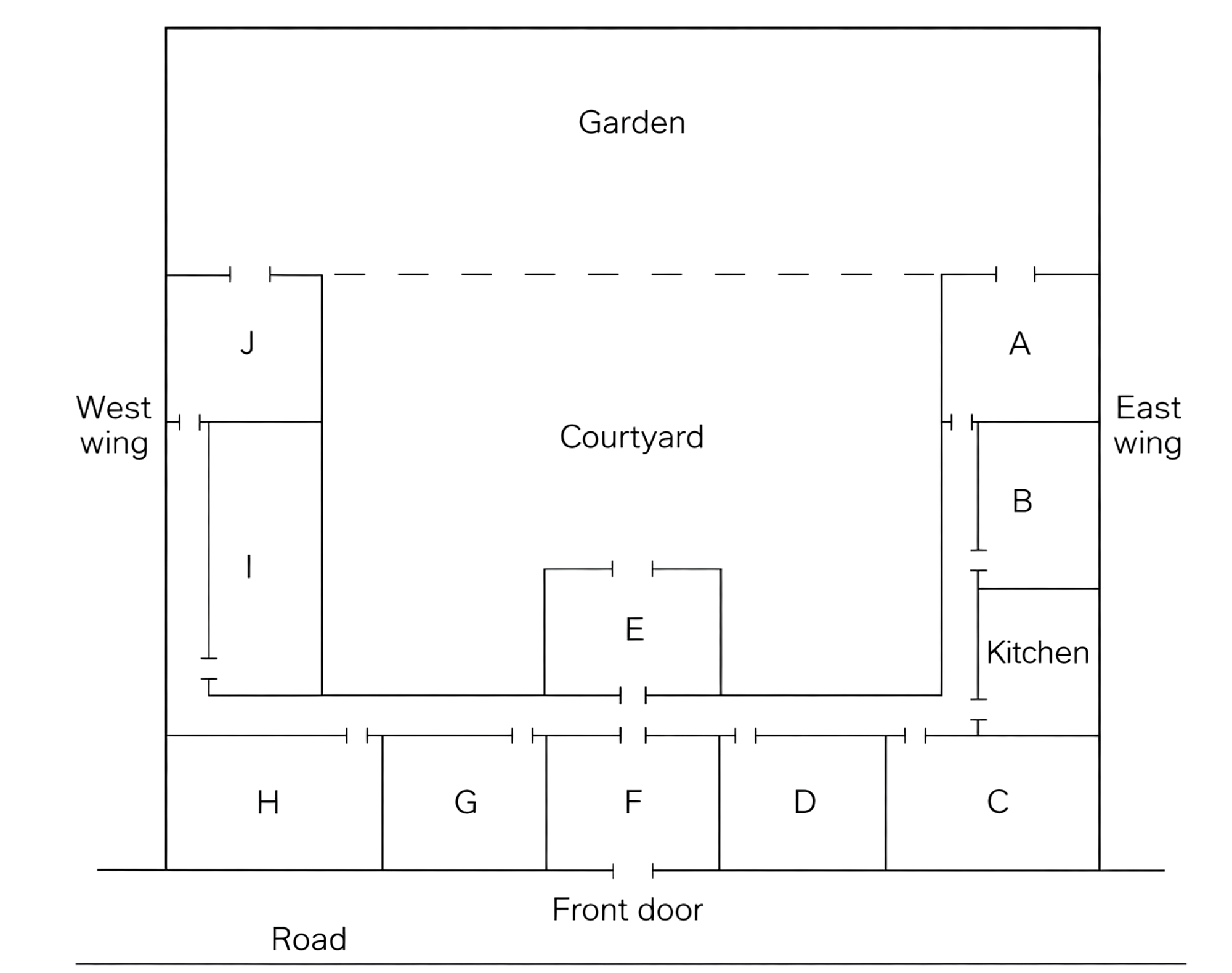
Here's a floor plan of the house. Ah, right. Now, I think it's really important to have a coffee lounge.
Do you agree? Definitely. What about having it in the corner room beside the existing kitchen?
It's the obvious place. But the front door opens into quite a big space and it would be nice and welcoming if people are there drinking coffee and chatting rather than walking into a large empty space. I see what you mean.
OK, I agree. I think it needs a technology room where people can access laptops or tablets and maybe get training too. Good idea.
How about the room next to the kitchen in the east wing? I'm not sure. It might be noisy or even have steam from the kitchen, which wouldn't be good.
Let's put it in the west wing, the room you go into just after the bend in the corridor. OK. What do you think about having a music room where people can download music and listen through headphones?
Yes, it'd be nice to be able to sit and listen and look out onto the courtyard and garden How about putting it at the far end of the west wing? There are quite large windows there and a door into the garden Right And maybe a TV room too? Maybe the first room to the right when you go in through the front door Shouldn't it be one of the larger rooms?
I don't really think so It could be quite cosy and people who want to watch different channels could use a computer or a tablet. OK, near the entrance then. What do you think about having a reading room with newspapers and magazines?
Uh-huh. Let's put that in the east wing next to the existing kitchen. People can look across the corridor into the courtyard. but if the kitchen's going to be renovated that room could become a canteen it's quite big no let's have the reading room at the far end of the east wing with a view of the garden right what do you think about having a meeting room essential i'd say i think that room that sticks out into the courtyard opposite the front door would be rather nice for meetings yes it's got a door out into the courtyard and light coming in on three sides.
Then the community centre will need a manager who'll need an office. Where shall we put that? Maybe the large room in the corner to the left?
Hmm, I think it'd be better to have it nearer the front door so the manager can keep an eye on people going in and out. I see what you mean. Okay, so the room on the left of the entrance area as you go in.
Yes, that'd be best. Anything else? I can't think of anything for the moment, but we can always come back to this later.
Before you hear the rest of the discussion, you have some time to look at questions 28 to 30. Now listen and answer questions 28 to 30. Let's sort out what we need to do before we start writing our report, shall we, Baz?
We should probably write a section in it about community centres in general, what sort of facilities they provide, how they're funded and so on. I wouldn't mind doing that, if that's OK with you, Lindy. All right.
And we need to look into the planning regulations to see how to get permission for changing the way the building's used. From residential to a community centre, you mean? Yes.
I quite fancy doing that. Fine. I've thought a bit about how to research the history of the house, starting when it was built in the 18th century.
It would be good if we could talk to some people who used to live there, or neighbours who knew it. Good idea. We can work on that together as it will be quite a big job to track people down, interview them, look at documents in the library's local history collection and so on.
That's fine by me.
That is the end of
section three.
You now have half a minute to check your answers. Thank you
Now turn to
section 4
Section 4. You will hear a lecturer talking about caves. First, you have some time to look at questions 31 to 33.
Now listen carefully and answer questions 31 to 33. If there is one natural feature which has long fascinated man, it is caves, those natural underground spaces into which people can enter. No known cave in the world can exist without it being extensively explored.
Whether it be in remote areas, such as the Clearwater Cave in Borneo, or immensely long and difficult, such as Mammoth Cave in America. Or perhaps the most challenging, those caves below the water table, full with water, in which case the exploration is known as cave diving. Whatever the case, if the caves are known, as complex and difficult as they usually are, they will be explored.
The formal name for the study of caves is speleology, and involves many disciplines such as chemistry, geology, biology and cartography or the science of making accurate maps since the largest caves can be hundreds of kilometres long and highly complicated. If the exploration is just for fun, the activity is known as caving. But with the difficulties and dangers involved, the average caver is often involved with one of these speleological sciences.
As for the number of caves in the world, research suggests that only a fraction have been found and documented, mostly in the areas in which caving has long been a popular activity, such as in America, France or Australia. China, for example, has huge areas of limestone bedrock, prime material for cave formation, and logically must contain among the largest number of caves in the world, Yet only few are documented due to the lack of interest in caving there. Thus, as exploration continues, new caves will be discovered and it is likely that the numbers could radically change in the future.
Before you hear the rest of the lecture, you have some time to look at questions 34 to 40. Now listen and answer questions 34 to 40. With caves being such mysterious and intriguing places, the obvious question concerns how they form.
The most common cause is the effect of slightly acidic water in a process called dissolution. Here, water seeps into the ground and down through rock masses. If this rock is soluble, the water dissolves some of it, and over time, the passage expands to become a cave or cave system.
The largest and most common of these involves limestone, although other materials are possible, including gypsum, marble and even salt. Now, if the cave is formed at the same time as the rock, it is called a primary cave, and the most common of these are lava tubes. When lava from volcanoes flows downhill, the topmost surface cools and solidifies first, leaving the hotter lava to continue to flow beneath.
If most of this eventually flows out, a hollow tube is left. The country, Iceland, has some excellent caves of this type, and even far-flung Australia has a few. Finally, there are sea caves, formed from waves pounding into coastal cliffs and eroding into fault lines or softer rock.
These caves are usually the shortest, about 50 metres at most since the erosive action of the waves can only reach a certain distance However, it is limestone caves which will always be the most interesting This is due to the presence of limestone formations As the groundwater seeps downward through the ceiling of the caves it encounters a different pressure and temperature causing it to deposit a small amount of its dissolved calcium carbonate. Over time, through the action of millions of drops, this deposition process results in ever-growing masses, known as stalactites, if hanging from the ceiling, or stalagmites, if growing from the floor. Alternatively, the water may flow over a large surface of rock, forming flowstone, and with other sorts of processes, can result in beautiful milky white formations of astonishing complexity.
One of the best examples of this, as well as of what surprising discoveries may yet await, is the Lechugula Cave in New Mexico. In the 1950s, some cavers heard the sound of wind underneath some large boulders on the cave floor, a clear sign of a deeper passageway. It took until 1984 for a group of cavers to gain permission to start digging, and two years later, in 1986, they broke through into a walkable passageway, unlocking one of the longest cave systems in the world, the deepest in America, and some of the most beautiful formations ever found.
Unusually, many of these were yellow with sulfur, suggesting that the caves were a result of hydrogen sulphide from nearby oil deposits. This was forced through fracture lines combining with existing groundwater to form sulphuric acid dissolving the limestone from the bottom up instead of the normal top-down seepage which characterises most limestone cave formations.
That is the end of
section 4.
You now have half a minute to check your answers
That is the end of the listening test In the real IELTS test, you would now have 10 minutes to transfer your answers to the answer sheet