显示原文
Section 1 You will hear a woman talking to a man who works in a tourist information office. First, you have some time to look at questions 1 to 6. You will see that there is an example that has been done for you.
On this occasion only, the conversation relating to this will be played first. Good morning. Can I help you?
I hope so. I have a friend in Spain, and her two daughters are coming to the city to study for a month. So I thought the Tourist Information Center was the best place to ask about hostels.
Can you recommend any? Of course. I usually suggest one of the hosteling international places.
H.I. West End is a big hostel in a residential area, but it's only 10 minutes from downtown if you take a bus. It's really popular.
The journey time is by bus, so bus has been written in the space. Now we shall begin. You should answer the questions as you listen, because you will not hear the recording a second time.
Listen carefully and answer questions 1 to 6. Good morning. Can I help you?
I hope so. I have a friend in Spain, and her two daughters are coming to the city to study for a month. Uh-huh.
So I thought the Tourist Information Center was the best place to ask about hostels. Can you recommend any? Of course.
I usually suggest one of the hosteling international places. H.I. West End is a big hostel in a residential area, but it's only 10 minutes from downtown if you take a bus.
It's really popular. Okay, sounds good. I need to know how much it costs.
The girls want a double room to themselves. They don't want to share with other people. That makes it more expensive.
The price is under $30 for a bed in a dormitory, but they'll be paying $50 a night. But if they become members of Hostelling International, the price comes down to $41 a night. Membership costs $35.
Right. And membership offers them benefits, too, on all kinds of activities. Oh.
What kind of things? Oh, skydiving and whitewater rafting, things like that. Hmm.
I don't think they're interested in that kind of thing. If they become members, will they get cheaper entrance tickets to museums? Oh, yes.
And also discounts on bicycle and car hire. Okay. It's probably worth it.
Is the hostel very noisy? They're coming here to do some studying. I think it is quite noisy as it's a really big hostel.
And if they want to use the Internet, this hostel still makes a charge, unfortunately. It's $1 for 15 minutes and $3 for an hour. It might not be ideal for them.
What else can you recommend? Is there anything in a quiet area? There's Ellis Goat Hostel.
Hmm. How do you spell that? E-L-L-I-S-C-O-A-T.
I've never heard that name before. And where is that? It's on the beach looking over the bay.
Here, look on the map. Oh. It's quiet, but not far from Dragon Island.
There's plenty going on there in the evening. Oh, that's a nice area. And if they want to go to Dragon Island, it only takes a couple of minutes to walk down to the ferry.
Mm-hmm. So how much is a room there? It's in such a nice spot that the rooms are a bit more expensive.
Mm-hmm. They're $62. Does that include any meals?
Unfortunately not. Oh. It is possible to buy meals in the hostel at a reasonable price, but because it isn't very busy in the winter, they only cook in summer.
Now listen and answer questions 7 to 10. Oh, I think I know the place you mean. It's an old building, isn't it?
Yes, it's well known as it's one of the oldest in the city. There's been a hotel there since 1887 when it was first built. It was turned into a hostel in 1985, and they've invested a lot of money restoring it inside.
Hmm, they'd like that. But I'm just looking on the map at where their college is. It's right in the center.
It is a bit far for them from there. The hostel actually has scooters for hire at a very good price, so they could do that. Uh, it would be quicker than cycling or walking to the center.
Hmm. It is a bit expensive, but it sounds like the best one so far, unless there's something a bit cheaper. Okay.
Uh, well, what about the Backpackers Hostel? That's not so expensive. It's in a side street in the entertainment district.
Uh. They wouldn't need to go far to find everything they want. They could walk everywhere.
And it's very reasonable. Only $45 and another $5 if they want to have breakfast. But what about other meals?
There's no cafe, but on each floor in this hostel, there's a kitchen for residents to cook in. I'm not sure how well equipped they are, but it should be fine for basic meals. Well, that's really very helpful.
I'll pass all this information on now. Do ask your friends to ring me if they need to know anything else. I will.
Thank you. End of
section one.
You now have half a minute to check your answers. Part 2 You will hear a school principal talking to a group of parents who are volunteering at a school fair. First, you have some time to look at questions 11 to 14.
Now listen carefully and answer questions 11 to 14. Good evening and thank you for coming to the Kenvale School Fair Volunteers Meeting. As you know, this is the biggest fundraising event in the school year, and as usual we're expecting lots of people to come which is why we're starting to prepare now six months before the big day.
I'll begin tonight by talking about the different volunteer roles so you can decide what you'd like to do. The entertainment coordinator position involves deciding what kinds of rides and activities will be at the fair and making sure there's a good variety of things to do. From past experience, this role involves a lot of liaising with other helpers and the entertainers, which means that most of the work is done after office hours.
We need an advertising and promotion coordinator to make sure that people hear about the fair and lots of people come. We know this is a big job, so we've decided to have a couple of people doing it to share the load. The parent who did this role last year has just been offered a job, which starts next month, so she won't be able to lend us the benefit of her experience, sadly.
The technical coordinator makes sure that there is a suitable stage for the performers and that there are enough speakers and people can hear them and so on. Now, this may sound like a technical background is required, but it's not, as you don't actually have to set up or fix anything yourself. Having a car is essential though because in the week leading up to the event you'll need to be able to get to the school early in the mornings and occasionally later at night.
We also need a staffing coordinator. This person will be required to look after the many helpers on the day of the fair. This role has just been created based on our experience of last year's event.
We found that our volunteers felt a bit overworked, and so we're hoping that this role will make things easier. It will help to reduce stress if you organize the helpers about a month before the fair. Before you hear the rest of the talk, you have some time to look at questions 15 to 20.
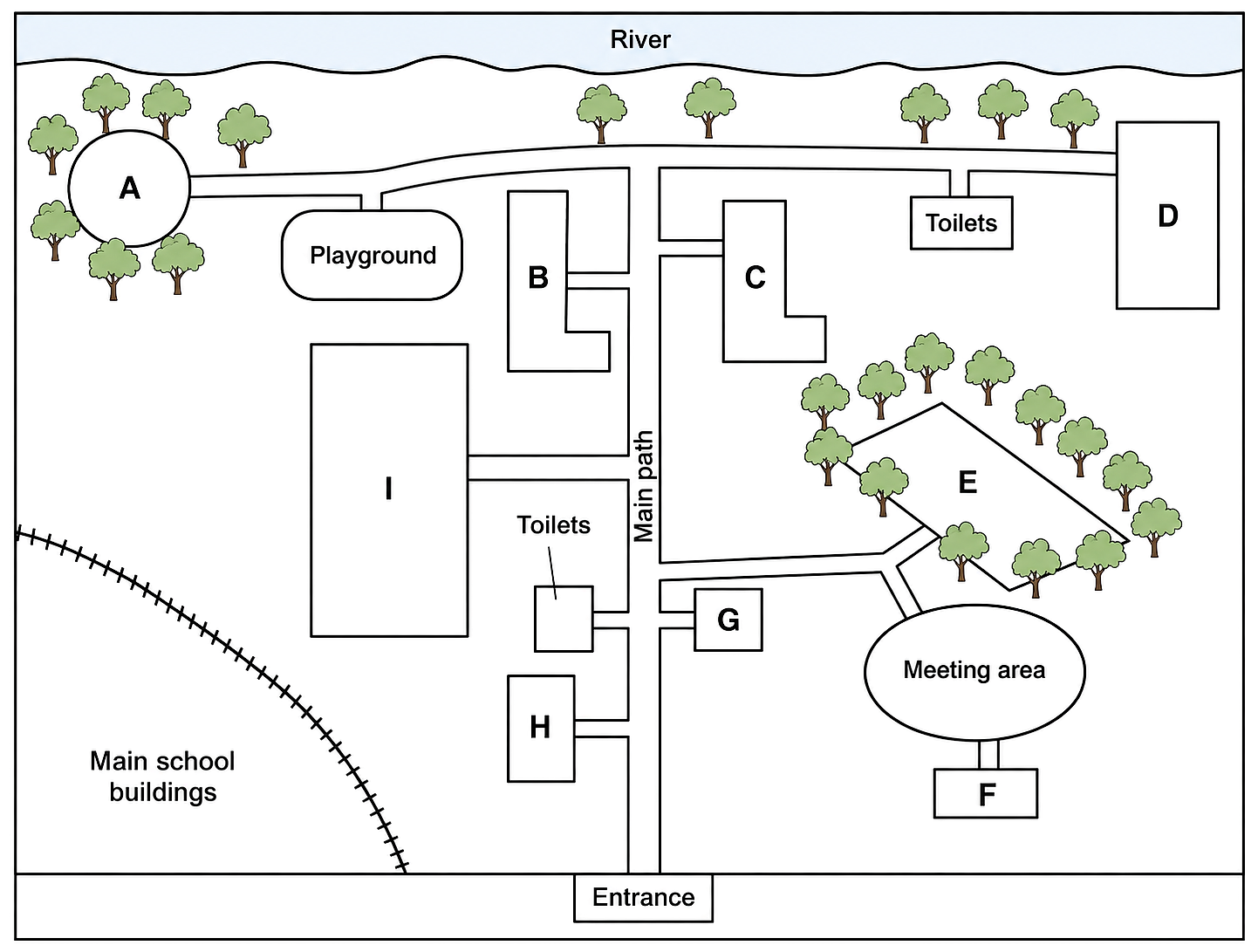
Thank you. Now, moving on to the map of the school fair, I'll point out some of the more important areas that you'll need to know about so you can help direct the visitors. You can see that we'll be using the large grounds just behind the school, and we'll set up temporary areas and pathways there.
The first thing I'll show you are the fairground rides, which are always popular with the children. If you look at the map, you'll see the fair entrance at the bottom. From there, follow the main path in the direction of the river, and it's the third area on the left, the large rectangular area.
The entertainment stage is a big feature of the fair, and this is where everyone will be able to see all the performers. To find this, go straight along the main path until you get to the river. right and follow the path to the end, and there it is. There's not much shade here, so we should remind parents to bring hats for their children.
If anyone wants a cold drink or a snack, then they'll ask you where the cafe is. Originally, we were going to put it opposite the toilets, but we've decided to put it near the river to take advantage of the views and breezes. You can see it on the map.
It's a circular area, surrounded by trees, near the playground. The first aid tent is always an important part of the fair. We wanted to put that in an area that was easily accessible and a bit separated from the other attractions, but near the entrance.
If you look at the map, you'll see it south of the toilets, not far from the school fence line. The market stalls are where visitors will be able to pick up a bargain or some homemade produce. Last year these were located just south of the meeting area, but the stallholders complained that it was too exposed and hot.
So this year we've moved them to the north of the meeting area. Lots of good shelter provided by the trees here. Of course, they'll be the ever-popular pony rides.
To reach these, direct visitors to follow the main path from the entrance until they reach the L-shaped area on the left, next to the playground. Now, as always said,
That is the end of part two. You now have 30 seconds to check your answers to part two. Part 3 You will hear two students called Jeannie and Dan discussing some research on the effects of music on consumer behaviour.
First you have some time to look at questions 21 to 26 Now, listen carefully and answer questions 21 to 26. Hi, Dan. How's it going?
Hello, Jeannie. Pretty well, thanks. Have you finished your research yet?
Yes, it's all done. I've spent several weeks on it, from the very beginning of deciding the topic to carrying out the research and writing the essay. Congratulations.
Seems like a big project. I know the research has to do with music, but what is it exactly about? Well, at first I didn't have a specific purpose until one day I read a report that said, if appropriate music is played while people are eating, It may cause some changes in their behaviour, but the report didn't illustrate the changes in detail.
So, I wanted to carry out a thorough investigation into this. That's quite unique. So, how did you conduct your research?
I started by looking for five different restaurants and then went to each of the restaurants to order some food and observe other people. I mainly focused on how the music is played instead of how people eat. Findings of my observations indicate that the five restaurants have something in common.
They all have a special section to play the music. More importantly, although the music is played at different times, the volume is unchanged. Sounds attractive.
I've never read anything about this before. In addition to observation, what other research methods have you used? I also distributed the survey questionnaire to people dining there.
What questions are posed in your questionnaire? Well, the first section of the questionnaire asks subjects to indicate the number of times they have been to the restaurant previously, the number of people they dine with, and whether they think they will return to the restaurant. These early questions don't involve musical preferences. but largely act as distractors, the intention being that subjects will be less inclined to think that the survey is about the music being played.
That sounds very reasonable. Did you design the questionnaire by yourself? Actually, no.
I read an assignment a student wrote last year, which was just kept beside a dictionary in the library. I came across it when I was looking something up in the dictionary. Oh, you were so lucky.
Is there any other question included in the questionnaire? Yes. Subjects are also asked why they choose to dine at a particular restaurant.
Several reasons are listed in the questionnaire. I thought people would put service first, but that's not the case. Only about 12% of them have chosen this reason, while the majority of respondents think whether they will pick this restaurant depends on how many available seats it has.
They think it's terrible to eat in a crowded place. Yes, everyone wants to enjoy a meal comfortably. Then I guess maybe the location of a restaurant is an important factor, since no one likes to waste too much time on the way?
It used to be, but nowadays nearly every household has a private car, so they don't have to be worried about the traffic problem. What I find interesting, however, is that a large percentage of people say they will compare different restaurants in the neighbourhood on the Internet first. If one of them stands out from its rivals, they will choose it.
Wow, that's really interesting. Before you hear the rest of the discussion, you have some time to look at questions 27 to 30. Now, listen and answer questions 27 to 30.
What else there? Well, the second section of the questionnaire asks subjects to respond to the music being played by rating so that the relationship between music and perceived atmosphere could be examined directly. As a means of examining purchase intention, the final section of the questionnaire asks them to indicate the maximum amount of money they are prepared to spend on their main meal.
So, what have you finally discovered? I collected all the questionnaires and analyzed people's answers to get a clear idea of their reactions to different music conditions. The result shows that music has become an indispensable part of restaurants.
If people find there isn't any music during the meal, they will think the restaurant charges too much. Yes, now music is everywhere in our life. Is there any difference in people's attitudes towards different musical styles?
Yes. Most people think that if jazz is being played when eating, they tend to stay at the restaurant longer and order more food to enjoy the music. But this is quite the opposite of what happens when classical music is played.
Many customers think if the restaurant plays classical music, they wouldn't like to stay there for another minute. but to finish the food quickly and hurry away because they don't like this type of music at all. And lastly, about pop music. It's very popular these days, especially among young people, as I've noticed in restaurants.
They like listening to this type of music during their meals. As a result, this greatly increases the possibility of their presence at the same restaurant. Great.
I've learned a lot from your research. I think is meaningful and innovative. Thanks for telling me, Jeannie.
You're welcome, Dan.
That is the end of Part 3. You now have 30 seconds to check your answers to Part 3. Thank you
Section 4. You will hear a lecturer in education describing some research into the humor of young children. First, you have some time to look at questions 31 to 40 on page 7.
Thank you. Now listen carefully and answer questions 31 to 40. We all think we know what makes children laugh, but can we really explain it?
And is it useful for educators to be aware of how children's humour works? Well, to answer these questions, I'd like to tell you about the large-scale study on the humour of primary school children that I was commissioned to carry out two years ago. The aim of the study was to find out what children find funny in their everyday lives, both at school and at home.
We wanted to know how children used humour to interact with each other. For example, when they were in the playground, we wanted to know what sort of jokes they told one another and which ones were most popular. Some research was done in this area about 50 years ago, but it's never been followed up, so that's one area that we wanted to find out more about in our research.
And we also wanted to find out about what children find funny when they're at home watching television, since many children spend quite a significant amount of time doing this. So how did we go about finding out this information? well we interviewed a total of 150 children in six different primary schools around the city we had originally intended to have one-to-one interviews but we decided that this would be too time-consuming and also might be stressful for the children so instead each interviewer had several groups, each consisting of three or four children. They were asked questions like, what was the last thing that made you laugh, and do you know any funny stories?
Then another method we used to collect information about what makes children laugh was through the use of humour diaries. So we asked the parents of some of the children in which their children had laughed. So what were the main findings?
Well, some of them weren't quite what you'd have expected. You'd think that people laugh when things are funny, but that's not always the case. One thing we found was that children nearly always laugh if they're in a situation which is unfamiliar to them.
They're a bit nervous because they're not sure what sort of action it's appropriate for them to take, so they laugh. Another type of situation in which we found children often laughed was when people did things which were surprising. If someone's walking down the street with a dog on a lead, that's quite unsurprising, but if someone's got a chicken on a lead, the child will laugh because the usual conventions that govern our behaviour aren't being followed.
It's funny because it's surprising. Another interesting area is what sort of person makes children laugh most, and here we found that nearly all primary school children find situations particularly humorous if they involve people looking foolish, and particularly if these are adults. The children probably find this empowering to see them at a disadvantage for once.
One thing that was observed frequently in the humour diaries was that laughter often erupted spontaneously during pretend games and role-play. Our research showed there's a strong link between laughter and being creative. It's an area that's received little attention to date, maybe because this type of humour isn't often observed in research situations. as well as these there were other findings that we made during the research process one quite surprising finding was the fact that when looking at what children find funny there seems to be hardly any difference between boys and girls so the children's gender doesn't seem to be significant boys sometimes show a slight preference for physical humor but there's nothing much in it.
For educators, as well as for those involved in children's media, it's worth stressing that children still find many of the same things funny as they did in the past. There hasn't been much change in what they laugh at over the years. If you look at what makes children laugh in the 21st century, there's really not much difference from what made their grandparents laugh in the 20th century.
They still react positively to the same sort of things. So, for example, in the media, they enjoy humour which is non-verbal, where the humour comes from pictures rather than words. And one of the most striking findings that came out of our research, both the interviews and the diaries, is that just as in their grandparents' generation, what children find incredibly funny is humour that is founded on some kind of danger.
The fact that they know it isn't real gives them permission to laugh somehow. So what we can conclude from all this is that humour is incredibly important to children. It plays a crucial role...