显示原文
====================
IELTS Listening Transcript
====================
PART 1
Speaker 0: Hear a woman talking on the phone to a furniture company.
Speaker 0: First, you have some time to look at questions one to five.
Speaker 0: Now we shall begin.
Speaker 0: You should answer the questions as you listen because you will not hear the recording a second time.
Speaker 0: Listen carefully and answer questions one to five.
Speaker 1: Good afternoon. Katie Furniture. Can I help you?
Speaker 2: Oh, hello. Yes. I'm setting up a new office, and I don't have Internet access yet, but I'd like to place an order for some furniture.
Speaker 1: That's fine. You can do it over the phone, and I can fill in the form for you this end.
Speaker 2: Oh, great. Thanks.
Speaker 1: I just need to take a few customer details first, if that's okay.
Speaker 2: Yes. Fine.
Speaker 1: What name is it?
Speaker 2: My name? Yes. Oh, it's Sue Brown.
Speaker 1: Sue Brown. Thanks. And what's the name of your company, Miss Brown?
Speaker 2: It's a clothing company. It's called Dress Your Best.
Speaker 1: Okay. I'll just note that down. Dress for best.
Speaker 2: No. Your best.
Speaker 1: Oh, right. Got it. So you make smart clothes?
Speaker 2: Yes. Formal dress for weddings and special occasions. We also repair and alter clothes.
Speaker 1: I see. And where are you located? What's your postal address?
Speaker 2: Right. Well, we're on Kirby Trading Estate.
Speaker 1: Kirby. How do you spell that?
Speaker 2: It's K-I-R-B-Y.
Speaker 1: Oh, I know that area. It's New Hampton Road, isn't it?
Speaker 2: Yes. That's right. Number 210 in South Down.
Speaker 1: Okay. And can I have a contact number for our delivery man?
Speaker 2: Sure. It's probably best if I give you my mobile number.
Speaker 1: Okay.
Speaker 2: The number's 09356788545.
Speaker 1: Okay. 778.
Speaker 2: No. 788545.
Speaker 1: Okay. That's great. Now just a couple more questions before I take your order.
Speaker 2: Fine.
Speaker 1: We have two delivery dates this month, and you should be able to have either. When are they? Well, there's one on the sixteenth of the month, but there's a charge of $40 for that one.
Speaker 2: Oh, that's a lot.
Speaker 1: Or there's option two, which is the end of the month. I'll have to confirm the date later, and that's a free delivery.
Speaker 2: I'll take option two. Thanks. I don't want to pay a charge.
Speaker 1: Okay. I'll note down no charge.
Speaker 2: We haven't organised the office yet, so there should be plenty of time.
Speaker 1: Mhmm. And lastly, you don't have an account with us, so how would you like to pay?
Speaker 2: I'll pay by credit card.
Speaker 1: Okay. Will that be Visa?
Speaker 2: Is American Express okay?
Speaker 1: Absolutely fine.
Speaker 0: Before you hear the rest of the conversation, you have some time to look at questions six to 10.
Speaker 0: Now listen and answer questions six to 10.
Speaker 1: So what would you like to order?
Speaker 2: Well, I've been looking in your catalogue, and you have some office chairs that look very comfortable for our type of work. Is there an item code?
Speaker 1: Yes. It's ASP 23.
Speaker 2: Okay.
Speaker 1: Those chairs come in pink, white, and black.
Speaker 2: Yes. The pink looks nice, but I think the darker color is better for us. You can see light materials on it more easily.
Speaker 1: That's true.
Speaker 2: We'll have five of those, I think.
Speaker 1: Okay. I've got that. Anything else?
Speaker 2: Do you have any striped mats?
Speaker 1: I'm sorry. Not at the moment. They're out of stock. We should have some in next month.
Speaker 2: Never mind. Well, I'd also like two of your glass desks. They're lovely, aren't they?
Speaker 1: Yes.
Speaker 2: You seem to have two sizes.
Speaker 1: Basically, large or small. I think the code for the small ones is...
Speaker 2: I think we'll have the large ones. The code here is TG586.
Speaker 1: Okay. So that's two glass desks. Any lamps for those?
Speaker 2: No. We have to get special lamps for our work.
Speaker 1: Oh, I see. Do you have another supplier for those?
Speaker 2: Yes. We do need some furniture for our customers, though.
Speaker 1: Okay. For a waiting area or something?
Speaker 2: Well, we have to discuss the work with them, so we need a nice sofa. Something soft and I thought leather.
Speaker 1: Ah, yes. A good choice.
Speaker 2: There's a three seater here, DFD 44. That seems to be in red, cream, or chocolate brown.
Speaker 1: Yes. It does come in yellow as well.
Speaker 2: Yellow. I'd thought of red, but that sounds lively. Yes. I'll have that color. I think brown's a bit too dull and cream shows the dirt too much.
Speaker 1: Yeah. You're right. Anything else? A coffee table perhaps?
Speaker 2: Yes. I think so. Maybe TX 22, the silver one.
Speaker 1: A very good choice.
Speaker 2: Well, that's it, I think.
Speaker 1: Okay. I'll just add that up for you and then take your credit card details.
Speaker 0: That is the end of section one. You now have half a minute to check your answers.
PART 2
Speaker 3: Now listen carefully and answer questions 11 to 17.
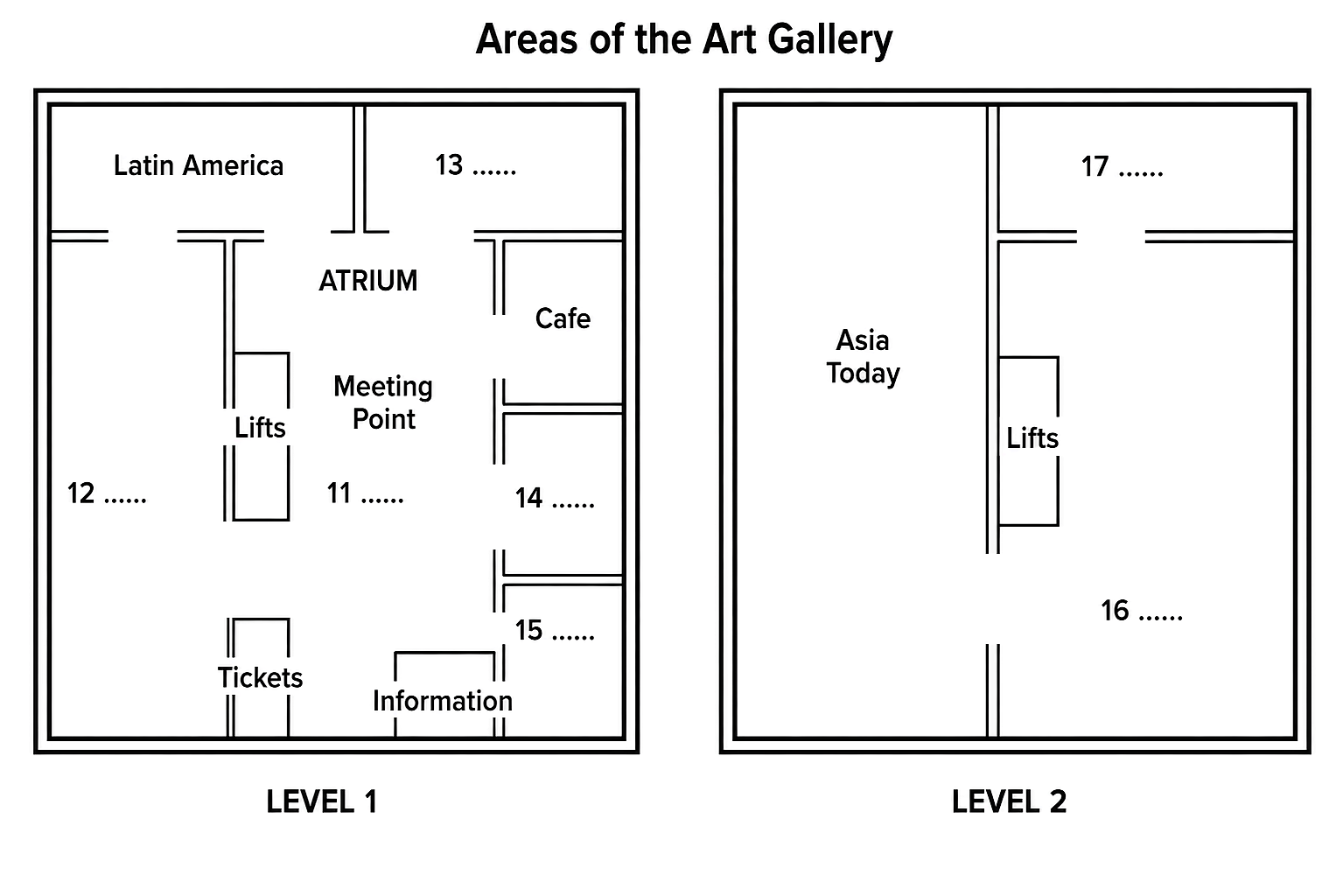
Speaker 4: Welcome to the Modern Art Gallery. It is my pleasure to introduce you to the various sections of the gallery. The gallery consists of two levels. As you can see from the map, we are in the large atrium on Level 1 at the meeting point. First of all, I'll tell you about the exhibits on this level. In this room, you will find an exhibition of our very own heroes. Told in photographs, paintings and memorabilia, this is a great starting point if you want to find out more about the people who have played an important role in our city. Between the ticket booth and lifts, you'll find the entrance to the other major display on this level. All the works featured here are by modern artists who have won awards in the last few years. Recent winners such as Martelli and Kashiwagi are on display, and I suggest you take advantage of it while it's here. If you like sculpture, then please visit our section called Latin America in the far corner. There's an excellent collection of two of Colombia's finest. Sculptures by Morales and Alvares are rarely not to be missed. One of my favourite areas on the first level is for our younger visitors. The resident art teacher is here throughout the school holidays to help your children create a piece of art in the learning zone. You'll find it between the Latin American exhibition and the cafe. On the right here, you'll find the Gallery Cafe, which serves drinks and light meals throughout the day. If you have membership at any of the galleries or museums in the city, you can make use of the section reserved for members just next door, which has views of the lake and an excellent menu. Before you make your way to the second Level, you might like to take a look at the books and prints on sale in the shop located next to the information desk. Gift certificates and membership packages can be bought there. Now let me introduce the second level of the gallery. As you step out of the lifts, you come into the largest exhibition in the gallery. From World War one to the present day, this exhibition shows how photographers have responded to some of the most important local and global events in history. On the other side of the lifts is another permanent exhibition called Asia Today. Divided by region, you will experience work from the best Asian artists. And last but not least is one of the most innovative areas of the gallery, our permanent movie theatres. This cinema has two theatres showing films every two hours throughout the day. This month, we feature European filmmakers in the genre of animation from the millennium year to present day.
Speaker 3: Before you hear the rest of the talk, you have some time to look at questions 18 to 20.
Speaker 3: Now listen and answer questions 18 to 20.
Speaker 4: If you have a full day to spend, there are several excellent museums in the city. In the same complex as this gallery, you'll find the Natural History Museum, which has an excellent collection of gemstones. For those of you with children, though, the best option is the recently upgraded Science Centre, just next door to the Maritime Museum on the Quayside. If you are here with the family, and you do intend to visit more than one museum, I definitely recommend purchasing the Family Pass, as this will work out much cheaper and is a really good deal. You can visit two museums in one day, providing there is an adult in the group with between two and four children 16. If you were here for a week or so, and you would like to visit several museums or galleries, you might consider the Culture Pass. This allows unlimited entry for two adults to all galleries for three days. You will save a lot by doing this, and you could revisit any of the galleries if you like. It's also really good value, as it covers travel on the routes between the museums on weekdays, as well as the entry fee, so you save on transport too. We hope you enjoy your visit today, and continue to support us if you have any questions.
Speaker 3: That is the end of part two.
PART 3
Speaker 5: Part three. You will hear a business student called Laura talking to her tutor about some research she is planning to do on employee absence. First, you have some time to look at questions 21 to 24. Listen carefully and answer questions 21 to 24.
Speaker 6: Hello, Laura. Have a seat.
Speaker 7: So I understand you're planning to investigate absence from work for your research project.
Speaker 6: That's alright.
Speaker 7: I'm going to base it on a local company called Burkock Engineering.
Speaker 6: Is there any particular reason why you've chosen Burkock?
Speaker 7: Well, I'd originally thought of asking another company, FG Engineering, because I did my placement there and I knew the staff there, but the CEO wasn't very keen. But she knows the managing director at Burcock, and she spoke to him, and then he got in touch with me. Apparently, absence is a major problem there, so he's quite interested in having it investigated.
Speaker 6: Okay.
Speaker 7: So my central theme is absence, but I'm thinking of concentrating on long term absence. I thought that might allow me to give more helpful feedback to the company.
Speaker 6: If I were you, I wouldn't be that specific. I'd look at absence as a whole. You might get more interesting results.
Speaker 7: Oh, okay.
Speaker 6: So what's the main thing you expect to find? Rises in absence rates over time?
Speaker 7: Not really. Initially, I wondered if workers often take time off without real justification, but I think that'll be hard to determine. So, well, I think I may find that it's something to do with what sort of job the employee is doing.
Speaker 6: Okay. Now have you thought how you'll get your information?
Speaker 7: Well, first of all, I need access to the company records.
Speaker 6: Yes. Obviously, you'll need overall absence figures, though it's unlikely they'll let you have them for individual workers. And you probably won't have access to personal information like when they were born, but you should be able to use anonymous details like the type of work they do or how long they've been with the company.
Speaker 7: Okay.
Speaker 5: Before you hear the rest of the discussion, you have some time to look at questions 25 to 30.
Speaker 5: Now listen and answer questions 25 to 30.
Speaker 6: So let's think a bit more about your questionnaire.
Speaker 7: I know that it shouldn't be too long or people get bored.
Speaker 6: No. But if it's too short, you don't get enough information.
Speaker 7: The trick is to get the balance right. I think the questions should be closed questions too. I mean, where people choose an answer from a list.
Speaker 6: But then you miss the chance of getting unexpected information, so I'd include one or two open ended questions too.
Speaker 7: Okay. And I won't ask for names or addresses or anything.
Speaker 6: No. It needs to be anonymous. And after you've drafted it, you need to give it to at least one person to check there aren't any problems. So you need to leave enough time for that and any revisions necessary.
Speaker 7: What about the covering letter that I'll send out with the questionnaire? I'll need to introduce myself and explain what the questionnaire is for, but what else should I include?
Speaker 6: I'd reassure people that the survey isn't going to be used to assess them personally. Otherwise they might choose not to take part.
Speaker 7: Yes. I'll make that clear. And what about when they do it? Will they be allowed to use work time?
Speaker 6: That's really up to their manager, but you should say roughly how much time it'll take.
Speaker 7: Okay.
Speaker 6: So now you need to produce a schedule with dates, for example, when you'll send out the questionnaire.
Speaker 7: Yes. Okay. Once I can arrange that date with the manager, I'll be able to fix the deadline for getting the completed questionnaires back. And I want to use the time in between to analyse the figures that HR is going to give me from their database, though they haven't said exactly when I'll get them.
Speaker 6: And you have to submit your assignment by the end of June?
Speaker 7: Actually, I have to get it finished by the second because I've arranged a work placement after that.
Speaker 6: Okay.
Speaker 7: So our next meeting is two weeks today. Is that still okay?
Speaker 6: Yes. And in the meantime, I'll send you an...
Speaker 5: That is the end of part three. You now have thirty seconds to check your answers to part three.
PART 4
Speaker 8: Section four. You will hear a talk on the research of the behavior of chimpanzees. First, you have time to look at questions 31 to 40. Now listen carefully and answer questions 31 to 40.
Speaker 9: Welcome back to my series of short lectures on apes. Today, we will examine recent and historical breakthroughs on the behavior of chimpanzees, otherwise known as chimps. The word chimpanzee is an umbrella term for two different species of apes in the genus Pan, which are the common chimpanzee or pan troglodytes found in West and Central Africa, and the bonobo or pan paniscus, which are found in the forests of the Democratic Republic of the Congo. Chimpanzees belong to the Hominidae family together with gorillas, orangutans, and indeed humans. Current research tells us that the chimps broke away from the human branch of the Hominidae family approximately six million years ago and remain the closest living relative to humans to this day. More modern researchers into chimpanzees have centered on their behavioral characteristics once all biological and genetic factors have been ruled out. In this way, scientists have unearthed an unfathomable amount of similarities between human and chimpanzee behavior. Although much of this research has taken place through observation of captive chimps, the results are widely seen as an authoritative reflection of chimps living in the wild. Chimps live in large so-called communities comprised of many male and female members, with the social hierarchy determined by an individual chimp's position and influence. Through such research, scientists have found that chimps learn and adapt through observation of others' behavior. Once in power, the alpha male is often seen to alter its body language in order to retain power. For example, he might puff himself up in order to intimidate others, while lower ranking chimps are noted to behave more submissively and holding out their hands while grunting. Female chimpanzees also have a distinct social hierarchy with high social standing inherited by children. It is not unheard of for dominant females within a community to unite and overthrow the alpha male, backing another in his place. James Diamond, in his book, The Third Chimpanzee, suggests that chimps should now be reclassified in the genus Homo instead of Pan, and there are many arguments still in favor of this. Male common chimpanzees are on average 1.7 meters in height, weighing 70 kilograms, with their female counterparts being somewhat smaller. By comparison, the bonobo is slightly shorter and lighter, but with longer arms and legs. However, both species walk on all fours and climb trees with great ease. Jane Goodall made a groundbreaking discovery in 1960 when she observed the use of tools among chimpanzees, including digging for termites with large sticks. A recent study claimed to reveal that common chimpanzees in Senegal have been using spears sharpened with their teeth to hunt. However, these reports remain unsubstantiated. Researchers have witnessed such tools, namely rocks, being used by chimps to open coconut shells and indeed crushing nuts with stone hammers. As scientific technology has developed, so too has our knowledge of the sheer extent of the chimps' intelligence. Research has now shown that chimps have the capability to learn and use symbols and understand aspects of the human language, including syntax as well as numerical sequences. As I mentioned earlier, the umbrella term chimpanzee is comprised of the common chimpanzee and the bonobo. These two subspecies are divided along the Congo River, with the common chimps living on one side and the bonobos living on the opposite side of the river. Over the past few decades, both of these subspecies have witnessed an alarming decrease in population density, with animal activists now working harder than ever to protect those remaining and encourage procreation. In addition, next week's episode will focus more closely on how chimpanzees in captivity are able to learn things through imitating the behavior of humans, as well as how chimpanzees' behaviors have developed over many generations. Thank you very much for attending this evening's lecture. I hope you found it intellectually stimulating, and I look forward to seeing you again next week. Good night.
Speaker 8: That is the end of section four. You now have half a minute to check your answers. That is the end of the listening test. In the IELTS test, you will now have ten minutes to transfer your answers to the answer sheet.