Bu set hakkında: Gerçek sınav materyalinden, sınava girenlerin hatırladıklarından derlenmiş ve hafifçe düzenlenmiştir. IELTS, küresel bir soru havuzundan seçer, bu nedenle bu materyal dünya çapında dolaşır. Size tam, uygulanabilir bir test sunmak için, aynı dönemde raporlanan materyaller bir araya getirilmiştir — yani bir set, tek bir sınav oturumundan değil, birkaç sınav tarihinden içerik içerebilir. Herhangi bir ses kaydı pratik amaçlı yeniden yaratılmıştır. Çalışmayı kolaylaştırmak için düzenlenmiştir. Sınava girenlerin hatırladıklarına dayalıdır — resmi IELTS materyali değildir.
Reading Passage 1: Termite Mounds
To most of us, termites are destructive insects which can cause damage on a devastating scale. But according to Dr Rupert Soar of Loughborough University’s School of Mechanical and Manufacturing Engineering, these pests may serve a useful purpose for us after all. His multi-disciplinary team of British and American engineers and biologists have set out to investigate the giant mounds built by termites in Namibia, in sub-Saharan Africa, as part of the most extensive study of these structures ever taken.
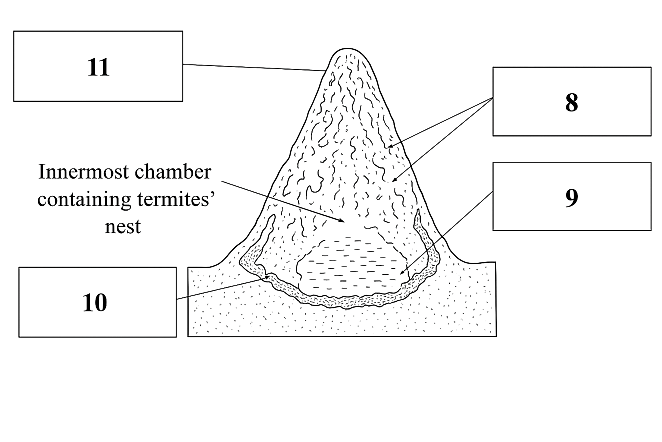
Termite mounds are impressive for their size alone; typically they are three metres high, and some as tall as eight metres have been found. They also reach far into the earth, where the insects ‘mine’ their building materials, carefully selecting each grain of sand they use. The termite's nest is contained in the central cavity of the mound, safely protected from the harsh environment outside. The mound itself is formed of an intricate lattice of tunnels, which split into smaller and smaller tunnels, much like a person’s blood vessels.
This complex system of tunnels draws in air from the outside, capturing wind energy to drive it through the mound. It also serves to expel spent respiratory gases from the nest to prevent the termites from suffocating, so ensuring them a continuous provision of fresh, breathable air. So detailed is the design that the nest stays within three degrees of a constant temperature, despite variations on the outside of up to 50°C, from blistering heat in the daytime to below freezing on the coldest nights. The mound also automatically regulates moisture in the air, by means of its underground ‘cellar’, and evaporation from the top of the mound. Some colonies even had ‘chimneys’ at a height of 20m to control moisture loss in the hottest regions of sub-Saharan Africa.
Furthermore, the termites have evolved in such a way as to outsource some of their biological functions. Part of their digestive process is carried out by a fungus, which they ‘farm’ inside the mound. This fungus, which is found nowhere else on earth, thrives in the constant and optimum environment of the mound. The termites feed the fungus with slightly chewed wood pulp, which the fungus then breaks down into a digestible sugary food to provide the insects with energy, and cellulose which they use for building. And, although the termites must generate waste, none ever leaves the structure, indicating that there is also some kind of internal waste-recycling system.
Scientists are so excited by the mounds that they have labelled them a ‘super organism’ because, in Soar’s words, “They dance on the edge of what we would perceive to cool down, or if you’re too cold you need to thrive: that’s called homeostasis. What the termites have done is to move homeostatic function away from their body, into the structure in which they live.” As more information comes to light about the unique features of termite mounds, we may ultimately need to redefine our understanding of what constitutes a ‘living’ organism.
To reveal the structure of the mounds, Soar’s team begins by filling and covering them with plaster of Paris, a chalky white paste based on the mineral gypsum, which becomes rock-solid when dry. The researchers then carve the plaster of Paris into half-millimetre-thick slices, and photograph them sequentially. Once the pictures are digitally scanned, computer technology is able to recreate complex three-dimensional images of the mounds. These models have enabled the team to map termite architecture at a level of detail never before attained.
Soar hopes that the models will explain how termite mounds create a self-regulating living environment which manages to respond to changing internal and external conditions without drawing on any outside source of power. If they do, the findings could be invaluable in informing future architectural design, and could inspire buildings that are self-sufficient, environmentally, and cheap to run. ‘As we approach a world of climate change, we need temperatures to rise,’ he explains, ‘there will not be enough fuel to drive air conditioners around the world.’ It is hoped, says Soar, ‘that the findings will provide clues that aid the ultimate development of new kinds of human habitats, suitable for a variety of arid, hostile environments not only on the earth but maybe one day on the moon and beyond.’
- 1
Paragraph A
- i. methods used to investigate termite mound formation
- ii. challenging our assumptions about the nature of life
- iii. reconsidering the termite’s reputation
- iv. principal functions of the termite mound
- v. distribution of termite mounds in sub-Saharan Africa
- vi. some potential benefits of understanding termite architecture
- vii. the astonishing physical dimensions of the termite mound
- viii. termite mounds under threat from global climate change
- ix. a mutually beneficial relationship
- 2
Paragraph B
- i. methods used to investigate termite mound formation
- ii. challenging our assumptions about the nature of life
- iii. reconsidering the termite’s reputation
- iv. principal functions of the termite mound
- v. distribution of termite mounds in sub-Saharan Africa
- vi. some potential benefits of understanding termite architecture
- vii. the astonishing physical dimensions of the termite mound
- viii. termite mounds under threat from global climate change
- ix. a mutually beneficial relationship
- 3
Paragraph C
- i. methods used to investigate termite mound formation
- ii. challenging our assumptions about the nature of life
- iii. reconsidering the termite’s reputation
- iv. principal functions of the termite mound
- v. distribution of termite mounds in sub-Saharan Africa
- vi. some potential benefits of understanding termite architecture
- vii. the astonishing physical dimensions of the termite mound
- viii. termite mounds under threat from global climate change
- ix. a mutually beneficial relationship
- 4
Paragraph D
- i. methods used to investigate termite mound formation
- ii. challenging our assumptions about the nature of life
- iii. reconsidering the termite’s reputation
- iv. principal functions of the termite mound
- v. distribution of termite mounds in sub-Saharan Africa
- vi. some potential benefits of understanding termite architecture
- vii. the astonishing physical dimensions of the termite mound
- viii. termite mounds under threat from global climate change
- ix. a mutually beneficial relationship
- 5
Paragraph E
- i. methods used to investigate termite mound formation
- ii. challenging our assumptions about the nature of life
- iii. reconsidering the termite’s reputation
- iv. principal functions of the termite mound
- v. distribution of termite mounds in sub-Saharan Africa
- vi. some potential benefits of understanding termite architecture
- vii. the astonishing physical dimensions of the termite mound
- viii. termite mounds under threat from global climate change
- ix. a mutually beneficial relationship
- 6
Paragraph F
- i. methods used to investigate termite mound formation
- ii. challenging our assumptions about the nature of life
- iii. reconsidering the termite’s reputation
- iv. principal functions of the termite mound
- v. distribution of termite mounds in sub-Saharan Africa
- vi. some potential benefits of understanding termite architecture
- vii. the astonishing physical dimensions of the termite mound
- viii. termite mounds under threat from global climate change
- ix. a mutually beneficial relationship
- 7
Paragraph G
- i. methods used to investigate termite mound formation
- ii. challenging our assumptions about the nature of life
- iii. reconsidering the termite’s reputation
- iv. principal functions of the termite mound
- v. distribution of termite mounds in sub-Saharan Africa
- vi. some potential benefits of understanding termite architecture
- vii. the astonishing physical dimensions of the termite mound
- viii. termite mounds under threat from global climate change
- ix. a mutually beneficial relationship
- 8
network of ______ helps to give the termites a constant
- 9
______ supply and to maintain a limited temperature range
- 10
cellar to aid control of ______ levels in mound
- 11
top of the mound permits ______
- 12
The termite mound appears to process its refuse material internally.
- YES. YES
- NO. NO
- NOT GIVEN. NOT GIVEN
- 13
Dr Soar’s reconstruction involves scanning a single photograph of a complete mound into a computer.
- YES. YES
- NO. NO
- NOT GIVEN. NOT GIVEN
- 14
New information about termite architecture could help people deal with future energy crises.
- YES. YES
- NO. NO
- NOT GIVEN. NOT GIVEN
Reading Passage 2: Skyscraper Farming
A Today’s environmental scientists are in no doubt that the world’s resources of fertile soil are rapidly deteriorating, and that new land for agriculture is becoming ever more sparse. Intensive farming, urbanisation, desertification and sea-level rises are all putting growing pressure on the planet’s agricultural land and therefore on food supplies. Currently 24 per cent of the world’s 11.5 billion hectares of cultivated land has already undergone human-induced soil degradation, particularly through erosion, according to a recent study by the UK Government Office for Science.
B The global population is expected to exceed nine billion by 2050 — up a third from today’s level — and studies suggest that food production will have to go up by 70 per cent if we are to feed all of those new mouths. This means that scientists will have to develop new ways of growing crops if we are to avoid a humanitarian crisis. Indeed, UN Food and Agriculture Organization figures suggest that the number of under-nourished people is already growing, and with escalating climate change, crop yields in many areas have been projected to decline.
C With this in mind, some scientists and agricultural experts are advocating an innovative alternative to traditional farming whereby skyscrapers packed with shelf-based systems for growing vegetables on each storey — known as ‘vertical farms’ — could hold the key to revolutionising agriculture. Columbia University professor Dickson Despommier claims that vertical farming could boost crop yields many times over. A single 20-storey vertical farm could theoretically feed 50,000 people. And if the theory translates into reality as proposed, 160 skyscraper-sized vertical farms could feed the entire population of New York City, while 180 would be needed for London, 289 for Cairo and 302 for Kolkata.
D It’s a compelling vision, and one that has already been put into practice in Asia — albeit on a smaller scale. ‘But there are problems, such as initial investment and operating costs that are too great,’ says a spokesman for Japan’s Ministry of Agriculture, Forestry and Fisheries. Nevertheless, Tokyo-based mushroom producer Hokuto Corporation is a model example of how a vertical farm can be profitable. With 28 vertical mushroom farms operating across the country, it produces some 68,000 tonnes of mushrooms annually. ‘Vertical mushroom farms have more advantages than ground-level farms,’ says Hokuto’s Ted Yamanoko, who highlights the relative cost-effectiveness of his organisation’s farming practices together with reduced emissions of greenhouse gases.
E And the impact of vertical farms could extend beyond feeding established urban populations. Despommier sees them as being capable of helping centres of displaced persons — such as refugee camps — in much the same way that Mobile Army Surgical Hospital (MASH) units are deployed in emergencies. ‘Developing an emergency-response system for crop production inside specially constructed modular and highly transportable greenhouses would allow for humanitarian interventions,’ he says. ‘If you have three or four storeys of food already growing someplace, they could become mobile units that could be picked up by helicopters and dropped into the middle of a crisis zone.’
F But it isn’t only about increasing food production. Despommier is concerned about the harm that farming has done to the world’s landscape over a relatively short time span, particularly the elimination of hardwood forests. ‘Farming is only 12,000 years old,’ he points out. ‘Vertical farming could allow us for the first time to feed everyone on Earth and still return land to its original ecological function.’ Natalie Jeremijenko of New York University agrees. Reducing the land needed for food production could enrich biodiversity, which in turn can raise the productivity of conventional farms. Furthermore, vertical farming could dramatically cut fossil-fuel use and reduce geopolitical tensions in regions where poor farming conditions drive conflict and malnutrition.
- 15
14 Paragraph A
- i. Potential production capabilities of vertical farms
- ii. Opposition to new ideas about food production
- iii. A successful application of vertical-farming technology
- iv. The potential to provide urgent relief
- v. The original inspiration for vertical farming
- vi. Various environmental benefits of vertical farming
- vii. An increasing problem for farmers worldwide
- viii. A return to traditional farming methods
- ix. A rising demand for food
- 16
- 17
- 18
- 19
- 20
- 21
20 A UK Government study found that __________ is a significant factor contributing to worldwide levels of soil degradation.
- 22
21 Disadvantages of vertical-farming projects include the expense of setting them up, as well as their high __________.
- 23
22 __________ could potentially be used to take vertical-farming facilities to areas where there is a critical food shortage.
- 24
23 Vertical farming can have financial benefits.
- A. Dickson Despommier
- B. Ted Yamanoko
- C. Natalie Jeremijenko
- 25
24 Traditional farming has had a negative effect on the natural world.
- 26
25 Vertical farming could dramatically increase world food production.
- 27
26 Traditional farms may benefit from wider use of vertical farming.
Reading Passage 3: Sea Change for Salinity
One of the most serious problems facing Australian farmers is an increase in the salt content in the soil. However, there are new weapons emerging in the fight against salinity.
A
Beneath the flat, impassive surface of Australia lie hidden mountains, valleys and gorges – ancient traps and channels for the deadly salt that is stealthily killing so much of the Australian landscape. The war on salt is calling forth new weapons. A suite of high technologies used by geologists to see underground and prospect for gold and minerals is now being used to pinpoint the presence of salt beneath the landscape, and to predict where it might move.
B
Unless this process is clearly understood, warns Chief of Exploration and Mining Dr Neil Phillips, the hard work now underway of planning and tree-planting on the surface may be rendered ineffective: salt can still sneak past and erupt, following one of the ancient river channels formed millions of years ago. The use of airborne electromagnetics to detect salt hidden beneath the landscape has been around for a decade, but the past two years have seen a major development in its precision and powers of detection. Like the use of radar in battles, it has the potential to turn the tide of the struggle in favour of the defence by helping to pinpoint, plot and predict the movements of the foe.
C
Angus Howell, who farms near Warrenbayne, in Southeast Australia, saw his first outbreak of salt in 1948. Over the ensuing decades the patches spread and multiplied until they consumed almost 100 hectares. By the late 1970s, Howell and his fellow farmers had decided it was time for action and established a government-funded “Landcare” group in a bid to save Australia’s farmland. But despite a mounting effort by scientists, farmers and governments, the “white death” continued to encroach. Small successes were eclipsed by larger defeats and fresh outbreaks.
D
“The technical solutions just aren’t there yet for dealing with broadacre salinity, nor are the social and economic solutions. How do you introduce the land-use changes that are needed when people still need to make a living?” Howell asks. There is no satisfactory solution yet. Part of the problem has lain in salt’s ability to mount ambushes, emerging somewhere new, sometimes unexpected and unexplained, beating plans to intercept it. Only now are scientists starting to really disclose its secret subterranean stores and passages.
E
The need for such knowledge is pressing. Salt has already afflicted six million hectares of once-productive country. At present rates, it is predicted that, by 2050, it will have sterilised a total of 17 million hectares and the waters of Australia’s Murray River will regularly exceed the World Health Organisation’s salt limits for drinking water. Defeating this assault may take centuries, not decades.
F
Electromagnetic surveys measure the electrical conductivity of soil to reveal the distribution of salt and the nature and variability of the regolith – the weathered rock and sediment that may lie above the bedrock. Magnetic surveys measure small differences in the Earth’s magnetic field, enabling scientists to probe the deep past and reconstruct ancient landscapes – rivers, basins and faults now buried under tens of metres of sediment. These features help to reveal where groundwater is stored, dictate the direction of groundwater movement, and are critical to predicting or ruling out salinity hot-spots.
G
Radiometric analysis is based on the detection of radiation emitted by elements contained in rocks and soils, allowing scientists to delineate landforms. These factors influence the mobility of salt through the soil profile and help determine where to plant particular crop species to tackle the problem. Using data from the Murray River region, scientists have revealed a network of ancient drainage systems that channelled water beneath the current land-surface. These buried channels may carry salt and sometimes run at right angles to channels on the surface. This implies that the salt could move underground in quite a different direction to what one would expect by looking at surface slope and drainage.
H
One of the biggest advances in detection, says Professor Neil Phillips, has come with the integration of different techniques such as magnetics, electromagnetics and radiometrics, and ground mapping. Individually, these technologies only gave clues to what was going on underground. Together they provide a far more revealing picture of the subsurface landscape, several hundred metres deep. Advanced airborne electromagnetics, in particular, enables scientists to take “slices” of the landscape at depths of five metres, ten metres, fifteen metres and so on, to determine where salt may be stored at depth. This is building up a four-dimensional picture of the subsurface landscape, enabling researchers to understand movements of salt in length, breadth, depth and time. From such technologies it will be possible to locate salt stores, identify how saline they are, look at man-made and natural changes to the landscape that may cause it to mobilise, and then predict where it will head to and over what time span. This in turn will give the salt warriors time to model various ways of containing or curbing the menace, see what works best and then try it out on the ground.
- 28
27 a prediction of the future risk of salt to water supplies.
- 29
28 the reason why technologies must be combined to be effective.
- 30
29 a reference to the recent improvements in the accuracy of airborne electromagnetics.
- 31
30 the organization of concerned farmers into an official body.
- 32
31 the estimated length of time salinity is likely to be a problem.
- 33
32 a summary of stages in a proposed plan of action to combat the salt problem.
- 34
33 the possibility that current re-vegetation practices are a waste of time.
- 35
34 Electromagnetic surveys
- A. can help farmers choose the best location for plants.
- B. can show the composition of the top layer of the ground.
- C. can detect how far below ground the salt is.
- D. can determine how old the salt is in a particular area.
- 36
35 Radiometric analysis
- A. can help farmers choose the best location for plants.
- B. can show the composition of the top layer of the ground.
- C. can detect how far below ground the salt is.
- D. can determine how old the salt is in a particular area.
- 37
36 Airborne electromagnetics
- A. can help farmers choose the best location for plants.
- B. can show the composition of the top layer of the ground.
- C. can detect how far below ground the salt is.
- D. can determine how old the salt is in a particular area.
- 38
37 What link does the writer make between salt and gold?
- A. They can both be found in the same locations.
- B. Both have been found to have an impact on the landscape.
- C. The same techniques can be used to find both.
- D. Neither is present in mountainous areas.
- 39
38 What is the ‘process’ referred to in Section B?
- A. the killing of vegetation by salt
- B. salt’s ability to travel below ground
- C. the ability of trees to decrease salt levels
- D. the detection of salt by tracing other minerals
- 40
39 According to Angus Howell, one problem in the fight against salinity is that
- A. not enough farmers are concerned about the fight.
- B. farmers’ requests for help have been ignored.
- C. some possible measures may cause farmers to lose income.
- D. the government has not provided farmers with sufficient financial support.
- 41
40 Which of the following best describes the writer’s view of the salinity problem in Australia?
- A. Farmers are fighting an enemy that moves secretly and hides well.
- B. Farmers have been able to contain this enemy in a small area.
- C. Farmers have already had significant success in fighting this problem.
- D. Farmers need to form more organised groups to solve this problem.
Cevap anahtarını göster