Bu set hakkında: Gerçek sınav materyalinden, sınava girenlerin hatırladıklarından derlenmiş ve hafifçe düzenlenmiştir. IELTS, küresel bir soru havuzundan seçer, bu nedenle bu materyal dünya çapında dolaşır. Size tam, uygulanabilir bir test sunmak için, aynı dönemde raporlanan materyaller bir araya getirilmiştir — yani bir set, tek bir sınav oturumundan değil, birkaç sınav tarihinden içerik içerebilir. Herhangi bir ses kaydı pratik amaçlı yeniden yaratılmıştır. Çalışmayı kolaylaştırmak için düzenlenmiştir. Sınava girenlerin hatırladıklarına dayalıdır — resmi IELTS materyali değildir.
Reading Passage 1: The Burgess Shale fossils: Fauna vanished with a whimper, not a bang
Some discoveries are so unusual it takes decades and sometimes even centuries to understand their full significance. One such discovery is the fossil bed known as the Burgess Shale, which contains a record of bizarre creatures that lived 505 million years ago. It was discovered in the Canadian Rockies over a century ago, and was popularized in 1989 in a book, Wonderful Life, by Stephen Jay Gould, an American paleontologist. The Burgess Shale fossils were created at a time when the future Canadian land mass was situated near the Earth’s equator. The creatures were preserved when an entire marine ecosystem was buried in mud that eventually hardened and became exposed hundreds of millions of years later in an outcrop of the Rocky Mountains. American paleontologist Charles Walcott, following reports of fabulous fossil finds by construction workers on a Canadian railway who were digging in the mountains in the late 19th century, is said to have tripped over a block of shale in 1909 that revealed the area’s remarkable supply of specimens. It has long been believed that the curious fauna that lived there vanished in a series of extinctions because the fossil record ends abruptly. But that no longer appears to be the case.
The Burgess Shale began to form soon after a period known as the Cambrian explosion, when most major groups of complex animals arose over a surprisingly short period. Before 560 million years ago, most living things were either individual cells or simple colonies of cells. Then, and for reasons that remain a mystery, life massively diversified and became ever more complex as the rate of evolution increased. An unusual feature of the Burgess Shale is that it is one of the earliest fossil beds to contain impressions of soft body parts alongside the remains of bones and shells, which is highly unusual. Although the fossil bed was discovered on a mountain, these animals originally existed below an ocean, the bed of which was later pushed up to create the Rockies. Nobody knows exactly why they were so well preserved. One possibility is that the creatures were buried quickly and in conditions that were hostile to the bacteria that cause decomposition of soft body parts. Those who first worked on the Burgess Shale, unearthing 65,000 specimens over a 14-year period up to 1924, assumed that the fossils came from extinct members of groups of animals in existence today. This turned out to be misleading because many of the creatures are so unusual that they are still difficult to classify.
One such example is Opabinia, a creature that grew to about 8 cm (3 inches), had five eyes, a body that was a series of lobes, a tail in the shape of a fan, and that ate using a proboscis. The proboscis had a set of grasping claws on the end, with which it grabbed food and stuffed it into its mouth. Nectocaris, meanwhile, could be mistaken for a leech, but with fins and tentacles. Weirdest of all was Hallucigenia, described by paleontologist Simon Conway Morris, when he re-examined Walcott’s specimens in 1979. With its multiplicity of spines and tentacles, little about Hallucigenia made sense, but scientists hypothesized that the spines were legs that helped it move and the tentacles were for feeding. Like an abstract painting, its orientation is a mystery at first, making it difficult to work out which way up it went, which hole food went into, and which hole food came out of. Paleontologists had long thought that many of the Burgess Shale animals were examples of experiments in evolution. In other words, entirely new forms of life that did not survive or lead to other groups or species. Hallucigenia, ironically, turned out to be the exception that proved the rule. It is now thought to be an ancestor of the modern group of arthropods, which includes everything from flies and butterflies to centipedes and crabs.
Now another misconception has been quashed. Writing in Nature recently, Peter Van Roy of Yale University in the United States and his colleagues suggest that the sudden absence of such crazy soft-bodied fossils does not indicate a mass extinction, but merely an end to the unusual local circumstances that caused the creatures to be preserved. In an area of the Atlas Mountains of Morocco, Van Roy’s team of researchers has found another diverse (and sometimes bizarre) assemblage of soft-bodied organisms from a period after the Burgess Shale was formed. One discovery includes something that may be a stalked barnacle. This suggests that the evolution of such complex life went on uninterrupted. For its part, the Burgess Shale continues to produce an astonishing array of indefinable creatures faster than paleontologists can examine them. The world still has plenty to learn about this wonderful life.
- 1
The Burgess Shale became widely known to the public because of Gould’s book.
- 2
Charles Walcott had to get permission from Canadian authorities to gain access to the fossil site.
- 3
The Burgess Shale includes impressions of soft and hard body parts.
- 4
The Burgess Shale creatures were land animals.
- 5
Researchers now believe that Hallucigenia is unrelated to any modern creature.
- 6
Burgess Shale was formed following a time called the _______.
- 7
Charles Walcott learnt of the fossil finds from people building a _______.
- 8
A researcher looked at Burgess Shale findings again in _______.
- 9
Peter Van Roy – Believes that discoveries in Morocco show that the _______ of complex life forms continued.
- 10
Opabinia: Tail resembling a _______.
- 11
Opabinia: Claws used to hold _______.
- 12
Nectocaris: Looked like a _______.
- 13
Hallucigenia: Spines used to _______.
Reading Passage 2: Intelligent Behaviour in Birds
Many people are aware of the intelligence of chimpanzees and other mammals. However, birds also demonstrate intelligent behaviour.
A
For centuries, many scholars maintained that humans were the only intelligent organisms on Earth. Many traits were considered to be exclusively human examples of acumen – for example, language, tool use, deception, and awareness of self and others. However, exciting new research on a number of animals, particularly birds, has called into question the uniqueness of these traits, forcing us to reconsider this opinion. In 1964, people were amazed when naturalist Jane Goodall first discovered chimpanzees making and using tools. But ornithologists, people who study birds, were not overly surprised. Almost 20 years earlier, a renowned ornithologist had shown that tool use was commonplace in populations of woodpecker finches residing on the Galápagos Islands. These tiny birds routinely used twigs to extract grubs from under bark.
B
Since then, the catalogue of tool-using animals has grown. At least three Australian bird species make tools similar to those of the woodpecker finch, and when white-winged choughs come across shellfish, they have been known to use rocks as hammers to crack open the recalcitrant shells. Other birds show a more sophisticated level of insight. For example, black kites have been reported dropping bait into lakes to bring fish to the surface of the water, thereby making them easier to catch. A kite may also pick up a smouldering stick from an area recently burned by a bushfire and drop the stick on a patch of unburned grass. The bird then feasts on the small animals that flee from the subsequent fire.
C
Most tool-using behaviours are a means of extracting food, which may provide a clue as to how the mental abilities needed for tool use evolved. The predominant explanation is based on the proverb that ‘necessity is the mother of invention’. Essentially, brain tissue is energetically expensive, so animals should have evolved only the intellectual capabilities required to overcome the challenges they face in their environment. Consider a hypothetical duck grazing on a seemingly endless supply of grass. Being particularly intelligent will not help the duck eat more grass. In contrast, other species, such as birds of prey, live in a more challenging environment, where food may be distributed erratically, hidden from view or highly mobile. The food itself may be quite intelligent. So, if there are not enough resources to feed all individuals, then only the smartest in each generation will live and reproduce.
D
New Caledonian crows boast many different tools in their toolkit. They use a hooked tool made by removing all but one of the side branches from a twig. They fashion serrated rakes (using their beaks as scissors) from stiff, leathery pandanus leaves. They also make probes by modifying their own moulted feathers. Each tool is used in slightly different ways to pull grubs from deep within tree trunks. The crows carry their favourite tool from one foraging site to the next. They also store their tools for later reuse in a secure place on their perch. Problem-solving abilities have traditionally been thought to be beyond the reach of animals. Nevertheless, birds are coming up with innovative solutions all the time. Recently, New Caledonian crows were observed moulding a piece of wire, something they had never seen before, into a hook and then using it to retrieve food.
E
Literally hundreds of such reports have accumulated in back copies of scientific journals. Recently, a team of biologists from McGill University in Canada collated them and compared the frequency and size of innovations with the size of the birds’ forebrain (the brain area responsible for higher-order information processing) relative to the hindbrain. The team uncovered a clear relationship: birds with relatively large forebrains are able to invent fresh solutions to ecological challenges, and to exploit the discoveries and inventions of others, more often than birds with relatively small forebrains.
F
Intelligence in birds may also arise as a result of selection to overcome the dynamic challenges of communal living. Since this involves competition between group members, to be successful a social animal may need to be able to reflect on its own intentions, as well as those of others. The consequence of being part of a community may be the evolution of a distinctly ‘political’ brain.
G
What better way to exercise a political brain than to be deceitful! Perhaps the best example of deception among birds comes from the white-winged choughs. Choughs are cooperative breeders – that is, they form a communal group consisting of one breeding pair and up to 15 non-breeding ‘helpers’. However, because young choughs have so little enthusiasm for foraging, or gathering food, they are often too hungry to help. And because it is socially unacceptable to be part of a group and provide little help, young choughs often act deceptively. For example, when an adult is watching, a young chough will place some food in the mouth of a hungry chick but not release it. Instead, it waits until the adult departs and then eats the food itself. A chough can also help the group by preening the chicks. Interestingly, it is more likely to preen the chicks if another bird can see it do so. A chough that has been sitting totally still on the nest while the rest of the group is foraging out of sight will comically spring up and frantically start to preen the chicks as soon as some of its group members come into view. It is likely that these young choughs are only motivated to help when others are watching because they are concerned about their social status. Choughs need other choughs to like them, as they cannot breed without them.
- 14
Paragraph A
- i. The theory linking capacity for tool use in birds and survival
- ii. The influence of humans on tool use
- iii. The theory linking cognitive ability and living in a society
- iv. Reviewing long-held beliefs
- v. Intelligence helps birds to remember
- vi. How some birds trick each other
- vii. Physiological evidence of birds’ intelligence
- viii. Several examples of birds that use tools
- ix. One species’ multiple tool-using techniques
- 15
Paragraph B
- i. The theory linking capacity for tool use in birds and survival
- ii. The influence of humans on tool use
- iii. The theory linking cognitive ability and living in a society
- iv. Reviewing long-held beliefs
- v. Intelligence helps birds to remember
- vi. How some birds trick each other
- vii. Physiological evidence of birds’ intelligence
- viii. Several examples of birds that use tools
- ix. One species’ multiple tool-using techniques
- 16
Paragraph C
- i. The theory linking capacity for tool use in birds and survival
- ii. The influence of humans on tool use
- iii. The theory linking cognitive ability and living in a society
- iv. Reviewing long-held beliefs
- v. Intelligence helps birds to remember
- vi. How some birds trick each other
- vii. Physiological evidence of birds’ intelligence
- viii. Several examples of birds that use tools
- ix. One species’ multiple tool-using techniques
- 17
Paragraph D
- i. The theory linking capacity for tool use in birds and survival
- ii. The influence of humans on tool use
- iii. The theory linking cognitive ability and living in a society
- iv. Reviewing long-held beliefs
- v. Intelligence helps birds to remember
- vi. How some birds trick each other
- vii. Physiological evidence of birds’ intelligence
- viii. Several examples of birds that use tools
- ix. One species’ multiple tool-using techniques
- 18
Paragraph E
- i. The theory linking capacity for tool use in birds and survival
- ii. The influence of humans on tool use
- iii. The theory linking cognitive ability and living in a society
- iv. Reviewing long-held beliefs
- v. Intelligence helps birds to remember
- vi. How some birds trick each other
- vii. Physiological evidence of birds’ intelligence
- viii. Several examples of birds that use tools
- ix. One species’ multiple tool-using techniques
- 19
Paragraph F
- i. The theory linking capacity for tool use in birds and survival
- ii. The influence of humans on tool use
- iii. The theory linking cognitive ability and living in a society
- iv. Reviewing long-held beliefs
- v. Intelligence helps birds to remember
- vi. How some birds trick each other
- vii. Physiological evidence of birds’ intelligence
- viii. Several examples of birds that use tools
- ix. One species’ multiple tool-using techniques
- 20
Paragraph G
- i. The theory linking capacity for tool use in birds and survival
- ii. The influence of humans on tool use
- iii. The theory linking cognitive ability and living in a society
- iv. Reviewing long-held beliefs
- v. Intelligence helps birds to remember
- vi. How some birds trick each other
- vii. Physiological evidence of birds’ intelligence
- viii. Several examples of birds that use tools
- ix. One species’ multiple tool-using techniques
- 21
21. keeping tools that they like to use
- 22
22. drawing out their prey by frightening it
- 23
23. the use of tools to remove the outer covering from food
- 24
24. using food to attract their prey
- 25
25. the use of unfamiliar materials to make tools
- 26
26. engaging in certain activities for the benefit of observers
Reading Passage 3: New Zealand Seaweed
Call us not weeds; we are flowers of the sea.
Section A
Seaweed is a particularly nutritious food, which absorbs and concentrates traces of a wide variety of minerals necessary to the body's health. Many elements may occur in seaweed - aluminium, barium, calcium, chlorine, copper, iodine and iron, to name but a few - traces normally produced by erosion and carried to the seaweed beds by river and sea currents. Seaweeds are also rich in vitamins: indeed, Eskimos obtain a high proportion of their bodily requirements of vitamin C from the seaweeds they eat.
The nutritive value of seaweed has long been recognised. For instance, there is a remarkably low incidence of goitre amongst the Japanese, and for that matter, amongst our own Maori people, who have always eaten seaweeds, and this may well be attributed to the high iodine content of this food. Research into old Maori eating customs shows that jellies were made using seaweeds, fresh fruit and nuts, fuchsia and tutu berries, cape gooseberries, and many other fruits which either grew here naturally or were sown from seeds brought by settlers and explorers.
Section B
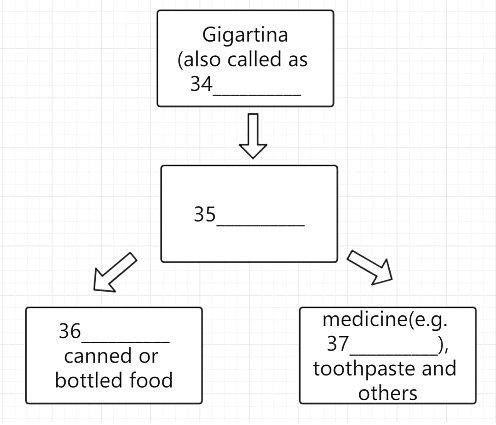
New Zealand lays claim to approximately 700 species of seaweed, some of which have no representation outside this country. Of several species grown worldwide, New Zealand also has a particularly large share. For example, it is estimated that New Zealand has some 30 species of Gigartina, a close relative of carrageen or Irish moss. These are often referred to as the New Zealand carrageens. The gel-forming substance called agar which can be extracted from this species gives them great commercial application in seameal, from which seameal custard is made, and in cough mixture, confectionery, cosmetics, the canning, paint and leather industries, the manufacture of duplicating pads, and in toothpaste. In fact, during World War II, New Zealand Gigartina were sent to Australia to be used in toothpaste.
Section C
Yet although New Zealand has so much of the commercially profitable red seaweeds, several of which are a source of agar (Pterocladia, Gelidium, Chondrus, Gigartina), before 1940 relatively little use was made of them. New Zealand used to import the Northern Hemisphere Irish moss (Chondrus crispus) from England and ready-made agar from Japan. Although distribution of the Gigartina is confined to certain areas according to species, it is only on the east coast of the North Island that its occurrence is rare. And even then, the east coast, and the area around Hokiangna, have a considerable supply of the two species of Pterocladia from which agar is also available. Happily, New Zealand-made agar is now obtainable in health food shops.
Section D
Seaweeds are divided into three classes determined by colour - red, brown and green - and each tends to live in a specific location. However, except for the unmistakable sea lettuce (Ulva), few are totally one colour; and especially when dry, some species can change colour quite significantly - a brown one may turn quite black, or a red one appear black, brown, pink or purple.
Identification is nevertheless facilitated by the fact that the factors which determine where a seaweed will grow are quite precise, and they therefore tend to occur in very well-defined zones. Although there are exceptions, the green seaweeds are mainly shallow-water algae; the browns belong to medium depths, and the reds are plants of the deeper water. Flat rock surfaces near mid-level tides are the most usual habitat of sea bombs, Venus’ necklace and most brown seaweeds. This is also the location of the purple laver or Maori karengo, which looks rather like a reddish-purple lettuce. Deep-water rocks on open coasts, exposed only at very low tide, are usually the site of bull kelp, strap weeds and similar tough specimens. Those species able to resist long periods of exposure to the sun and air are usually found on the upper shore, while those less able to stand such exposure occur nearer to or below the low-water mark. Radiation from the sun, the temperature level, and the length of time immersed all play a part in the zoning of seaweeds.
Section E
Propagation of seaweeds occurs by spores, or by fertilisation of egg cells. None have roots in the usual sense; few have leaves, and none have flowers, fruits or seeds. The plants absorb their nourishment through their fronds when they are surrounded by water: the base or "holdfast" of seaweeds is purely an attaching organ, not an absorbing one.
Section F
Some of the large seaweeds maintain buoyancy with air-filled floats; others, such as bull kelp, have large cells filled with air. Some, which spend a good part of their time exposed to the air, often reduce dehydration either by having swollen stems that contain water, or they may (like Venus' necklace) have swollen nodules, or they may have distinctive shape like a sea bomb. Others, like the sea cactus, are filled with slimy fluid or have coating of mucilage on the surface. In some of the larger kelps, this coating is not only to keep the plant moist but also to protect it from the violent action of waves.
- 27
28 Section A
- i. Locations and features of different seaweeds
- ii. Various products of seaweeds
- iii. Use of seaweeds in Japan
- iv. Seaweed species around the globe
- v. Nutritious value of seaweeds
- vi. Why it doesn't dry or sink
- vii. Where to find red seaweeds
- viii. Underuse of native species
- ix. Mystery solved
- x. How seaweeds reproduce and grow
- 28
29 Section B
- i. Locations and features of different seaweeds
- ii. Various products of seaweeds
- iii. Use of seaweeds in Japan
- iv. Seaweed species around the globe
- v. Nutritious value of seaweeds
- vi. Why it doesn't dry or sink
- vii. Where to find red seaweeds
- viii. Underuse of native species
- ix. Mystery solved
- x. How seaweeds reproduce and grow
- 29
30 Section C
- i. Locations and features of different seaweeds
- ii. Various products of seaweeds
- iii. Use of seaweeds in Japan
- iv. Seaweed species around the globe
- v. Nutritious value of seaweeds
- vi. Why it doesn't dry or sink
- vii. Where to find red seaweeds
- viii. Underuse of native species
- ix. Mystery solved
- x. How seaweeds reproduce and grow
- 30
31 Section D
- i. Locations and features of different seaweeds
- ii. Various products of seaweeds
- iii. Use of seaweeds in Japan
- iv. Seaweed species around the globe
- v. Nutritious value of seaweeds
- vi. Why it doesn't dry or sink
- vii. Where to find red seaweeds
- viii. Underuse of native species
- ix. Mystery solved
- x. How seaweeds reproduce and grow
- 31
32 Section E
- i. Locations and features of different seaweeds
- ii. Various products of seaweeds
- iii. Use of seaweeds in Japan
- iv. Seaweed species around the globe
- v. Nutritious value of seaweeds
- vi. Why it doesn't dry or sink
- vii. Where to find red seaweeds
- viii. Underuse of native species
- ix. Mystery solved
- x. How seaweeds reproduce and grow
- 32
33 Section F
- i. Locations and features of different seaweeds
- ii. Various products of seaweeds
- iii. Use of seaweeds in Japan
- iv. Seaweed species around the globe
- v. Nutritious value of seaweeds
- vi. Why it doesn't dry or sink
- vii. Where to find red seaweeds
- viii. Underuse of native species
- ix. Mystery solved
- x. How seaweeds reproduce and grow
- 33
34 Flow chart: The main species used for commercial purposes in New Zealand is _________.
- 34
35 Flow chart: From this, _________ is extracted.
- 35
36 Flow chart: This is used in _________ and other products.
- 36
37 Flow chart: Other products include _________.
- 37
38 Can resist exposure to sunlight at high-water mark
- A. Green seaweeds
- B. Brown seaweeds
- C. Red seaweeds
- 38
39 Grow in far open sea water
- A. Green seaweeds
- B. Brown seaweeds
- C. Red seaweeds
- 39
40 Share their habitat with karengo
- A. Green seaweeds
- B. Brown seaweeds
- C. Red seaweeds
Cevap anahtarını göster