Bu set hakkında: Gerçek sınav materyalinden, sınava girenlerin hatırladıklarından derlenmiş ve hafifçe düzenlenmiştir. IELTS, küresel bir soru havuzundan seçer, bu nedenle bu materyal dünya çapında dolaşır. Size tam, uygulanabilir bir test sunmak için, aynı dönemde raporlanan materyaller bir araya getirilmiştir — yani bir set, tek bir sınav oturumundan değil, birkaç sınav tarihinden içerik içerebilir. Herhangi bir ses kaydı pratik amaçlı yeniden yaratılmıştır. Çalışmayı kolaylaştırmak için düzenlenmiştir. Sınava girenlerin hatırladıklarına dayalıdır — resmi IELTS materyali değildir.
Reading Passage 1: Tunnelling under the Thames
The first tunnel ever to be built under a major river was the tunnel under London’s River Thames.
At the beginning of the 19th century, the port of London was the busiest in the world. Cargoes that had travelled thousands of miles and survived all the hazards of the sea were unloaded on the banks of the Thames, only for their owners to discover that the most frustrating portion of their journey lay ahead. Consignments intended for the southern parts of Britain had to be lifted onto horse carts, pulled through the docks and across London Bridge, built in the 12th century and as impractical as its early date implies. By 1820, London Bridge had become the centre of the world’s largest traffic jam.
It was an intolerable situation, and it was clear that if private enterprise could build another crossing closer to the docks, there would be good money to be made in tolls paid by users. Another bridge was out of the question, as this would deny sailing ships access to the city centre and ambitious men turned their thoughts to tunnelling beneath the Thames instead. This was not such an obvious idea as it might appear. Although increasing demand for coal had meant a great many tunnels had been dug in mines in Britain, working methods remained primitive. Tunnels were dug by men with simple tools, by candlelight. However, in 1807, a group of businessmen set themselves up as the Thames Archway Company. Their ambition was to tunnel below the Thames, but there was little to guide them as there had been no previous attempt to do this. Their chief engineer was Richard Trevithick, designer of the world’s first high-pressure steam engine. His men made progress at the beginning, but then things began to go disastrously wrong, with muddy soil pouring into the tunnel. Eventually, the Thames Archway Company had had enough. Its funds were exhausted. Trevithick was sick from exposure to the river water, and its efforts had proved only that a passage under the river exceeded the limits of contemporary mining technology.
At that time, the only machines used in mines were pumps. It took a man of genius to recognise that a different sort of machine was needed, a machine that could prevent the roof and walls of a tunnel from collapsing. This man was Marc Brunel, a Frenchman who had become one of the most prominent engineers in Britain. Not long after the failure of the Thames Archway Company, Brunel saw a rotten piece of wood lying on the riverbank. Examining the wood through a magnifying glass, he observed it was infested with something that looked like a worm. Brunel realised that as it tunnelled through the wood, it would push chewed wood into its mouth and digest it, then excrete a hard substance that lined the new tunnel. Brunel realised that the worm’s digging technique could be adapted to produce a new way of tunnelling. His realisation led him to invent a device that has been used in one form or another in most major tunnels built since: the tunnelling shield. It consisted of a heavy iron frame that could be pushed forward a few inches at a time. The front of the frame was made up of a series of iron frames that could be folded back to allow miners to dig the ground ahead. Behind these frames was a wall consisting of a series of iron plates pressed against the tunnel face and supported on a set of horizontal wooden planks, that would prevent the face from collapsing. It was a complex and rather cumbersome machine and not easy to use, but it seemed that it would protect the miners from the worst of the river’s water. Brunel’s team carefully examined earth samples taken from beneath the riverbed, and subsequently decided to dig the tunnel close to the muddy river bottom, where he could expect to find clay. This would be a more solid and safe substance to dig through than the sand that was found deeper down.
Brunel began work on his tunnel in 1825, but the problems of such an operation soon became apparent. Although the shield itself worked well, water began to drip into the tunnel. This was more of an annoyance than a danger while the pump was working, but this machine proved unreliable and sometimes failed altogether. When the pump broke down, work had to stop as the tunnel quickly flooded. There were occasions when the miners had to abandon their tools and flee for their lives. Even when Brunel’s men were able to work, they had to run the constant risk of the pumps failing. They also complained of frequent headaches and dizziness, caused by the poor air quality. The air underground was dirty and stale, contaminated due to the lack of an adequate ventilation system. There were lighting problems too. Illuminating the tunnels by candlelight was a constant challenge. Lamps give off only a very weak glow, and there were a number of accidents because the miners could not see what they were doing. Lastly, a number of Brunel’s miners walked off the job because they could not tolerate the excessive temperatures that developed in the cramped conditions underground.
Despite all these setbacks, the tunnel finally emerged on the opposite river bank on August 12, 1841. Brunel’s triumph, however, was only partial. The small payment per person made by the thousands of visitors who flocked to see the marvel hardly paid even a penny per foot of the tunnel’s construction costs. Brunel had gone bankrupt long before the project was completed, and the government loan he had required to complete the project had to be paid back with interest. As a result, there was not enough funding to make it accessible to horse-drawn vehicles, as intended. Instead, the passageways were filled with souvenir sellers and entertainers. In the end, the tunnel was closed two years later, used at night, before it was finally closed entirely and fell into dereliction for decades.
It was only when the underground railway came to London in the 1880s that the Thames Tunnel found and achieved a measure of real usefulness. It was bought in 1869 by the East London Railway, who found it to be in such excellent condition that it was immediately pressed into service as a route for passenger trains heading east. The tunnel became, and remains, part of the London Underground network.
- 1
1. In the early 19th century, the port of London was considered a safer destination than other ports.
- 2
2. London Bridge provided quick access for cargo being sent to southern Britain.
- 3
3. It was generally believed that a new river crossing would be profitable.
- 4
4. Building a second bridge crossing was initially considered to be the best solution.
- 5
5. It was believed that coal could be found under the River Thames.
- 6
6. The Thames Archway Company was the first group to try tunnelling below the Thames.
- 7
7. Some of Trevithick's men were injured during a mudslide at his tunnel.
- 8
8. The Thames Archway Company ran out of money to finance the tunnel project.
- 9
Marc Brunel's tunnel: Preparing to build the tunnel. Brunel noticed how a kind of ______ made its tunnels in wood.
- 10
Brunel planned to build a shallow tunnel so the earth would have a higher content of ______.
- 11
The miners suffered from ______ because of pollution in the tunnels.
- 12
Lighting problems led to several ______.
- 13
Brunel did not have enough money to repay his debt to the ______.
Reading Passage 2: Roller Coaster
A The technological advancements that have led to the creation of modern roller coasters are beyond the wildest dreams of those who built the first coasters 600 years ago. Kingda Ka in New Jersey is the tallest and fastest roller coaster in the world, accelerating from 0 to 128 mph in 3.5 seconds (most sports cars reach 60 mph in 4 seconds or more). The Kingda Ka Roller Coaster takes riders to a height of 456 feet (more than a football field and a half), where they then drop 418 feet at an angle of 90 degrees (straight up). Roller coasters amaze not only with their speed and height but also with the talent of the engineers who build them. All roller coasters have the ability to provide greater thrills with less risk than regular road riding. Throughout history, roller coasters have undergone dramatic changes. From humble beginnings when the Russian ice slid off to the metal monsters of today. It is one of the purest architectural styles because art and architecture are harmoniously integrated.
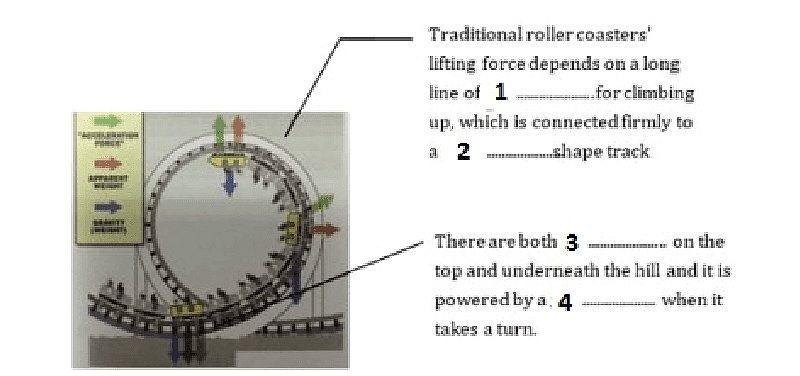
B From a distance, the roller coaster can be mistaken for an ordinary train. It consists of interconnected wagons that move along the railway network. Unlike traditional trains, roller coasters do not have their own power plants or engines. Gravity and momentum account for most of the train's motion. To gain speed, you need to either accelerate the train on the first hill or jump start it hard. The primary means of lifting is a lengthy chain that runs up the hillside beneath the railroad. His loop around the gear may spin around twice, and it's tied to a chain. This was done twice, once at the peak and once at the trough. A simple motor turns gears at the foot of the hill. This rotates the chain loops and allows conveyor-type chains to climb ramps. The roller coaster vehicle is attached to the chain with a chain carrier and a stable folding hook. The dogs cling desperately to the links of the chain as the train slides down the hill. Connect the chain cleats and the train just pulls up the mountain. Release the chain driver at the top of the slope and the train will begin to fall.
C There is a rich history behind the evolution of roller coasters. It is thought that the first roller coasters were based on the huge ice slides that were famous in Russia in the 16th and 17th centuries. The slide consisted of long, steep, ice-covered wooden slides, some reaching 70 feet in height. Sledders on both ice and wood careened down the slope and landed heavily on the beach below. Sceptics and believers argue over exactly when these ice slides transitioned into actual moving carts. The most accepted hypothesis is that an ambitious Frenchman brought the ice slide idea to France. The French replaced the ice slides with waxed slides and added wheels as the ice in the area melted. In 1817, the world's first train-mounted roller coaster, Russes a Belleville (sometimes spelt "Russian Mountains of Belleville") debuted. (In this example the pull axle slipped into a groove cut into the wood). The French accelerated this idea via way of means of growing an extra complicated song format with a couple of automobiles and diverse corners.
D The debate over which nation had the first "genuine" roller coaster is almost as heated as the argument over which nation had the first roller coaster. Many individuals will say that it is the Maunch Chunk-Summit Hill and Switch Back Railroad in Pennsylvania. The Maunch Chunk-Summit Hill and Switch Back Railroad, once the second railroad in the United States, is widely recognised as the finest roller coaster in history. It was originally built to transport coal from the peak of Mount Pisgah to the foot of Mount Jefferson, but mining tycoon Josiah White had the bright idea to turn it into a seasonal thrill ride. The Lehigh Valley is where it is located. Due to its rapid rise in popularity, it swiftly shifted its concentration to serving passengers solely. A steam engine capable of 100 mph would convey riders to the mountain's summit, after which they would be free to coast back down. The term "switchback railroad" refers to the reversing track at the top of the mountain that the steam engine used to let the passengers coast down. At the terminal of this layout, the steam locomotive would decouple its carriages, allowing passengers to coast downhill in the opposite direction. Despite a few minor track modifications and a few name changes over a century, the railroad functioned from 1829 to 1937.
E The roller coaster boom in America has just begun. Invented by Lamarr Thompson, the Serpentine Railway is widely credited with bringing the Jetwaden coaster to the mainstream. The switchback railroad first appeared in 1884 on Coney Island in New York City and quickly spread across the country. The prolonged popularity of these rides, which gave a relatively moderate sensation compared to modern roller coasters, can be concerning. Customers paid him a dime to queue for up to five hours on two parallel sections of the gently undulating Tandematterbahn at speeds of six miles per hour. However, due to the overwhelming response to the Serpentine roller coaster, many individuals, Thompson included, started developing more extensive and more sophisticated jet coasters.
F In terms of glider innovation, the 1910s and 1920s stand out as particularly remarkable times. B. Unstop Wheels, a device that binds the roller coaster to the track by resisting great gravity, are only one example of the new wave of technology that has opened up previously unimaginable possibilities for the glider. In 1919, there were roughly 1,500 roller coasters in North America, and that number has only gone up since then. After that, the Great Depression destroyed many American theme parks. The amusement parks of the late 1930s continued to thrive despite their dilapidated appearance. However, when WWII ended in 1942, the glider gradually deteriorated. The majority of roller coasters in the United States are currently shuttered. The United States certainly hasn't caught up to the number of roller coasters that were around in the Jazz Age.
- 14
The first roller coaster perhaps originated from Russia which is wrapped up by ________, which was introduced into France, and it was modified to ________ because the temperature there would ________ the ice. This time ________ were installed on the board. In America, the first roller coaster was said to appear in Pennsylvania, it was actually a railroad that was designed to send ________ between two mountains. Josiah White turned it into a thrill ride, it was also called switch backtrack and a ________ there allowed riders to slide down back again.
- 15
The great depression affected amusement parks yet did not shake the significant role of the US roller coaster in the world.
- YES. YES
- NO. NO
- NOT GIVEN. NOT GIVEN
- 16
Switchback railways began to gain popularity since their first construction in New York.
- YES. YES
- NO. NO
- NOT GIVEN. NOT GIVEN
- 17
French added more innovations to Russia's ice slide including both cars and tracks.
- YES. YES
- NO. NO
- NOT GIVEN. NOT GIVEN
- 18
The most exciting roller-coaster in the world is in New Jersey.
- YES. YES
- NO. NO
- NOT GIVEN. NOT GIVEN
- 19
The working mechanism of a roller-coaster is explained through the diagram. Choose NO MORE THAN TWO WORDS AND/OR A NUMBER from the passage for each answer: 27. ________ 28. ________ 29. ________ 30. ________
Reading Passage 3: 200 Years of Australian Landscapes at the Royal Academy in London
This exhibition promises to chart the evolution of a nation through its art, but not everyone agrees with the reasons behind the choice of artwork. For the casual viewer, the exhibition of landscapes, Australia, selected by the Royal Academy of Art, will be a spectacular guide through Australian art history. Included in the exhibition are a range of artists and styles, dating from the earliest days of colonial art and progressing through expressionism and modernism to the greats of the 20th century, culminating with the current generation of Australian artists. It is hardly surprising, then, that this results in a flexible, wide-ranging notion of landscape. But this landmark exhibition gives rise to some questions, and perhaps problems, regarding Britain’s relationship with its former colony. By choosing a style of painting at which British artists excel, the Academy could be seen as inviting criticism that hints at a telling attitude towards Australian art by comparison. But it is the very theme of landscape that provides the strongest connection to Australian art from Britain. To consider it condescending is perhaps too strong, but for Joanna Mendelssohn, an Australian critic and Associate Professor at the University of NSW’s College of Fine Arts (COFA), there is a suggestion that British artistic values have directed this exhibition, rather than allowing Australia the freedom to demonstrate its maturity. What Mendelssohn found surprising about this exhibition was that the underlying rules for the selection of works seemed to have been so conservative. Since the landscape is a very strong British artistic theme, it appeared to her that when the British looked to the art of a former colony, there was a tendency for them to think that those colonies would continue to be like the British themselves. In reviewing Australia, the British insisted on looking at the genre of landscape painting. Because of colonial ties, it was inevitable during Australian art’s formative years that it would reflect Britain’s devotion to the beloved landscape before its own character and idiosyncrasies took shape. And while Mendelssohn’s concern over the exhibition’s conventional selection is valid, the Academy is nevertheless embracing the peculiarities of Australian art from the mid-19th century onward, albeit within the boundaries of landscape. Australia is curated by Kathleen Soriano, director of exhibitions at the Royal Academy. “Certainly the influence of English, French, or German art is much more evident in the early periods, in the early 1800s to mid-1800s,” she says. “What I wanted to show was how Australian art develops a real distinctiveness, associated with the landscape and the light.”
The fusion of tradition of the European kind with something more specifically Australian, and often personal, is crucial to the exhibition, and extends particularly to some of the more contemporary artists involved. Sydney-born video artist Shaun Gladwell is a good example of this. Gladwell’s most famous piece, which is featured in the exhibition, is Storm Sequence (2000), a video of Gladwell skateboarding on the Bondi seafront as one of Sydney’s signature brutal storms lingers offshore. It is his acknowledgment of landscape (or seascape) tradition, colored by Gladwell’s own individualism. “To exhibit my work in this show might make some sense because I was interested in Turner and the idea of atmosphere affecting vision, something I was really interested in around the time of Storm Sequence. I was thinking about this tradition of Romantic landscape, but I wanted to make it personal,” says Gladwell. But he didn’t want to just embark on borrowing imagery from elsewhere. He wanted to bring it to his experience and his world through skateboarding and beach culture. So while it may seem narrow for Britain to reduce Australian art to the genre of landscape, there can be little denying that British landscape painting is still relevant to a current generation of Australian practitioners, however indirectly.
Visitors to the exhibition encounter Australian Aboriginal art first, the idea being that these works warrant a prominent position because they were ‘first’. Over the last couple of decades, London has hosted many successful exhibitions of Aboriginal art in smaller spaces, but for Soriano, Australia represents an opportunity to place such art in a broader context, with new relationships to the art of the settlers and white Australia. ‘One of the reasons landscape makes sense as being the right theme was because Aboriginal art started in and on the landscape,’ she says. ‘[The exhibition] is a beautiful meshing of the two different kinds of art, that allowed me to bring them together comfortably and honestly within this theme. It was important for me to present Indigenous art to audiences, and I felt it was most authentic that it was seen as part of Australian art history, rather than a separate area with a world of its own.’
Meanwhile, Australian critic Mendelssohn also points out that London is increasingly less important to today’s generation of artists, and this somewhat weakens the ceremony surrounding the exhibition in London. ‘China is the most important art market in the world,’ she says. ‘If you’ve made it in Shanghai, you’ve made it. The world has changed. My students in Australia, who come from all over the world, really want to see Venice Biennale and Art Basel, but they’re less interested in going to London. When I was growing up, London was the destination, and then when I was at university all the smart young things wanted to go to New York,’ she added. ‘Now they want to go everywhere. There’s no such thing as the centre and the periphery like there used to be. It’s much more complicated.’
- 20
27. As expected, the artworks chosen for the exhibition reflect a narrow interpretation of landscape.
- 21
28. The Academy rejected Australian suggestions for the subject of the exhibition.
- 22
29. The colonial relationship meant that early Australian landscape painting followed the traditions of English landscape painting.
- 23
30. The exhibition reflects the fact that Australian art developed its own particular qualities.
- 24
31. Contemporary Australian artists have generally rejected British landscape traditions.
- 25
32. What is the writer’s main point in the second paragraph?
- A. Australian landscape painting derives from the British tradition.
- B. Australian landscape painting is more highly regarded than British.
- C. Britain is still imposing its principles on Australian art.
- D. British art cannot be compared to Australian art.
- 26
33. What does Joanna Mendelssohn find surprising?
- A. Modern Australian landscape painting has great variety.
- B. The guidelines for the choice of work were very traditional.
- C. Landscape painting remains a popular subject for British artists.
- D. The British find the Australian landscape unsuitable as a subject.
- 27
34. Shaun Gladwell’s work is included in the exhibition because
- A. it adopts a subjective approach to depicting the landscape.
- B. skateboarding is an inspiration to many Australian artists.
- C. storms are a significant feature in the Australian landscape.
- D. Bondi is an iconic Australian location.
- 28
35. What was the reason for Soriano including Aboriginal art in the exhibition?
- A. It is not well known in London art circles.
- B. Aboriginal landscape painting influenced Australian settlers.
- C. It is part of the Australian art tradition and not independent of it.
- D. Modern Aboriginal painting deals with changes to the landscape.
- 29
36. By referring to China, Mendelssohn is making the point that
- A. having an exhibition in London is not as important as it used to be.
- B. young artists in Britain are not interested in Australian art.
- C. art from Shanghai is more important than Australian art.
- D. New York is still a preferred destination for young artists.
- 30
37. In spite of its conservatism, the Royal Academy exhibition
- A. reflects the mood created by the natural environment.
- B. demonstrates that the dominant art form in Australia is landscape painting.
- C. demonstrates an understanding of the historical importance of the land.
- D. showcases a very small number of artists.
- E. demonstrates a strong European flavour.
- F. shows an acceptance of the unique qualities of Australian art.
- 31
38. Australian art of the early to mid-1800s
- A. reflects the mood created by the natural environment.
- B. demonstrates that the dominant art form in Australia is landscape painting.
- C. demonstrates an understanding of the historical importance of the land.
- D. showcases a very small number of artists.
- E. demonstrates a strong European flavour.
- F. shows an acceptance of the unique qualities of Australian art.
- 32
39. The modern work by Gladwell chosen for the exhibition
- A. reflects the mood created by the natural environment.
- B. demonstrates that the dominant art form in Australia is landscape painting.
- C. demonstrates an understanding of the historical importance of the land.
- D. showcases a very small number of artists.
- E. demonstrates a strong European flavour.
- F. shows an acceptance of the unique qualities of Australian art.
- 33
40. Including Aboriginal art in the exhibition
- A. reflects the mood created by the natural environment.
- B. demonstrates that the dominant art form in Australia is landscape painting.
- C. demonstrates an understanding of the historical importance of the land.
- D. showcases a very small number of artists.
- E. demonstrates a strong European flavour.
- F. shows an acceptance of the unique qualities of Australian art.
Cevap anahtarını göster