Sınava girenlerin hatırladıklarından yeniden oluşturulmuştur — resmi IELTS materyali değildir. Ses ve pasajlar pratik amaçlı yeniden yaratılmıştır.
Transkripti göster
====================
IELTS Listening Transcript
====================
PART 1
Speaker 0: Now turn to section one.
Speaker 0: Section one.
Speaker 0: You will hear a woman calling the London Police Department to report a robbery.
Speaker 0: First, you have some time to look at questions one to four.
Speaker 0: You will see that there is an example which has been done for you. On this occasion only, the conversation relating to this will be played first.
Speaker 1: Hello. London Police Department.
Speaker 2: Yes. I would like to report a robbery.
Speaker 0: The woman says that she would like to report a robbery, so robbery has been written in the space. Now we shall begin. You should answer the questions as you listen because you will not hear the recording a second time.
Speaker 0: Listen carefully and answer questions one to four.
Speaker 1: Hello. London Police Department.
Speaker 2: Yes. I would like to report a robbery.
Speaker 1: Alright. Just a minute while I pull up the form. Okay. Could you give me your first and last name?
Speaker 2: Anna Greg.
Speaker 1: Anna Greg, G R E G?
Speaker 2: No. Greg, G R I E G.
Speaker 1: Got it. Alright. Moving on. Gender, female. Date of birth? 03/15/1980.
Speaker 1: Alright. Thanks. Just a few more personal information questions, and then we can address your claim. Alright. What's the address?
Speaker 2: 4 Ellendale Street.
Speaker 1: That's E L L E N D A L E.
Speaker 2: Oh, right. Ellendale Street.
Speaker 1: Yeah. We've had a lot of break-ins in that area lately. And the postal code?
Speaker 2: W5 2AT.
Speaker 1: And are you a citizen of the UK?
Speaker 2: No.
Speaker 1: Okay. What type of citizenship do you have?
Speaker 2: Well, I lived in the United States for most of my life, but I am actually of Grenadian nationality.
Speaker 1: Okay. So is that the country that issued your passport?
Speaker 2: Yes.
Speaker 1: Alright.
Speaker 0: Before you hear the rest of the conversation, you have some time to look at questions five to 10.
Speaker 0: Now listen and answer questions five to 10.
Speaker 1: And what is the crime you're reporting?
Speaker 2: I already said a robbery.
Speaker 1: Alright. Sorry. This is about the hundredth robbery report I filled out today. Have you had any prior break-ins?
Speaker 2: In the building or just my flat?
Speaker 1: The unit below mine got broken into last year.
Speaker 2: No. Just your flat.
Speaker 1: Oh, then no. Not here.
Speaker 1: Alright. Let's see here. Can you think of anything that was out of the ordinary around your building or anyone who may have had reason to do this?
Speaker 2: No. It seemed like just a normal evening. I didn't see anyone suspicious and can't think of anyone that would target me specifically.
Speaker 1: How long has this been your place of residence?
Speaker 2: Let me think. I moved in on February 1, and it's October. So it's been about eight months already. Wow. Time flies.
Speaker 1: And that is just for Ellendale?
Speaker 2: Yeah?
Speaker 1: Yes. I have lived in the UK for just over one year.
Speaker 1: I see. Can you give me the first and last names of all members of the household?
Speaker 2: Actually, I live alone.
Speaker 1: Okay. So no other occupants. And can you give me a brief account of what happened?
Speaker 2: I left to go to a dinner party at 6 PM. And when I returned at eleven, I found the place ransacked and a lot of my things gone.
Speaker 1: Any sign of forced entry?
Speaker 2: Yes. The back door was wide open, and it looked like someone used a crowbar to force it open.
Speaker 1: I see. And just to be clear, was the door locked when you left?
Speaker 2: Of course.
Speaker 1: Hey. You would be surprised how many reports we get where people have failed to lock their doors. Now I need you to list any missing items valued above £200.
Speaker 2: So far, I'm missing my computer, my purse with my wallet in it, and the TV.
Speaker 1: Okay. Let's start with the computer. What is the estimated value?
Speaker 2: £500.
Speaker 1: And what is the serial number?
Speaker 2: G4168770.
Speaker 1: Thank you. And a visual description?
Speaker 2: It is a black 13 inch Pendus Cloudbook. There is an Oxford sticker on the lid.
Speaker 1: Okay. And could you give me a description of the purse?
Speaker 2: Sure. It's a Claude Frieder shoulder bag, and the material is silver colored cloth.
Speaker 1: Price?
Speaker 2: £300.
Speaker 1: Okay. That concludes my report. I'll submit it, and we'll let you know of any developments.
Speaker 0: That is the end of section one. You now have half a minute to check your answers.
PART 2
Speaker 1: Hello. London police.
Speaker 3: Part two.
Speaker 3: You will hear a hotel manager talking to some new staff.
Speaker 3: First, you have some time to look at questions 11 to 15.
Speaker 3: Now listen carefully and answer questions 11 to 15.
Speaker 4: Good morning, all of you. I do apologize for being a little late starting our meeting. One of our guests has been taken ill. Susie, who's our assistant manager, has driven him to the hospital, but she was in the middle of compiling our weekly report for head office, which is urgent, and I had to finish writing it for her.
Speaker 4: Now this is the first day of work at the Ocean Edge Hotel for all of you. Let me say something that might surprise you. You've all got a qualification in hospitality, and some of you have got very high grades. But to me, what counts most is that you enjoy the contact with guests and really want to make a career in the hospitality industry. You'll be getting some very valuable experience here, so make the most of it.
Speaker 4: A few words about the history of the Ocean Edge Hotel. There have been buildings on this site for about two hundred and fifty years. We know that in the eighteenth century there was a bakery here, when the town was very new. The building was destroyed by fire in the early nineteenth century and houses were constructed on the site. These, in their turn, were demolished in the middle of the twentieth century and replaced by the hotel.
Speaker 4: I think it's fair to say that this is a popular place to work. We're always getting job applications from local people, even when we haven't any vacancies. And whereas in many hotels staff tend to stay for a year or even less, here five is pretty standard. And in fact, several of our staff have been here for ten years or more. You're the first people we've appointed in the last three years, and we only needed to do that because we're currently constructing 25 new bedrooms.
Speaker 4: Depending on their location, hotels usually have mostly business guests or mostly tourists. We attract a large number of tourists who come to spend a few days beside the ocean. We also have quite a lot of people who are here on business and perhaps stay for one or two nights. What we've noticed recently, though, is that we're getting more and more regulars – people staying here for four nights every week because they have jobs in this locality, but live somewhere else in the country. So they go home for the weekend.
Speaker 3: Before you hear the rest of the talk, you have some time to look at questions 16 to 20.
Speaker 3: Now listen and answer questions 16 to 20.
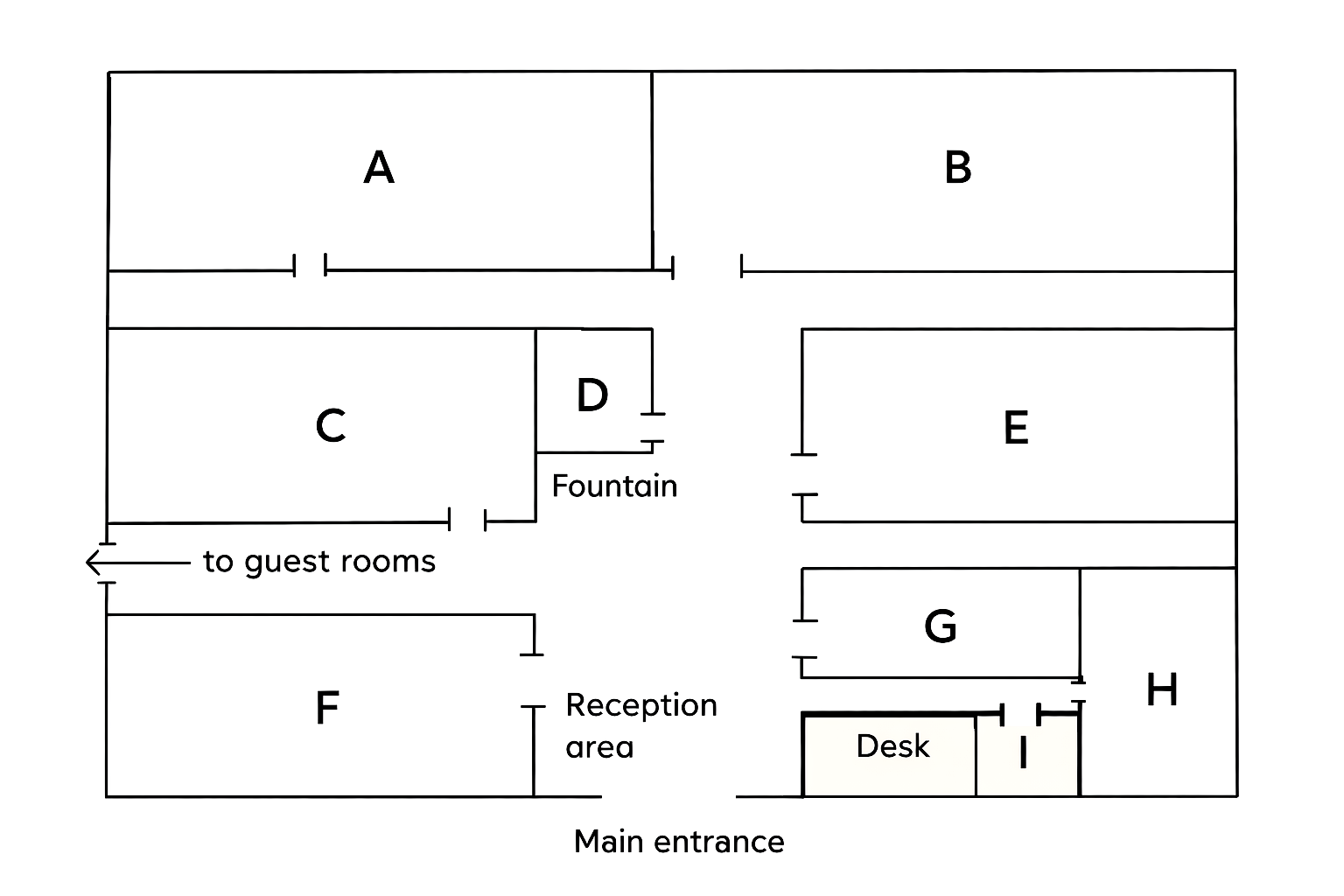
Speaker 4: Now let me give you an idea of the layout of the hotel. All the bedrooms are along walkways in the gardens, and the main building, which we're in now, has most of the other rooms that guests use.
Speaker 4: Obviously, when they arrive, the first place they find themselves in is the reception area where we're sitting. The desk is over on the right of the entrance, and the office is immediately behind it. There's a connecting door from the desk itself and another entrance from the corridor.
Speaker 4: A lot of local residents hire the function room for parties and other events. This is right at the front of the hotel, on the left of the reception area opposite the desk. This room is booked several evenings a week and most weekends. It's a major source of income.
Speaker 4: Companies are very important customers for us, and a large number of local firms hold conferences here. To reach the main conference room, you go past the fountain as far as you can and the doors directly in front of you.
Speaker 4: The meeting room is often hired by companies and other local organizations for small gatherings. For this room, you turn into the corridor at the side of the reception desk and you'll see the room facing you at the end of the corridor.
Speaker 4: Our restaurant is open to the public as well as to hotel residents, and I'm pleased to say it has a very good reputation locally. You turn left just before the fountain as though you're heading for the guests' rooms, and it's the large room on your right.
Speaker 4: Next, I should mention that there...
Speaker 3: That is the end of part two. You now have thirty seconds to check your answers to part two.
PART 3
Speaker 5: Part three.
Speaker 5: You will hear two students named Amy and Mike discussing Maori carvings.
Speaker 5: First, you have some time to look at questions 21 to 25.
Speaker 5: Now listen carefully and answer questions 21 to 25.
Speaker 6: Hi, Mike. Aren't these New Zealand carvings we've been studying in class fascinating?
Speaker 7: Oh, hi, Amy. Oh, the Maori greenstone tikis. They're all a bit organic for my taste. You know, all curves and twisting shapes. I like modern stuff, geometric shapes, but I can see the skill involved in making them.
Speaker 6: But the stories behind the tikis are what make them interesting. Besides, I imagine it would be difficult to create geometric patterns. The shape of each tiki seems to follow the natural contours of the stone. It's extremely hard, and it requires expertise and time to shape.
Speaker 7: That's true. I suppose that's why modern greenstone carvings are so expensive, but there aren't that many genuine old ones around. Archaeologists rarely discover such treasures, which is odd given they are such a huge part of Maori culture. I wonder if archaeological dig sites were raided and the tikis were taken to sell.
Speaker 6: I believe it's because the owners valued them and so preserved them. Many of them would have been passed down through the generations and remain in the possession of the families today, like heirlooms. Do you know what they were used for?
Speaker 7: I thought they were just an art form or a means of decoration. But Professor Matteu says that the Maori believed tikis were sacred and could be used as a pathway to their ancestors. They believed the dead could speak to them through these talismans.
Speaker 6: So they don't represent tribes or anything? Interesting. How many different kinds are there? There must be hundreds of variations.
Speaker 7: There are other greenstone carvings beside tikis, although I can't remember all their names. Traditional tikis themselves can be divided into two distinct groups, though.
Speaker 6: Can they? By the materials? I've seen some with metal features. Or is it to do with size or where they were made?
Speaker 7: Actually, it is the ways that their feet, heads, and hands are placed that make the major difference.
Speaker 6: Is it easy to discern the difference between the ancient stones and more modern reproductions? Are the styles very different?
Speaker 7: Modern reproductions usually use a different type of stone, although they may be of the same design. They may also be of a smaller size. But it's actually quite easy to tell if you are buying a genuine carving or a mass produced souvenir.
Speaker 6: How?
Speaker 7: Nowadays, they are produced by machine using lasers even, so they have no blemishes. In genuine carvings, they aren't always perfect because the Maori used simple hand tools. For example, the hole that the cord is fed through isn't perfectly round.
Speaker 6: That makes sense.
Speaker 5: Before you hear the rest of the discussion, you have some time to look at questions 26 to 30.
Speaker 5: Now listen carefully and answer questions 26 to 30.
Speaker 6: Actually, it's amazing that they produce such detailed tikis with such simple tools and materials. Talk me through the process. I know the basic shape is carved from New Zealand greenstone.
Speaker 7: Yes. But first, they had to get a blank of the right size.
Speaker 6: You mean a piece of stone of the right size and basic shape?
Speaker 7: That's right. They used a hard stone tool, something rough, to wear a groove into a piece of greenstone. After they'd scored it with that, they could just snap it in two. I guess they could have used some kind of hammer, though. They repeated the process until they had a piece of stone suitable for what they wanted to carve, usually flat pieces for tikis.
Speaker 6: Right. Because they're fairly small and quite thin, then they started carving?
Speaker 7: Not right away. Before they could start carving, they needed an absolutely smooth, flat surface. Nowadays, when we want to do something like that, we'd clamp the stone in a vise and use a sander. But they used a heavy block of sandstone and rubbed the piece of greenstone on it over and over to prepare it for carving.
Speaker 6: It must have been very time consuming. So how did they cut out the little details like hands and feet?
Speaker 7: They had carving tools. They used small chips of stone glued and tied onto a wooden handle. Then they also used a piece of sharpened bone made into a point.
Speaker 6: Is that what they used to make the holes?
Speaker 7: Actually, they had a special tool to make holes. It was a stick tied between two heavy pebbles with a point at the end. They would wrap string around it, pull it back and forth to wear a hole into the tiki. They used the same technique to make round shapes too, but didn't make the hole go all the way through.
Speaker 6: And I've seen some tikis with colored eyes or decorations. Are they painted?
Speaker 7: Mostly, they are inlaid with different colored stone or mother of pearl from shells, or sometimes dyed pieces of bone. They were fixed in place using teratogum, a sticky plant resin. They used plants to make the natural strings too.
Speaker 6: That's right. The Maori were very resourceful, weren't they?
Speaker 7: They certainly were.
PART 4
Speaker 8: Part four.
Speaker 8: You will hear part of a biology lecture about an animal called the African clawed frog.
Speaker 8: First, you have some time to look at questions 31 to 40.
Speaker 8: Now listen carefully and answer questions 31 to 40.
Speaker 9: Today, I'd like to look at another type of amphibian, the African clawed frog, whose Latin name is Xenopus laevis. Its name is derived from the three short claws on each hind foot, which it uses to tear apart its food. The Latin word Xenopus means strange foot, and laevis means smooth.
Speaker 9: I'll start with a general description. The African clawed frog is a species of frog that can be commonly found in the Eastern and southern parts of Africa. They have a flattened head and body but no tongue or external ears. As the Latin name suggests, African clawed frogs have smooth skin, unlike the toad whose skin always has a rough texture. The body of African frogs is covered with mucus which can give their sensitive skin protection, thus playing an indispensable role in their survival.
Speaker 9: Male and female African clawed frogs can be easily distinguished through several characteristics, and the major one is their size. Generally, male frogs are about half as big as females. Specifically, female frogs are usually 4.5 inches long, weighing around seven ounces, while males are generally 2.5 inches long and two ounces heavy.
Speaker 9: Then let's turn to their habitats. African clawed frogs are entirely aquatic frogs, so they live in water all their life, whether they are tadpoles or adult frogs. Although they can live in a wide range of freshwater environments, they particularly like still water instead of fast flowing streams. During the summer, African clawed frogs are mainly found in warm rivers, and during the rainy season, they tend to move into flooded forests. In the wild, African clawed frogs are highly adaptable to changes in the environment around them, whether in oases or glacier covered lakes. Besides, they can even survive in water with high salt levels. It is because African clawed frogs have a unique physiological mechanism in their body that could automatically regulate the balance of water inside and outside their body.
Speaker 9: In dry weather, African clawed frogs always burrow themselves into mud where they can survive for more than a year. They are incredibly hardy and long lived with an average lifespan of five to fifteen years. Some are even recorded to have lived for twenty to twenty five years. However, African clawed frogs are susceptible to the pollution of the water even though they are not listed as endangered species.
Speaker 9: Now let's talk about the diet of African clawed frogs. They are carnivores that like hunting insects, spiders, worms, fish etc. African clawed frogs depend on the sense of smell to detect their prey. They first use the claws on their hind feet to tear pieces of ample food. Then the front feet, which are not webbed, play an important role in feeding. African clawed frogs use their front feet to push food into their mouths, and meanwhile, a distinctive pump system is used to draw or suck food in their mouths.
Speaker 9: So we can see African clawed frogs are voracious predators and can quickly adapt to many habitats. Therefore, in some parts of the world, African clawed frogs act like invasive species, which will negatively affect other species in the freshwater ecosystems. The evidence shows that they have devastated the populations of native frogs and other creatures by eating their young. As a result, African clawed frogs are illegal to own, transport, or sell without any permit in some states of America, like California, Washington, Arizona, etcetera, where African clawed frogs have been seen as a type of pest. However it's legal to own African clawed frogs in Canada.
Speaker 9: But not many people know that African clawed frogs are also used in medicine. As we mentioned before, the skin of African clawed frogs is covered with mucus, which has properties of antibiotic. This chemical can help kill bacteria and cure the infection and is widely used by both the medical profession and the general public. So we shouldn't ignore the medical value of African clawed frogs.
Speaker 8: That is the end of part four. You now have one minute to check your answers to part four.