Sınava girenlerin anlatımlarından yeniden oluşturulmuştur — resmi IELTS materyali değildir. Sesler ve pasajlar pratik amaçlı yeniden oluşturulmuştur.
Transkripti göster
====================
IELTS Listening Transcript
====================
PART 1
Speaker 0: You will hear a number of different recordings, and you will have to answer questions on what you hear. There will be time for you to read the instructions and questions, and you will have a chance to check your work after each section. All the recordings will be played once only. The test is in four sections. Write all your answers on the listening question booklet. At the end of the real test, you will be given ten minutes to transfer your answers from the question booklet to an answer sheet. You should be prepared to do this with the practices. Now turn to section one. Section one.
Speaker 1: Hello. How can I help you today?
Speaker 2: Ah, yes. Hello. I'm just phoning you as I have seen an advertisement on your website for a property that I'm interested in renting.
Speaker 1: If possible, I'd like to find out some more information before I organize a viewing. No problem at all. What is the address of the property that you'd like to inquire about?
Speaker 1: It's 21 North Avenue. Okay. What is it that you'd like to know?
Speaker 2: First of all, I'd like to know what facilities the office has as I need to make sure that it'll be suitable for my advertising company.
Speaker 1: I see. The office contains a large open plan space with a wide frontage onto a busy street with lots of passersby. So your business would have a really good street presence. There is also a toilet and newly refurbished kitchen equipped with a dishwasher and oven.
Speaker 2: Wow. That sounds great. I'd definitely like to register my interest.
Speaker 1: Okay. Perfect. I just need to take some details from you, if that's okay. What is your full name?
Speaker 2: Jonathan Smith.
Speaker 1: And what position do you hold in your company, Jonathan?
Speaker 2: Until recently, I was sales manager. However, I've recently been promoted to regional manager, so I'll be in charge of running our new office.
Speaker 2: Can I ask where the office is located?
Speaker 1: Yes, of course. It's located downtown, just around the corner from Royal Square Shopping Centre.
Speaker 2: That's a bit too far out of the centre for my liking. I'd much prefer to be located in close proximity to the station. Do you have any property located in that vicinity? It would help me to narrow down the results if you could tell me how many employees you intend to have working in the office.
Speaker 2: Our branch is made up of 30 employees, and we'd like some extra space for meetings and presentations.
Speaker 1: Most average office spaces are around 8,000 square feet, but it sounds like you would need more space than that. I think that 10,000 square feet would be more suitable for your needs. Now let's see. We have 10 properties that match those criteria, so let's try and narrow it down.
Speaker 3: Before you hear the rest of the conversation, you have some time to look at questions five to 10. Now listen and answer questions five to 10.
Speaker 1: Do you have any other requirements?
Speaker 2: Well, we'll need access to the office twelve hours a day, but security should be twenty-four hour. We don't hold any money on the premises, but it's crucial that we protect our customer information against theft. Okay. Anything else?
Speaker 2: Yes. Ideally, I would prefer the new office to be split over two levels so that the working office area is kept separate from street level. That will enable us to locate a reception at Ground Floor level to welcome customers when they arrive.
Speaker 2: And are there any particular facilities that you need? Our employees work very hard throughout the day, and I want to make sure that they're well nourished. It would therefore be ideal if I could provide them with a kitchen to cook hot meals at lunchtime.
Speaker 1: Would you want the kitchen to be located at first floor level with the office?
Speaker 2: No. I don't want the office to be filled with the smell of food. It would be better if the new office had a basement where we could locate the kitchen and staff room area to keep it at arm's length from the workspace.
Speaker 1: Okay. I have now narrowed the search to two available properties. Do you have any other requirements that could narrow our search down to one result?
Speaker 2: All of our office staff will be working at desktop computers, so I'll need the office to be equipped with at least 40 power sockets if possible.
Speaker 2: Anything else? Studies have shown that exercise is very important for maintaining happiness and healthy brain function. In an office environment, it's very difficult to get sufficient daily exercise, so it would be great if they had access to a nearby exercise area.
Speaker 1: One of the available offices is located next door to a gym. Would this be suitable?
Speaker 2: Yes. Absolutely. A gym is exactly what I was thinking of. Brilliant.
Speaker 1: Do you need the office to be furnished?
Speaker 2: I don't think so. I already have some furniture, so I would prefer to bring this myself.
Speaker 1: That's no problem at all.
Speaker 2: And before I forget, we will definitely require Wi-Fi access as much of our work and customer recruitment is carried out online.
Speaker 1: No problem. It sounds like the property will suit your needs perfectly. I've taken the liberty of booking you a viewing at 3 PM on Thursday, so you can see it for yourself. Is there anything else I can help you with today?
Speaker 2: No. I think that's all the information I need. Thanks very much for your help.
Speaker 1: No problem. It's been my pleasure to be of assistance. Goodbye.
Speaker 3: That is the end of section one. You now have half a minute to check your answers. Now turn to section two.
PART 2
Speaker 4: Section two. You will hear the manager of a new sports center talking to potential customers about the facilities there. First, you have some time to look at questions 11 to 16 on page four. Now listen carefully and answer questions 11 to 16.
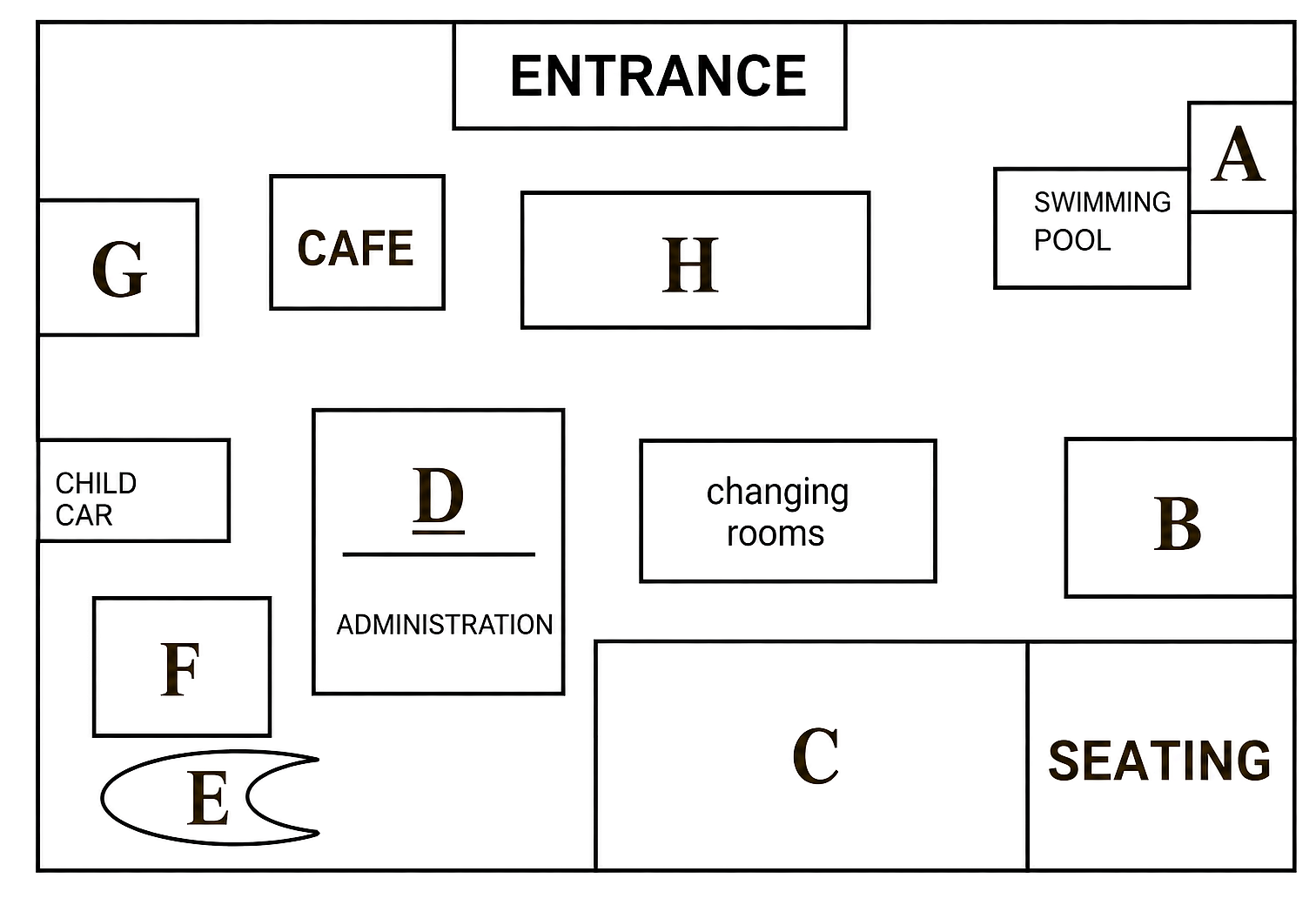
Speaker 5: Good evening, and welcome to Carrara's brand new Sports and Leisure Centre. First, I'll tell you about our facilities, then feel free to wander around the centre. Now as you can see from the map I've given you, we're sitting in our cafe, which we hope will be a favorite place to visit after exercising. To one side of us and right in front of you as you enter the complex is the shop. Be sure to have a look in there later as we've got some great opening specials on footwear. On the other side of the cafe, and ideally situated between the cafe and the child minding facilities, we have the playground. You can sit and relax there while your kids have a great time on the equipment. And our child care facilities are available to anyone using the centre. Let's talk a little bit about our heated swimming pool, which is also near the entrance, on the other side from the cafe. It has a five meter water slide, which will be very popular with kids of all ages. And in the corner, nearest the changing rooms, we have a high-tech hot spa. The water is heated to 38 degrees centigrade, which is the ideal temperature to relax tired muscles after a workout. So where can you do these workouts? Well, we have a large weights room located at the cafe end of the administration block. In the weights room, you'll find all the latest equipment. We also have trainers there who can put a program together for you. Another place to get a good workout is in the gym, which is shown on the map to the right of the changing rooms. There will be all sorts of classes offered there. Our aim is to provide all your exercise and recovery needs. So as well as the spa to help aching bodies, we also have a special area for massage. It's in the funny shaped room close to the administration area. Its distinctive shape has already led to the nickname of the Bullet Room. We'll be offering Swedish and Chinese massage there, and we'll offer physiotherapy in the future.
Speaker 4: Before you hear the rest of the talk, you have some time to look at questions 17 to 20 on page five. Now listen and answer questions 17 to 20.
Speaker 5: Now let me tell you something about our different memberships. Firstly, we offer different types of membership to cater for different needs. If you are a fitness freak, then choose our all in membership. This gives you access to everything in the center, all the classes and sports. It's usually our most expensive option. But for a short time, we're offering twelve months for the price of 9, which is a huge saving. If you prefer just the gym classes, you may want to consider the gym and weights package. It works out at $10 a week, which is good value. If you just want to swim, then we recommend getting a swim plus membership. With this, you have unlimited use of the pool and spa. The other package we've reduced for this month only is the off peak. This is aimed at people who are happy to come at less busy times. And finally, we have the family pack. We believe in keeping the whole family fit and healthy, so this package works out cheaper than buying it separately. Your flyer has details of all the prices. So anyone who signs up for a new membership tonight will receive two fantastic presents from us. We wanted to make these rewards something different from the norm. We could have just chosen a towel for you to use in the gym or some clothing from the shop, but we wanted to show our appreciation by giving you something special. So not only are we going to give you a voucher for a session in our massage center, a great way to unwind after your workout, but you'll also get this great device that measures your heart rate. And finally, just for turning up tonight, we'd like to give everyone here a drink bottle to take away with them. That's all I wanted to say.
Speaker 4: That is the end of section two. You now have half a minute to check your answers.
PART 3
Speaker 6: Section three. You will hear two psychology students called Katie and Daniel discussing how taking a walk can affect people's creativity and physical well-being. First, you have some time to look at questions 21 to 26 on page five. Now listen carefully and answer questions 21 to 26.
Speaker 7: Hi, Daniel.
Speaker 8: Katie, you look as if you're off somewhere. Yes. I was just heading out for a walk. Funny. I was just reading an article about some research that's been done on the effects of walking on creativity.
Speaker 7: Sounds interesting.
Speaker 8: I've always found walking helped me think, but this article confirms that everybody can benefit.
Speaker 7: Oh, tell me more. Okay. But I may even do some more research on it at some point, so don't pinch my idea. Promise.
Speaker 8: Well, in the experiments, the researchers tested participants' creativity by comparing how many ideas they thought of while they were walking compared to while they were doing other activities.
Speaker 7: What? Like listening to music? Nothing like that. But they did analyze the ideas participants came up with when sitting, both outdoors and inside. What I found surprising was that they didn't compare walking to other forms of exercise, like running, for example. Right.
Speaker 8: So what was the difference between the experiments?
Speaker 7: Well, in each one, the activities were put together in different ways. Several of the experiments specifically focused on the ability of participants to come up with new ideas. Then the final experiment was a control test of sorts. Oh, right. In one experiment, participants had to think of unusual uses for three everyday objects within a time limit. Okay. And then there was an experiment with words.
Speaker 8: What did they ask them to do? Compare words in unusual ways. For example, the word sweet. If participants simply said sweet as sugar, that wasn't creative. But an answer like sweet as a cat with honey on its paws was. Okay.
Speaker 7: I can see why they'd ask them to do that. Really? I just don't see how the experiment is fair. Why? Because the conclusions are based only on the researcher's opinion. I think it's more that anyone who'd studied language would be at an advantage.
Speaker 8: Okay. Was there an experiment about focused thinking?
Speaker 7: Yeah. There was. It aimed to find out if walking helped focused thinking, though I wasn't sure that I agreed with their findings. They decided that walking doesn't help this type of thinking.
Speaker 8: What evidence did they have? Well, that's it. I don't think there was enough evidence to support their conclusions even if their methods were sound.
Speaker 7: Well, I'd certainly hesitate before making such a bold statement.
Speaker 8: Still, it's a first step, isn't it? I suppose to move forward with this, they'll need to test other ways people keep fit, like swimming.
Speaker 7: That would be useful. But personally, I'd like to know more about the fundamental reason for the effect on people's creativity.
Speaker 8: That would be good. Then it could be applied more widely in work, for example. Again, that's secondary, really.
Speaker 6: Before you hear the rest of the discussion, you have some time to look at questions 27 to 30 on page six. Now listen and answer questions 27 to 30.
Speaker 7: But how would you test walking if you wanted to assess its physical benefits?
Speaker 8: Well, firstly, I'd like to know more about the benefits of different situations.
Speaker 7: What about the effect of footwear? Hadn't thought of that. Well, I've read that shoes with thinner soles were found to be better for people's joints. It even made the skeletal structure tougher.
Speaker 8: Interesting. Was that because they lost weight? Not as far as I'm aware.
Speaker 7: And then there's walking in the mountains.
Speaker 8: Walking in the mountains. I think I've read something about that. Doesn't altitude help people regulate their sleep patterns?
Speaker 7: It's more that it improves your vision. It must be those breathtaking views. Yeah.
Speaker 8: And what about the effect that walking has for elderly people? Better balance by any chance? More than that. It had a positive effect by helping them maintain their body clock's natural rhythm, both when going to bed and waking up. Right.
Speaker 7: And what about the effect of walking long distances?
Speaker 8: Well, a person needs to find the balance between their optimum speed and their natural breathing pattern. Once they're synchronized, they can just keep on going for much longer periods than they could before.
Speaker 7: I can see how that would work. But anyway, you
Speaker 6: That is the end of section three. You now have half a minute to check your answers. Now turn to section four on page seven.
PART 4
Speaker 3: Section four. You will hear part of a lecture about time measurement. First, you have some time to look at questions 31 to 40.
Speaker 3: Good morning, everyone. Today I'm going to talk about the research project I've been involved in on time measurement. Do you know how time is measured? Consider how we measure length and how, with time, we encounter a difficulty. Before we could grasp it, it would slip through our fingers. In fact, as we can see, we are forced to have the resource to measure something else. The movement of something in space or a set of movements in space. All the methods that have been employed so far really measure time by a motion in space. The measurement of time is no easy matter, a scientific unit only arrived at after much thought and reflection. As the most primitive form of measurement, the sun seems to be natural. Ever since man first noticed the regular movements of the sun and stars, we have wondered about the passage of time. Prehistoric people first recorded time according to the sun's position. To start off, let us take noon, which is when the sun is on the meridian at the highest point of its course across the heavens, and when it casts the shortest shadow. But this measurement, which was regarded as a major one in ancient times, was less important than the natural events that occurred. The earliest natural events that had been recognized were in the heavens, but during the course of the year, there were many other events that indicated significant changes in the environment. Seasonal winds and rains, the flooding of rivers, the flowering of trees and plants, and the breeding cycles or migration of animals all led to natural divisions of the year, and the further observation and local customs led to the recognition of the season. Years later, precise measurements were invented because the passage of time was extremely important for astronomers and priests who were responsible for determining the exact hour for daily rituals and for important religious festivals. Apart from the connection with religion, accurate time measurement was also related to the government since they divided the day or the night into different periods in order to regulate work and various events. For thousands of years, devices had been used to measure and keep track of time. The current sexagesimal system of time measurement dates back to approximately 2,000 BCE from the Sumerians. It was found that the earliest ancient timekeepers were mainly invented and used in Mesopotamia, where the water clock was introduced from, as well as in North Africa, especially in the area of ancient Egypt. So now I'd like to introduce you to some of the most well known ancient timekeepers as well as the disadvantages of them for which they were replaced by various new forms of clocks that were used afterwards. A sundial is a device that tells the time of day by the apparent positioning of the sun in the sky. In the narrowest sense of the word, it consists of a flat plate and a nomen, which casts a shadow onto the dial. As the sun appears to move across the sky, the shadow aligns with different hour lines, which are marked on the dial to indicate the time of day. However, it was quickly noted that the length of the day varied at different times of the year. Therefore, there could have been a difference between clock time and sundial time. In addition, the sundial was of no use at night, so a water clock was invented. The water clock, or klepsydra, appeared to have been invented around 1500 BCE and was a device which relied on the steady flow of water from or into a container. Measurements could be marked on the container or on a receptacle for the water. It was reliable, but the water flow still depended on the variation of pressure and temperature from the top of water in the container. As the technology of glassblowing developed, from sometime in the fourteenth century, it became possible to make sand glasses. Originally, they were used as a measurement for periods of time like lamps or candles. But as clocks became more accurate, they were calibrated to measure specific periods of time. The drawback, however, as you can imagine, was the limited length of time they could measure. The last timekeeper to be introduced is the fire candle clock. Candle clocks took advantage of a simple concept: the slow and consistent nature of a burning wax candle. By utilizing this process, our ancestors were able to keep steady track of the time. The clocks were created by engraving the length of the candle with evenly spaced markings. Each marking represented a single unit of time, and as the wax burned down, each hour would disappear. However, the drafts and the variable quality of the wax mainly influenced the time of burning. Like oil lamps, candles were used to mark the passage of time from one event to another rather than tell the time of day.
Speaker 3: That is the end of section four. You now have half a minute to check your answers.
====================
Chinese Translation
====================
第一部分
Speaker 0:你将听到几段不同的录音,并需要根据听到的内容回答问题。每段录音结束后,你会有时间阅读题目和说明,并有机会检查答案。所有录音只播放一次。考试共分四个部分。请将所有答案写在听力答题册上。在真实考试结束时,你会有十分钟时间将答案从答题册誊写到答题卡上。请做好准备进行练习。现在请翻到第一部分。第一部分。
Speaker 1:你好。今天有什么可以帮你的吗?
Speaker 2:啊,是的。你好。我打电话来是因为我在你们的网站上看到一则广告,对一处我想租的房产感兴趣。如果可以的话,我想在安排看房之前先了解更多信息。没问题。你想咨询的房产地址是哪里?
Speaker 1:是北大道21号。好的。你想了解什么?
Speaker 2:首先,我想知道办公室有哪些设施,因为我需要确保它适合我的广告公司。
Speaker 1:我明白了。这间办公室有一个大型开放式空间,临街面很宽,面向一条繁忙的街道,人流量很大。所以你的公司会有很好的街面曝光度。此外还有卫生间和一间新装修的厨房,配有洗碗机和烤箱。
Speaker 2:哇。听起来很棒。我 definitely 想登记我的意向。
Speaker 1:好的。完美。我需要记录一些你的信息,可以吗?请问你的全名是什么?
Speaker 2:乔纳森·史密斯。
Speaker 1:乔纳森,你在公司担任什么职位?
Speaker 2:直到最近,我都是销售经理。不过,我最近刚被提升为区域经理,所以我会负责管理我们的新办公室。
Speaker 2:我能问一下办公室的位置吗?
Speaker 1:当然可以。它位于市中心,就在皇家广场购物中心的拐角处。
Speaker 2:对我来说,那离市中心有点远了。我更希望办公室靠近车站。你们在那个区域有房产吗?如果你能告诉我你打算安排多少员工在办公室工作,那将有助于我缩小搜索结果。
Speaker 2:我们的分公司有30名员工,我们还需要一些额外的空间用于会议和演示。
Speaker 1:大多数普通办公空间大约在8000平方英尺左右,但听起来你需要更大的空间。我认为10000平方英尺更适合你的需求。让我看看。我们有10处符合这些条件的房产,所以我们来试着缩小范围。
Speaker 3:在听对话的其余部分之前,你有时间看一下第五到第十题。现在请听录音并回答第五到第十题。
Speaker 1:你还有其他要求吗?
Speaker 2:嗯,我们需要每天十二小时可以进入办公室,但安保需要是二十四小时的。我们不在场所内存放现金,但保护客户信息免遭盗窃至关重要。好的。还有别的吗?
Speaker 2:是的。理想情况下,我希望新办公室能分成两层,这样办公区域与街道层分开。这样我们就可以在一楼设置一个接待处,在客户到达时迎接他们。
Speaker 2:另外,你们需要什么特别的设施吗?我们的员工整天工作非常努力,我想确保他们能得到良好的饮食。因此,如果我能为他们提供一个在午餐时间烹饪热食的厨房,那就太理想了。
Speaker 1:你希望厨房和办公室一样设在二楼吗?
Speaker 2:不。我不想让办公室充满食物的味道。如果新办公室有一个地下室,我们可以把厨房和员工休息区设在那里,与工作区保持距离,那就更好了。
Speaker 1:好的。我现在已经把搜索范围缩小到两处可用的房产了。你还有其他要求可以让我们进一步缩小到一处结果吗?
Speaker 2:我们所有的办公室员工都将使用台式电脑工作,所以如果可能的话,我需要办公室配备至少40个电源插座。
Speaker 2:还有别的吗?研究表明,运动对于保持快乐和健康的大脑功能非常重要。在办公环境中,很难获得足够的日常锻炼,所以如果附近有锻炼区域就太好了。
Speaker 1:其中一处可用的办公室隔壁就是一家健身房。这个合适吗?
Speaker 2:是的。当然。健身房正是我想要的。太棒了。
Speaker 1:你需要办公室配备家具吗?
Speaker 2:我想不用。我已经有一些家具了,所以我更愿意自己带过来。
Speaker 1:完全没问题。
Speaker 2:还有,趁我还没忘,我们 definitely 需要Wi-Fi接入,因为我们的大部分工作和客户招募都是在线上进行的。
Speaker 1:没问题。听起来这处房产会完美满足你的需求。我已经冒昧地为你预约了周四下午3点的看房,这样你可以亲自看看。今天还有什么其他我能帮忙的吗?
Speaker 2:没有了。我想这就是我需要了解的所有信息了。非常感谢你的帮助。
Speaker 1:不客气。很高兴能帮到你。再见。
Speaker 3:第一部分到此结束。你现在有半分钟时间检查答案。现在请翻到第二部分。
第二部分
Speaker 4:第二部分。你将听到一家新体育中心的经理向潜在客户介绍那里的设施。首先,你有时间看一下第四页的第11到16题。现在请仔细听并回答第11到16题。
Speaker 5:晚上好,欢迎来到卡拉拉全新的体育休闲中心。首先,我将向你们介绍我们的设施,然后请随意在中心内参观。正如你们从我给的地图上看到的,我们现在坐在我们的咖啡馆里,我们希望这里能成为大家运动后最喜欢来的地方。在我们的一侧,也就是你们进入综合体时正前方,是商店。稍后一定要进去看看,因为我们在鞋类产品上有很棒的开幕特价。在咖啡馆的另一侧,位于咖啡馆和儿童看护设施之间的理想位置,是我们的游乐场。你可以坐在那里放松,而你的孩子们可以在游乐设施上尽情玩耍。我们的儿童看护设施对所有使用中心的人开放。现在来谈谈我们的恒温游泳池,它也在入口附近,在咖啡馆的另一边。它有一个五米长的水滑梯,肯定会受到所有年龄段孩子们的欢迎。在靠近更衣室的角落里,我们有一个高科技的热水按摩池。水温加热到38摄氏度,这是锻炼后放松疲劳肌肉的理想温度。那么,你可以在哪里进行这些锻炼呢?嗯,我们有一个大型举重室,位于行政楼靠近咖啡馆的一端。在举重室里,你会发现所有最新的设备。我们还有教练在那里,可以为你制定训练计划。另一个进行锻炼的好地方是健身房,在地图上显示在更衣室的右侧。那里将提供各种课程。我们的目标是满足你所有的锻炼和恢复需求。所以,除了帮助缓解身体酸痛的按摩池,我们还有一个专门的按摩区域。它位于靠近行政区的那个形状奇特的房间里。其独特的形状已经为它赢得了“子弹房”的绰号。我们将在那里提供瑞典式和中医按摩,并且将来还会提供物理治疗。
Speaker 4:在听演讲的其余部分之前,你有时间看一下第五页的第17到20题。现在请听并回答第17到20题。
Speaker 5:现在让我告诉你们一些关于我们不同会员资格的信息。首先,我们提供不同类型的会员资格以满足不同需求。如果你是一个健身狂热者,那么选择我们的全能会员资格。这让你可以使用中心内的一切设施、所有课程和运动项目。这通常是我们最昂贵的选择。但短期内,我们提供“付9个月的钱享受12个月”的优惠,这是一笔巨大的节省。如果你只喜欢健身课程,你可以考虑健身和举重套餐。算下来是每周10美元,非常划算。如果你只想游泳,那么我们建议你选择游泳增强会员资格。有了这个,你可以无限次使用游泳池和按摩池。另一个仅限本月降价的套餐是“非高峰时段”套餐。这是为那些愿意在非繁忙时段来的人准备的。最后,我们有家庭套餐。我们相信让整个家庭保持健康,所以这个套餐比单独购买要便宜。你们的宣传单上有所有价格的详细信息。所以,任何今晚注册新会员的人都会收到我们送出的两份精彩礼物。我们希望这些奖励与众不同。我们本可以只选择一条供你在健身房使用的毛巾或商店里的一些衣服,但我们想通过赠送一些特别的东西来表达我们的感谢。所以,我们不仅会赠送你一张在我们按摩中心进行一次疗程的优惠券——这是锻炼后放松的好方法——而且你还会得到这个测量心率的好设备。最后,仅仅为了今晚的光临,我们想送给在座的每一位一个饮水瓶带回家。我想说的就是这些。
Speaker 4:第二部分到此结束。你现在有半分钟时间检查答案。
第三部分
Speaker 6:第三部分。你将听到两名心理学学生凯蒂和丹尼尔讨论散步如何影响人们的创造力和身体健康。首先,你有时间看一下第五页的第21到26题。现在请仔细听并回答第21到26题。
Speaker 7:嗨,丹尼尔。
Speaker 8:凯蒂,你看起来好像要去什么地方。是的。我正要出去散步。真巧。我刚刚读了一篇关于散步对创造力影响的研究文章。
Speaker 7:听起来很有趣。
Speaker 8:我一直觉得散步有助于我思考,但这篇文章证实了每个人都能从中受益。
Speaker 7:哦,跟我说说。好的。但我以后可能还会对此做更多研究,所以别剽窃我的想法。保证。
Speaker 8:嗯,在实验中,研究人员通过比较参与者在走路时与进行其他活动时想出的点子数量来测试他们的创造力。
Speaker 7:什么?像听音乐那样?不是那样的。但他们确实分析了参与者在坐着时想出的点子,无论是在户外还是室内。我觉得惊讶的是,他们没有将散步与其他形式的锻炼进行比较,比如跑步。对。
Speaker 8:那么这些实验之间有什么不同呢?
Speaker 7:嗯,在每个实验中,活动都是以不同的方式组合的。有几个实验特别关注参与者提出新想法的能力。然后最后一个实验是一种对照测试。哦,对。在一个实验中,参与者必须在规定时间内想出三种日常物品的不寻常用途。好的。然后还有一个关于词语的实验。
Speaker 8:他们要求他们做什么?以不寻常的方式比较词语。例如,“甜”这个词。如果参与者只是说“像糖一样甜”,那就不算有创意。但像“甜得像爪子沾了蜜的猫”这样的答案就算。好的。
Speaker 7:我明白他们为什么让他们这么做了。真的吗?我只是不明白这个实验怎么公平。为什么?因为结论仅仅基于研究人员的意见。我认为更像是任何学过语言的人都会更有优势。
Speaker 8:好的。有没有关于专注思考的实验?
Speaker 7:有的。有。它旨在查明散步是否有助于专注思考,尽管我不确定我是否同意他们的发现。他们认为散步无助于这种类型的思考。
Speaker 8:他们有什么证据?嗯,就是这样。我认为即使他们的方法是可靠的,也没有足够的证据支持他们的结论。
Speaker 7:嗯,我在做出如此大胆的声明之前肯定会犹豫。
Speaker 8:不过,这是第一步,不是吗?我想为了在这方面取得进展,他们需要测试人们保持健康的其他方式,比如游泳。
Speaker 7:那会很有用。但就个人而言,我想更多地了解影响人们创造力的根本原因。
Speaker 8:那会很好。然后它就可以更广泛地应用于工作中,例如。再说一次,这实际上是次要的。
Speaker 6:在听讨论的其余部分之前,你有时间看一下第六页的第27到30题。现在请听并回答第27到30题。
Speaker 7:但是,如果你想评估散步对身体的好处,你会如何测试它?
Speaker 8:嗯,首先,我想更多地了解不同情况下的好处。
Speaker 7:那鞋子的影响呢?没想到这一点。嗯,我读到过,鞋底更薄的鞋子对人们的关节更好。它甚至使骨骼结构更强健。
Speaker 8:有趣。那是因为他们体重减轻了吗?据我所知不是。
Speaker 7:还有在山里散步。
Speaker 8:在山里散步。我想我读过一些关于这方面的东西。海拔不是有助于人们调节睡眠模式吗?
Speaker 7:更多的是它能改善你的视力。一定是那些令人叹为观止的景色。是的。
Speaker 8:那散步对老年人的影响呢?也许是更好的平衡能力?不止如此。它通过帮助他们维持生物钟的自然节律产生了积极影响,无论是在睡觉时还是醒来时。对。
Speaker 7:那长距离散步的效果呢?
Speaker 8:嗯,一个人需要找到最佳速度和自然呼吸模式之间的平衡。一旦它们同步了,他们就能比之前坚持更长的时间。
Speaker 7:我明白那是如何起作用的了。但不管怎样,你
Speaker 6:第三部分到此结束。你现在有半分钟时间检查答案。现在请翻到第七页的第四部分。
第四部分
Speaker 3:第四部分。你将听到一段关于时间测量的讲座节选。首先,你有时间看一下第31到40题。
Speaker 3:大家早上好。今天我要谈谈我参与的一个关于时间测量的研究项目。你知道时间是如何测量的吗?想想我们如何测量长度,以及我们在测量时间时遇到的困难。在我们抓住它之前,它就会从指缝间溜走。事实上,正如我们所见,我们不得不借助测量其他东西。测量空间中某物的运动或一系列空间运动。迄今为止使用的所有方法实际上都是通过空间中的运动来测量时间。测量时间并非易事,它是一个经过深思熟虑才得出的科学单位。作为最原始的测量形式,太阳似乎是自然而然的。自从人类首次注意到太阳和星星有规律的运动以来,我们就一直在思考时间的流逝。史前人类首先根据太阳的位置记录时间。首先,我们以正午为例,此时太阳位于子午线上,处于其横跨天空轨迹的最高点,并且投下最短的影子。但是,这种在古代被视为重要测量的方式,其重要性不如发生的自然事件。最早被认识到的自然事件是在天空中,但在一年中,还有许多其他事件表明环境发生了重大变化。季节性的风和雨、河流泛滥、树木和植物的开花、动物的繁殖周期或迁徙,都导致了年份的自然划分,进一步的观察和当地习俗导致了对季节的认识。多年以后,精确的测量被发明出来,因为时间的流逝对于负责确定日常仪式和重要宗教节日确切时刻的天文学家和祭司来说极其重要。除了与宗教的联系,精确的时间测量也与政府有关,因为他们将白天或夜晚划分为不同的时段,以规范工作和各种活动。几千年来,人们一直使用各种装置来测量和记录时间。当前六十进制的计时系统可以追溯到大约公元前2000年的苏美尔人。人们发现,最早的古计时器主要是在美索不达米亚发明和使用的,水钟就是从那里引入的,此外还有北非,特别是古埃及地区。所以现在我想向你们介绍一些最著名的古计时器,以及它们的缺点,正是这些缺点导致它们被后来使用的各种新型钟表所取代。日晷是一种通过太阳在天空中的视位置来指示白天时间的装置。从最狭义上讲,它由一个平板和一个晷针组成,晷针在表盘上投下阴影。当太阳看起来在天空中移动时,阴影与表盘上标记的不同小时线对齐,以指示一天中的时间。然而,人们很快注意到,一年中不同时间白天的长度是不同的。因此,时钟时间和日晷时间之间可能存在差异。此外,日晷在夜间无法使用,因此水钟被发明出来。水钟,或称漏壶,似乎是在公元前1500年左右发明的,它是一种依靠水稳定地流入或流出容器的装置。测量标记可以刻在容器或盛水器上。它很可靠,但水流仍然取决于容器内水顶部的压力和温度变化。随着玻璃吹制技术的发展,从十四世纪的某个时候开始,制造沙漏成为可能。最初,它们被用来测量像油灯或蜡烛燃烧那样的一段时间。但随着钟表变得更加精确,它们被校准来测量特定的时间段。然而,正如你可以想象的,缺点是它们能测量的时间长度有限。最后要介绍的计时器是火烛钟。蜡烛钟利用了一个简单的概念:燃烧的蜡烛缓慢而稳定的特性。通过利用这个过程,我们的祖先能够稳定地追踪时间。这种钟是通过在蜡烛的长度上雕刻均匀间隔的标记来制作的。每个标记代表一个时间单位,随着蜡燃烧殆尽,每个小时标记就会消失。然而,气流和蜡烛质量的不稳定主要影响了燃烧时间。像油灯一样,蜡烛被用来标记从一个事件到另一个事件的时间流逝,而不是指示一天中的具体时间。
Speaker 3:第四部分到此结束。你现在有半分钟时间检查答案。