Sobre este conjunto: compilado e levemente revisado a partir de material real de provas relatadas por candidatos. O IELTS usa um banco de questões global, então esse material circula no mundo todo. Para montar uma prova completa, materiais relatados no mesmo período são reunidos — então um conjunto pode combinar conteúdos de várias datas de exame, não de uma única aplicação. Qualquer áudio é uma recriação para prática. Organizado para facilitar o estudo. Baseado em relatos de candidatos — não é material oficial do IELTS.
Reading Passage 1: The Whale Goes to Court
In 1818 a whale became the subject of a controversial court case in New York City. The case involved an old law requiring those who sold fish oil to pay a fee in order to have their barrels inspected by city officials, and certified. However, an oil merchant named Samuel Judd refused to pay the inspection fee on three barrels of oil, claiming that no inspection was necessary because it was whale oil, and whales were not fish. The state disagreed, and so a date was set for a court to decide not a point of law, but the answer to a more fundamental question: is a whale a fish?
As simple as that question may appear today, the answer was far from obvious in the early nineteenth century. Indeed, the public debate in New York sparked off by the trial was sensational. At stake was nothing less than what most regarded as the order of nature. According to the commonly accepted scheme of things, if an animal was not a beast or a bird, it was a fish, regardless of whether it breathed air or suckled its young. For as long as anyone could remember, all non-human creatures had been organised according to the categories of birds, beasts and fish. For the average person the answer seemed perfectly obvious: whales swam in the sea and therefore they were fish.
Against this traditional framework stood the new Linnaean system of classification, which sought to introduce more scientific values into the classification of living things. Barely half a century old in 1818, the Linnaean system controversially classified whales as mammals because they shared two mammalian characteristics: they were warm-blooded and breathed air.
So the trial began in December 1818. Judd's defence lawyers chose as their star witness one of New York's most prominent figures, the congressman Samuel Mitchill. Referred to as a 'living encyclopaedia' and a 'walking library', Mitchill was a renowned natural history lecturer at the college of Physicians and Surgeons who liked to dare his students to test his knowledge of the natural world. 'Show me the fin, and I will name the fish,' he boasted. Scientifically, it was an open-and-shut case, and Judd's defence lawyers believed they only had to do one simple thing to win the trial: insist that it be decided by biology alone. Mitchill seemed fully qualified for this role.
But this is where the case becomes interesting, and is the reason why the trial of the whale is not some dusty nineteenth-century obscurity. For rather than debate Mitchill on his area of expertise, lawyers for the New York City fish-oil inspectors chose a different tack. Lead counsel William Sampson turned the trial into a contest between scientific learning and common sense, by asking plain-spoken whalers to make their case before the jury.
The crux of Sampson's case was the trial's implication with regard to humans, should Judd be found not guilty. Sampson told jury members that if they accepted Mitchill's testimony on whales, they were obliged to accept a lower place for their own kind in the natural order. As a result, Mitchill's day in court did not go smoothly, not least because he was forced to acknowledge serious disputes among his peers regarding exactly how to classify biological organisms. Sampson then took aim at Mitchill himself and what he represented: privileged aristocrats from the scientific community who had lost touch with reality. The smooth-talking Sampson then claimed Mitchill's beliefs had their origin in Europe – something he rightly judged would infuriate the citizens of always-independent New York. This revolutionary new thinking Sampson claimed, was something that honest working New Yorkers could do without. No longer was this a case about barrels of oil but the proper place of scientific knowledge in the U.S.A.
Ultimately, what won the case for Samuel Judd were not Mitchill's scientific arguments, but testimony from a different sphere altogether. In New York's markets, the merchants implicitly understood that whale oil and fish oil were not the same: whale oil could be used as a fuel for lamps because it could be burned without giving off smoke; fish oil, on the other hand, was nasty, impure stuff used primarily in tanning leather. In the end it was this testimony that led to Judd's victory. The trial of the whale still has relevance today, when the court of public opinion remains easily swayed by sceptics. The 1818 trial was really about this question: who gets to decide on the place of the natural world in the human world – scientific experts or public opinion? Whether the issue today is the effects of human activity on the climate of this planet, or one of many other contemporary topics, the legacy of Judd's case continues to be of relevance.
- 1
An inspection fee on fish oil was introduced in New York in 1818.
- 2
Samuel Judd argued that the inspection fee should exclude whale oil.
- 3
Judd had been in trouble with city officials before the inspection fee disagreement.
- 4
Many New Yorkers were interested in the court case at the time.
- 5
Traditionally, non-human creatures had been classified in one of three groups.
- 6
Generally speaking ordinary people thought fish were the lowest form of life.
- 7
Whales were excluded from the Linnaean system in 1818.
- 8
Samuel Mitchill worked as a congressman and a ________.
- 9
William Sampson called ________ as witnesses in order to appeal to the common sense of the jury.
- 10
New Yorkers disliked Mitchill because his ideas came from ________.
- 11
In the end it was statements from local ________ not Mitchill's testimony which helped Judd win.
- 12
Whale oil made a good ________ because it was clean.
- 13
Judd's case is relevant today, e.g. in the debate about Earth's ________.
Reading Passage 2: Roller coaster: the great fairground attraction
How they move
Like a passenger train, a roller coaster consists of a series of connected cars that move on a track. But unlike a passenger train, it has no engine or power source of its own. For most of the ride, it is moved only by the forces of inertia and gravity. The only exertion of energy occurs at the very beginning of the ride when the coaster train is pulled up the lift hill.
The traditional lifting mechanism is a long length of chain running up the hill under the track. The chain is fastened in a loop, which is wound around a gear at the top of the hill and another one at the bottom. The gear at the bottom of the hill is turned by a motor. This turns the chain so that it continually moves up the hill like a long conveyor belt. The coaster cars grip onto the chain, which simply pulls them to the top. At the summit, the train is released and starts its descent.
The purpose of this initial ascent is to build up a sort of reservoir of potential energy, which simply means that as the coaster gets higher in the air, there is a greater distance gravity can pull it down.
As the train starts coasting down the hill, this potential energy is converted into kinetic energy (energy of motion), and the train speeds up. At the bottom of the hill, this has reached its maximum, and this propels the train up the second hill, again building up the potential-energy level.
In this way, the course of the track is constantly converting energy from kinetic to potential and back again. This fluctuation in acceleration is what makes roller coasters so much fun. At its most basic level, this is all a roller coaster is – a machine that uses gravity and inertia to send a train along a winding track.
Coasting through history
Roller coasters have a long, fascinating history. Their direct ancestors were ice slides, popular in Russia in the 16th and 17th centuries. They consisted of a long, steep, wooden slide covered in ice. Riders walked up a ladder or set of stairs to the top of the slide, as high as 21 metres up. At the top, they climbed into sleds made of wood or blocks of ice and shot down the slope. At the base, the sleds would crash-land in a sand pile.
It seems that the idea was then imported into France. For most of the year, the warmer climate would melt the ice, so the French started building waxed slides instead. To help the sleds move down these slides, they added wheels, and in 1817, for the first time, a train was attached to the track. The French continued to expand on this idea, coming up with more complex track layouts, with multiple cars and all sorts of twists and turns.
The first American roller coaster was built in the mountains of Pennsylvania in the mid-1800s, originally to provide an easy way to send coal to the railway 29 km down the mountain. When the track was first built, a crew at the bottom of the mountain would attach the cart to a team of mules after emptying the load, and the mules would drag it back up to the top. They were eventually replaced with steam engines to make the system more efficient.
Soon after these improvements were made, the railway company built a new tunnel that brought the freight trains much closer to the coal mine. No longer required for its original purpose, the roller coaster was configured as a ‘scenic tour’. For one dollar, tourists got a leisurely ride up to the top of the mountain, followed by a wild, bumpy ride straight down. This was soon a resounding success, attracting thousands of tourists every year.
Scenic rides like this continued to thrive and were joined by wooden roller coasters similar to the ones we know today. These coasters were the main attraction at popular amusement parks throughout the United States, such as the many parks of Coney Island in New York. By the 1920s, roller coasters were in full swing, with some 2,000 rides in operation around the country.
Following the Great Depression, a decline in roller-coaster production began in the early 1930s, but a second roller-coaster boom in the 1970s and the beginning of the 1980s revitalised the amusement-park industry and introduced a slew of innovative tubular steel coasters.
This was followed by a decline in interest for the rest of the decade, but since the early 1990s the amusement-park industry has experienced another coaster boom of sorts. New launching techniques and other technological developments have opened up a world of options for designers, so in some rides you feel as if you are flying. In the next few years we can expect to see many faster, taller and more twisted rides popping up in amusement parks around the world.
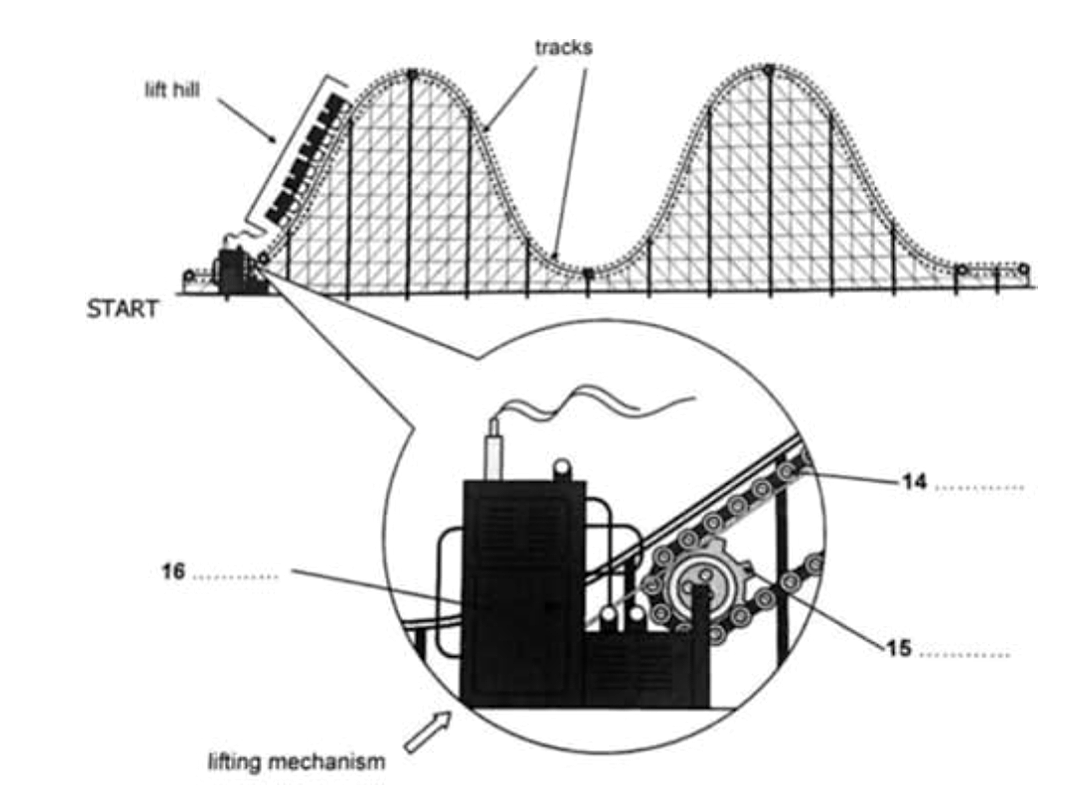
- 14
Label the diagram below. Choose ONE WORD ONLY from the passage for each answer. (Questions 14–16)
- 15
Complete the summary below. Choose NO MORE THAN TWO WORDS from the passage for each answer. (Questions 17–21)
History of roller coasters
• Modern roller coasters are descended from 16th-century Russian slides with a surface of 17 _______.
• In France, because of the higher temperatures, the wooden surface on the slides was 18 _______, and 19 _______ were attached to the cars to ease the descent.
• The first US roller coaster was used for transporting 20 _______ down a mountainside in carts.
• Initially, these were pulled by mules, but in time power was produced by 21 _______.
- 16
Do the following statements agree with the information given in Reading Passage 2? (Questions 22–26)
22 The earliest modifications to the basic slide were made in France.
23 Roller coasters continued to increase in popularity throughout the 1920s and 1930s.
24 New roller-coaster technology was introduced in the 1970s in response to public demand.
25 Roller coasters were less popular for most of the 1980s than in the 1970s and 1990s.
26 The design of roller-coaster rides became more varied in the 1990s.
- T. TRUE
- F. FALSE
- NG. NOT GIVEN
Reading Passage 3: Book Review: The Discovery of Slowness
The English explorer and writer John Franklin (1786–1847) joined the Navy at the age of 14, and fought at the battle of Trafalgar. When peace came, he turned his attention to Arctic exploration, and in particular to solving the conundrum of the Northwest Passage, a mythical clear-water route through the ice which would, if it existed, link the Pacific Ocean on America’s West Coast with the Atlantic on its East. The first expedition Franklin led to the Arctic was an arduous overland journey lasting from 1819 to 1822, in which he and his twenty-strong team covered 8,880 kilometres on foot. Their expedition was a triumph of surveying – they managed to chart hundreds of kilometres of previously unknown coastline – but food ran out on their journey back to civilisation, and the men were forced to eat their belts and their boots (which they boiled up to make leather soup).
There followed a career as a travel writer and public speaker (‘the man who ate his boots’ was Franklin’s tag-line). Then in 1845, Franklin set off back to the Arctic with two ships – the Erebus and the Terror – and 129 men. Nothing was heard of them for 14 years, although more than 30 expeditions were dispatched in search of them. Eventually it was discovered that Franklin and all his team had perished after their ships were trapped in the ice.
In his personal correspondence and published memoirs, Franklin comes across as a man dedicated to the external duties of war and exploration, who kept introspection and self-analysis to a minimum. His blandness makes him an amenably malleable subject for a novelist, and Sten Nadolny has taken full advantage of this in his book. Most important, Nadolny has endowed John Franklin with a defining trait for which there is no historical evidence: Langsamkeit (‘slowness’, or ‘calmness’).
Slowness influences not only Franklin’s behaviour, but also his vision, his thought and his speech. The opening scene of The Discovery of Slowness depicts Franklin as a young boy, failing to catch a ball because his reaction time is too slow. Despite the bullying of his peers, Franklin resolves not to fall into step with ‘their way of doing things’. For Nadolny, Franklin’s fascination with the Arctic stems from his desire to find an environment suited to his peculiar slowness. He describes Franklin as a boy dreaming of the ‘time without hours and days’ which exists in the far north, a place ‘where nobody would find him too slow’.
Ice is a slow mover. The compressed blue ice inside an Alpine crevasse will have fallen as snow several decades earlier. Polar pack ice takes at least two years to form. The film of crystals which first appears on the surface of the sea thickens into a silkily pliant layer called nilas; this in turn consolidates into young ice, which then deepens during several seasons to become pack. Ice demands a corresponding patience from those who venture onto it. The explorers who have thrived at high latitudes and at high altitudes haven’t usually been men of great speed. They have tended instead to demonstrate unusual self-possession, a considerable capacity for boredom, and a talent for the uncomplaining endurance of suffering.
These were all qualities which the historical Franklin possessed in abundance, and so Nadolny’s exaggeration of them isn’t unreasonable. Even as an adult, Franklin’s slowness of thought means that he is unable to speak fluently, so he learns by heart ‘entire fleets of words and batteries of responses’, and speaks a languid, bric-à-brac language. In the Navy, his method of thinking first and acting later initially provokes mockery from his fellow sailors. But Franklin persists in doing things his way, and gradually earns the respect of those around him. To a commodore who tells him to speed up his report of an engagement, he replies: ‘When I tell something, sir, I use my own rhythm.’ A lieutenant says approvingly of him: ‘Because Franklin is so slow, he never loses time.’
Nadolny also brings his central metaphor of slowness to bear on the novel’s language. The chapters describing Franklin’s early years are a medley of separate fragments, rhetorical questions, associative jumps and exclamation marks. In the later sections recounting Franklin’s first Arctic expedition, Nadolny brilliantly sets the narrative pace to the rhythms of the frozen landscape, and to the ‘slowness which is bred by hunger’.
Since it was first published in Germany in 1983, The Discovery of Slowness has sold more than a million copies and been translated into 15 languages. It has been adopted as a manual and manifesto by European pressure groups and institutions representing causes as diverse as sustainable development, management science and motoring policy, even becoming involved in the debate about speed limits on German roads. The various groups that have taken the novel up have one thing in common: a dislike of the high-speed culture of Post-modernity. Nadolny’s Franklin appeals to them because he is immune to ‘the compulsion to be constantly occupied’, and to the idea that ‘someone was better if he could do the same thing fast’. It’s easy to see where the attraction lies for those in management. The novel is crammed with quotations about time-efficiency, punctiliousness and profitability: ‘What did “too late” mean? They hadn’t waited for it long enough, that’s what it meant.’
- 17
27 a summary of Franklin’s occupation in the period before his first expedition
- 18
28 a reference to a feature of Franklin’s character in Nadolny’s novel that has no definite basis in fact
- 19
29 a connection between the central theme of the novel and an environmental process
- 20
30 a reference to the widespread appeal of Nadolny’s novel
- 21
31 a summary of events following Franklin’s return from his first expedition
- 22
32. Little is known from Franklin’s correspondence and published writings about his ________.
- A. a bully
- B. discoveries
- C. educational
- D. family
- E. isolation
- F. an outsider
- G. personality
- H. problems
- I. remoteness
- J. a scholar
- K. sporting
- L. timelessness
- 23
33. He begins the book by showing how this affects the young Franklin’s ________ activities.
- A. a bully
- B. discoveries
- C. educational
- D. family
- E. isolation
- F. an outsider
- G. personality
- H. problems
- I. remoteness
- J. a scholar
- K. sporting
- L. timelessness
- 24
34. and makes him become ________.
- A. a bully
- B. discoveries
- C. educational
- D. family
- E. isolation
- F. an outsider
- G. personality
- H. problems
- I. remoteness
- J. a scholar
- K. sporting
- L. timelessness
- 25
35. As a child, it is the quality of ________ that attracts Franklin to the Arctic.
- A. a bully
- B. discoveries
- C. educational
- D. family
- E. isolation
- F. an outsider
- G. personality
- H. problems
- I. remoteness
- J. a scholar
- K. sporting
- L. timelessness
- 26
36 In paragraph E, the writer describes different types of ice in order to illustrate
- A. the extreme conditions that Polar explorers have to face.
- B. the unusual quality of the beauty of Polar regions.
- C. the vital importance of preserving the Arctic environment.
- D. the personal qualities required of an explorer in Arctic conditions.
- 27
37 What is said about the way Franklin communicates?
- A. He expresses a very limited range of ideas.
- B. He is only willing to discuss things he is familiar with.
- C. He uses words and phrases that he has previously memorised.
- D. He is only fluent when talking about naval matters.
- 28
38 How does the attitude of the other sailors change towards Franklin?
- A. They no longer notice his slowness.
- B. They start to copy his approach to work.
- C. They begin to recognise his efforts to overcome his problems.
- D. They eventually appreciate his good qualities.
- 29
39 The chapters of The Discovery of Slowness which describe Franklin’s early years contain
- A. text from a wide variety of sources.
- B. short, disconnected pieces of text.
- C. descriptions of the Arctic landscape.
- D. information about other explorers like Franklin.
- 30
40 The Discovery of Slowness has achieved widespread popularity because
- A. it reflects many people’s concern about one aspect of modern life.
- B. it offers achievable solutions to many of the problems of today.
- C. it tells the story of someone’s triumph over personal problems.
- D. it shows how life in the past was less pressured than it is now.
Mostrar gabarito