Reconstruído a partir de relatos de candidatos — não é material oficial do IELTS. Áudio e textos são recriações para prática.
Mostrar transcrição
====================
IELTS Listening Transcript
====================
PART 1
Speaker 0: Section one.
Speaker 0: You will hear a telephone conversation between a woman who is looking for information about holidays and an agent for a tour company.
Speaker 0: First, you have some time to look at questions one to seven on page two.
Speaker 0: You will see that there is an example that has been done for you.
Speaker 0: On this occasion only, the conversation relating to this will be played first.
Speaker 2: Asia Pacific Tours. Can I help you?
Speaker 1: Yes. I've been looking at your website, and I'd like some more information about your activity holidays.
Speaker 2: Certainly. You know, of course, the prices of the tours include stays in three star hotels, and they include airfares.
Speaker 1: Great. What about your tour of Vietnam? My sister went there last year and loved it.
Speaker 0: The first tour the caller asks about is Vietnam. So Vietnam has been written in the space.
Speaker 0: Now we shall begin. You should answer the questions as you listen because you will not hear the recording a second time.
Speaker 0: Listen carefully and answer questions one to seven.
Speaker 2: Asia Pacific Tours. Can I help you?
Speaker 1: Yes. I've been looking at your website, and I'd like some more information about your activity holidays.
Speaker 2: Certainly. You know, of course, the prices of the tours include stays in three star hotels, and they include airfares.
Speaker 1: Great. What about your tour of Vietnam?
Speaker 2: My sister went there last year and loved it. Yes. It's a really beautiful place and probably our fastest growing destination. Now that package includes several opportunities to take courses.
Speaker 1: Don't you have a cookery course of some kind?
Speaker 2: We certainly do. If you love eating out in Vietnam like most people do and want to know how to prepare a meal, you can learn how from a master in a five star hotel. On another day, you have a choice of two activities. The first is instruction in diving in the South China Sea, not a certificate course, but just an introduction. Most people think it's wonderful. Or if you want to stay dry but still want some exercise, you can spend the day on a trek through the jungle near the beach. It's not difficult, and everyone seems to enjoy it.
Speaker 1: Anything cultural on offer?
Speaker 2: We used to take people to a Vietnamese opera, but that didn't prove so popular. So now we include a dance show, and our clients all rave about that. They say the colors are just magnificent.
Speaker 1: What's the cost?
Speaker 2: I've just noticed it's now a special price. The holiday used to be £1,600, but it's just been reduced to £1,450. So you do save quite a bit. And as I said, it seems to be our up and coming tour.
Speaker 1: Well, let's see. Perhaps you could tell me a little about the Hong Kong tour. I noticed it includes a walk in the hills of one of their country parks, where you have the chance to see birds of all sorts.
Speaker 2: Yes. That's a very popular activity. People don't realize that Hong Kong isn't just a crowded city. That's a half day activity, and you go with a trained escort, and it includes dinner in a monastery where you end your day. And then we wouldn't want you to miss out altogether on shopping, so there's another day when we take you around an electronics factory. Now that might sound like an odd thing to do, but it's actually really fascinating and not like your usual ceramics factory. And you can buy their products there quite cheaply. Now the whole Hong Kong package is just £1,320 per person.
Speaker 1: Sounds interesting.
Speaker 0: Before you hear the rest of the conversation, you have some time to look at questions eight to 10 on page two.
Speaker 0: Now listen and answer questions eight to 10.
Speaker 1: But let me find out about one more place. I've always wanted to go to Korea, but not on this trip. And I've been to Thailand, which I loved. But what about your Japan package?
Speaker 2: Good choice. Well, that tour includes a terrific trip to a museum of traditional costume. The exhibits are gorgeous. They've got an absolutely priceless collection.
Speaker 1: And I think the website says you take your clients to a market, don't you? A crafts market, I think.
Speaker 2: Well, we do go to a market, but it's one that sells fish, and it's one of the largest in the world. And you have the chance to sample the wares in a little restaurant nearby. We also give you plenty of free time to wander around the city with our guides if you want.
Speaker 1: And what's the cost of all that?
Speaker 2: £1,800.
Speaker 1: Well, you've been ever so helpful. I've noted all the details down, and I'll get back to you when I've made up my mind.
Speaker 2: If we can give you any more help, do ring back.
Speaker 1: Thanks. I will.
Speaker 0: That is the end of section one. You now have half a minute to check your answers.
Speaker 3: Joy Inletz.
PART 2
Speaker 4: Now turn to section two.
Speaker 4: Section two.
Speaker 4: You'll hear a tour guide talking to a group of visitors about Bestley Castle.
Speaker 4: First, you have some time to look at questions 11 to 15.
Speaker 4: Now listen carefully and answer questions 11 to 15.
Speaker 3: Welcome to Bessley Castle. It's nice to see so many of you here today. Before we go in, I'd like to tell you some information about the castle, the things to see and do, and the facilities available to you in the grounds. We'll do our best to make this a truly memorable visit.
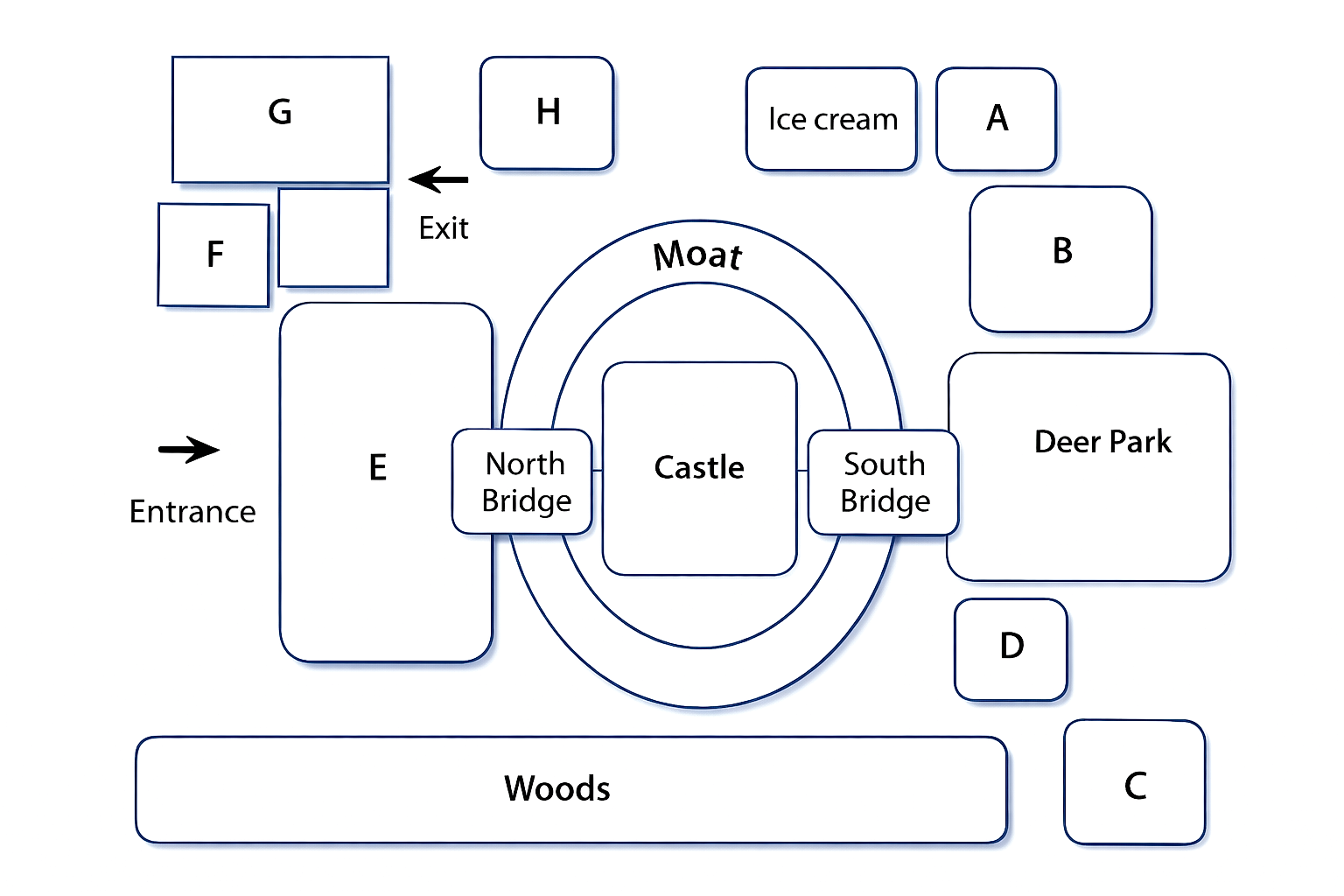
Speaker 3: Now the castle grounds are quite big, and we don't want you to get lost. So I'm going to give you an idea of the layout. At the moment, we are at the entrance, and immediately to our left is the tourist information office. Go here if you need any questions answered. They'll be happy to help. And, of course, behind the tourist office is the car park where the coach dropped you off, and it'll also pick you up from the same spot at 5 PM today.
Speaker 3: In front of us are the water gardens. If you stroll through, you get to the Northbridge, which is the entrance to Besley Castle. Take your time and enjoy looking around the castle. There's a lot of history steeped in those walls.
Speaker 3: As you leave the castle via the South Bridge, you'll be greeted with the sight of roaming deer. During the day, there will be scheduled feeding opportunities where visitors can get involved. However, we do request that you do not feed the deer outside these times.
Speaker 3: To the right of the Deer Park is the Castle Museum, and behind that is our award winning restaurant. It's a relatively new addition to the castle grounds, but is fast gaining a reputation for its food. Alternatively, you can choose to dine in the picnic area on the other side of the Deer Park. It's perfect for the family as it's next to the kids play area and homemade ice cream hut.
Speaker 3: We hope that on your way out, you pop into the gift shop by the exit for something to remember us by.
Speaker 4: Before you hear the rest of the talk, you have some time to look at questions 16 to 20.
Speaker 4: Now listen and answer questions 16 to 20.
Speaker 3: Admission to the grounds is free for all. That includes the museum, gardens, and picnic area. There is an admission fee for the castle, which is £6.50 for adults with a 10% discount for students and retired people. Children under the age of 16 pay half adult price and under eight go in free.
Speaker 3: There are many spectacular events throughout the year, and for most of them, there's also an admission fee. As these events are in high demand, it's a good idea to book well in advance.
Speaker 3: Some of the exciting events planned for this year are the summer medieval festival, where you can watch old fashioned knights and experience a feast in the halls of the castle as if you were a guest of King Henry the eighth himself.
Speaker 3: There are several concerts planned this year too, including a rock concert at an admission price of £10 per person and a special jazz concert, which is free to the public. I'm sure you'll agree that all tastes and ages will be satisfied.
Speaker 3: One scary but extremely popular event is the annual haunted castle event at the end of October, where the castle comes alive at night. Why don't you come along if you're brave enough?
Speaker 3: Another sight to see is the fantastic firework display on November 5, and the cost of that includes refreshments.
Speaker 3: We also have a long tradition of raising money for charity. The charity event held every year on the first day of May will this year be an archery contest. Entrance is free, but donations are certainly welcome. This year, we'll be collecting money on behalf of a charity for elderly people, Age Concern.
Speaker 3: Just in case you can't remember all of that, you can pick up a leaflet showing the timetable and prices for all events from the tourist information desk. You can also go online to get this information from our website.
Speaker 4: That is the end of section two. You now have half a minute to check your answers.
PART 3
Speaker 5: Now turn to section three.
Speaker 5: Section three.
Speaker 5: You will hear two business students talking about the research they have done into one area of business.
Speaker 5: First, you have some time to look at questions 21 to 26.
Speaker 5: Now listen carefully and answer questions 21 to 26.
Speaker 6: Okay. So let's look at what topic we've got for the next tutorial. Ah, intellectual property. That's anything that you produce from your own ideas or creative activity. It's like the property of your mind.
Speaker 5: And we have to look at the different ways of legally protecting these ideas and inventions.
Speaker 6: Right. We need to know what they are and be able to talk about them. You wanna start with copyright?
Speaker 5: Yeah. It's the one I knew a bit about already. It's your right as the author or inventor lasting for seventy years after your death. It's free, and you don't even have to apply for it. But it doesn't fit every situation, does it? Okay. What about some other kinds of registration?
Speaker 6: I did some research on patents.
Speaker 5: Right. A patent means no one else can financially benefit from your invention.
Speaker 6: Right. It seems to be very costly to apply for. So you really need to know what you've invented is worth going through all the rigmarole for.
Speaker 5: Well, I don't think it's something you can do without professional help. It's a very complicated process.
Speaker 6: Let's have a look at trademarks next. We are both quite familiar with these. I mean, just think how well known the logos of some companies are. They seem to really instill trust in a brand, and so they add millions of dollars to how much a company's worth. And from what I've discovered,
Speaker 5: it doesn't seem to cost much to register trademarks either.
Speaker 5: Okay. So what's next? Ah, design. This has quite a specific meaning as it relates to how something looks and not how it works. I read it's standard for the big corporations that make mobile phones to register the design of their handsets so they remain quite distinctive.
Speaker 6: That's interesting. I wasn't aware of that. So how does design differ from the next category of protection?
Speaker 5: You mean circuit? Well, circuits are a type of protection that safeguards original layout design for things like computer chips. So it's fairly narrow in its meaning, and it is quite limited as it can only be enforced in this country.
Speaker 6: Yeah. The blueprint could be copied and reproduced in other countries, and the owner has no legal protection.
Speaker 5: So my view is, what's the point? Maybe in time it will be recognized elsewhere.
Speaker 6: I find the next category quite interesting. When I think of trade secrets, I immediately think of Granny Mae's cookies. They've deliberately not patented their special recipe so that the other manufacturers don't know what the ingredients are. Hard for them to discover.
Speaker 5: Yeah. But it must be difficult to maintain a trade secret because you have to make sure that all staff sign an agreement and stick to it if they leave.
Speaker 6: That's true. Okay. So we're happy with what we've discussed with different types of intellectual property.
Speaker 5: Before you hear the rest of the discussion, you have some time to look at questions 27 to 30.
Speaker 5: Now listen and answer questions 27 to 30.
Speaker 6: Next, we have to write up the process that one company uses to manage its intellectual property.
Speaker 5: Yeah. In the company we looked at, there were certainly a lot of people involved in this process, from the research leader through to the commercialization committee.
Speaker 6: Right. Well, it all gets initiated by the quarterly research report. This is produced by the – let me look at my notes – the project leader. They have to write up the report with details of how they are meeting their research deadlines. And they put details in it about changes
Speaker 5: intellectual property, don't they? Things like they now realize that they are researching something that may be patentable after all, and they have to identify this as early as possible.
Speaker 6: And do they send the report to an external expert at this stage?
Speaker 5: No, they send it on to the Commercialization Committee, which consists of the program leader and an industry representative. They review the report bearing amendments to the intellectual property.
Speaker 6: Right. Then from that review meeting, all the amendments are brought together and gone through by the delivery officer who works out the most beneficial way to register the intellectual property.
Speaker 5: Yes. This stage can take quite a long time. The project leader must get really frustrated by all this. If I've got this right, they then let the business manager know what has been decided, and it's at this point that the intellectual property gets taken out of the control of the research area and it becomes more to do with the financial or commercial issues of registration.
Speaker 6: Exactly. So if they feel that their proposal fits within the allocated budget for intellectual property and a likely return on the investment is worth it, they will then need to engage the help of a specialist in the field. It's extremely likely that they will find themselves.
Speaker 5: That is the end of section three. You now have half a minute to check your answers.
PART 4
Speaker 7: Part four.
Speaker 7: You will hear part of a presentation about the early history of salt.
Speaker 7: First, you have some time to look at questions 31 to 40.
Speaker 7: Now listen carefully and answer questions 31 to 40.
Speaker 8: In my presentation, I'm going to talk about salt. In modern times, when we talk about salt, people may associate it with high blood pressure or increased heart risk, and many health experts warn that we should use less salt in our meals and dishes. However, we should not ignore its importance in our cuisine and even in early human history.
Speaker 8: Salt is one of the oldest, most ubiquitous food seasonings. The taste of salt is one of the basic human tastes. More importantly, salt plays an indispensable role in the health of human beings. For example, it regulates the body's acid base balance.
Speaker 8: Because of its importance to survival, salt has often been considered a valuable commodity during human history. This can be tracked all the way back to ancient Greece, ancient Egypt, and ancient Rome when salt was highly valued and used as a method of trade and currency.
Speaker 8: In ancient Rome, the busiest road leading to the city was the Via Salaria, which means the salt route in English. A soldier's pay, which partly consisted of salt, was known as salarium argentum in Latin, from which we derived the English word salary. A soldier's salary was cut if he was not worth his salt, an expression still used today.
Speaker 8: In fact, salt was not only the first condiment discovered, but also the first preservative. We know today that food goes bad because microorganisms in the food multiply in abundance, and a high salt environment is not conducive to microbial reproduction. Extremely high concentrations of salt can even kill microorganisms in the food. The ancients certainly didn't know this, but they did know that salted food can be preserved for a long time.
Speaker 8: The use of salt as a preservative can be traced to ancient Sweden. At first, hunting was the principal means of livelihood. In this case, meat supplies were unlikely to be frequent. What's more, fewer animals were available for hunting. In order to ensure the supply of meat, many families in Sweden began to raise animals in the surrounding forests during the summer when the weather was suitable for animals to survive. These animals were fed every day until about three to four months later. That's in October. They were ready to be butchered for meat, and that was the only month when ancient Swedish people had fresh meat on their table. Then with the continuous increase in productivity, people finally had some meat left. However, how to store the meat had become a headache until someone invented a whole new way to preserve food, salting. People tried to keep meat from going bad by adding some salt to it, and it could be preserved for several months and even years.
Speaker 8: There was evidence that salt was widely used to preserve meat. Historical documents in 1573 recorded the Swedish king's everyday meals, mentioning that 175 pounds of meat was consumed each year, but over 150 pounds was salty. From this, we can clearly see the importance of salt in Sweden at that time. In addition, the documents also noted the annual sales of beer in Sweden soared during that period, and this must be related to high levels of salt in their food.
Speaker 8: Now let's turn to the sources of salt. Where is salt from? Well, salt is common in nature. It has long been found that salt can be extracted from seawater, mineral deposits, saline lakes, brine, spring, etcetera, among which the two most important ones are oceans and basins. On the floor of the latter often lie deserts where traces of salt can be found, such as the Sahara.
Speaker 8: Furthermore, the quality of different salt types varies a lot. For example, salt from seawater is always mixed with impurities. So after the salt is dried, the sediments and other chemicals needed to be purified before eating. However, this is not the case with salt from spring water. We can hardly find any impurities, and the salt level is much more concentrated.
Speaker 8: Then how did people distribute salt around the world? Of course, in modern times, we have various ways of transporting goods. But in ancient times, it was not the case. Take ancient Sweden we mentioned before as an example. Because of the heavy use of salt in the diet, Sweden could not feed itself and had to import large amounts of salt from other countries. In order to make sure they could buy enough salt from abroad, the Swedish had to attach great importance to shipping and keep it undamaged, as it was the most crucial way at that time.
Speaker 8: While in other ancient countries, in order to distribute salt to other places, groups of men were employed. They put bags of salt on their shoulders or backs and moved them to the surrounding regions. And gradually, these people were considered as a mode of transport in early times. Later, with the improvement of traffic conditions, salt trade between different regions was boosted, and long distance food trade was also promoted, making communication between different cultures more frequent and
Speaker 7: That is the end of part four. You now have one minute to check.