Listening 2026-03 Test 4

Mês da prova: 2026-03

Reconstruído a partir de relatos de candidatos — não é material oficial do IELTS. Áudio e textos são recriações para prática.

Áudio recriado

SECTION 1

Complete the notes below. Write ONE WORD AND/OR A NUMBER for each answer.

Enquiry about Airmail Reasons for moving: • Family reunion • Pleasant 1 _________ • Job opportunity Type of work: 2 _________ job Post address: 3 _________ Street, Sydney Accommodation: free for the first 4 _________ Name: Jennifer 5 _________ Current address: 6 _________ Road, Auckland Postcode: 7 _________ Mailing date: 8 _________
  1. 1

    Pleasant 1 _________

  2. 2

    Type of work: 2 _________ job

  3. 3

    Post address: 3 _________ Street, Sydney

  4. 4

    Accommodation: free for the first 4 _________

  5. 5

    Name: Jennifer 5 _________

  6. 6

    Current address: 6 _________ Road, Auckland

  7. 7

    Postcode: 7 _________

  8. 8

    Mailing date: 8 _________

SECTION 1

Choose TWO letters, A-E. Which TWO items will be sent to Australia?

  1. 9

    Which TWO items will be sent to Australia?

    • A. files
    • B. medicine
    • C. music instrument
    • D. diving equipment
    • E. books
  2. 10

    Which TWO items will be sent to Australia?

    • A. files
    • B. medicine
    • C. music instrument
    • D. diving equipment
    • E. books

SECTION 2

Choose the correct letter, A, B or C.

  1. 11

    The speaker stresses the importance to Clifton Bird Park of

    • A. birds that are now endangered.
    • B. birds from all over the world.
    • C. birds that are common in the local area.
  2. 12

    People who volunteer to help with gardening at the park

    • A. must work at weekends.
    • B. need to come at least once a month.
    • C. will only be required in the busy season.
  3. 13

    According to the speaker, who would be the ideal gardening volunteer?

    • A. someone who can work independently.
    • B. someone who is willing to work in any weather.
    • C. someone who knows a lot about plants.
  4. 14

    Volunteer guides will mainly be working with

    • A. international visitors.
    • B. local people from Clifton.
    • C. school groups.
  5. 15

    What is still required for the Maintenance Day at the bird park?

    • A. food and drink.
    • B. transport.
    • C. tools.

SECTION 2

Label the map below. Write the correct letter, A-H, next to questions 16-20.
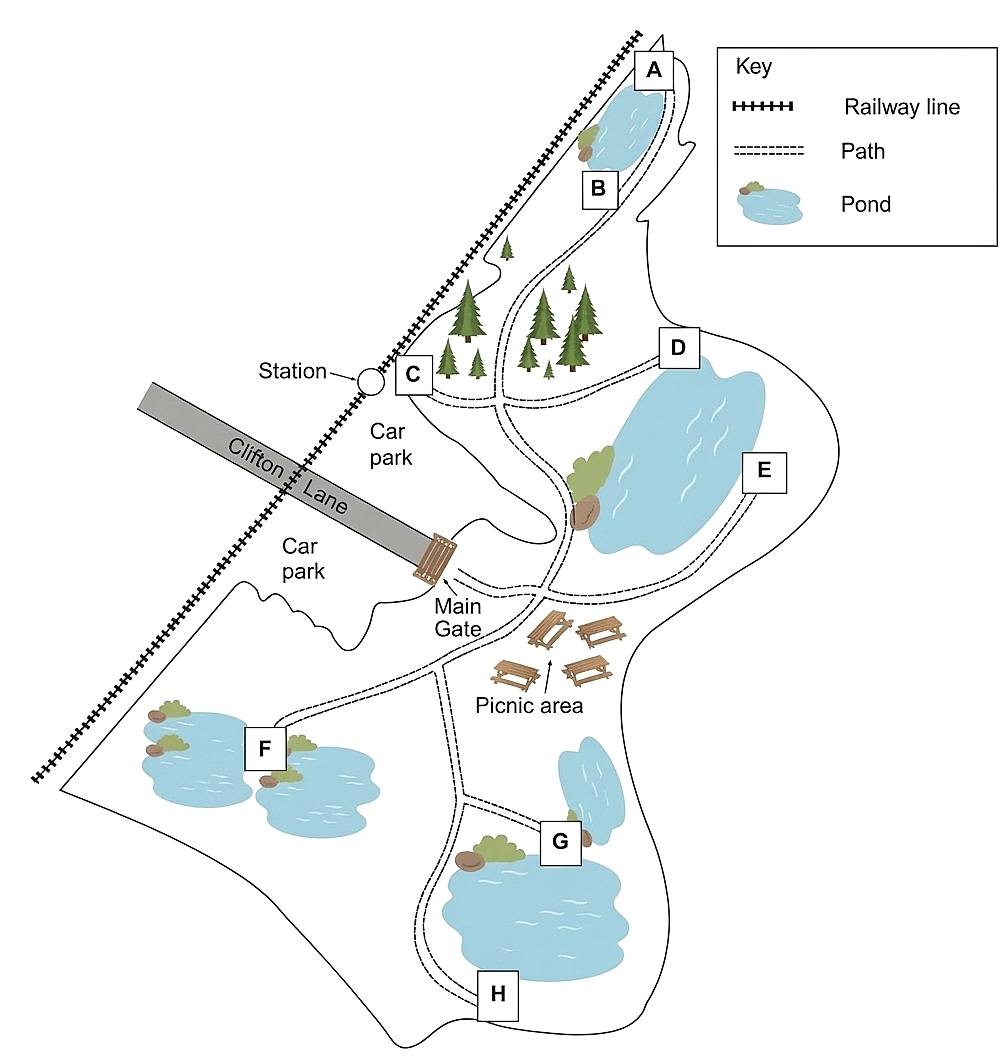
Map of Clifton Bird Park 16. Wooden bridge 17. Observation tower 18. Visitor cabins 19. Nesting boxes 20. Boat sheds
Recreated diagram for questions 16, 17, 18, 19, 20
  1. 16

    Wooden bridge

  2. 17

    Observation tower

  3. 18

    Visitor cabins

  4. 19

    Nesting boxes

  5. 20

    Boat sheds

SECTION 3

Choose the correct letter A, B or C.

  1. 21

    Joy wants to finish this assignment soon because

    • A. there is a lot to do and the assignment will affect her final grade.
    • B. they have another assignment to do and there isn't much time.
    • C. they have to put their findings into practice before the semester ends.
  2. 22

    Why does Tim want to ignore the theory chapter in their textbook?

    • A. The theory is too complex to be of practical help.
    • B. The focus of their project differs from the topic in the book.
    • C. There is insufficient time to read the entire chapter.
  3. 23

    Joy thinks that on the discussion board students should post

    • A. responses to materials they have studied.
    • B. suggestions on what books they think would be useful.
    • C. new areas of research that need to be investigated.
  4. 24

    What does Tim want to discuss?

    • A. the function of a teacher
    • B. the role of individual learner
    • C. teacher-student dynamics
  5. 25

    Joy and Tim decide not to interview the teachers because

    • A. the teachers are too busy.
    • B. the result will be marked by the teachers.
    • C. interviewing students would be more productive.

SECTION 3

What comment do Tim and Joy make about each of the following factors involved in successful learning outcomes? Choose FIVE answers from the box and write the correct letter, A-G, next to Questions 26-30.

Factors 26. classroom management _____ 27. feedback _____ 28. lesson planning _____ 29. individual tutoring _____ 30. access to technology _____ Comments A It needs funding. B It is necessary for progress. C It needs better supervision. D It is a basic requirement. E It should be optional. F It saves time. G It is the key to success.
  1. 26

    classroom management

  2. 27

    feedback

  3. 28

    lesson planning

  4. 29

    individual tutoring

  5. 30

    access to technology

SECTION 4

Write ONE WORD ONLY for each answer.

Intelligence Investigation Theory from a psychologist-Spearman: • IQ is passed down from parents, keeping the same through each one's 31 _________ • Intelligence can't be changed since it was believed a genetic 32 _________ • The evidence originated from the research of 33 _________ Theory from other psychologists: • Children grew up in the same family tend to go through similar 34 _________ • Children moved to another culture witnessed a great 35 _________ in the research. Theory from Howard Gardner: • there are at least 7 different types of intelligence, such as linguistic, logical and 36 _________ skills. • Various cognitive skills like speech, are regulated by various circuits in the 37 _________ • Some people are not good at identifying others' 38 _________ Conclusion • When a sense of rhythm is developed, you can unexpectedly improve your music, dancing and 39 _________ • To remember a chemical formula or physical law, the best way is to make it into a 40 _________
  1. 31

    IQ is passed down from parents, keeping the same through each one's 31 _________

  2. 32

    Intelligence can't be changed since it was believed a genetic 32 _________

  3. 33

    The evidence originated from the research of 33 _________

  4. 34

    Children grew up in the same family tend to go through similar 34 _________

  5. 35

    Children moved to another culture witnessed a great 35 _________ in the research.

  6. 36

    there are at least 7 different types of intelligence, such as linguistic, logical and 36 _________ skills.

  7. 37

    Various cognitive skills like speech, are regulated by various circuits in the 37 _________

  8. 38

    Some people are not good at identifying others' 38 _________

  9. 39

    you can unexpectedly improve your music, dancing and 39 _________

  10. 40

    the best way is to make it into a 40 _________

Folha de respostas

Preencha enquanto faz — a correção é instantânea e local, e cada erro vai para seu registro de erros junto com a lição que resolve.

  1. 1.
  2. 2.
  3. 3.
  4. 4.
  5. 5.
  6. 6.
  7. 7.
  8. 8.
  9. 9.
  10. 10.
  11. 11.
  12. 12.
  13. 13.
  14. 14.
  15. 15.
  16. 16.
  17. 17.
  18. 18.
  19. 19.
  20. 20.
  21. 21.
  22. 22.
  23. 23.
  24. 24.
  25. 25.
  26. 26.
  27. 27.
  28. 28.
  29. 29.
  30. 30.
  31. 31.
  32. 32.
  33. 33.
  34. 34.
  35. 35.
  36. 36.
  37. 37.
  38. 38.
  39. 39.
  40. 40.
Salvo neste dispositivo — não precisa de conta. Faça login na sua página de progresso se quiser sincronizar em outro lugar.
Mostrar transcrição
==================== IELTS Listening Transcript ==================== PART 1 Speaker 0: Part one. Speaker 1: You will hear a man from the New Zealand Post Office Service telephoning a woman. First, you have some time to look at questions one to eight. Now listen carefully and answer questions one to eight. Speaker 2: Hello. Speaker 3: Jennifer speaking. Hello, Jennifer. My name's Ben Smith. I'm from the New Zealand Post Office Service. I understand you left a couple of questions on our website forum. Seeing as though you left your phone number as a contact, I thought you might prefer us to call. Speaker 2: Oh, Ben. It's nice to speak to you again. I really appreciate your help last month. Yes, as I will be moving to Australia soon and need to send some of my things via air mail. I just wasn't sure how to get my mail redirected. Speaker 3: I can help you with that. It's interesting that I recently got more inquiries about international mailing due to migration to other countries. May I ask why you are moving? Speaker 2: There are a few reasons, such as I have family in Australia, and the weather there is warmer, but mainly because it's hard to find a job here. I have just got the news that I was successful in applying for a job in Australia. I'll be starting in November. Speaker 3: How exciting. Congratulations. I have never been to Australia, but I've heard it's a nice place. Is it a permanent job? Speaker 2: No. I will only be working for that company as a temporary assistant over this summer. Speaker 3: You never know. I might get homesick and want to come back after a few months anyway. I hope the job goes well for you. What postal address will you be using in Australia? Speaker 2: I had organised some accommodation at a hostel in Sydney for the first week, but that fell through, so I will stay at my friend's house until I find somewhere else. My things will have to be sent to her place for now, and the address is 9 Queen Street, Sydney. Speaker 3: Can I know how long you will be staying there? We want to make sure you get your mail while you are there. Speaker 2: I will be staying there for the first two months. You know, it's free staying with her. Speaker 3: That's nice. Now, I've got a couple more questions for you. What is your full name and current address? Speaker 2: My name is Jennifer Simmons. Speaker 3: How do you spell your surname, please? Speaker 2: It's S-I-M-M-O-N-S. Speaker 3: Got that. And your address, please? Speaker 2: Oh, right. I'm currently living at 16 Ocean Road, Auckland. Speaker 3: And your postcode? Speaker 2: It's 245. Speaker 3: That doesn't come up in our system as a valid postcode. Can you check that again, please? Speaker 2: Yes. Sorry. I'm not good at remembering numbers. It's 425. Speaker 3: When would you like your things to be emailed? Speaker 2: I will leave New Zealand on the September 23, but I will try to send them on the twenty second. So that's the day before. How long will it take for my things to get to Australia? Speaker 3: It will take about a week. Speaker 2: Perfect. That should give me time to get organised in Australia before everything arrives. Speaker 1: Before you hear the rest of the conversation, you have some time to look at questions nine to 10. Now listen and answer questions nine to 10. Speaker 3: May I ask about the content of your delivery? There are some things that you have to sign a goods declaration for, such as expensive items or if you're importing medications in bulk. Speaker 2: I won't be sending anything like that. It'll mainly be personal items. I was thinking of posting some books, but I guess that's quite expensive because they are heavy and my guitar is kind of big. Speaker 3: Yes, it can be quite expensive. Speaker 2: I might not send them then. I definitely need to send some of my files. I have one standard size file box full of them. Speaker 3: Sure. Anything else? Speaker 2: I've heard the beaches and the ocean are beautiful in Australia. I enjoy diving, so I'm going to send my diving gear as well. I have packed it into a box to send it more easily. Would you mind if I weighed everything and sent you information to get a quote on the price? Speaker 3: Just send it to info@postalservice.nz. Can I help you with anything else? Speaker 2: No. That's everything. Thank you for your help. Speaker 0: That is the end of part one. You now have half a minute to check your answers to part one. PART 2 Speaker 4: Part two. You will hear a woman called Sandra Hayes who works at a bird park talking to a group of people who want to volunteer there. First, you have some time to look at questions 11 to 15. Now listen carefully and answer questions 11 to 15. Speaker 5: Hello. My name is Sandra Hayes, and I'm from Clifton Bird Park. It's great to see so many possible volunteers here. The park is now a very popular attraction in this area. I think people love coming to see so many different types of birds in a beautiful environment. For some species that we have here, there aren't many still alive in the wild, so a big part of our job is to make sure we help their numbers increase. All the birds are native species. We need volunteers to help the bird park officers with different jobs. One of these is gardening. Obviously, summer is the time when we have most visitors, but the park needs looking after all year round. If you want to help, you can choose which day, although we do already have plenty of volunteers working Saturdays and Sundays. But one day every four weeks is the minimum commitment that we ask for. So who's the ideal volunteer for gardening work? If you have expert knowledge about flowers and trees, great. But we're looking more for people who are flexible and turn up no matter whether it's raining or baking hot. That's what'll make you the best person for the job. It's all teamwork, so you'll have plenty of support. What about volunteer guides? A guide's role is to point out the birds and talk about the conservation program. In general, it's people in a foreign tour group that you're responsible for. The Clifton residents who come to the park usually know their way around. We get a few teachers bringing in classes, but they're the park officer's responsibility. The last thing to mention is the park's maintenance day, which is coming up soon. We're hoping to get as many volunteers as possible to come and help tidy things up. If anyone is able to drive some other volunteers to the event, please let me know because we need help there. The park officers will provide you with spades and drills and hammers, all of that stuff, and they'll be offering you some refreshments too, so it should be a good day out. Speaker 4: Before you hear the rest of the talk, you have some time to look at questions 16 to 20. Now listen and answer questions 16 to 20. Speaker 5: So here's a map of Clifton Bird Park. As you can see, the railway line runs along the northwest of the park, and road access is on that side too from Clifton Lane. We want volunteers to work on a few different areas on maintenance day, which is coming up soon. Firstly, the wooden bridge. I'll explain where that is. You can see Clifton Lane in the main gate into the park. On the southern side of Clifton Lane is one of our car parks, and below that, there are two similar sized ponds. The wooden bridge runs between those two ponds. We just need to make it a bit stronger. Some volunteers will be doing a bit of painting at the observation tower. The tower's in the southeast corner of the map. You see there are two different sized ponds there? The tower's on the south side of the larger pond at the end of the path. We'll need about three people to help out. We need to replace the windows and the visitor cabins. So on the map, you can see our car park on the north side of Clifton Lane. There's the woods, and on the left hand side of the map, the railway line. The visitors' cabins are marked there between the woods and the railway station. You'll also be repairing some nesting boxes. See the picnic area? The path you want is between there and the big pond. Follow it round all the way to the end. So as we're looking at the map now, the nesting boxes are on the right of that pond. Finally, the boat sheds. Towards the top of the map, you've got that smallish pond quite near the railway line, and there are two places marked up there. The boat sheds are on the same side of the pond as the woods, not the place marked at the tip of the park. What we want you to do... Speaker 4: That is the end of part two. You now have thirty seconds to check your answers to part two. PART 3 Speaker 6: Part three. You will hear two students named Joy and Tim discussing their classroom management project. First, you have some time to look at questions 21 to 25. Now listen carefully and answer questions 21 to 25. Speaker 7: Hi, Tim. I thought you'd never get here. We still have so much of our classroom management project to complete. I don't know how we'll get it done. Speaker 6: Take it easy, Joy. Our results for this course won't be high enough if we rush to finish. It's our final assignments for the semester. We don't have any other projects to do, so we can focus on this. Speaker 7: I'm not worried about my results, but we need to finish it because part of the project is to implement the results of our research and make the classroom a better learning environment. If we don't start soon, we'll run out of time. You know, the semester will finish next month. Speaker 6: That's true. What do you think of the theory chapter in our textbook? I don't think we should bother with it. Speaker 7: Are you saying that because you find the theory in that chapter too difficult to understand, or is the chapter just too long? Speaker 6: Neither. My real issue is that it doesn't have much bearing on the subject we're researching. Our project is on classroom management, not on company structuring. Speaker 7: There are parallels, though. We're learning about management and structure for careers in business management. This classroom based project is just a training ground. Speaker 6: Maybe. Anyway, last time we were considering the benefits of a discussion board in each home group room. What have you come up with? Speaker 7: The role of the discussion board is for sharing ideas. Each of us can learn from what others have done before us. I thought instead of the students merely stating what textbooks they think will be beneficial, it would be more useful to document what they've already studied and the reactions they had to the material. Speaker 6: In that way, we can find books that will further their own research. Speaker 7: That's great. What about you? How have you been getting on with your analysis of classroom structure? Speaker 6: I've been thinking about what we should discuss in our essay on that topic. The teacher's role has been discussed in previous research papers, as has the important relationship between teachers and their students. But I haven't come across much research on the place an individual student holds in the classroom. So this is what I want to talk about. Speaker 7: That could be a controversial topic. The roles have slowly evolved. Traditionally, the teacher dominated the classroom. Now the general idea is that the teacher is a mentor to guide students' learning rather than telling them what to do. Speaker 6: I agree. It places the students on a more equal footing with the teacher, so the students have more respect for their teachers. Should we conduct interviews with the teachers regarding this developing interaction? It's not required that we do it. We could interview the students instead. Speaker 7: I was considering it, but I think it may be difficult for many of the teachers to find the time. I tried to have discussion with some of the professors, but they were all tied up with marking the first year students' exam papers and suggested I come back in a week or so. Speaker 6: If that's the case, we'd better not bother them. Speaker 6: Before you hear the rest of the discussion, you have some time to look at questions 26 to 30. Now listen carefully and answer questions 26 to 30. Speaker 6: What about this last research question about the factors that contribute to successful learning outcomes? Speaker 7: Well, obviously, classroom management comes into it. I think for students, it's impossible to gain the full benefits of studying without it. Speaker 6: In fact, I'd say it is the single most important factor of success in learning. Speaker 7: I agree, but I think feedback is pretty important too. There has to be a real dialogue going on between teachers and students, and constructive criticism is essential to students' progress and development. Speaker 6: True. And I've been thinking about the shift in roles in recent years, but the essentials are still the same. For instance, effective lesson planning is pretty fundamental. Speaker 7: Teachers have the responsibility to do it properly. Speaker 6: I agree. That is a requirement for every teacher. I believe that each student learns at his or her own pace. Some students may need individual tutoring. I think it should be a matter of choice, though, as it doesn't work well for everyone. Speaker 7: You are right. I'd like to see more supervision in the lab too. Some of the students need a lot more help than they're getting. Speaker 6: Yes. That's true. And it would also be beneficial if students had more access to technology. Nowadays, teachers can use a few simple clicks with a computer to finish something that might take them hours or even days in the past. Speaker 7: I agree. Even though funding technology can be expensive, it pays in the long run. Speaker 6: I am not sure. We can record it in our research though as a recommendation. Speaker 6: That is the end of part three. You now have thirty seconds to check your answers to part three. PART 4 Speaker 4: Part four. First, you have some time to look at questions 31 to 40. Now listen carefully and answer questions 31 to 40. Speaker 8: Today, I am going to consider three series of intelligence. Early psychologist states, such as Spearman in the 1920s, believed that each individual has a single general level of intelligence known as IQ. According to the theory, we are born with a certain level of intelligence, which is inherited from our parents, and our intelligence remains constant throughout our life. It follows that any intelligence tests we do at any time will give broadly similar results. If this is true, it suggests that there isn't much you can do to make yourself more intelligent, since it's a genetic feature. Most of the evidence for the genetic origin of intelligence has come from studies of twins, which shows considerable similarity in their intelligence. However, other psychologists have interpreted the findings of this research differently. The theory says that the similarity in intelligence between the subjects used in such studies may have an environmental rather than genetic origin. These psychologists point out that children brought up in the same family are likely to have experiences which are very similar. Yet some research into children who have moved home and live in another culture, from the after few years, there was a significant improvement in the results. In the 1990s, Howard Gardner claimed that there are at least seven separate intelligences such as linguistic and logical skills and also other less traditional ones such as the category of musical abilities. Research in neuropsychology suggests that different cooperative abilities such as speech may be partially independent of each other and controlled by different circuits within the brain. Support for this theory comes from the fact that some people show weakness in one particular area, for instance some find it very difficult to recognise someone's face. Well they may have no problem remembering names. This apparent variation in strengths and weaknesses within one person supports Gardner's view, and the intelligence is multiple rather than general. If you develop a sense of rhythm, this can improve not only music and dance as you'd expect but also areas that aren't obviously linked. Spelling for instance. If you need to learn the chemical formula or law of physics by heart, turn it into a song. It doesn't matter at all if you are out of a key but it will be easier for you to learn it. Speaker 4: That is the end of part four. You now have one minute to check your answers to part four.
Mostrar gabarito

Gabarito

  1. 1. weather

    Jennifer says she is moving because 'the weather there is warmer,' so 'weather' is the correct answer.

  2. 2. temporary

    Jennifer says, 'I will only be working for that company as a temporary assistant over this summer,' so the job is 'temporary.'

  3. 3. 9 Queen

    Jennifer says, 'the address is 9 Queen Street, Sydney,' so '9 Queen' is correct.

  4. 4. 2 months

    Jennifer says, 'I will be staying there for the first two months,' so '2 months' is the answer.

  5. 5. Simmons

    Jennifer spells her surname as 'S-I-M-M-O-N-S,' so 'Simmons' is correct.

  6. 6. 16 Ocean

    Jennifer says, 'I'm currently living at 16 Ocean Road, Auckland,' so '16 Ocean' is the answer.

  7. 7. 425

    Jennifer first says '245' but then corrects herself to '425,' and the answer is written as '0425' to match the format.

  8. 8. 22nd September

    Jennifer says, 'I will try to send them on the twenty second,' so '22nd September' is correct.

  9. 9. A

    Jennifer says, 'I definitely need to send some of my files. I have one standard size file box full of them,' so 'files' is correct. She considers sending books and her guitar but decides not to because they are too heavy or big.

  10. 10. D

    Jennifer says, 'I'm going to send my diving gear as well,' so 'diving equipment' is correct. She decides not to send books or her guitar.

  11. 11. A

    The speaker says, 'For some species that we have here, there aren't many still alive in the wild, so a big part of our job is to make sure we help their numbers increase,' showing the focus is on endangered birds. Option B is tempting but the passage only mentions native species, not birds from all over the world.

  12. 12. B

    The speaker says, 'one day every four weeks is the minimum commitment that we ask for,' so volunteers need to come at least once a month. Option A is wrong because volunteers can choose the day, and C is wrong because work is needed all year round.

  13. 13. B

    The speaker says, 'we're looking more for people who are flexible and turn up no matter whether it's raining or baking hot,' so willingness to work in any weather is most important. Option C is tempting but expert knowledge is not required.

  14. 14. A

    The speaker says, 'A guide's role is to point out the birds... In general, it's people in a foreign tour group that you're responsible for,' so guides mainly work with international visitors. Option B is wrong because locals know their way around.

  15. 15. B

    The speaker says, 'If anyone is able to drive some other volunteers to the event, please let me know because we need help there,' so transport is still required. Food and tools are already provided.

  16. 16. F

    The speaker says, 'The wooden bridge runs between those two ponds,' which matches location F on the map.

  17. 17. H

    The speaker says, 'The tower's in the southeast corner of the map... at the end of the path,' which matches location H.

  18. 18. C

    The speaker says, 'The visitors' cabins are marked there between the woods and the railway station,' which matches location C.

  19. 19. E

    The speaker says, 'the nesting boxes are on the right of that pond,' which matches location E.

  20. 20. B

    The speaker says, 'The boat sheds are on the same side of the pond as the woods,' which matches location B.

  21. 21. C

    Joy says, 'part of the project is to implement the results of our research and make the classroom a better learning environment. If we don't start soon, we'll run out of time. You know, the semester will finish next month,' so they need to put their findings into practice before the semester ends.

  22. 22. B

    Tim says, 'My real issue is that it doesn't have much bearing on the subject we're researching. Our project is on classroom management, not on company structuring,' so the focus is different.

  23. 23. A

    Joy says, 'it would be more useful to document what they've already studied and the reactions they had to the material,' so students should post responses to materials they have studied.

  24. 24. B

    Tim says, 'I haven't come across much research on the place an individual student holds in the classroom. So this is what I want to talk about,' so he wants to discuss the role of the individual learner.

  25. 25. A

    Joy says, 'I think it may be difficult for many of the teachers to find the time,' so they decide not to interview teachers because they are too busy.

  26. 26. G

    Tim says, 'classroom management comes into it. I think for students, it's impossible to gain the full benefits of studying without it,' so classroom management is a key factor.

  27. 27. B

    Joy says, 'I think feedback is pretty important too. There has to be a real dialogue going on between teachers and students,' so feedback is another factor.

  28. 28. D

    Tim says, 'effective lesson planning is pretty fundamental,' so lesson planning is important.

  29. 29. E

    Tim says, 'Some students may need individual tutoring. I think it should be a matter of choice,' so individual tutoring is a factor.

  30. 30. F

    Tim says, 'it would also be beneficial if students had more access to technology,' so access to technology is a factor.

  31. 31. Life

    The passage says, 'our intelligence remains constant throughout our life,' so 'life' is the answer.

  32. 32. Feature

    The passage says, 'it's a genetic feature,' so 'feature' is correct.

  33. 33. Twins

    The passage says, 'Most of the evidence for the genetic origin of intelligence has come from studies of twins,' so 'twins' is the answer.

  34. 34. Experiences

    The passage says, 'children brought up in the same family are likely to have experiences which are very similar,' so 'experiences' is correct.

  35. 35. Improvement

    The passage says, 'there was a significant improvement in the results,' so 'improvement' is the answer.

  36. 36. Musical

    The passage says, 'there are at least seven separate intelligences such as linguistic and logical skills and also other less traditional ones such as the category of musical abilities,' so 'musical' is correct.

  37. 37. Brain

    The passage says, 'different cooperative abilities such as speech may be partially independent of each other and controlled by different circuits within the brain,' so 'brain' is the answer.

  38. 38. Face

    The passage says, 'some people show weakness in one particular area, for instance some find it very difficult to recognise someone's face,' so 'face' is correct.

  39. 39. Spelling

    The passage says, 'If you develop a sense of rhythm, this can improve not only music and dance as you'd expect but also areas that aren't obviously linked. Spelling for instance,' so 'spelling' is the answer.

  40. 40. Song

    The passage says, 'If you need to learn the chemical formula or law of physics by heart, turn it into a song,' so 'song' is correct.

Listening 2026-03 Test 4 — IELTS Listening Actual Test with Answers | IELTS Actual Tests