このセットについて:受験者の記憶からまとめて一部修正した実際の試験素材です。IELTSは世界中の問題プールから出題されるため、この素材も世界中で使われています。1回分の完全なテストを作るため、同時期に報告された内容を組み合わせており、1回の試験日のみの内容ではありません。音声は練習用の再現です。学習しやすいように整理されています。受験者の記憶に基づいており、公式IELTS教材ではありません。
Reading Passage 1: Travel Accounts
A
There are many reasons why individuals have traveled beyond their own societies. Some travelers may have simply desired to satisfy curiosity about the larger world. Until recent times, however, trade, business dealings, diplomacy, political administration, military campaigns, exile, flight from persecution, migration, pilgrimage, missionary efforts, and the quest for economic or educational opportunities were more common inducements for foreign travel than was a mere curiosity. While the travelers’ accounts give much valuable information on these foreign lands and provide a window for the understanding of the local cultures and histories, they are also a mirror to the travelers themselves, for these accounts help them to have a better understanding of themselves.
B
Records of foreign travel appeared soon after the invention of writing, and fragmentary travel accounts appeared in both Mesopotamia and Egypt in ancient times. After the formation of large, imperial states in the classical world, travel accounts emerged as a prominent literary genre in many lands, and they held especially strong appeal for rulers desiring useful knowledge about their realms. The Greek historian Herodotus reported on his travels in Egypt and Anatolia in researching the history of the Persian wars. The Chinese envoy Zhang Qian described much of central Asia as far west as Bactria (modern-day Afghanistan) on the basis of travels undertaken in the first century BC while searching for allies for the Han dynasty. Hellenistic and Roman geographers such as Ptolemy, Strabo, and Pliny the Elder relied on their own travels through much of the Mediterranean world as well as reports of other travelers to compile vast compendia of geographical knowledge.
C
During the postclassical era (about 500 to 1500 CE), trade and pilgrimage emerged as major incentives for travel to foreign lands. Muslim merchants sought trading opportunities throughout much of the eastern hemisphere. They described lands, peoples, and commercial products of the Indian Ocean basin from East Africa to Indonesia, and they supplied the first written accounts of societies in sub-Saharan west Africa. While merchants set out in search of trade and profit, devout Muslims traveled as pilgrims to Mecca to make their hajj and visit the holy sites of Islam. Since the prophet Muhammad’s original pilgrimage to Mecca, untold millions of Muslims have followed his example, and thousands of hajj accounts have related their experiences. One of the best known Muslim travelers, Ibn Battuta, began his travels with the hajj but then went on to visit central Asia, India, China, sub-Saharan Africa, and parts of Mediterranean Europe before returning finally to his home in Morocco. East Asian travelers were not quite so prominent as Muslims during the postclassical era, but they too followed many of the highways and sea lanes of the eastern hemisphere. Chinese merchants frequently visited Southeast Asia and India, occasionally venturing even to east Africa, and devout East Asian Buddhists undertook distant pilgrimages. Between the 5th and 9th centuries CE, hundreds and possibly even thousands of Chinese Buddhists traveled to India to study with Buddhist teachers, collect sacred texts, and visit holy sites. Written accounts recorded the experiences of many pilgrims, such as Faxian, Xuanzang, and Yijing. Though not so numerous as the Chinese pilgrims, Buddhists from Japan, Korea, and other lands also ventured abroad in the interests of spiritual enlightenment.
D
Medieval Europeans did not hit the roads in such large numbers as their Muslim and east Asian counterparts during the early part of the postclassical era, although gradually increasing crowds of Christian pilgrims flowed to Jerusalem, Rome, Santiago de Compostela (in northern Spain), and other sites. After the 12th century, however, merchants, pilgrims, and missionaries from medieval Europe traveled widely and left numerous travel accounts, of which Marco Polo’s description of his travels and sojourn in China is the best known. As they became familiar with the larger world of the eastern hemisphere – and the profitable commercial opportunities that it offered – European peoples worked to find new and more direct routes to Asian and African markets. Their efforts took them not only to all parts of the eastern hemisphere but eventually to the Americas and Oceania as well.
E
If Muslim and Chinese peoples dominated travel writing in postclassical times, European explorers, conquerors, merchants, and missionaries took center stage during the early modern era (about 1500 to 1800 CE). By no means did Muslim and Chinese travel come to a halt in early modern times. But European peoples ventured to the distant corners of the globe, and European printing presses churned out thousands of travel accounts that described foreign lands and peoples for a reading public with an apparently insatiable appetite for news about the larger world. The volume of travel literature was so great that several editors, including Giambattista Ramusio, Richard Hakluyt, Theodore de Bry, and Samuel Purchas, assembled numerous travel accounts and made them available in enormous published collections.
F
During the 19th century, European travelers made their way to the interior regions of Africa and the Americas, generating a fresh round of travel writing as they did so. Meanwhile, European colonial administrators devoted numerous writing to the societies of their colonial subjects, particularly in Asian and African colonies they established. By midcentury, attention was flowing also in the other direction. Painfully aware of the military and technological prowess of European and Euro-American societies, Asian travelers, in particular, visited Europe and the United States in hopes of discovering principles useful for the reorganization of their own societies. Among the most prominent of these travelers who made extensive use of their overseas observations and experiences in their own writing were the Japanese reformer Fukuzawa Yukichi and the Chinese revolutionary Sun Yat-sen.
G
With the development of inexpensive and reliable means of mass transport, the 20th century witnessed explosions both in the frequency of long-distance travel and in the volume of travel writing. While a great deal of travel took place for reasons of business, administration, diplomacy, pilgrimage, and missionary work, as in ages past, increasingly effective modes of mass transport made it possible for new kinds of travel to flourish. The most distinctive of them was mass tourism, which emerged as a major form of consumption for individuals living in the world’s wealthy societies. Tourism enabled consumers to get away from home to see the sights in Rome, take a cruise through the Caribbean, walk the Great Wall of China, visit some wineries in Bordeaux, or go on safari in Kenya. A peculiar variant of the travel account arose to meet the needs of these tourists: the guidebook, which offered advice on food, lodging, shopping, local customs, and all the sights that visitors should not miss seeing. Tourism has had a massive economic impact throughout the world, but other new forms of travel have also had considerable influence in contemporary times. Recent times have seen unprecedented waves of migration, for example, and numerous migrants have sought to record their experiences and articulate their feelings about life in foreign lands. Recent times have also seen an unprecedented development of ethnic consciousness, and many are the intellectuals and writers in the diaspora who have visited the homes of their ancestors to see how much of their forebears’ values and cultural traditions they themselves have inherited. Particularly notable among their accounts are the memoirs of Malcolm X and Maya Angelou describing their visits to Africa.
- 1
Classical era Egypt and Anatolia Herodotus To obtain information on ________.
- 2
1st century BC Central Asia Zhang Qian To seek ________.
- 3
Roman Empire Mediterranean Ptolemy, Strabo, Pliny the Elder To gather ________.
- 4
Post-classical era Eastern Hemisphere Muslims For business and ________.
- 5
5th to 9th centuries CE India Asian Buddhists To study with ________ and for spiritual enlightenment.
- 6
19th century Asia, Africa Colonial administrator To provide information on the ________ they conquer.
- 7
By the mid-century of the 1800s Europe and United States Sun Yat-sen, Fukuzawa Yukichi To learn ________ for the reorganization of their societies.
- 8
20th century Mass tourism People from ________ countries For entertainment.
- 9
Why did some people travel in the early days?
- A. to do research on themselves
- B. to write travel books
- C. to have a better understanding of other people and places
- D. to study local culture
- 10
The travelers' accounts are a mirror to themselves,
- A. because they help them to be aware of local histories.
- B. because travelers are curious about the world.
- C. because travelers could do more research on the unknown.
- D. because they reflect the writers' own experience and social life.
- 11
Most of the people who went to holy sites during the early part of postclassical era are
- A. Europeans.
- B. Muslim and East Asians.
- C. Americans.
- D. Greeks.
- 12
During the early modern era, a large number of travel books were published
- A. to provide what the public wants.
- B. to encourage the public's feedback.
- C. to gain profit.
- D. to prompt trips to the new world.
- 13
What stimulated the market for traveling in the 20th century?
- A. the wealthy
- B. travel books
- C. delicious food
- D. mass transport
Reading Passage 2: Stress Less
How busy is too busy? For some it means sometimes having to have a short lunch; for others it may mean missing lunch altogether. For a few, it is not being able to take a day off once a month. Then there is a group of people for whom working every evening and weekend is normal, and feeling stressed is taken for granted. For most senior executives, workloads swing between extremely busy and frenzied. Neil Plumridge, vice-president of a management consultancy company, says that his weeks vary from a ‘manageable’ 45 hours to 80 hours, but average 60 hours.
Three signs warn Plumridge about his workload: sleep, scheduling and family. He knows he is doing too much when he gets less than six hours’ sleep for three consecutive nights, when he is constantly having to reschedule appointments, and when he misses a family birthday or anniversary. ‘Then,’ he says, ‘I know things are out of control.’ Plumridge states that stress is often caused by his having unrealistic expectations of himself. ‘I’ll promise a client that I’ll do something tomorrow, and then I’ll promise another client that I’ll do the same thing, when I know it’s not going to happen. I could have said: “Why don’t I give that to you in 48 hours?” The client wouldn’t care.’
Over-committing is something people experience as an individual problem. However, new research indicates that people may be designed to over-commit. A study in the Journal of Experimental Psychology shows that people always believe that they will be less busy in the future. This is a misapprehension according to the authors of the report, Gal Zauberman of the University of North Carolina and John Lynch of Duke University. ‘On average, an individual will be just as busy two weeks or a month from now as he or she is today. But that is not how it appears in everyday life,’ they say. ‘People make commitments long in advance that they would never make if the same commitments required immediate action. They discount future time investments relatively steeply.’
Being ‘too busy’ is highly subjective, but for any individual there are some concrete signs of stress: disturbed sleep and declining mental and physical health are the most common examples. Figures for National Workers’ Compensation (insurance against injury caused by work) show that stress causes the most loss of time of any workplace injury: employees suffering stress are absent from work for an average of 16.6 weeks. The effects of stress are also expensive. The Australian Government insurer reports that, in 2003–2004, claims for stress-related psychological injury accounted for 7% of insurance claims, but almost 27% of the amount paid out in claim payments.
Experts say the key to dealing with stress is not to focus on relief — a game of golf or a massage — but to reassess workloads. Neil Plumridge says he makes it a priority to work out what has to change: that might mean allocating extra staff to a job, allowing more time, or changing expectations. He also relies on the advice of colleagues, saying that his peers coach each other on business problems: ‘Just a fresh pair of eyes over an issue can help,’ he states.
Executive stress is not confined to big organisations. Vanessa Stoykov has been running her own advertising agency and public relations business for seven years. Her company has grown so fast that it appeared on the Business Review Weekly ‘Fast 100’ list of fastest-growing small enterprises in 2004, just after Stoykov had her first child. In 2005, revenue was projected to double to $2.4 million. She had just had her second child. With a fast-growing business and two small children, Stoykov says she has mastered the art of caring for children, typing, and talking on the phone at the same time. But, unlike many others, she appears to thrive on the mental stimulation of running her own business, despite the stress.
Jan Elsner, a psychologist who specialises in executive coaching, says that doing well on a demanding workload is typical of senior executives. Some people work best with high-adrenaline periods followed by quieter times, while others thrive under sustained pressure. Elsner’s practice is based on a movement known as positive psychology, a school of thought that argues that positive experiences — feeling engaged and challenged, for example — do not balance out negative experiences such as stress; instead they help people increase their resilience over time. Elsner says that many of the senior business people she coaches are increasingly relying more on regulating stress through methods such as meditation. She points to research showing that meditation can alter the biochemistry of the brain and the way that brains and bodies react to stress.
Some experts believe there is too much emphasis on treating job stress as an individual problem. Tony LaMontagne, of the University of Melbourne, says that while personality traits do have some effect on stress, it is systemic stressors — qualities of job roles and organisations themselves — that have a far greater effect. His recent research shows that the major predictor of stress is the level of job control a person has. The best type of job combines challenging work with high autonomy. The worst jobs combine challenging work and low control. People with demanding jobs but little autonomy have up to four times the probability of depression and more than double the risk of heart attack.
- 14
High-level workers tend to react positively to stress
- A. Neil Plumridge
- B. Gal Zauberman and John Lynch
- C. Jan Elsner
- D. Tony LaMontagne
- 15
Stress levels are increased by trying to please customers
- A. Neil Plumridge
- B. Gal Zauberman and John Lynch
- C. Jan Elsner
- D. Tony LaMontagne
- 16
Support from other workers may relieve stress
- A. Neil Plumridge
- B. Gal Zauberman and John Lynch
- C. Jan Elsner
- D. Tony LaMontagne
- 17
Lack of independence at work is often responsible for stress
- A. Neil Plumridge
- B. Gal Zauberman and John Lynch
- C. Jan Elsner
- D. Tony LaMontagne
- 18
Workers commonly expect their workloads to lessen over time
- A. Neil Plumridge
- B. Gal Zauberman and John Lynch
- C. Jan Elsner
- D. Tony LaMontagne
- 19
Which of the following is NOT mentioned by Neil Plumridge as an indication that his workload is too heavy?
- A. an inability to keep to his schedule
- B. inattention to family celebrations
- C. a lack of concentration on a task
- D. a period of insufficient sleep
- 20
Which method of lessening work stress is NOT suggested by Neil Plumridge?
- A. rethinking ideas of what can be achieved
- B. extending the deadline for completing the task
- C. using more workers on a project
- D. taking more time off for sport or other recreation
- 21
According to Jan Elsner, meditation offers a method of
- A. taking a worker’s mind off his troubles.
- B. changing the physical response to stress.
- C. resting more effectively.
- D. encouraging executives to take breaks.
- 22
Statistics on workers’ compensation show that people take more time off work due to stress than for any other ________ at work.
- 23
On average, workers who take time off because of stress stay away for ________.
- 24
This absence comes at a high price — while the number of insurance claims due to stress amount to only ________ of the total, they account for a much higher proportion of the cost of claim payments.
- 25
Experts believe that seeking to relieve stress through physical therapies such as sport or ________ may be less effective than simply reviewing your ________.
- 26
Experts believe that seeking to relieve stress through physical therapies such as sport or massage may be less effective than simply reviewing your ________.
Reading Passage 3: Elephant Communication
O’ Connell-Rodwell, a post-doctoral fellow at Stanford University, has traveled to Namibia’s first-ever wildlife reserve to explore the mystical and complicated realm of elephant communication. She, along with her colleagues, is part of a scientific revolution that started almost 20 years ago. This revolution has made a stunning revelation: elephants are capable of communicating with one another over long distances by means of low-frequency sounds, also known as infrasound, which are too deep for humans to hear.
As might be expected, African elephants’ ability to detect seismic sound may have something to do with their ears. The hammer bone in an elephant’s inner ear is proportionally huge for a mammal, but it is normal for animals that use vibrational signals. Thus, it may be a sign that elephants can use seismic sounds to communicate.
Other aspects of elephant anatomy also support this ability. First, their massive bodies, which enable them to give out low-frequency sounds almost as powerful as the sound a jet makes during take-off, serve as ideal frames for receiving ground vibrations and transmitting them to the inner ear. Second, the elephant’s toe bones are set in a fatty pad, which might help focus vibrations from the ground into the bone. Finally, the elephant has an enormous brain that sits in the cranial cavity behind the eyes, in line with the auditory canal. The front of the skull is riddled with sinus cavities, which might function as resonating chambers for ground vibrations.
It remains unclear how elephants detect such vibrations, but O’ Connell-Rodwell suggests that the pachyderms are ‘listening’ with their trunks and feet instead of (or in addition to) their ears. The elephant trunk may be the most versatile appendage in nature: it is used for drinking, bathing, smelling, feeding and scratching. Both trunk and feet contain two types of nerve endings that are sensitive to pressure—one detects infrasonic vibration and the other responds to vibrations of slightly higher frequencies. As O’ Connell-Rodwell sees it, this research has a boundless and unpredictable future. ‘Our work is really at the interface of geophysics, neurophysiology and ecology,’ she says. ‘We’re raising questions that have never even been considered before.’
Scientists have long known that seismic communication is widespread among small animals such as spiders, scorpions, insects and many vertebrates, including white-lipped frogs, blind mole-rats, kangaroo rats and golden moles. Nevertheless, O’ Connell-Rodwell was the first to argue that a giant land animal is also sending and receiving seismic signals. ‘I used to lay a male planthopper on a stem and replay the calling sound of a female; the male would exhibit the same kind of behaviour that happens in elephants: he would freeze, press down on his legs, move forward a little, then stay still again. I found it fascinating, and it made me think that perhaps auditory communication is not the only thing going on.’
Scientists have confirmed that an elephant’s capacity to communicate over long distances is essential for survival, especially in places like Etosha, where more than 2,400 savanna elephants range over an area larger than New Jersey. It is already difficult for an elephant to find a mate in such a vast wilderness, and elephant reproductive biology only complicates matters. Breeding herds also adopt low-frequency sounds to warn of predators. Even though adult elephants have no enemies other than human beings, calves are vulnerable and susceptible to attacks from lions and hyenas. At the sight of a predator, older herd members clump together to protect the young before running away.
We now know that elephants can respond to warning calls in the air, but can they detect signals transmitted solely through the ground? To investigate, the research team designed an experiment in 2002 that used electronic devices to send signals through the ground at Mushara. ‘The outcomes of our 2002 study revealed that elephants could indeed sense warning signals through the ground,’ O’ Connell-Rodwell observes.
Last year, an experiment was set up to pursue the problem further. It used three different recordings: the 1994 warning call from Mushara, an anti-predator call recorded by scientist Joyce Poole in Kenya, and a made-up warble tone. ‘The data I’ve observed so far imply that the elephants responded exactly as I expected. However, the fascinating finding is that the anti-predator call from Kenya—unfamiliar to them—caused them to gather, tense up and rumble aggressively as well; but they didn’t always flee. I didn’t expect the results to be that clear-cut.’
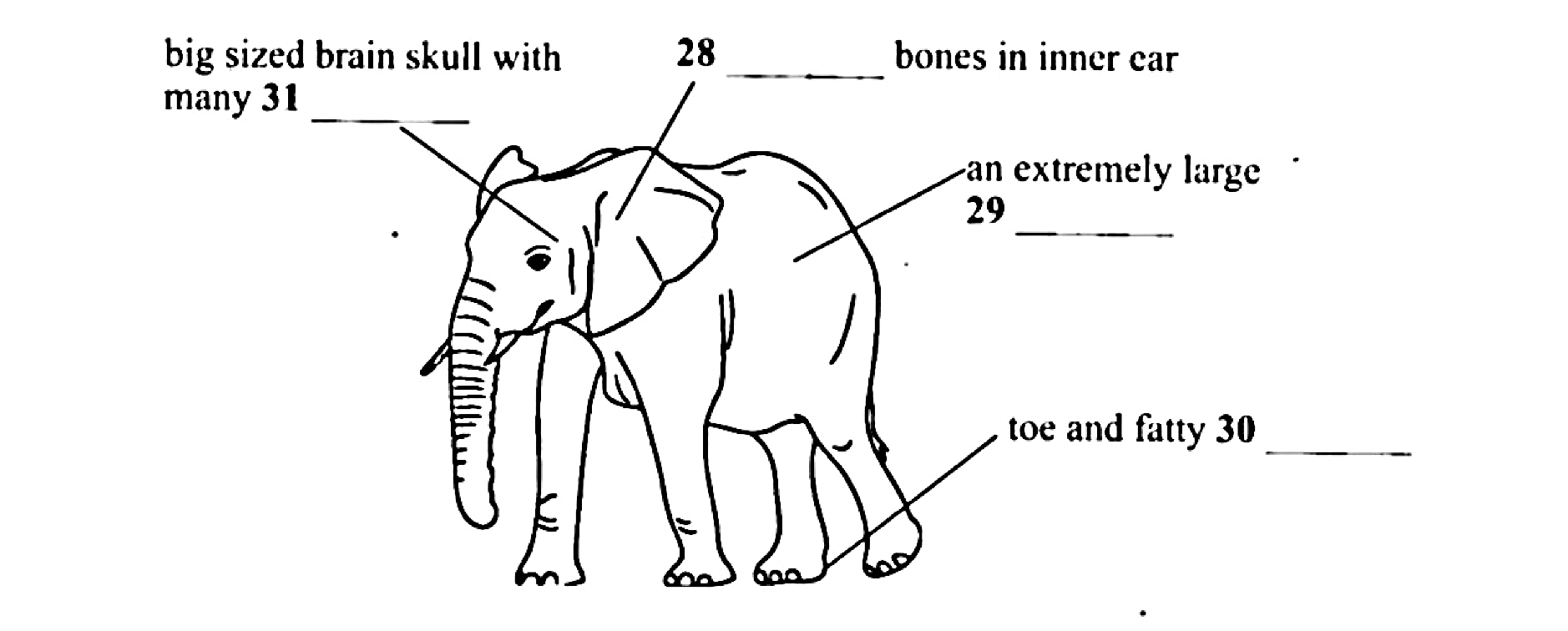
- 27
Label the diagram below. Choose NO MORE THAN TWO WORDS from the passage for each answer.
- 28
Complete the summary below. Choose NO MORE THAN THREE WORDS from the passage for each answer.
How the elephants sense these sound vibrations is still unknown, but O’Connell-Rodwell, a post-doctoral researcher at Stanford University, proposes that elephants are ‘listening’ with their ________ by two kinds of nerve endings that respond to vibrations with both ________ frequency and slightly higher frequencies. O’Connell-Rodwell’s work is at the combination of geophysics, neurophysiology and ________.
It was known that seismic communication existed extensively within small animals, but O’Connell-Rodwell was the first person to indicate that a large land animal would send and receive ________ too. Also, she noticed the freezing behaviour by putting a male planthopper on a stem and playing back a female call, which might prove the existence of other communicative approaches besides ________.
Scientists have determined that an elephant’s ability to communicate over long distances is essential, especially when elephant herds are finding a ________ or are warning of predators. Finally, the results of our 2002 study showed us that elephants could detect warning calls through the ________.
- 29
According to the passage, it is determined that an elephant needs to communicate over long distances for its survival
- A. when a threatening predator appears.
- B. when young elephants meet humans.
- C. when older members of the herd want to flee from the group.
- D. when a female elephant is in estrus.
- 30
What is the author’s attitude toward the experiment using three different recordings in the last paragraph?
- A. The outcome is definitely out of the original expectation.
- B. The data cannot be very clearly obtained.
- C. The result can be somewhat undecided or inaccurate.
- D. The result can be unfamiliar to the public.
解答を表示