Dibuat ulang dari ingatan peserta ujian — bukan materi resmi IELTS. Audio dan teks adalah rekreasi untuk latihan.
Tampilkan transkrip
====================
IELTS Listening Transcript
====================
PART 1
Speaker 0: Section one.
Speaker 0: You will hear a telephone conversation between a musician and a man working in a music agency.
Speaker 0: First, you have some time to look at questions one to five on page two.
Speaker 0: You will see that there is an example that has been done for you.
Speaker 0: On this occasion only, the conversation relating to this will be played first.
Speaker 2: Hello. Music Alive. How can I help you?
Speaker 1: Hi. I've just moved to the area, and I saw your advert. I wanted to find out about your services.
Speaker 2: Sure. What would you like to know?
Speaker 1: Well, I've got a number of questions if that's okay. Have you got a few minutes?
Speaker 2: Of course. Can I make a note of your name?
Speaker 1: Yes. I'm Jim, Jim Granley.
Speaker 0: The man's name is Jim Granley, so Granley has been written in the space.
Speaker 0: Now we shall begin. You should answer the questions as you listen because you will not hear the recording a second time.
Speaker 0: Listen carefully and answer questions one to five.
Speaker 2: Hello. Music Alive. How can I help you?
Speaker 1: Hi. I've just moved to the area, and I saw your advert. I wanted to find out about your services.
Speaker 2: Sure. What would you like to know?
Speaker 1: Well, I've got a number of questions if that's okay. Have you got a few minutes?
Speaker 2: Of course. Can I make a note of your name?
Speaker 1: Yes. I'm Jim. Jim Granley.
Speaker 2: Thanks. And do you represent every type of musician? Can you tell me a bit about that?
Speaker 1: Well, we're basically a networking agency for musicians, but we don't actually find you work. We have all our members on our database, the type of music they play, and also we can put people in touch if they want to form a band, for example.
Speaker 2: Is there a lot of live music here?
Speaker 1: Yes. And venues contact us when they need musicians, etcetera. We deal with modern music, especially rock, which is what most people seem to enjoy around here. But we do also represent some jazz musicians. We don't accept classical music, I'm afraid.
Speaker 2: No. That's fine. What do you play?
Speaker 1: Guitar and violin and a bit of flute. As I'm new here, I thought you could help me get in touch with people.
Speaker 2: I see. Sure. We actually have a newsletter I could send you that would give you a good idea of what we do and how you can benefit from joining. The latest one came out this week. Would you like me to send you a copy?
Speaker 1: That would be great. Is it weekly?
Speaker 2: No. Every month. Weekly would be too much work, I think.
Speaker 1: Right. And what are the costs for joining and becoming a member? Is it expensive? I'm on a tight budget.
Speaker 2: You and every other musician in the region. No. We do everything to keep costs down because we know what it's like. We're pretty much all musicians ourselves too. So to join is just £35, and that's a one off payment. Oh, actually, that's the discounted rate for young musicians under eighteens. The standard rate is £45.
Speaker 1: Unfortunately, I'm over 18. And how about joining? Can I join when I want? Now, for example, or do you have a limit on numbers?
Speaker 2: No. You can join anytime. We don't have a limit on the numbers of members we can have. The more, the merrier, in fact. Our membership's gone up recently from 700 to 750.
Speaker 0: Before you hear the rest of the conversation, you have some time to look at questions six to 10 on page two.
Speaker 0: Now listen and answer questions six to 10.
Speaker 1: That's good. And your ad says you also have facilities there that musicians can use. Can you explain a bit about that?
Speaker 2: Sure. Well, it's not huge, but we do have a couple of rooms where you can rehearse. They're soundproof. And we've just opened a studio, a small one. And it's already proving popular with bands that want to send demo tapes to venues and record labels.
Speaker 1: Wow. That sounds brilliant. And is that free? Guess not.
Speaker 2: No. That's extra. But we do have some free services. For example, we can offer legal advice if you need it for contracts and things like that. Pretty useful stuff, you know.
Speaker 1: Great. So if I'm interested, what's the next step? How do I become a member?
Speaker 2: Well, simple, really. Just send us a letter with your contact details and a recording made within the last couple of months. That'll give other members an idea of what you play.
Speaker 1: And where are you based?
Speaker 2: We're at 707 Kippax Street, Marbury.
Speaker 1: How do you spell Kippax?
Speaker 2: It's K I, P P, A X.
Speaker 1: And is there an email address?
Speaker 2: Yes. It's music.talent@bsu.co.uk.
Speaker 1: Talent as in the word?
Speaker 2: Yes.
Speaker 1: Right. Just one last thing.
Speaker 0: That is the end of section one.
PART 2
Speaker 3: Section two.
Speaker 3: You hear a talk by a counsellor from the University of New South Wales who will introduce some useful facilities and services on the campus.
Speaker 3: First, you have some time to look at questions 11 to 15.
Speaker 3: Now listen carefully and answer questions 11 to 15.
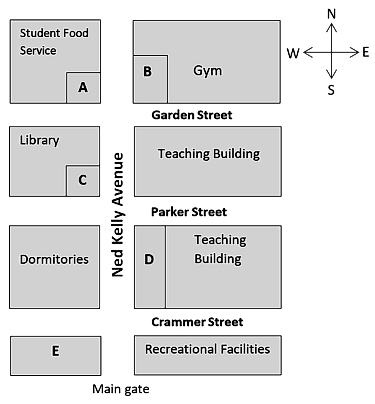
Speaker 4: Hello, everyone, and welcome to the University of New South Wales. The first thing I'd like to do at today's orientation session is get you all oriented. That means tell you the location of some useful facilities and services. So first of all, take out the maps we gave you all as you came in the door. The map is the big yellow sheet of paper. As you can see on the map, north is at the top, south at the bottom, etcetera. Which way is north? Well, look through that window on my left, your right. See the rising sun? That would have to be east. So north must be directly behind me. Now we're at the campus main gate. The recreational facilities are on my right hand, and its opposite is the student center. No questions? Good. Pretty easy. Right? Okay. Did everyone eat breakfast at the student food service this morning? Was the food good? Yes. Yes. I am joking. I've eaten there too. So after a meal like that, you must be eager to go to a doctor. Right? Well, I have good news for you. The student health center is located about half a kilometer straight north of here. Look on your maps. You see the street on the east side of this building, Ned Kelly Avenue? Just follow that about 500 meters, and the health center will be on your left at the 3rd Cross Street. Now I know you all just got here, so you must be wondering how to tell your folks you've arrived safely, how much you miss the dog, and how you already need more money. If you don't have an iPhone, you probably are wondering where to find a computer. Well, I have good news. If you go straight out of its door and walk down the Garden Street, you'll see the Internet unit on your left side just next to the gym. The hours are posted on the door and the computers are free, but you must bring your student ID card with you. Like I tell everyone, if you need help with anything, you can probably find right here in the student center. Do you see the four buildings there between the student center and the library? Those are the dormitories. The men's dorms are the two on the South, the women's, the two on the North. Okay. Now I'm sorry to have to tell you, but the university has been doing a lot of repairs and remodeling, and it's not all done yet. So there may be some small problems with your dorm rooms. Maybe the window doesn't open. Maybe an air conditioner is missing or does not work. If there are any problems, you can go to the complaint office, which is right beside the teaching building between the Parker Street and the Crammer Street. Just tell them your problem, and they should have it fixed by the time you graduate in four years. I'm joking, but please be patient. There are a lot of little things they need to take care of. Tired of the school food? No? Give it a week. Or maybe you just need a place to get coffee in the wee hours of the night during one of those marathon study sessions. Either way, you definitely have to check out the little cafe just past the women's dormitories. They've got free Wi Fi, so a lot of students saddle up with coffee and a bagel for hours on end to get work done.
Speaker 3: Before you hear the rest of the talk, you have some time to look at questions 16 to 20.
Speaker 3: Now listen and answer questions 16 to 20.
Speaker 4: As for the dorm rooms, I have some bad news and some good news. The bad news is the rooms are small and you'll probably be sharing space with at least three other students. The good news is that each room has its own bathroom. What's good about sharing a bathroom with three strangers? Good question. Okay. Call it bad news and worse news. Hey, maybe try this for good news. Each dorm has a kitchen. If you want to make snacks or meals, you can do it there. You can buy food containers at any campus convenience store so you can store your food in the kitchen. But a word of warning, you should definitely write your name on your food containers. Sad to say, there are food thieves among your fellow students. Speaking of thieves, a word about security. I mean, this is Australia and we do get drunken bushrangers wandering onto campus. Each of you will be given a key for your dorm room. Don't lose it. You have to pay for any replacement and fill out a bunch of papers too. Red tape. Your key does not work for the front door of your dorm, however. To the right of each door, there's a keypad with numbers. When you move in, they will tell you the code you use to enter the door. Please do not tell the code to people who do not live in the dorm. Let's see. Have I forgotten anything? Oh, yes. Most of you are not rich. Correct? So when your clothes get dirty, you can't just throw them away and buy new ones. That means you have to learn to do laundry. Or men, that means you have to hurry up and get married. If you decide to wash those clothes and not get married, there are laundries in each dorm. Where? Oh, I almost forgot to tell you. The laundry for each dorm is in the basement. Some real good news this time if you're a student, it is free. You do have to buy your own soap, however. The laundry closes by the by at 11:30. And now that I've mentioned 11:30, please remember, the dorm doors are locked at 11:30 PM. Your code will not work. If you want to get in, you'll have to call the night watchman. Don't worry. You can get that number at the dorm office. Yes. The dorm office and the complaint office are the same office. Alright then. Before we continue, are there any questions?
Speaker 3: That is the end of section two. You now have half a minute to check your answers.
PART 3
Speaker 5: Part three.
Speaker 5: You will hear two first year students, Rosie and Martin, discussing a project about sports shoes they are working on.
Speaker 5: First, you have some time to look at questions 21 to 26.
Speaker 5: Now listen carefully and answer questions 21 to 26.
Speaker 5: Okay, Martin. Before we plan our presentation for the project, let's discuss what we've done so far.
Speaker 6: Okay, Rosie. When the tutor gave us the theme of sports shoes to base our project on, I was not all that interested, but I'm starting to get into it. I've pretty much finished the research stage.
Speaker 5: Me too. At first, I had no idea what to write for the essay, so I asked some senior students for advice, and they gave me some websites to look at where I found some articles on sports shoes and got some ideas.
Speaker 6: Yes. I searched for pictures of sports shoes online and applied them in my research. It's beneficial.
Speaker 5: Right.
Speaker 6: According to the project's requirements, we have to find an example for the research, and I've just completed this part.
Speaker 5: What example do you use? You said you'd like to borrow a sample from the tutor.
Speaker 6: That was my first thought, but I realized maybe the tutor wanted us to do our own thing, not copy. Then I cut off my old sports shoes and separated them into different parts so that I could make a careful study of the internal structure.
Speaker 5: It's a good idea.
Speaker 6: Then I drew a diagram which could show precisely each part of the shoes. Through the research, I found that sports shoes nowadays have significantly improved.
Speaker 5: What do you mean?
Speaker 6: For example, designers these days use better raw materials, which are not only durable but also make the skin of feet breathe more easily. Moreover, they also take into account the factor of foot shape, but they've ignored the foot movement, which is essential for sportspeople.
Speaker 5: Interesting. I think I can add this to the essay.
Speaker 6: Okay. Given that you've got most ideas for the essay so far, I think you can mainly finish the written sections of the project, and I can take care of every detail of the presentation.
Speaker 5: Does this appeal to you? I'm okay with that. I prefer written work to give in a presentation.
Speaker 6: That's good. What do we need to do next?
Speaker 5: Well, according to the plan, we will give a presentation next Wednesday. And before that, we'll have to finish the questionnaire left by the tutor, and I think we can handle it this weekend.
Speaker 6: Okay. Do we have to do some face to face interviews?
Speaker 5: The tutor said that would be for the next assignment, not this one.
Speaker 6: Okay. Then about the presentation. I remember in the last tutorial, the tutor advised us to use some slides to make the presentation more attractive, but I'll also need a whiteboard because I like writing or drawing when necessary.
Speaker 5: We can ask our tutor for help. He might have one and can lend it to us. Right.
Speaker 5: Before you hear the rest of the conversation, you have some time to look at questions 27 to 30.
Speaker 5: Now listen and answer questions 27 to 30.
Speaker 5: Well, Martin, let's go through the draft of the essay together and see whether there are any changes we have to make.
Speaker 6: Okay, Rosie. I think the summary gives a brief and precise description of the project's main ideas.
Speaker 5: Where will it go? I'd like to put it at the end of the essay. What do you think?
Speaker 6: Good idea. And I think the result part describes in detail what the research has achieved, but I'm wondering whether it should go directly behind the part of the research as they are closely related.
Speaker 5: Yes. I think that'd be better. I'll move this part. Then the conclusion, I'm wondering whether I've used too many technical terms which other students might struggle with.
Speaker 6: You're right. Not everyone will be familiar with the subject.
Speaker 5: So I think we could replace them with straightforward explanations.
Speaker 6: I agree. Lastly, the discussion. I like this part as it presents a series of questions that we can talk about with other students after the presentation.
Speaker 5: Yes. But I think the questions look messy and need to be better sequenced. Maybe we could arrange them in a list.
Speaker 6: Okay. That'd be better.
Speaker 5: Alright. That's all about the essay. Now let's talk about the presentation.
Speaker 5: That is the end of part three. You now have half a minute to check your answers to part three.
PART 4
Speaker 7: Section four.
Speaker 7: You will hear part of a lecture about oxytocin and trust.
Speaker 7: First, you have some time to look at questions 31 to 40.
Speaker 7: Now listen carefully and answer questions 31 to 40.
Speaker 7: The development of trust is an essential social tool, allowing people to form productive and meaningful relationships, both at a professional and personal level. Trust is indispensable in friendship, love, families, and organizations, and plays a key role in economic exchange and politics. Much recent evidence indicates that trust contributes to economic, political, and social success. When we make contacts with strangers, such as doing business with the clients who we meet for the first time, our trust in them can only rely on their kindness. So from our own judgment or the comments from other people, we can have a rough idea if the stranger is trustworthy. Trust is important because it is the basis around which all human relationships evolve. Without trust, there can be no relationship. Trust can come naturally, or it can be manifested. If you find trust of this magnitude in life, then you are lucky. Also, you can always count on them to protect through all, if not most of life's perils. Trust is important because if you don't trust someone, then they are not available. Believe it or not, reducing the chance of suffering from poverty is to understand trust because when you trust other people, you can have more support and resources. However, our ability to trust others varies from individual to individual, just like different people's ability of recognizing a person's face is not the same. Bonds of trust are also extremely fragile. A single act of betrayal, such as a marital affair, can instantly erase years of trustworthy behavior. The consequences of such breaches in confidence can be disastrous and not only for a relationship. The study demonstrates how oxytocin can facilitate social interactions after trust has been violated by potentially lowering defense mechanisms associated with social risks and by overcoming negative feedback that is important for adapting behavior in the future. Luckily, oxytocin in our body has the ability to inspire trust in and among people. This chemical is released whenever interaction happens between people. To study social interactions, economists and more recently neuroscientists take advantage of a simple experiment. Two participants play the so called trust game. The first participant is faced with a decision to keep a sum of money or share it with the second participant who has no obligation to give the money back. He would get more money if the second person returns it. In this game, the first person is left with an important social dilemma to trust or not to trust. Although it is more profitable to trust, doing so leaves the investor at risk of betrayal. Trust is not something that naturally occurs when two people meet for the first time. It involves a process. One person has to show the quality of being trustworthy to the other person. This can be achieved by certain behaviors and communication. Therefore, trust is conditional. People should not take it for granted. Oxytocin does not only exist in human beings. Animals also have this gift, and it can be seen when they have cooperation with each other. Oxytocin in monkeys, for example, allow them to work together to find food and to fight against enemies. The Nash equilibrium's game theory, the first participant will make the best decision he can with no expectations that the second participant would change his decision. The second participant will do the same. So the outcome depends on the decision of the other person. This game is similar to the one we just talked about. The oxytocin level doesn't stay the same in a person's body. Studies have found that people who are under a lot of stress would have higher levels of oxytocin. Oxytocin causes a substantial increase in trust among humans, thereby greatly increasing the benefits from social interactions. It's also noted that the effects of oxytocin on trust is not due to a general increase in the readiness to bear risks. On the contrary, oxytocin specifically affects an individual's willingness to accept social risks arising through interpersonal interactions. To sum up, oxytocin is like a kind of social glue that is helpful in social bonding. Further research is needed to explore oxytocin and trust, and how this hormone can be used to strengthen our trust in others, and even treat mental disorders that specifically relate to deficiencies in social behavior. Next, we're going to talk about...
Speaker 7: That is the end of section four. You now have half a minute to check your answers.