Listening 2026-05 Test 8

Exam month: 2026-05

Rebuilt from test-taker recalls — not official IELTS material. Audio and passages are recreations for practice.

Recreated audio

Section 1

Complete the notes below. Write ONE WORD AND/OR A NUMBER for each answer.

Poppy Reserve The poppies will be at their best at the end of the 1 _________ The poppies on the hills are 2 _________ in color The reserve is located to the 3 _________ of the garden The best time for photography is 4 _________ Wear 5 _________ because of rattlesnakes Activity Time Duration 6 _________ tour 1.5 hours viewpoint of 7 _________ 8 _________ Wildlife 9 _________ am to 1:00 pm To bring the tripods and 10 _________ lens of camera
  1. 1

    The poppies will be at their best at the end of the 1 _________

  2. 2

    The poppies on the hills are 2 _________ in color

  3. 3

    The reserve is located to the 3 _________ of the garden

  4. 4

    The best time for photography is 4 _________

  5. 5

    Wear 5 _________ because of rattlesnakes

  6. 6

    6 _________ tour 1.5 hours viewpoint of 7 _________

  7. 7

    6 general tour 1.5 hours viewpoint of 7 _________

  8. 8

    8 _________

  9. 9

    Wildlife 9 _________ am to 1:00 pm

  10. 10

    To bring the tripods and 10 _________ lens of camera

Section 2

Choose TWO letters, A-E. Which TWO things will employees need to do during their first week in their new office space?

  1. 11

    Which TWO things will employees need to do during their first week in their new office space?

    • A. find out about safety procedures
    • B. collect a new form of identification
    • C. move boxes containing documents
    • D. make a note of any problem that occurs
    • E. learn about new company technology
  2. 12

    Which TWO things will employees need to do during their first week in their new office space?

    • A. find out about safety procedures
    • B. collect a new form of identification
    • C. move boxes containing documents
    • D. make a note of any problem that occurs
    • E. learn about new company technology

Section 2

Choose TWO letters, A-E. Which TWO steps have the company taken to improve the physical environment of employees' offices?

  1. 13

    Which TWO steps have the company taken to improve the physical environment of employees' offices?

    • A. provided comfortable seating
    • B. installed a new heating system
    • C. used attractive materials
    • D. enlarged people's working space
    • E. replaced the old type of lights
  2. 14

    Which TWO steps have the company taken to improve the physical environment of employees' offices?

    • A. provided comfortable seating
    • B. installed a new heating system
    • C. used attractive materials
    • D. enlarged people's working space
    • E. replaced the old type of lights

Section 2

Label the map below. Write the correct letter, A-l, next to Questions 15-20.
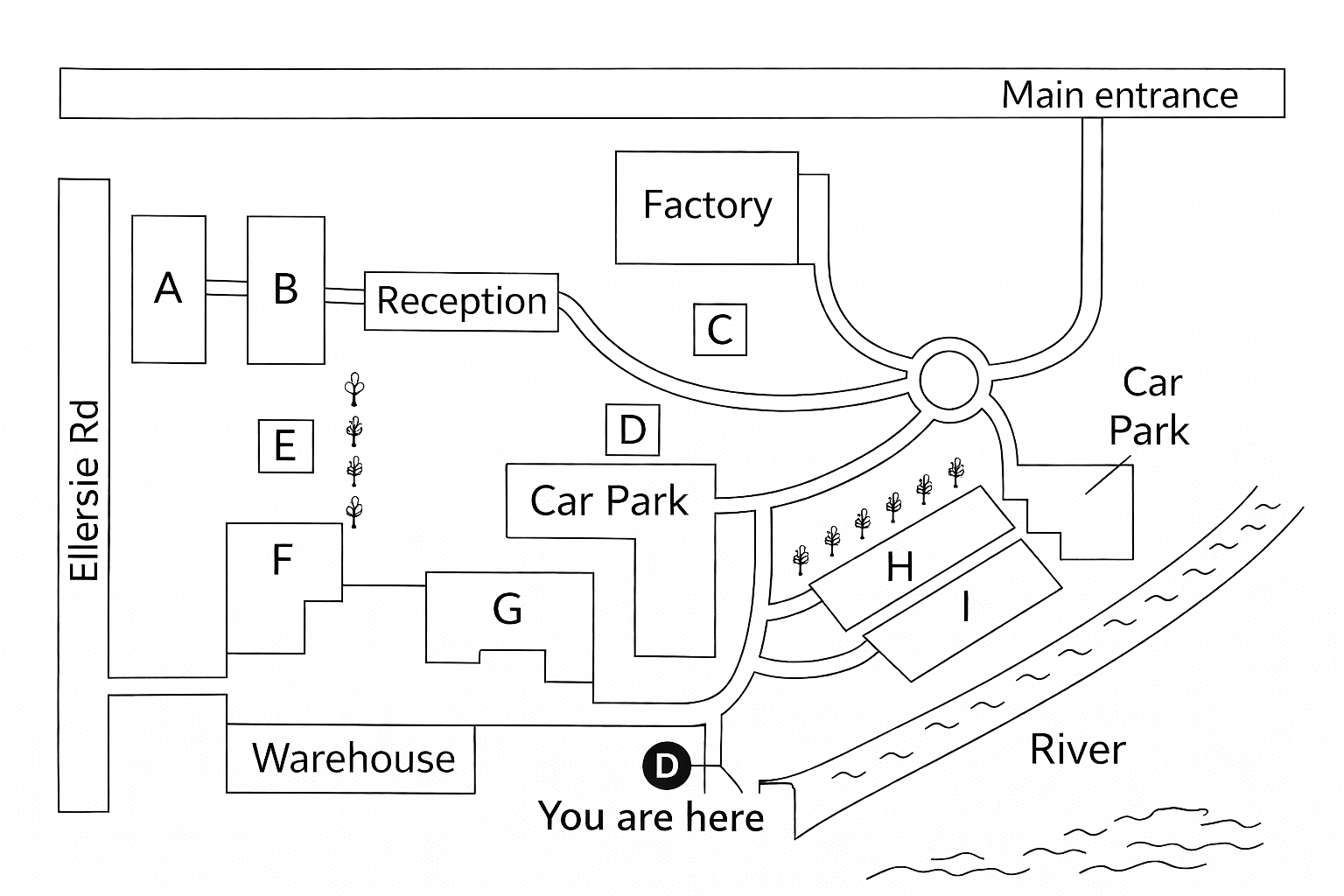
Willford Living Museum 15. Conference Centre 16. New Office Space 17. Stores 18. Finance 19. Café 20. IT Department
Recreated diagram for questions 15, 16, 17, 18, 19, 20
  1. 15

    Conference Centre

  2. 16

    New Office Space

  3. 17

    Stores

  4. 18

    Finance

  5. 19

    Café

  6. 20

    IT Department

Section 3

Choose the correct letter, A, B or C.

  1. 21

    Why did buildings made of plastic fail to please the public in the 1960s?

    • A. People didn't think they were good for the environment.
    • B. People didn't want to live in them.
    • C. People didn't find them visually appealing.
  2. 22

    In the 1960s and 1970s, engineers were unable to overcome the problem of

    • A. damage caused in the production process.
    • B. the effects of light and water.
    • C. the potential danger of wind.
  3. 23

    Luke and Millie agree to try to get more information about present-day plastics from

    • A. journals.
    • B. a PhD student.
    • C. websites.
  4. 24

    What do Luke and Millie agree about the article by Peterson?

    • A. It provided useful examples.
    • B. It was easy to understand.
    • C. It was a good introduction to the topic.

Section 3

What description applies to each of the following structures? Choose SIX answers from the box and write the correct letter, A-G, next to questions 25-30.

Descriptions A. easy to transport B. not much room inside C. made from recycled materials D. designed to promote technology E. never actually built F. easy to keep clean G. very strong construction Structures 25. the 'house of the future' (1957) 26. the 'wonderhouse' (1964) 27. spaceship houses (1968-78) 28. foam houses (1979-83) 29. plastic exhibition hall 30. New Zealand house
  1. 25

    the 'house of the future' (1957)

  2. 26

    the 'wonderhouse' (1964)

  3. 27

    spaceship houses (1968-78)

  4. 28

    foam houses (1979-83)

  5. 29

    plastic exhibition hall

  6. 30

    New Zealand house

Section 4

Complete the notes below. Write ONE WORD ONLY for each answer.

Plastics exhibition History • first plastic developed to replace ivory in sports equipment • semi-synthetics, e.g. commercial celluloid used 31 _________ • experiments making plastics from 32 _________ products were unsuccessful • earliest fabric to be produced was artificial 33 _________ • first plastic produced in a 34 _________ • invented by a 35 _________ called Hendrik Baekeland • unusual because it becomes 36 _________ when heated Exhibition Problems with display: • older plastic objects may release acidic 37 _________ • plastic objects degrade in 38 _________ Popular exhibits: • chandelier made using recycled 39 _________ • 40 a________ made in Japan from semi-synthetic materials based on substances found in plantations
  1. 31

    semi-synthetics, e.g. commercial celluloid used 31 _________

  2. 32

    experiments making plastics from 32 _________ products were unsuccessful

  3. 33

    earliest fabric to be produced was artificial 33 _________

  4. 34

    first plastic produced in a 34 _________

  5. 35

    invented by a 35 _________ called Hendrik Baekeland

  6. 36

    unusual because it becomes 36 _________ when heated

  7. 37

    older plastic objects may release acidic 37 _________

  8. 38

    plastic objects degrade in 38 _________

  9. 39

    chandelier made using recycled 39 _________

  10. 40

    40 a________ made in Japan from semi-synthetic materials based on substances found in plantations

Show transcript
==================== IELTS Listening Transcript ==================== PART 1 Speaker 0: Part one. Speaker 0: You will hear a telephone conversation between a woman and a park ranger. Speaker 0: First, you have some time to look at questions one to five. Speaker 0: Listen carefully and answer questions one to five. Speaker 1: Almond Valley Poppy Reserve. May I help you? Speaker 2: Is the nature reserve open now? Speaker 1: Yes. We are actually open all year, although this is the best time of year to see the wildflowers. Speaker 2: Are the poppies blooming yet? Speaker 1: Absolutely. They started to bloom last week and are already beautiful, but they should peak and be in full bloom at the end of the month. Speaker 2: Oh, I was planning on coming at the end of this week. Is that too early? Speaker 1: No. Not at all. The hills are already covered with orange poppies. Speaker 2: I thought poppies were red. Speaker 1: Not in California. I've never seen a red poppy here. Speaker 2: The Poppy Reserve is in Ocean County. Right? Speaker 1: Right. From Lakeside, you'll need to drive about an hour east. Speaker 2: What time does the reserve open? Speaker 1: The reserve is open from sunrise to sunset. It's best to come early in the morning to beat the crowds, but for the best photography, you might want to consider a mid-afternoon visit on a weekday. Speaker 2: I heard that there are a lot of rattlesnakes in the desert. Is it dangerous to walk about? Speaker 1: Most wildlife is quite safe. There are very few people bitten by rattlesnakes, so we do recommend wearing trousers just to be on the safe side. Speaker 2: Alright. I was hoping that I might have the chance to see some wildlife too. Oh, how much is the admission to the reserve? Speaker 1: It's $5. Speaker 2: Can I use my National Park Pass to enter the reserve? Speaker 1: Unfortunately not, since it is a state park, not a national park. Speaker 2: Alright. I heard from a friend that there is a nature tour available. Can you tell me about it? Speaker 1: Certainly. But can you excuse me just a sec? I'll be right back. Speaker 2: Okay. Speaker 0: Before you hear the rest of the conversation, you have some time to look at questions six to ten. Speaker 0: Now listen and answer questions six to ten. Speaker 1: Hello? Speaker 2: Yes. I'm still here. Speaker 1: Now, you are interested in the nature tours. Right? Speaker 2: Oh, there's more than one? Speaker 1: Yes. We have the general tour, which is the one your friend may have taken, but we also have two more specialized tours. Starting at 7:30 AM is our general tour. That's early for some people, I know. It's offered every hour too. But it's a great time, and it only lasts thirty minutes. Speaker 2: Is that the tour that takes you to the Vista Points? Speaker 1: Yes. That is one of the highlights, along with a film introducing the park and the museum. You're welcome to tour the museum at your leisure. It's a great tour for those who just want to take panoramic pictures with automatic cameras. Speaker 2: Well, if I come all that way, I'd like to have a more detailed tour. Speaker 1: Then you are in luck, because we have a wonderful wildflower tour every two hours from 8 AM. It lasts one hour, and the volunteer will give you information about many of the flowers on the reserve. Speaker 2: Besides the poppies, will cream cups be in bloom? Speaker 1: Yes. And you will see lots of sage too. We have a volunteer who is really good at giving tips on close-up photography. Speaker 2: You mentioned another tour. Speaker 1: Yes. The last one is the wildlife tour, but it is offered at very limited times. Speaker 2: Is that because most of the wildlife is nocturnal? Speaker 1: Yes. So we offer this tour only two times: 5:30 AM or 7 PM. Speaker 2: Wow. That early? But don't the snakes and lizards like the sun? Speaker 1: Right. First, let me say it takes about an hour and a half, but you will have the opportunity to see other animals like coyotes, quail, and roadrunners. You have to get here before the crowds arrive or after most of them leave. Speaker 2: Well, that makes sense. Does it require a lot of walking? Speaker 1: More like a lot of standing. But most of the time, you will be at one or two locations, so we recommend bringing a tripod and zoom lens if you want to take pictures. Speaker 2: Well, thank you very much. You've been extremely helpful and informative. Speaker 1: You're welcome. Glad I could be of service. Goodbye. Speaker 2: Goodbye. PART 2 Speaker 3: You will hear the manager of a factory talking to office staff about renovation work at the factory complex. Speaker 3: First, you have some time to look at questions 11 to 14. Speaker 3: Now listen carefully and answer questions 11 to 14. Speaker 4: Good afternoon. First of all, I want to say thank you for your patience for the last six months. As you know, all the office staff had to move to temporary offices while the renovation work at the factory complex was taking place. But finally, that work is finished, and everyone can return to the factory complex and their new office space. We're hoping everything will go smoothly, but there are a couple of things we'll need you to do during your first week back. You'll be pleased to know that your files and folders have been placed at your desk, so there's no need for you to go hunting around for any records. A couple of people have asked whether their old pass will still work at the security gate, or will they need to get their photo done and update their personal details. I can assure you that the old pass will still get you through the gate, no problem. Once you've had a chance to settle into the new offices, please take the time to view a training video for the operating system we're now using. We think it's going to manage all our programmes far more efficiently. Obviously, the sooner you can get this done, the better. Also, for next week, because the renovations have meant a complete redesign of some of the company's buildings, you'll need to attend a session on things like what to do if you hear the fire alarm go off, and where to meet if you have to evacuate the buildings. We'll let you know as soon as we have a definite time for that. It's going to be a busy week for everyone, but hopefully the kind of challenge that can help bring the team together. We'll make a time for you to report back to me on Friday. Alright. We've also taken some steps to improve the physical environment in your offices. Bigger windows mean that the offices are a lot brighter, and that's better for your eyes. We've also invested in some adjustable chairs. You can lower or raise them to whatever height feels right for you. What else? We've now got some quality insulation in the ceilings and walls that'll make everything a lot warmer. Also, another thing, we've set aside several rooms for project work. That will allow a team to get together around the same table. We feel that more opportunities for face-to-face discussion will benefit the whole company. So when you have had time... Speaker 3: Before you hear the rest of the talk, you have some time to look at questions 15 to 20. Speaker 3: Now listen and answer questions 15 to 20. Speaker 4: Okay. So let's look at a plan of the factory complex and see how it's changed. You can see that the main entrance is at the top of the map. Ellersley Road is on the left-hand side, and the warehouse is at the bottom. Okay. Let's start with one of the new buildings. The conference centre perhaps. If you look at the lower half of your plan, on the right, there are two long buildings that are parallel to each other. The conference centre is the one with a view of the river. Hopefully, that's something visitors to the factory complex will appreciate, especially on a sunny day when it's clear outside. Now, what about the new office space? As you know, the offices used to be in that large building right alongside Ellersley Road, and that could get a bit noisy at times. So what we've done is move the office space further away from the road, into the building that directly joins on to reception. This should mean employees can benefit from a quieter working environment, as well as the other improvements I mentioned earlier. We also decided to move the stores building, so it could be a lot closer to the warehouse. So now, if you were going to enter the factory complex from the Ellersley Road entrance, stores would be the building immediately on your left. The warehouse staff have already commented that having the stores here is much more convenient. Yes, I'm sure it's going to save a lot of time. Finance was another building that had to be relocated. They just didn't have enough space before. So you can see the main entrance on the plan, right? And below that is the roundabout. Then there's the road that goes from the roundabout directly to reception. Well, the finance building is about halfway along that road. On the plan, the factory is just above it. The cafe, just so you know, is in the same place as before. It's not ideally located for the factory workers, that's true, but it's not too far if you're heading down from reception or up from the warehouse. But what we've done is try to make the environment a bit more pleasant. So whereas before you looked straight from the cafe onto the large car park, now there's a line of trees separating them. I think you'll agree that this was a good decision. Putting in the trees, I mean. It was also necessary to relocate the IT department. Of course, for some of their work, they can do it remotely. But from time to time, the IT people do need to visit the different buildings around the factory complex. For that reason, we've given the IT department a more central location. It's that square building you see right in the centre of the plan, one of the closest buildings to the larger car park. Something I'd like to say about the car park actually. Speaker 3: That is the end of part two. You now have half a minute to check your answers. PART 3 Speaker 5: Part three. Speaker 5: You will hear two architecture students called Luke and Millie discussing their assignment about the use of plastic as a building material. Speaker 5: First, you have some time to look at questions 21 to 24. Speaker 5: Now listen carefully and answer questions 21 to 24. Speaker 7: Hi, Millie. Speaker 6: Hi, Luke. Speaker 7: So we're here to talk over our first assignment on alternative building materials. Speaker 6: Yeah. I think it will be really interesting to learn more about how plastic has been used. I found lots of information from the 1960s. Speaker 7: So did you find out why the idea of plastic buildings wasn't popular with the public at that time? Speaker 6: It wasn't the materials' environmental credentials. Speaker 7: The concept of plastic houses was just too futuristic. Speaker 6: So you mean it was their appearance? Speaker 7: No. People liked their modern design, but the idea of that sort of building as a home just didn't appeal. Speaker 6: Right. I did some research on the kind of problems engineers had with the old plastics in the 1960s and 1970s. Speaker 7: What did you learn? Speaker 6: Well, firstly, because plastic doesn't weigh very much, the buildings weren't very good in windy weather. They managed to fix that by amending the shape of the buildings, but the real disadvantage was that when the plastic was exposed to the light, it developed fine cracks, and when rain got into these cracks, the plastic would deform and lose its strength. Speaker 7: Right. I wonder where we can find some more information about the situation nowadays. Speaker 6: Maybe we could ask one of the PhD students. Speaker 7: I expect they'll be too busy. Speaker 6: Yeah, that's true. Speaker 7: Well, we could always use the Internet. Speaker 6: Maybe we should research more academic sources like the journals we have in the library. Speaker 7: Okay. That way we can reference everything properly at the end of the assignment. Have you read Peterson's article about plastic houses? Speaker 6: Yeah. It was really good. Speaker 7: But it didn't have enough illustrations of the houses. That was a shame. They'd have been useful for us as examples in our presentation. I like the way it was organized, though. That was really clear. Speaker 6: Yeah. And it wasn't too technical, but you did need to know a bit about plastic houses before you read it to get the most out of it. Speaker 7: That's true. Speaker 5: Before you hear the rest of the discussion, you have some time to look at questions 25 to 30. Speaker 5: Now listen and answer questions 25 to 30. Speaker 7: Okay. Well, shall we start comparing our findings then? Speaker 6: Sure. I'll make some notes. Speaker 7: Well, the earliest one I read about was a plastic house called the House Of The Future that was built in 1957, though no one actually lived in it. It was on show at a theme park in America for ten years. After that, they demolished it. But they had a hard time. It was really built to last. They couldn't break the plastic up. Speaker 6: Was that the one that had an ultrasonic dishwashing machine? Speaker 7: Yes. That would still be pretty revolutionary today. Speaker 6: Did you read about the Wonder House? It was designed in 1964 by an industrial designer called Alfred Noyes. Speaker 7: Oh, the one with the roof like a sort of tent or an umbrella. Speaker 6: That's right. The roof was made of fibreglass, and it curved down to the ground at each corner, enclosing a big central space. Then the sides were filled with glass or plastic. It was a really innovative idea for the time, but Noyes only made a small model, and the design wasn't implemented. Speaker 7: Pity. Speaker 6: What about those spaceship houses they built between 1968 and 1978? Like flying saucers. Speaker 7: They built over 100 of them. I don't know if I'd want to live in one. The living area was quite limited, and they had really low ceilings. But they do look really futuristic, don't they? Speaker 6: With their white walls and circular shape, yes. But the plastic houses I like are the foam houses they built between 1979 and 1983. They've got really curvy shapes. They built them by spraying foam over a great big balloon. Speaker 7: They were partly built to show what computers could do in the home, things like controlling heat and lights and so on. Quite new ideas at the time. And they were very well insulated as well, so they saved energy. Speaker 6: People were just beginning to get into that. I read about a plastic exhibition hall that can all be packed away in a relatively small container. You just put it on a truck and take it to wherever you want it, then inflate it. You know, fill it up with air, and there's room for hundreds of people. And when the exhibition or whatever's over, you just take it down again, and you can reuse it again and again. And there's a house in New Zealand that's built from household and industrial waste, like plastic boxes. Speaker 7: They say it's a much better construction material than bricks from the point of view of insulation. Speaker 6: Yes. They're using that idea to build houses in other parts of the world too. Speaker 7: Okay. Well, it looks as if we've got plenty of stuff. Speaker 5: That is the end of part three. You now have thirty seconds to check your answers to part three. PART 4 Speaker 8: Good morning. My name's Susan Mossman, and as well as being a part-time lecturer on the university's Museum Science degree, I'm also curator of a new exhibition opening at the Bidmouth Museum called Plasticity. This traces the history of plastics and ways they are being developed and used today. The first type of plastic was originally developed in response to a call from the makers of sports equipment. Animal-derived materials were becoming extremely expensive, so manufacturers launched a competition to find an alternative to ivory for making pool and billiard balls. Although various forms of plastic were developed, none of them were good enough to win the competition. But the inventors knew they were on to a good thing, and started researching a variety of different substances, partly based on organic material, what we call semisynthetics. One of the early semisynthetic materials produced was the first commercially produced celluloid, or plastic film, which was made by dissolving cotton in a strong acid, such as nitric acid. Unfortunately, this had a tendency to explode, so technicians had to be very careful with it. They also experimented with making plastics out of products derived from milk, but this didn't really work, and efforts were therefore concentrated on other organic material. One of the first uses of plastic was in the production of artificial fabric, and the earliest successful one was a substitute for silk. This was obviously a very expensive fibre, so artificial alternatives were thought to be worth investing in. The next significant breakthrough came in 1907 with the invention of Bakelite. This was the first entirely synthetic plastic made in a laboratory. It was invented by Hendrik Beikeland, a chemist who had made a fortune from producing paper used in photographic processes. Bakelite is a pretty unusual type of plastic because it actually gets hard when it's heated, whereas most other plastic becomes more malleable when hot. That is, they become more plastic, which is of course where the name for the category of materials comes from. So strictly speaking, Bakelite isn't a plastic at all. But now let's look at the exhibition itself. In it we show a variety of semisynthetic and totally synthetic plastics, some of them dating back 100 years. Some of the older plastics on display are unstable. This means that when they are in the process of degrading, they may produce gases which are acidic, and which can cause neighbouring objects in the display to disintegrate. We had to be very careful with these displays because there is one thing which causes plastic objects to degrade or break down, and that is light. So we've had to think of ways to get around this problem when setting up the objects on display. We have about 850 objects in the exhibition. One of our most interesting is a magnificent chandelier, a lamp designed to hang in the centre of the ceiling of a big hall. It's only when you look carefully that you can see this is a wonderful example of recycling. It's made entirely of pens, ones which we use and throw away every day. A second exhibit which is drawing a lot of attention is a car made entirely from plastic, which is now in small-scale production in Japan. ==================== Chinese Translation ==================== 第一部分 Speaker 0: 第一部分。 Speaker 0: 你将听到一位女士和一位公园管理员之间的电话对话。 Speaker 0: 首先,你有一些时间来看第1到第5题。 Speaker 0: 请仔细听,并回答第1到第5题。 Speaker 1: 杏仁谷罂粟保护区。有什么可以帮您的吗? Speaker 2: 自然保护区现在开放吗? Speaker 1: 是的。我们实际上全年开放,尽管现在是一年中观赏野花的最佳时节。 Speaker 2: 罂粟花开了吗? Speaker 1: 当然。它们上周开始开花,现在已经很美了,但应该会在月底达到盛开期。 Speaker 2: 哦,我本来打算这周末来。会不会太早了? Speaker 1: 不,一点也不早。山上已经开满了橙色的罂粟花。 Speaker 2: 我以为罂粟花是红色的。 Speaker 1: 在加州不是。我在这里从未见过红色的罂粟花。 Speaker 2: 罂粟保护区在海洋县,对吗? Speaker 1: 对。从湖滨市出发,你需要向东开车大约一小时。 Speaker 2: 保护区几点开门? Speaker 1: 保护区从日出开放到日落。最好清晨来以避开人群,但为了拍出最好的照片,你可能需要考虑在工作日的下午来。 Speaker 2: 我听说沙漠里有很多响尾蛇。走路危险吗? Speaker 1: 大多数野生动物都很安全。被响尾蛇咬伤的人非常少,所以我们建议穿长裤以防万一。 Speaker 2: 好的。我也希望能有机会看到一些野生动物。哦,保护区的门票多少钱? Speaker 1: 5美元。 Speaker 2: 我可以用我的国家公园通行证进入保护区吗? Speaker 1: 很遗憾不行,因为这是一个州立公园,不是国家公园。 Speaker 2: 好的。我听朋友说这里有一个自然导览游。你能给我介绍一下吗? Speaker 1: 当然可以。但你能稍等一下吗?我马上回来。 Speaker 2: 好的。 Speaker 0: 在你听到对话的其余部分之前,你有一些时间来看第6到第10题。 Speaker 0: 现在请听并回答第6到第10题。 Speaker 1: 喂? Speaker 2: 是的,我还在。 Speaker 1: 那么,你对自然导览游感兴趣,对吗? Speaker 2: 哦,不止一种吗? Speaker 1: 是的。我们有普通导览游,可能就是你的朋友参加的那种,但我们还有另外两种更专业的导览游。我们的普通导览游从早上7:30开始。我知道对有些人来说这有点早。它每小时也都有。但这是个很好的时间,而且只持续三十分钟。 Speaker 2: 是那个带你去观景点的导览游吗? Speaker 1: 是的。那是亮点之一,还有介绍公园和博物馆的电影。你可以随意参观博物馆。对于那些只想用自动相机拍全景照片的人来说,这是一个很棒的导览游。 Speaker 2: 嗯,如果我大老远来,我想要一个更详细的导览游。 Speaker 1: 那你运气好,因为我们从早上8点开始每两小时有一次很棒的野花导览游。它持续一小时,志愿者会告诉你保护区内许多花卉的信息。 Speaker 2: 除了罂粟花,奶油杯花会开吗? Speaker 1: 会的。你还会看到很多鼠尾草。我们有一位志愿者非常擅长提供特写摄影的技巧。 Speaker 2: 你提到了另一种导览游。 Speaker 1: 是的。最后一种是野生动物导览游,但只在非常有限的时间提供。 Speaker 2: 是因为大多数野生动物是夜行性的吗? Speaker 1: 是的。所以我们只提供两次这个导览游,早上5:30或晚上7点。 Speaker 2: 哇。那么早?但蛇和蜥蜴不是喜欢太阳吗? Speaker 1: 对。首先,我要说它大约需要一个半小时,但你将有机会看到其他动物,比如郊狼、鹌鹑和走鹃。你必须在人群到来之前或大多数人离开之后到达这里。 Speaker 2: 嗯,有道理。需要走很多路吗? Speaker 1: 更像是站很多。但大部分时间,你会在一个或两个地点,所以如果你想拍照,我们建议带上三脚架和变焦镜头。 Speaker 2: 好的,非常感谢。你帮了大忙,信息量很大。 Speaker 1: 不客气。很高兴能帮上忙。再见。 Speaker 2: 再见。 第二部分 Speaker 3: 你将听到一家工厂的经理向办公室员工谈论工厂综合体的翻新工作。 Speaker 3: 首先,你有一些时间来看第11到第14题。 Speaker 3: 现在请仔细听,并回答第11到第14题。 Speaker 4: 下午好。首先,我想感谢大家过去六个月的耐心。如你们所知,在工厂综合体进行翻新工作期间,所有办公室员工都不得不搬到临时办公室。但最终,这项工作完成了,每个人都可以回到工厂综合体和他们的新办公空间了。我们希望一切顺利,但在你们回来的第一周,有几件事需要你们做。你们会很高兴知道你们的文件和文件夹已经放在了你们的桌子上,所以你们不需要到处寻找任何记录。有几个人问过他们的旧通行证是否还能在安全门使用,或者他们是否需要拍照并更新个人信息。我可以向你们保证,旧通行证仍然可以让你们通过大门,没问题。一旦你们有机会安顿好新办公室,请花时间观看我们正在使用的操作系统的培训视频。我们认为它将更有效地管理我们所有的程序。显然,你们越早完成越好。另外,下周,由于翻新意味着公司一些建筑的完全重新设计,你们需要参加一个关于诸如听到火警响起时该怎么做,以及如果需要疏散建筑物该在哪里集合等内容的会议。我们一有确定的时间就会通知你们。对每个人来说,这将是忙碌的一周,但希望是那种有助于团队凝聚力的挑战。我们会在周五安排时间让你们向我汇报。好的。我们还采取了一些措施来改善你们办公室的物理环境。更大的窗户意味着办公室更明亮,这对你们的眼睛更好。我们还投资了一些可调节的椅子。你们可以根据自己的感觉降低或升高到合适的高度。还有什么?我们现在在天花板和墙壁上安装了高质量的隔热材料,这将使一切更温暖。另外,还有一件事,我们预留了几个房间用于项目工作。这将允许一个团队围坐在同一张桌子旁。我们认为更多的面对面讨论机会将使整个公司受益。所以当你们有时间…… Speaker 3: 在你听到讲话的其余部分之前,你有一些时间来看第15到第20题。 Speaker 3: 现在请听并回答第15到第20题。 Speaker 4: 好的。那么让我们看看工厂综合体的平面图,看看它发生了怎样的变化。你们可以看到主入口在地图的顶部。埃勒斯利路在左手边,仓库在底部。好的。让我们从其中一栋新建筑开始。也许是会议中心。如果你们看平面图的下半部分,在右边,有两栋平行的长建筑。会议中心是能看到河景的那一栋。希望这是工厂综合体的访客会欣赏的,尤其是在晴朗的日子里。现在,新的办公空间呢?如你们所知,办公室过去就在埃勒斯利路旁边的那栋大楼里,有时可能会有点吵。所以我们做的是将办公空间搬离道路更远,搬到了直接连接接待处的那栋楼里。这应该意味着员工可以受益于更安静的工作环境,以及我之前提到的其他改进。我们还决定搬迁仓库大楼,这样它可以更靠近仓库。所以现在,如果你们要从埃勒斯利路入口进入工厂综合体,仓库就是你们左手边的那栋楼。仓库员工已经评论说把仓库放在这里方便多了。是的,我相信这会节省很多时间。财务部是另一个需要搬迁的建筑。他们以前空间不够。所以你们可以在平面图上看到主入口,对吧?下面是一个环岛。然后有一条路从环岛直接通往接待处。嗯,财务大楼就在那条路的大约一半处。在平面图上,工厂就在它的上方。咖啡馆,让你们知道,还在原来的地方。对于工厂工人来说,它的位置并不理想,这是真的,但如果你们从接待处下来或从仓库上去,也不算太远。但我们所做的是努力让环境更宜人一些。所以以前你们从咖啡馆直接看到大型停车场,现在有一排树将它们隔开。我想你们会同意这是一个好的决定。我是说种树。搬迁IT部门也是必要的。当然,对于他们的一些工作,他们可以远程完成。但时不时地,IT人员确实需要走访工厂综合体内的不同建筑。出于这个原因,我们给了IT部门一个更中心的位置。就是你们在平面图正中心看到的那个方形建筑,是离大停车场最近的建筑之一。实际上,我想说说停车场。 Speaker 3: 第二部分到此结束。你现在有半分钟时间检查你的答案。 第三部分 Speaker 5: 第三部分。 Speaker 5: 你将听到两位建筑系学生卢克和米莉讨论他们关于使用塑料作为建筑材料的作业。 Speaker 5: 首先,你有一些时间来看第21到第24题。 Speaker 5: 现在请仔细听,并回答第21到第24题。 Speaker 7: 嗨,米莉。 Speaker 6: 嗨,卢克。 Speaker 7: 所以我们在这里讨论我们关于替代建筑材料的第一个作业。 Speaker 6: 是的。我认为了解更多关于塑料是如何被使用的会非常有趣。我找到了很多20世纪60年代的信息。 Speaker 7: 那你有没有发现为什么塑料建筑的想法在当时不受公众欢迎? Speaker 6: 不是材料的环境资质问题。 Speaker 7: 塑料房子的概念太未来主义了。 Speaker 6: 所以你的意思是它们的外观问题? Speaker 7: 不。人们喜欢它们现代的设计,但那种建筑作为家的想法并不吸引人。 Speaker 6: 对。我做了一些关于工程师在20世纪60年代和70年代遇到的旧塑料问题的研究。 Speaker 7: 你学到了什么? Speaker 6: 嗯,首先,因为塑料不是很重,这些建筑在刮风天气时表现不佳。他们通过修改建筑的形状解决了这个问题,但真正的缺点是当塑料暴露在光线下时,会产生细微的裂缝,当雨水渗入这些裂缝时,塑料会变形并失去强度。 Speaker 7: 对。我想知道我们现在在哪里可以找到更多关于当前情况的信息。 Speaker 6: 也许我们可以问问一位博士生。 Speaker 7: 我猜他们会很忙。 Speaker 6: 是的,没错。 Speaker 7: 嗯,我们总是可以用互联网。 Speaker 6: 也许我们应该研究更多的学术资源,比如图书馆里的期刊。 Speaker 7: 好的。这样我们就可以在作业结束时正确地引用所有内容。你读过彼得森关于塑料房子的文章吗? Speaker 6: 是的。写得很好。 Speaker 7: 但它没有足够的房子插图。真可惜。它们本来可以作为我们演示中的例子。不过我喜欢它的组织方式。非常清晰。 Speaker 6: 是的。而且不太技术性,但你在读之前确实需要对塑料房子有所了解才能充分利用它。 Speaker 7: 没错。 Speaker 5: 在你听到讨论的其余部分之前,你有一些时间来看第25到第30题。 Speaker 5: 现在请听并回答第25到第30题。 Speaker 7: 好的。嗯,我们开始比较我们的发现吧? Speaker 6: 当然。我做些笔记。 Speaker 7: 嗯,我读到的最早的一个塑料房子叫做“未来之家”,建于1957年,尽管实际上没有人住在里面。它在美国的一个主题公园展出了十年。之后,他们拆除了它。但他们费了很大劲。它建造得非常坚固。他们无法把塑料打碎。 Speaker 6: 是那个有超声波洗碗机的吗? Speaker 7: 是的。那在今天仍然相当具有革命性。 Speaker 6: 你读过关于“奇迹之家”吗?它是由一位名叫阿尔弗雷德·诺伊斯的工业设计师在1964年设计的。 Speaker 7: 哦,那个屋顶像帐篷或雨伞的那个。 Speaker 6: 没错。屋顶由玻璃纤维制成,在每个角落向下弯曲到地面,围成一个大的中央空间。然后侧面用玻璃或塑料填充。这在当时是一个非常创新的想法,但诺伊斯只做了一个小模型,设计没有实现。 Speaker 7: 可惜。 Speaker 6: 那些在1968年到1978年间建造的太空船房子呢?像飞碟一样。 Speaker 7: 他们建造了超过100个。我不知道我是否想住在里面。生活区非常有限,天花板真的很低。但它们看起来确实很未来主义,不是吗? Speaker 6: 有着白色的墙壁和圆形形状,是的。但我喜欢的塑料房子是他们在1979年到1983年间建造的泡沫房子。它们有非常弯曲的形状。他们通过在一个大气球上喷涂泡沫来建造它们。 Speaker 7: 它们部分是为了展示计算机在家里的功能,比如控制热量和灯光等等。在当时是相当新的想法。而且它们隔热也很好,所以节省能源。 Speaker 6: 人们当时刚开始对此感兴趣。我读到一个塑料展览厅,可以全部装在一个相对较小的容器里。你只需把它放在卡车上,带到任何你想要的地方,然后充气。你知道,充满空气,就有容纳数百人的空间。当展览或其他活动结束时,你只需再次把它拆下来,你可以一次又一次地重复使用。在新西兰有一所房子是用家庭和工业废物建造的,比如塑料盒子。 Speaker 7: 他们说从隔热的角度来看,它是一种比砖块好得多的建筑材料。 Speaker 6: 是的。他们也在世界其他地方用这个想法建造房屋。 Speaker 7: 好的。嗯,看起来我们有很多素材了。 Speaker 5: 第三部分到此结束。你现在有三十秒时间检查第三部分的答案。 第四部分 Speaker 8: 早上好。我的名字是苏珊·莫斯曼,除了在大学博物馆科学学位课程担任兼职讲师外,我还是比德茅斯博物馆一个名为“可塑性”的新展览的策展人。这个展览追溯了塑料的历史以及当今它们被开发和使用的方式。第一种塑料最初是为了响应体育器材制造商的需求而开发的。动物来源的材料变得极其昂贵,因此制造商发起了一场竞赛,以寻找象牙的替代品来制作台球和撞球。尽管开发了各种形式的塑料,但没有一种足够好到赢得比赛。但发明者知道他们发现了好东西,并开始研究各种不同的物质,部分基于有机材料,我们称之为半合成材料。早期生产的半合成材料之一是第一种商业生产的赛璐珞,或塑料胶片,它是通过将棉花溶解在强酸(如硝酸)中制成的。不幸的是,这有爆炸的倾向,所以技术人员必须非常小心。他们还尝试用牛奶衍生产品制造塑料,但这并没有真正成功,因此努力集中在其他有机材料上。塑料的最早用途之一是生产人造织物,最早成功的一种是丝绸的替代品。这显然是一种非常昂贵的纤维,因此人造替代品被认为值得投资。下一个重大突破发生在1907年,酚醛树脂被发明。这是第一种在实验室中完全合成的塑料。它是由亨德里克·贝克兰发明的,他是一位化学家,通过生产用于摄影过程的纸张发了财。酚醛树脂是一种非常不寻常的塑料,因为它在加热时实际上会变硬,而大多数其他塑料在热的时候会变得更可塑。也就是说,它们变得更“塑料”,这当然就是这类材料名称的来源。所以严格来说,酚醛树脂根本不是塑料。但现在让我们看看展览本身。在展览中,我们展示了各种半合成和全合成塑料,其中一些可以追溯到100年前。展出的一些较旧的塑料是不稳定的。这意味着当它们处于降解过程中时,可能会产生酸性气体,这些气体会导致展品中邻近的物体解体。我们必须非常小心这些展品,因为有一件事会导致塑料物体降解或分解,那就是光。所以我们在布置展品时必须想办法解决这个问题。展览中大约有850件物品。其中最有趣的一件是一个宏伟的枝形吊灯,一种设计悬挂在大厅天花板中央的灯。只有当你仔细观察时,你才会发现这是一个极好的回收利用的例子。它完全由笔制成,就是我们每天使用和丢弃的那种笔。第二个引起广泛关注的展品是一辆完全由塑料制成的汽车,目前正在日本进行小规模生产。
Show answer key

Answer key

  1. 1. month

    The answer is 'month' because the speaker says the poppies 'should peak and be in full bloom at the end of the month.'

  2. 2. orange

    The answer is 'orange' because the speaker says 'the hills are already covered with orange poppies.'

  3. 3. east

    The answer is 'east' because the speaker says, 'From Lakeside, you'll need to drive about an hour east.'

  4. 4. mid-afternoon

    The answer is 'mid-afternoon' because the speaker says, 'for the best photography, you might want to consider a mid-afternoon visit on a weekday.'

  5. 5. trousers

    The answer is 'trousers' because the speaker recommends 'wearing trousers just to be on the safe side' because of rattlesnakes.

  6. 6. general

    The answer is 'general' because the general tour is described as the one that lasts 1.5 hours and includes a viewpoint.

  7. 7. center

    The answer is 'center' because the general tour takes you to the Vista Points, which are highlights, and includes a film introducing the park and the museum (center).

  8. 8. 1 hour

    The answer is '1 hour' because the wildflower tour 'lasts one hour.'

  9. 9. 5:30

    The answer is '5:30' because the wildlife tour is offered 'only two times: 5:30 AM or 7 PM.'

  10. 10. zoom

    The answer is 'zoom' because the speaker says, 'we recommend bringing a tripod and zoom lens if you want to take pictures.'

  11. 11. A

    The answer is A (find out about safety procedures) because employees 'need to attend a session on things like what to do if you hear the fire alarm go off, and where to meet if you have to evacuate the buildings.'

  12. 12. E

    The answer is E (learn about new company technology) because employees are told to 'view a training video for the operating system we're now using.'

  13. 13. A

    The answer is A (provided comfortable seating) because the company 'invested in some adjustable chairs. You can lower or raise them to whatever height feels right for you.'

  14. 14. C

    The answer is C (used attractive materials) because the company 'now got some quality insulation in the ceilings and walls that'll make everything a lot warmer.' The most tempting wrong option is B (installed a new heating system), but the passage only mentions insulation, not a new heating system.

  15. 15. I

    The answer is 'I' because the conference centre is described as 'the one with a view of the river' in the lower right of the plan.

  16. 16. B

    The answer is 'B' because the new office space is 'in the building that directly joins on to reception,' which matches B on the plan.

  17. 17. F

    The answer is 'F' because the stores building is now 'immediately on your left' when entering from Ellersley Road, which is F on the plan.

  18. 18. C

    The answer is 'C' because the finance building is 'about halfway along that road' from the roundabout to reception, which is C on the plan.

  19. 19. E

    The answer is 'E' because the café is 'in the same place as before,' and E matches its location on the plan.

  20. 20. D

    The answer is 'D' because the IT department is 'that square building you see right in the centre of the plan,' which is D.

  21. 21. B

    The answer is B (People didn't want to live in them) because the speaker says, 'the idea of that sort of building as a home just didn't appeal.' Option C is tempting, but the passage says people liked the modern design.

  22. 22. B

    The answer is B (the effects of light and water) because the speaker says, 'when the plastic was exposed to the light, it developed fine cracks, and when rain got into these cracks, the plastic would deform and lose its strength.'

  23. 23. A

    The answer is A (journals) because Millie says, 'Maybe we should research more academic sources like the journals we have in the library,' and Luke agrees.

  24. 24. B

    The answer is B (It was easy to understand) because Millie says the article 'wasn't too technical,' but you needed some background knowledge. Option A is wrong because Luke says it 'didn't have enough illustrations.'

  25. 25. G

    The answer is 'G' because the 'House Of The Future' was built in 1957 and was on show at a theme park in America for ten years.

  26. 26. E

    The answer is 'E' because the 'Wonder House' was designed in 1964 by Alfred Noyes and had a roof like a tent or umbrella.

  27. 27. B

    The answer is 'B' because the spaceship houses were built between 1968 and 1978 and looked like flying saucers.

  28. 28. D

    The answer is 'D' because the foam houses were built between 1979 and 1983 and had curvy shapes made by spraying foam over a balloon.

  29. 29. A

    The answer is 'A' because the plastic exhibition hall can be packed away, transported, and inflated for use.

  30. 30. C

    The answer is 'C' because the New Zealand house is built from household and industrial waste, like plastic boxes.

  31. 31. cotton

    The answer is 'cotton' because celluloid was made by 'dissolving cotton in a strong acid.'

  32. 32. milk

    The answer is 'milk' because 'they also experimented with making plastics out of products derived from milk, but this didn't really work.'

  33. 33. silk

    The answer is 'silk' because 'the earliest successful one was a substitute for silk.'

  34. 34. laboratory

    The answer is 'laboratory' because Bakelite was 'the first entirely synthetic plastic made in a laboratory.'

  35. 35. chemist

    The answer is 'chemist' because Bakelite 'was invented by Hendrik Beikeland, a chemist.'

  36. 36. hard

    The answer is 'hard' because Bakelite 'actually gets hard when it's heated.'

  37. 37. gases

    The answer is 'gases' because 'when they are in the process of degrading, they may produce gases which are acidic.'

  38. 38. light

    The answer is 'light' because 'there is one thing which causes plastic objects to degrade or break down, and that is light.'

  39. 39. pens

    The answer is 'pens' because the chandelier is 'made entirely of pens, ones which we use and throw away every day.'

  40. 40. car

    The answer is 'car' because 'a car made entirely from plastic, which is now in small-scale production in Japan.'

Listening 2026-05 Test 8 — IELTS Listening Actual Test with Answers | IELTS Actual Tests