Listening 2026-01 Test 4

Bulan ujian: 2026-01

Dibangun ulang dari ingatan peserta — bukan materi resmi IELTS. Audio dan teks bacaan adalah rekreasi untuk latihan.

Audio yang direka ulang

Section 1: Birmingham Exhibition

Complete the notes below. Write NO MORE THAN TWO WORDS AND/OR A NUMBER for each answer.

BIRMINGHAM EXHIBITION • Open in: 1.______________ . • Length of exhibition: 2. ______________ . • A wide range of manufacturers will be showcased. • Some cars are available to observe and others are for 3. ______________ . • The 4. is prohibited to take into the museum. • Every ticket includes one free photo. • Price of the ticket: 5. £______________ (in advance). • Transfer to Mark 6. ______________ (Box Office Manager). • Held in the 7. ______________ Palace this year. • Not far from 8. ______________ . • Website: www. 9. ______________ .com. • Best way to contact: 10. ______________ .
  1. 1

    Open in: 1.______________ .

  2. 2

    Length of exhibition: 2. ______________ .

  3. 3

    Some cars are available to observe and others are for 3. ______________ .

  4. 4

    The 4. is prohibited to take into the museum.

  5. 5

    Price of the ticket: 5. £______________ (in advance).

  6. 6

    Transfer to Mark 6. ______________ (Box Office Manager).

  7. 7

    Held in the 7. ______________ Palace this year.

  8. 8

    Not far from 8. ______________ .

  9. 9

    Website: www. 9. ______________ .com.

  10. 10

    Best way to contact: 10. ______________ .

Section 2: Hospital Consultation

Answer the questions below. Choose the correct letter, A, B, or C.

  1. 11

    How many patients does the hospital consult every year?

    • A. 3,000.
    • B. 5,000.
    • C. 11,000.
  2. 12

    When can patients meet the female doctor?

    • A. On weekday mornings.
    • B. Three days a week.
    • C. Only on Mondays and Fridays.
  3. 13

    Who is the expert on treating hearing loss?

    • A. Mr. Roberts.
    • B. Mr Green.
    • C. Mr. Edwards.
  4. 14

    Where are patients recommended to buy their medicine?

    • A. The supermarket in the town.
    • B. Pharmacies nearby the city centre.
    • C. The health care's pharmacy.
  5. 15

    What will the patients be asked about whether they are willing to do?

    • A. Letting one student attend the consultation.
    • B. Asking postgraduate students to do treatment.
    • C. Meeting students in group discussion.

Section 2: Hospital Map Labelling

Label the map below. Write the correct letter, A-H, next to questions 16-20.
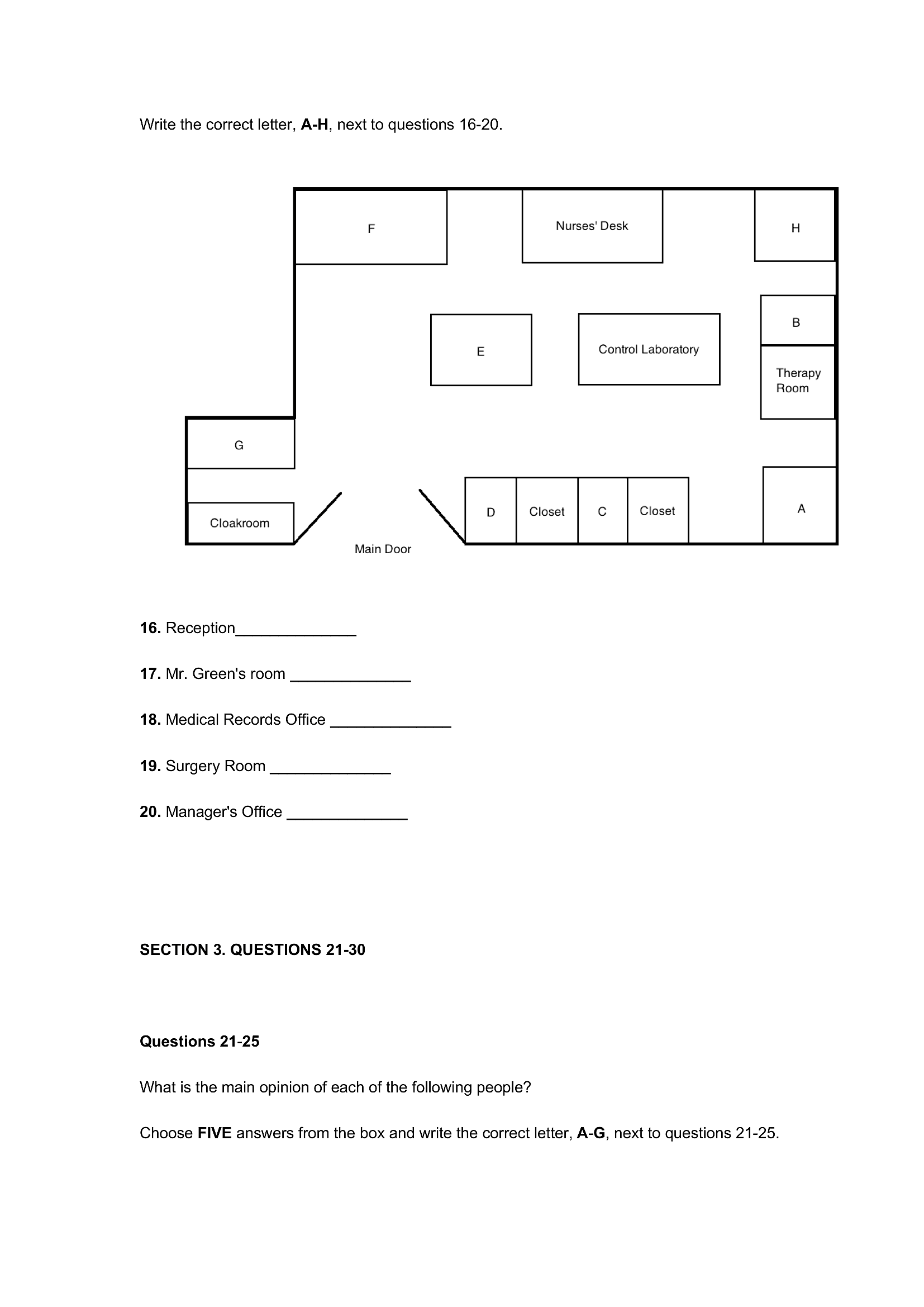
  1. 16

    Reception

  2. 17

    Mr. Green's room

  3. 18

    Medical Records Office

  4. 19

    Surgery Room

  5. 20

    Manager's Office

Section 3: Opinions on Lighting and Animals

What is the main opinion of each of the following people? Choose FIVE answers from the box and write the correct letter, A-G, next to questions 21-25.

Opinions A lightning restrictions B alternative lighting C reduce the number of insects D decline in the number of species E climate changes F impacts on the growth of animals G impacts on water quality
  1. 21

    Ken Simpson

  2. 22

    Dave Kepler

  3. 23

    Sharon Grey

  4. 24

    Maria Jackson

  5. 25

    Barbara Swallow

Section 3: Jim and Jane's Opinions

Choose the correct letter, A, B or C.

  1. 26

    What does Jim think about the difference among species in natural and artificial light?

    • A. It makes no difference.
    • B. Species will die out in natural light.
    • C. Species will die out in artificial light.
  2. 27

    One reason why Jim and Jane felt unsatisfied about the theories discussed in the lecture was that

    • A. governments didn't increase any spending on them.
    • B. most theories had nothing to do with the exam.
    • C. many theories lack solid proof in the field.

Section 3: Future Study Interests

Choose THREE letters, A-G. Which THREE topics are they interested in studying in the future?

A quality of life tourism B wildlife park animals C migration birds D animals living in rural areas E animals living in tropical climate F the impact of different environment on animals G pandas in the zoo
  1. 28

    Which THREE topics are they interested in studying in the future? (First choice)

    • A. quality of life tourism
    • B. wildlife park animals
    • C. migration birds
    • D. animals living in rural areas
    • E. animals living in tropical climate
    • F. the impact of different environment on animals
    • G. pandas in the zoo
  2. 29

    Which THREE topics are they interested in studying in the future? (Second choice)

    • A. quality of life tourism
    • B. wildlife park animals
    • C. migration birds
    • D. animals living in rural areas
    • E. animals living in tropical climate
    • F. the impact of different environment on animals
    • G. pandas in the zoo
  3. 30

    Which THREE topics are they interested in studying in the future? (Third choice)

    • A. quality of life tourism
    • B. wildlife park animals
    • C. migration birds
    • D. animals living in rural areas
    • E. animals living in tropical climate
    • F. the impact of different environment on animals
    • G. pandas in the zoo

Section 4: New Rules in Football

Choose TWO letters, A-E. Which TWO aspects did the new rules at the end of the 19th century focus on?

  1. 31

    Which TWO aspects did the new rules at the end of the 19th century focus on? (First aspect)

    • A. cooperation
    • B. competition
    • C. moral values
    • D. player's physical protection
    • E. business model
  2. 32

    Which TWO aspects did the new rules at the end of the 19th century focus on? (Second aspect)

    • A. cooperation
    • B. competition
    • C. moral values
    • D. player's physical protection
    • E. business model

Section 4: Football in the UK

Complete the sentences below. Write ONLY ONE WORD for each answer.

Football in the UK • At present the main reason why UK schools push football education is the pressure from 33. ______________ . • Prior to the 19th, football players used different 34.______________ of rules. • People attempted to standardise the rules from the whole 35. ______________ , known as the 'Cambridge Rules' in 1848. • Attendances were increasing due to the improvement of infrastructure and the 36. ______________ system. • Football became popular and it is regarded as a 37. ______________ event. • The football clubs were responsible for most of the 38. ______________ and development for the football association. • 39. ______________ against other teams were also organised by the football clubs. • In 1910s, 40. ______________ football players were approved of in the game.
  1. 33

    At present the main reason why UK schools push football education is the pressure from 33. ______________ .

  2. 34

    Prior to the 19th, football players used different 34.______________ of rules.

  3. 35

    People attempted to standardise the rules from the whole 35. ______________ , known as the 'Cambridge Rules' in 1848.

  4. 36

    Attendances were increasing due to the improvement of infrastructure and the 36. ______________ system.

  5. 37

    Football became popular and it is regarded as a 37. ______________ event.

  6. 38

    The football clubs were responsible for most of the 38. ______________ and development for the football association.

  7. 39

    39. ______________ against other teams were also organised by the football clubs.

  8. 40

    In 1910s, 40. ______________ football players were approved of in the game.

Tampilkan transkrip
==================== IELTS Listening Transcript ==================== PART 1 Speaker 0: You will hear a number of different recordings, and you will have to answer questions on what you hear. There will be time for you to read the instructions and questions, and you will have a chance to check your work. All the recordings will be played once only. The test is in four sections. At the end of the test, you will be given ten minutes to transfer your answers to an answer sheet. Now turn to section one. Section one. You will hear a woman phoning to inquire about exhibition information. First, you have some time to look at questions one to four. You will see that there is an example that has been done for you. On this occasion only, the conversation relating to this will be played first. Speaker 1: Good morning. You're through to the events coordinator at the Birmingham City Council. Speaker 2: How may I help you? Hello there. My husband and I are interested in purchasing tickets to the automobile exhibition, but I couldn't find many details about it on your website. And I was wondering whether you could provide me with some more information. Does it open in June? Speaker 0: The purpose of calling is to purchase tickets, so purchasing has been written in the space. Now we shall begin. You should answer the questions as you listen because you will not hear the recording a second time. Listen carefully and answer questions one to four. Speaker 1: Good morning. You're through to the events coordinator at the Birmingham City Council. Speaker 2: How may I help you? Hello there. My husband and I are interested in purchasing tickets to the automobile exhibition, but I couldn't find many details about it on your website. And I was wondering whether you could provide me with some more information. Does it open in June? Speaker 1: Yes. Of course, madam. The exhibition will take place during July and will showcase the history of automobiles from the very first commercial car in the late eighteen hundreds all the way through to the present day. Speaker 2: Is the exhibition open for the duration of July? Speaker 1: No, madam. The exhibition will last three days from July 1 to July 3, and then the cars will be taken to another exhibition. Speaker 2: Okay. Does the exhibition focus on a certain manufacturer? Speaker 1: No. It will showcase a wide range of manufacturers. Speaker 2: Wonderful. I'm ever so fed up of going to these shows and only seeing one manufacturer. Are there any opportunities to sit in or even drive the cars? Speaker 1: There will be many opportunities for you to sit in the cars. However, some of the cars will only be available to observe. We are yet to be told whether any of the antique cars will be available to drive. However, there will certainly be an opportunity to test drive some of the more modern cars on a purpose-built track. Speaker 2: That sounds like great fun. I mustn't forget to bring my camera or my husband will never forgive me. Speaker 1: I'm afraid to say that cameras are actually strictly not allowed to bring into the exhibition. There will, however, be a section where a professional photographer will be available to take photos of you sitting in a car in period clothing. Speaker 2: Well, that sounds like it could be fun, but I assume the photos won't be free. Speaker 1: On the contrary, one free photograph is included within every ticket, but each photo after this will cost £5. Speaker 0: Before you hear the rest of the conversation, you have some time to look at questions five to 10. Now listen and answer questions five to 10. Speaker 2: That's a nice surprise. Not many things are free anymore. I've been asking around about the ticket prices, but I haven't yet had a definite answer. Is it correct that the tickets are £100 whether you buy them now or on arrival? Speaker 1: I'm afraid not. If you buy the ticket in advance, the price is £110, but it's £165 on the door. Speaker 2: Oh, goodness. I suppose I best pay for them now then. Is it possible to buy tickets from you now over the phone? Speaker 1: Yes. Of course, madam. I'll transfer you to the box office manager, Mark Edgeworth. That's E D G E W O R T H, and he will probably need to take your credit card details and some personal details. Speaker 2: Yes. That's fine. Before you transfer me, I just need to ask a few more questions. Will the exhibition be held in the Birmingham Exhibition Center? I think that's where I went last time. Speaker 1: No, madam. The Birmingham Exhibition Center is currently undergoing some renovations. So this year, all exhibitions will be held in the Summer Palace. Speaker 2: Summer Palace? I'm not entirely sure where that is. Speaker 1: Well, it's not too far from city center. Once you're in the center, you should be able to find signs for the palace. If not, most people in Birmingham will be able to direct you. Speaker 2: Neither my husband nor I am particularly good with directions. Is there anywhere I can find this information on the Internet? Speaker 1: Our website will give you an address. Perhaps you could visit www.directions.com for more detailed information, and they should be able to provide you with step-by-step instructions. Speaker 2: Okay. And is this the best way to contact you by phone? Speaker 1: I think the most convenient way to contact us is inquiring online, which is much simpler than having to dial various different numbers to reach the right person. Unless you have any more questions, I'll transfer you now. Speaker 2: No. That's great. Thank you for your help. Speaker 0: That is the end of section one. You now have half a minute to check your answers. Now turn to section two. PART 2 Speaker 0: Section two. You will hear part of a talk given by a member of staff at a hospital. First, you have some time to look at questions 11 to 15. Now listen carefully and answer questions 11 to 15. Speaker 3: Hello and welcome to the home page for the Healthy Hearing Medical Clinic and Surgery where we'd like to share a little more information about the services we provide and more. Our hospital is one of the leading specialised hospitals in the United Kingdom, attracting the very best healthcare professionals from around the globe. Not only are we a leading medical practice, but we are also the only hospital in the United Kingdom dedicated entirely to the treatment of, and research into, the curing of hearing loss. Our facilities and staff here are renowned across Europe, attracting thousands of patients a year. Our consultations can number anything up to 11,000 patients a year. However, we aim to treat around 5,000 patients a year so as to maintain and ensure the quality of our services. Our patients are guaranteed the highest standard of care as well as the use of our first-class facilities. All patients requiring overnight treatment are provided with their own private room with ensuite facilities, as well as a state-of-the-art entertainment center which includes a flat-screen LCD television and PlayStation. Appointments with our healthcare professionals can be made at any time during the week with female doctors available between 8 AM and 11 AM. If you need to see a doctor outside of these times, please visit the out-of-hours page of our website for more information. Our doctors are all trained to an exceptionally high standard and practice a vast array of specialities. Mr. Roberts is a fully qualified ear and throat specialist. Mr. Edwards is a paediatric hearing specialist, while Mr. Green specialises in reversing hearing loss. For more details about our people, please visit the staff members page on our website. During a consultation, doctors will sometimes decide medication is required for which patients should receive a prescription. There are several pharmacies within the city, however we recommend that patients use the pharmacy housed within our healthcare facility. Our in-house pharmacy is well stocked at all times. Our products are competitively priced and our pharmacists are on hand to help and advise from 8 AM until 10 PM from Monday to Saturday and from 9 AM until 12 PM on Sundays. If you require any help outside of these hours, please see our out-of-hours page on the website. Since the Healthy Hearing Medical Clinic and Surgery also functions as a teaching hospital, we aim to provide our students with every opportunity to expose themselves to medicine in practice. Therefore, we would like to encourage our patients to give their consent for a medical student to attend their consultations. If our patients are not comfortable with this, there will be a form at reception where patients will be able to opt out. Speaker 0: Before you hear the rest of the talk, you have some time to look at questions 16 to 20. Now listen and answer questions 16 to 20. Speaker 3: Now please look at the map I've given you of the Healthy Hearing Medical Clinic and Surgery. For those not familiar with our practice, reception can be found through the main door at the end of the corridor. If your consultation is booked with Mr. Green, you need to go through the main door and turn right by the nurse's desk and his office is at the end of the corridor on your left-hand side. If you need to alter any of your personal details, please visit our secretary at the Office for Medical Records which you will find next to the Therapy Room. If you're awaiting surgery, please first check-in with reception before taking the first door on the right after you enter the clinic. Finally, in the event that you feel disappointed with any of the services we have provided or have any further questions, please locate our manager's office, which can be found near the Office for Medical Records and between two closets. If you have any more questions about the Healthy Hearing Medical Clinic and Surgery, please do not hesitate to contact us on 1256 111 011. Speaker 0: That is the end of section two. You now have half a minute to check your answers. Now turn to section three. PART 3 Speaker 0: Section three. You will hear Jim and Jane, two students, talking about their professor's lecture. First, you have some time to look at questions 21 to 25. Now listen carefully and answer questions 21 to 25. Speaker 4: Jane, what did you think of Professor Morgan's lecture? I don't know about you, but I find it incredibly difficult to believe that light influences the environment as much as he says. I've never seen any journal articles, websites, or anything that verifies his arguments. It's stupid. Speaker 3: On the contrary, I've seen a great deal of research supporting his argument from a wide range of renowned scientists. Have you looked at the recommended textbook listed on the course outline given to us at the beginning of the semester? All the information is in there. Perhaps you've just been looking in the wrong places. Speaker 4: I never look at the course outlines. I have so many loose sheets of paper I tend to lose anything I'm given by the end of the day. What's the textbook they recommend, and where can I get it from? I should probably go buy it soon. I'm already behind in the course. Speaker 3: Yeah. You definitely should buy it, and our grades are more important this year. It's called "The Influence of Light on the Environment." You should be able to find it in the bookshop on campus. If not, they'll order it within two weeks. In the meantime, you should read up on Ken Simpson's work. He argues that in order to protect natural habitats, governments should endeavor to turn off lights in cities at night. Speaker 4: Well, that's controversial. I doubt any government would be willing to do that anytime soon. I imagine roads would become quite dangerous without street lighting. For this issue, Dave Keppler suggests they could just replace the existing lights with more environmentally friendly bulbs. They could even install solar-powered lights. That way, roads will be more eco-friendly while maintaining safety. Although I guess they wouldn't be particularly effective in colder countries, especially during the winter. Speaker 3: That's quite a good idea, actually. The price of solar power is supposed to be on par with electricity within the next few decades, and it was on the news this morning. I've also heard that according to Sharon Gray, in countries with more sunlight, insect-eating animals tend to be smaller in size since there are fewer insects and the remaining insects produced a smaller number of eggs. Speaker 4: Yeah. I think I read somewhere that sunlight also has a negative effect on the quality of water, but I'm not sure I believe it. In many hot countries, particularly developing countries, there is a lot of water pollution caused by factories rather than sunlight. Nevertheless, Maria Jackson says that in direct sunlight, the surface of the water becomes more translucent. Therefore, it affects the amount of sunlight that aquatic insects can absorb. Not much research has been undertaken to prove Jackson's theory, but it seems to have been widely accepted anyway. Speaker 3: I've never heard of that. I'll have to look it up on Google. The only other theory I've studied is Barbara Swallow's study on how declined insect population adversely affects the frog population. Not that I'm complaining. I hate insects, especially spiders. Speaker 4: You have arachnophobia? I never would have guessed. Didn't your brother have a pet black widow spider? Speaker 3: Yes. He did, and I hated it. It escaped from its cage once, and we never found it. I had nightmares for months. Speaker 0: Before you hear the rest of the conversation, you have some time to look at questions 26 to 30. Now listen and answer questions 26 to 30. Speaker 3: Okay. Now I'm getting goosebumps. Let's change the subject. What's your stance on natural and artificial light? Speaker 4: Honestly, I'm not sure it makes much difference which one you use. Species will die out either way. I think the real argument we should consider is global warming and protection or replacement of finite fuels. Solar power provides us with an incredible opportunity to replace electricity, and governments should definitely increase spending on research in this field. The theories discussed in our lectures, like Simpson's and Gray's, are so vague and lack proof, so I don't understand why we even study them. Speaker 3: I see what you mean. I don't like learning unsupported theories for exams, and I'd rather spend my time learning something else. For example, I'd be much more interested in studying the animals in safari parks than researching migratory birds, particularly the effect of tourists on the quality of life of animals. As we know, every year thousands of visitors will drive in their own vehicles or ride in vehicles provided by the facility to observe freely roaming animals. Speaker 4: Yeah. That would be really interesting. Especially those animals living in more tropical countries like Borneo. Following on from that, I want to study how bringing animals over from foreign countries to put in our zoos affects their life expectancy. For example, do you remember when China sent pandas to Edinburgh Zoo? Apparently, one of the pandas became depressed, but it was never explained why. To me, obviously, you can't take an animal out of its natural habitat and put it in a cage on the other side of the world. It just doesn't work. Speaker 0: That is the end of section three. You now have half a minute to check your answers. Now turn to section four. PART 4 Speaker 0: Section four. You will hear a talk on the history of football in Great Britain in the nineteenth century. First, you have some time to look at questions 31 to 40. Now listen carefully and answer questions 31 to 40. Speaker 1: Great Britain is often hailed as the home of football, with talented players traveling from far and wide to play for teams in the English Premier League, one of the most popular football leagues on the planet. Today, we are going to take a look back to the nineteenth century Great Britain in an attempt to trace the evolution of the beautiful game as it is now known. Prior to the nineteenth century, the game featured a wide variety of local and regional adaptations, which were later smartened up and made more uniform to create our modern-day sports of association football, rugby football, and Ireland's Gaelic football. Even up to the mid-nineteenth century, Shrove Tide football or mob football was still widely practiced. According to the rules of mob football, there were no rules. A player could legally use any means whatsoever to obtain the ball, such as kicking, punching, biting, and gouging, with the only exceptions being murder and manslaughter. These games may be regarded as the ancestors of modern codes of football, and by comparison with later models of football, they were chaotic and had few cooperation. Towards the latter end of the nineteenth century and moving into the early part of the twentieth century, however, there appeared a newfound emphasis on moral values in football. Perhaps a more modern example of this can be seen in John Terry's suspension as England captain following reports of his infidelity to his wife. Furthermore, as mob football died away, there grew a greater concern for players' health and general well-being, with many clubs affording their top players access to frequent medical checkups and treatment. Despite the presence of Great Britain's unique state-funded national health service, football clubs are still seen today providing team members with state-of-the-art healthcare facilities, with the top clubs even housing their own specialist doctors and physicians. Today, football is a key feature of school children's day-to-day education, particularly for boys. With the help of football associations, all schools in the UK are boasting their own football teams. This mainly comes as a result of pressure put on schools and the government by concerned parents who felt that football education taught their children valuable lessons and indeed vital life skills, such as teamwork and a drive to succeed. Nowadays, many of the UK's top football clubs provide training facilities and outreach programs in an attempt to educate the nation's aspiring youths. As I previously mentioned, it was only during the nineteenth century that football in its uniform concept truly began to emerge, with footballers previously playing according to their own versions of the rules. However, it was not until the early twentieth century that different players actually began to play according to these standardized rules. Prior to the nineteenth century, football was played by all the major English public schools, including the likes of Eton College, Winchester College, and Harrow. In 1848, there was a meeting at Cambridge University in an attempt to lay down the laws of football. Present at the meeting were representatives of each of these major public schools, whom each brought a copy of the rules enforced by their own individual school's rules of football. The result of the meeting was what is now known as the Cambridge rules, thereby uniting the rules from across the country into one simple document. However, the Cambridge rules were not liked by all, and a new set of rules, Thring's rules, compounded in the book "The Simplest Game," became commonplace among dissenters. Across the country, improvements in infrastructure and public transport had a knock-on effect of dramatically increasing attendance to football games. Football quickly became a social event where spectators would meet friends, drink tea, and chat about the good old days. As football became more and more popular, it was decided that more money should be invested in maintaining the quality of pitches amongst other things, and there was even talk of installing seating for spectators. However, the question of who was to foot the bill quickly became a divisive issue with many believing that the government should fund football's development as a national sport. But in the end, the onus fell upon Britain's local and regional football clubs for the funding and development of the football association. They became responsible for the upkeep of football grounds, began to pay their best players a small salary, and organized competitions against other local and regional teams. And there began England's Football Association or the FA, as we know it in its current form, the governing body of football in England. As the FA continued to grow and accumulate greater wealth, it was able to attract more and more talented young men from across the country before finally accepting professional talent in the early twentieth century. Today, football is played at a professional level all over the world. Millions of people regularly go to football stadiums to follow their favorite teams, while billions more watch the game on television or on the Internet. Speaker 0: That is the end of section four. You now have half a minute to check your answers. That is the end of the listening test. In the IELTS test, you will now have ten minutes to transfer your answers to the answer sheet. ==================== Chinese Translation ==================== Speaker 0: 你将听到几段不同的录音,并需要根据听到的内容回答问题。每段录音前会有时间让你阅读题目和说明,结束后也有时间检查答案。所有录音只播放一遍。考试分为四个部分。考试结束后,你有十分钟时间将答案誊写到答题卡上。现在请翻到第一部分。第一部分。你将听到一位女士打电话咨询展览信息。首先,你有时间看第1到第4题。你会看到一个已经为你完成的示例。仅此一次,与示例相关的对话会先播放。 Speaker 1: 早上好。这里是伯明翰市议会活动协调员。 Speaker 2: 有什么可以帮您的?您好。我和我丈夫想购买汽车展览的门票,但在你们的网站上找不到太多详细信息。我想知道您是否能提供更多信息。展览是在六月开幕吗? Speaker 0: 打电话的目的是购买门票,所以“purchasing”已经填在空格里。现在正式开始。请边听边答题,因为录音不会重复播放。请仔细听,回答第1到第4题。 Speaker 1: 早上好。这里是伯明翰市议会活动协调员。 Speaker 2: 有什么可以帮您的?您好。我和我丈夫想购买汽车展览的门票,但在你们的网站上找不到太多详细信息。我想知道您是否能提供更多信息。展览是在六月开幕吗? Speaker 1: 是的,女士。展览将在七月举行,展示从19世纪末第一辆商用汽车至今的汽车历史。 Speaker 2: 展览在整个七月都开放吗? Speaker 1: 不,女士。展览只持续三天,从7月1日到7月3日,之后汽车将被运往另一个展览。 Speaker 2: 好的。展览会聚焦某个特定制造商吗? Speaker 1: 不会。它将展示各种制造商的产品。 Speaker 2: 太好了。我厌倦了那些只看一个制造商的展览。有没有机会坐进车里,甚至试驾? Speaker 1: 有很多机会可以坐进车里。不过,有些车只能观看。我们还不确定是否有古董车可以试驾。但肯定有机会在专门建造的赛道上试驾一些更现代的汽车。 Speaker 2: 听起来很有趣。我一定不能忘记带相机,否则我丈夫永远不会原谅我。 Speaker 1: 恐怕相机是严格禁止带入展览的。不过,会有一个区域,专业摄影师可以为你拍照,你可以穿着复古服装坐在车里。 Speaker 2: 听起来可能很有趣,但我猜照片不是免费的。 Speaker 1: 恰恰相反,每张门票包含一张免费照片,但之后每张照片收费5英镑。 Speaker 0: 在听对话剩余部分之前,你有时间看第5到第10题。现在请听并回答第5到第10题。 Speaker 2: 真是个惊喜。现在免费的东西不多了。我一直在打听票价,但还没有得到确切答案。门票是100英镑,无论现在买还是到现场买都一样吗? Speaker 1: 恐怕不是。如果提前购票,价格是110英镑,但现场购票是165英镑。 Speaker 2: 哦,天哪。我想最好现在就付钱。现在可以通过电话从您这里买票吗? Speaker 1: 是的,女士。我会把您转给票房经理马克·埃奇沃思。名字拼写是E-D-G-E-W-O-R-T-H。他可能需要您的信用卡信息和个人信息。 Speaker 2: 好的。在转接之前,我还有一些问题。展览会在伯明翰展览中心举行吗?我记得上次是在那里。 Speaker 1: 不,女士。伯明翰展览中心目前正在翻修。所以今年所有展览都在夏宫举行。 Speaker 2: 夏宫?我不太确定在哪里。 Speaker 1: 离市中心不远。到了市中心,你应该能找到通往夏宫的指示牌。如果找不到,大多数伯明翰人都会指路。 Speaker 2: 我和我丈夫都不太擅长认路。我在网上能找到这些信息吗? Speaker 1: 我们的网站会提供地址。也许你可以访问www.directions.com获取更详细的信息,他们应该能提供逐步指引。 Speaker 2: 好的。通过电话联系您是最好的方式吗? Speaker 1: 我认为最方便的方式是在线咨询,这比拨打各种号码找对人要简单得多。如果您没有其他问题,我现在就转接。 Speaker 2: 没有了。太好了。谢谢您的帮助。 Speaker 0: 第一部分结束。你现在有半分钟时间检查答案。现在请翻到第二部分。 Speaker 0: 第二部分。你将听到一位医院工作人员的部分讲话。首先,你有时间看第11到第15题。现在请仔细听,回答第11到第15题。 Speaker 3: 大家好,欢迎来到健康听力医疗诊所和手术室的主页。我们想分享更多关于我们提供的服务等信息。我们的医院是英国领先的专科医院之一,吸引了全球最优秀的医疗专业人员。我们不仅是领先的医疗机构,也是英国唯一一家完全致力于治疗和研究听力损失的医院。我们的设施和员工在欧洲享有盛誉,每年吸引数千名患者。我们的咨询量每年可达11,000人次。然而,我们每年目标治疗约5,000名患者,以维持和确保服务质量。患者可以享受最高标准的护理以及一流设施。所有需要过夜治疗的患者都拥有带套间设施的私人房间,以及配备平板液晶电视和PlayStation的最先进娱乐中心。与医疗专业人员的预约可以在每周任何时间进行,女性医生在上午8点到11点之间提供服务。如果您需要在这些时间之外看医生,请访问我们网站的“非工作时间”页面了解更多信息。我们的医生都经过高标准的培训,擅长多种专业。罗伯茨先生是合格耳喉专家。爱德华兹先生是儿科听力专家,而格林先生专攻逆转听力损失。关于我们人员的更多详情,请访问网站的员工页面。在咨询过程中,医生有时会决定需要药物治疗,患者应获得处方。市内有多家药房,但我们建议患者使用我们医疗设施内的药房。我们的内部药房库存充足。产品价格有竞争力,药剂师从周一至周六上午8点到晚上10点,周日上午9点到中午12点提供帮助和建议。如果您在这些时间之外需要帮助,请查看网站的“非工作时间”页面。由于健康听力医疗诊所和手术室也是一所教学医院,我们旨在为学生提供一切机会接触医学实践。因此,我们鼓励患者同意医学生参加他们的咨询。如果患者对此感到不适,可以在接待处填写表格选择退出。 Speaker 0: 在听讲话剩余部分之前,你有时间看第16到第20题。现在请听并回答第16到第20题。 Speaker 3: 现在请看健康听力医疗诊所和手术室的地图。对于不熟悉我们诊所的人,接待处位于走廊尽头的主门入口处。如果您与格林先生有预约,您需要进入主门,在护士台右转,他的办公室在走廊尽头的左侧。如果您需要更改个人信息,请前往医疗记录办公室的秘书处,该办公室位于治疗室旁边。如果您等待手术,请先在接待处登记,然后进入诊所后走右侧第一个门。最后,如果您对我们提供的任何服务感到不满意或有其他问题,请找到经理办公室,它位于医疗记录办公室附近,在两个储物柜之间。如果您对健康听力医疗诊所和手术室有任何其他问题,请随时拨打1256 111 011联系我们。 Speaker 0: 第二部分结束。你现在有半分钟时间检查答案。现在请翻到第三部分。 Speaker 0: 第三部分。你将听到吉姆和简两位学生讨论教授的讲座。首先,你有时间看第21到第25题。现在请仔细听,回答第21到第25题。 Speaker 4: 简,你觉得摩根教授的讲座怎么样?我不知道你怎么想,但我很难相信光对环境的影响有他说的那么大。我从没见过任何期刊文章、网站或其他东西能证实他的论点。这很愚蠢。 Speaker 3: 恰恰相反,我见过大量来自知名科学家的研究支持他的论点。你看过学期初课程大纲上推荐的书目吗?所有信息都在里面。也许你只是找错了地方。 Speaker 4: 我从不看课程大纲。我有太多散页,一天结束前就会弄丢任何给我的东西。他们推荐的是什么书?我在哪里能买到?我最好尽快去买。我已经落后了。 Speaker 3: 是的。你绝对应该买,而且今年的成绩更重要。书名是《光对环境的影响》。你应该能在校园书店找到。如果没有,他们会在两周内订购。同时,你应该读读肯·辛普森的作品。他认为为了保护自然栖息地,政府应该努力在夜间关闭城市灯光。 Speaker 4: 这很有争议。我怀疑任何政府短期内都不会愿意这么做。我想没有路灯的道路会变得很危险。对于这个问题,戴夫·凯普勒建议他们可以用更环保的灯泡替换现有灯泡。他们甚至可以安装太阳能灯。这样,道路在保持安全的同时会更环保。虽然我猜在较冷的国家,尤其是冬天,效果不会特别好。 Speaker 3: 这其实是个好主意。太阳能的价格预计在未来几十年内会与电力持平,今天早上新闻还报道了。我还听说,根据莎伦·格雷的说法,在阳光更充足的国家,食虫动物往往体型更小,因为昆虫更少,剩下的昆虫产卵数量也更少。 Speaker 4: 是的。我记得在哪里读到过,阳光对水质也有负面影响,但我不太相信。在许多炎热国家,特别是发展中国家,水污染主要是由工厂造成的,而不是阳光。尽管如此,玛丽亚·杰克逊说,在直射阳光下,水面变得更透明。因此,它影响了水生昆虫能吸收的阳光量。没有太多研究来证明杰克逊的理论,但它似乎已被广泛接受。 Speaker 3: 我从没听说过。我得在谷歌上查查。我学过的另一个理论是芭芭拉·斯沃洛关于昆虫数量下降对青蛙种群产生不利影响的研究。不是说我抱怨。我讨厌昆虫,尤其是蜘蛛。 Speaker 4: 你有蜘蛛恐惧症?我完全没想到。你哥哥不是养过一只黑寡妇蜘蛛吗? Speaker 3: 是的。他养过,我讨厌它。它有一次从笼子里逃出来,我们再也没找到。我做了几个月的噩梦。 Speaker 0: 在听对话剩余部分之前,你有时间看第26到第30题。现在请听并回答第26到第30题。 Speaker 3: 好吧。我现在起鸡皮疙瘩了。我们换个话题。你对自然光和人工光有什么看法? Speaker 4: 老实说,我不确定用哪种有多大区别。物种无论如何都会灭绝。我认为我们应该考虑的真正问题是全球变暖以及保护或替代有限燃料。太阳能为我们提供了替代电力的绝佳机会,政府绝对应该增加对这个领域研究的投入。我们讲座中讨论的理论,比如辛普森和格雷的,太模糊且缺乏证据,所以我不明白我们为什么要学它们。 Speaker 3: 我明白你的意思。我不喜欢为考试学习未经证实的理论,我宁愿花时间学点别的。比如,我对研究野生动物园里的动物比研究候鸟更感兴趣,特别是游客对动物生活质量的影响。我们知道,每年成千上万的游客会开自己的车或乘坐设施提供的车辆观察自由漫步的动物。 Speaker 4: 是的。那会很有趣。尤其是那些生活在婆罗洲等更热带国家的动物。接着这个,我想研究将外国动物带到我们的动物园如何影响它们的寿命。例如,你记得中国把熊猫送到爱丁堡动物园的时候吗?显然,其中一只熊猫变得抑郁,但从未解释原因。对我来说,显然你不能把动物从自然栖息地带出来,关在世界另一端的笼子里。这根本行不通。 Speaker 0: 第三部分结束。你现在有半分钟时间检查答案。现在请翻到第四部分。 Speaker 0: 第四部分。你将听到一篇关于19世纪大不列颠足球历史的演讲。首先,你有时间看第31到第40题。现在请仔细听,回答第31到第40题。 Speaker 1: 英国常被誉为足球之乡,才华横溢的球员从四面八方赶来为英超联赛的球队效力,英超是地球上最受欢迎的足球联赛之一。今天,我们将回顾19世纪的英国,试图追溯这项如今被称为“美丽运动”的演变过程。在19世纪之前,这项运动有各种各样的地方和区域改编,后来被整理和统一,形成了现代足球、橄榄球和爱尔兰盖尔式足球。直到19世纪中期,忏悔节足球或暴民足球仍然广泛流行。根据暴民足球的规则,没有规则。球员可以使用任何手段合法获得球,比如踢、打、咬和挖,唯一的例外是谋杀和过失杀人。这些比赛可以被视为现代足球规则的祖先,与后来的足球模式相比,它们混乱且缺乏合作。然而,到19世纪末和20世纪初,足球中出现了对道德价值观的新重视。也许一个更现代的例子是约翰·特里因婚外情报道被暂停英格兰队长职务。此外,随着暴民足球的消亡,人们对球员健康和福祉的关注增加,许多俱乐部为顶级球员提供频繁的体检和治疗。尽管英国有独特的国家资助的国民健康服务体系,但今天足球俱乐部仍然为队员提供最先进的医疗设施,顶级俱乐部甚至拥有自己的专科医生和医师。如今,足球是儿童日常教育的关键部分,尤其是男孩。在足球协会的帮助下,英国所有学校都拥有自己的足球队。这主要是由于关心教育的家长对学校和政府施加压力,他们认为足球教育教会了孩子宝贵的课程和重要的生活技能,如团队合作和成功动力。如今,许多英国顶级足球俱乐部提供训练设施和外展项目,以教育国家有抱负的年轻人。正如我之前提到的,直到19世纪,足球的统一概念才开始真正出现,此前球员们按照自己的规则版本比赛。然而,直到20世纪初,不同的球员才开始按照这些标准化规则比赛。在19世纪之前,所有主要的英国公立学校都踢足球,包括伊顿公学、温彻斯特公学和哈罗公学。1848年,剑桥大学召开了一次会议,试图制定足球规则。出席会议的是这些主要公立学校的代表,每个人都带来了自己学校执行的足球规则副本。会议的结果是现在所谓的剑桥规则,从而将全国各地的规则统一成一份简单的文件。然而,剑桥规则并非所有人都喜欢,一套新规则——斯林规则,汇编在《最简单的游戏》一书中,在反对者中变得普遍。在全国范围内,基础设施和公共交通的改善对足球比赛的观众人数产生了连锁反应,大幅增加。足球很快成为一种社交活动,观众可以会见朋友、喝茶、谈论过去的美好时光。随着足球越来越受欢迎,人们决定投入更多资金来维护球场质量等,甚至有人讨论为观众安装座位。然而,谁来买单的问题很快成为一个有争议的问题,许多人认为政府应该资助足球作为国家运动的发展。但最终,责任落在了英国地方和地区足球俱乐部身上,负责足球协会的资助和发展。他们负责维护足球场地,开始向最佳球员支付少量薪水,并组织与其他地方和地区球队的比赛。英格兰足球协会或英足总就此诞生,正如我们今天所知,它是英格兰足球的管理机构。随着英足总不断壮大和积累更多财富,它能够吸引全国越来越多有才华的年轻人,最终在20世纪初接受了职业人才。如今,足球在世界各地都有职业比赛。数百万人定期去足球场支持他们最喜欢的球队,而数十亿人通过电视或互联网观看比赛。 Speaker 0: 第四部分结束。你现在有半分钟时间检查答案。听力考试到此结束。在雅思考试中,你现在有十分钟时间将答案誊写到答题卡上。
Tampilkan kunci jawaban

Kunci jawaban

  1. 1. July

    The answer is 'July' because the woman asks if the exhibition opens in June, and is told, 'The exhibition will take place during July.'

  2. 2. Three days

    The answer is 'Three days' because it is stated, 'The exhibition will last three days from July 1 to July 3.'

  3. 3. Test driving

    The answer is 'Test driving' because the speaker says, 'there will certainly be an opportunity to test drive some of the more modern cars.'

  4. 4. Camera

    The answer is 'Camera' because it is said, 'cameras are actually strictly not allowed to bring into the exhibition.'

  5. 5. 110

    The answer is '110' because the ticket price is, 'If you buy the ticket in advance, the price is £110.'

  6. 6. Edgeworth

    The answer is 'Edgeworth' because the woman is told, 'I'll transfer you to the box office manager, Mark Edgeworth.'

  7. 7. Summer

    The answer is 'Summer' because the exhibition is held in 'the Summer Palace.'

  8. 8. City centre

    The answer is 'City centre' because the Summer Palace 'is not too far from city center.'

  9. 9. Directions

    The answer is 'Directions' because the website given is 'www.directions.com.'

  10. 10. Enquiring online

    The answer is 'Enquiring online' because the speaker says, 'the most convenient way to contact us is inquiring online.'

  11. 11. C

    The answer is 'C' (11,000) because it is said, 'Our consultations can number anything up to 11,000 patients a year.' The tempting wrong answer 'B' (5,000) is the number they aim to treat, not the number they consult.

  12. 12. A

    The answer is 'A' (On weekday mornings) because female doctors are 'available between 8 AM and 11 AM,' which are morning hours during the week. The other options mention specific days, but the passage says 'any time during the week.'

  13. 13. B

    The answer is 'B' (Mr Green) because 'Mr. Green specialises in reversing hearing loss.'

  14. 14. C

    The answer is 'C' (The health care's pharmacy) because 'we recommend that patients use the pharmacy housed within our healthcare facility.'

  15. 15. A

    The answer is 'A' (Letting one student attend the consultation) because patients are encouraged 'to give their consent for a medical student to attend their consultations.'

  16. 16. F

    The answer is 'F' because 'reception can be found through the main door at the end of the corridor.'

  17. 17. H

    The answer is 'H' because Mr. Green's office is 'at the end of the corridor on your left-hand side' after turning right by the nurse's desk.

  18. 18. A

    The answer is 'A' because the Medical Records Office is 'next to the Therapy Room.'

  19. 19. D

    The answer is 'D' because for surgery, 'take the first door on the right after you enter the clinic.'

  20. 20. C

    The answer is 'C' because the manager's office 'can be found near the Office for Medical Records and between two closets.'

  21. 21. A

    The answer is 'A' because Ken Simpson 'argues that in order to protect natural habitats, governments should endeavor to turn off lights in cities at night.'

  22. 22. B

    The answer is 'B' because Dave Kepler 'suggests they could just replace the existing lights with more environmentally friendly bulbs... even install solar-powered lights.'

  23. 23. F

    The answer is 'F' because Sharon Gray says 'in countries with more sunlight, insect-eating animals tend to be smaller in size.'

  24. 24. G

    The answer is 'G' because Maria Jackson says 'in direct sunlight, the surface of the water becomes more translucent... affects the amount of sunlight that aquatic insects can absorb.'

  25. 25. D

    The answer is 'D' because Barbara Swallow's study is about 'how declined insect population adversely affects the frog population.'

  26. 26. A

    The answer is 'A' (It makes no difference) because Jim says, 'I'm not sure it makes much difference which one you use. Species will die out either way.'

  27. 27. C

    The answer is 'C' (many theories lack solid proof in the field) because Jim says, 'The theories discussed in our lectures... are so vague and lack proof.'

  28. 28. B

    The answer is 'B' (wildlife park animals) because Jane says, 'I'd be much more interested in studying the animals in safari parks.'

  29. 29. E

    The answer is 'E' (animals living in tropical climate) because Jim says, 'Especially those animals living in more tropical countries like Borneo.'

  30. 30. F

    The answer is 'F' (the impact of different environment on animals) because Jim wants to study 'how bringing animals over from foreign countries to put in our zoos affects their life expectancy.'

  31. 31. C

    The answer is 'C' (moral values) because the passage says, 'there appeared a newfound emphasis on moral values in football.'

  32. 32. D

    The answer is 'D' (player's physical protection) because there was 'a greater concern for players' health and general well-being.'

  33. 33. Parents

    The answer is 'Parents' because football education in schools comes 'as a result of pressure put on schools and the government by concerned parents.'

  34. 34. Versions

    The answer is 'Versions' because 'footballers previously playing according to their own versions of the rules.'

  35. 35. Country

    The answer is 'Country' because the Cambridge rules 'united the rules from across the country into one simple document.'

  36. 36. Transport

    The answer is 'Transport' because 'improvements in infrastructure and public transport had a knock-on effect of dramatically increasing attendance.'

  37. 37. Social

    The answer is 'Social' because 'Football quickly became a social event where spectators would meet friends, drink tea, and chat.'

  38. 38. Funding

    The answer is 'Funding' because 'the onus fell upon Britain's local and regional football clubs for the funding and development of the football association.'

  39. 39. Competitions

    The answer is 'Competitions' because clubs 'organized competitions against other local and regional teams.'

  40. 40. Professional

    The answer is 'Professional' because the FA 'finally accepting professional talent in the early twentieth century.'