Sobre este conjunto: compilado y ligeramente editado a partir de material real de exámenes recordados por candidatos. IELTS utiliza un banco global de preguntas, así que este material circula en todo el mundo. Para darte una prueba completa y realizable, se agrupa material reportado en el mismo periodo — así que un conjunto puede combinar contenido de varias fechas de examen, no de una sola sesión. Cualquier audio es una recreación para practicar. Organizado para tu comodidad de estudio. Basado en recuerdos de candidatos — no es material oficial de IELTS.
Reading Passage 1: Olive Oil Production
Olive oil has been one of the staples of the Mediterranean diet for thousands of years and its popularity is growing rapidly in other parts of the world. It is one of the most versatile oils for cooking and it enhances the taste of many foods. Olive oil is the only type of vegetable/fruit oil that can be obtained from just pressing. Most other types of popular oils (corn, canola, etc.) must be processed in other ways to obtain the oil. Another important bonus is that olive oil has proven health benefits. Three basic grades of olive oil are most often available to the consumer: extra Virgin, Virgin and Olive Oil. In addition to the basic grades, olive oil differs from one country or region to another because of the types of olives that are grown, the harvesting methods, the time of the harvest, and the pressing techniques. These factors all contribute to the individual characteristics of the olive oil.
Olive trees must be properly cared for in order to achieve good economic yields. Care includes regular irrigation, pruning, fertilizing, and killing pests. Olives will survive on very poor sites with shallow soils but will grow very slowly and yield poorly. Deep soils tend to produce excessively vigorous trees, also with lower yields. The ideal site for olive oil production is a clay loam soil with good internal and surface drainage. Irrigation is necessary to produce heavy crops and avoid alternate bearing. The site must be free of hard winter frosts because wood damage will occur at temperatures below 15°F and a lengthy spell of freezing weather can ruin any chances for a decent crop. The growing season also must be warm enough so fruits mature before even light fall frosts (usually by early November) because of potential damage to the fruit and oil quality. Fortunately, olive trees are very hardy in hot summer temperatures and they are drought tolerant.
The best olive oils hold a certificate by an independent organization that authenticates the stone ground and cold pressed extraction process. In this process, olives are first harvested by hand at the proper stage of ripeness and maturity. Experts feel that hand harvesting, as opposed to mechanical harvesting, eliminates bruising of the fruit which causes tartness and oil acidity. The olives harvested are transferred daily to the mill. This is very important because this daily transfer minimizes the time spent between picking and pressing. Some extra virgin olive oil producers are known to transfer the olives by multi-ton trucks over long distances that expose the fragile fruit to crushing weight and the hot sun, which causes the olives to begin oxidizing and thus becoming acidic. In addition to the time lapse between harvesting and pressing, olive oil must be obtained using mechanical processes only to be considered virgin or extra virgin. If heat and/or chemical processes are used to produce the olive oil or if the time lapse is too long, it cannot be called virgin or extra virgin.
Once at the mill, the leaves are sucked away with air fans and the olives are washed with circulating potable water to remove all impurities. The first step of extraction is mashing the olives to create a paste. The oil, comprising 20% to 30% of the olive, is nestled in pockets within the fruit’s cells. The olives are crushed in a mill with two granite millstones rolling within a metal basin. Crushing and mixing the olives releases the oil from the cells of the olive without heating the paste. A side shutter on the mill’s basin allows the mixed olive paste to be discharged and applied to round mats. The mats are stacked and placed under the head of a hydraulic press frame that applies downward pressure and extracts the oil. The first pressing yields the superior quality oil, and the second and third pressings produce inferior quality oil. Some single estate producers collect the oil that results from just the initial crushing while many other producers use an additional step to extract more oil. The olive pulp is placed on mats constructed with hemp or polypropylene that are stacked and then pressed to squeeze the pulp. Oil and water filter through the mats to a collection tank below. The water and oil are then separated in a centrifuge.
Regardless of the method used for the first pressing, the temperature of the oil during production is extremely important in order to maintain the distinct characteristics of the oil. If the temperature of the oil climbs above 86ºF, it will be damaged and cannot be considered cold-pressed.
The first pressing oil contains the most “polyphenols”, substances that have been found to be powerful antioxidants capable of protecting against certain types of disease. The polyphenols are not the only substances in the olive with health-promoting effects, but they are quite unique when compared to other commonly used culinary oils such as sunflower and soy. It is these polyphenols that really set extra virgin olive oils apart from any other oil and any other form of olive oil. The more refined the olive oil is, the smaller the quantity of polyphenols.
The result of the producers’ efforts is a cold pressed extra virgin olive oil with high quality standards and organoleptic characteristics, which give the oil its health-protective and aromatic properties.
- 1
According to the text, which of the following does NOT influence the individual characteristics of olive oils from different areas?
- A. Access to water
- B. Picking techniques
- C. The date of the picking
- D. Olive varieties
- 2
According to the text, which of the following is NOT considered a part of olive tree handling?
- A. Replanting
- B. Feeding
- C. Killing parasites
- D. Careful watering
- 3
According to the text, what is the main harm of frost?
- A. It kills the olive tree
- B. The fruit won’t mature
- C. The olives produced will be small in size
- D. Not enough fruit will be produced
- 4
According to the text, which of the following does NOT have any impact on the “extra virgin” olive oil substantiation?
- A. The time gap between tree and bottle
- B. Using water in the extraction process
- C. The temperature of the extraction process
- D. Which pressing the oil is taken from
- 5
Olive trees don’t need a regular supply of water to survive.
- 6
No other cooking oils apart from olive oil contain polyphenols.
- 7
Damage to olives before they are pressed can affect the taste of the oil.
- 8
The Olive Oil Production Process: Olive trees should be planted in _________.
- 9
Trees must be carefully irrigated and fertilized and ________ if you want to get ________.
- 10
Olives are crushed to form a _________.
- 11
The paste is put on round mats inside a _________.
- 12
Water is removed by a _________.
Reading Passage 2: Antarctic research
Thirteen nations took part in the recent International Polar Year.
A New Zealand’s contribution to International Polar Year was a 52-day voyage by the ship Tangaroa in order to conduct research in Antarctica’s Ross Sea. Lead scientist Mary Livingston emphasises just what a multi-faceted expedition this was, bringing together zoologists, oceanographers, meteorologists and other scientists from the Ministry of Fisheries, the National Institute for Water and Atmospheric Research, the National Museum and various universities, to study life beneath the seas of Antarctica. Competition for berths – the ship can carry 44 people, including 13 crew – was fierce. Voyage leader Stu Hanchet says, ‘We could have filled the science positions four times over … we had so many people requesting a berth … We ended up with a really strong team.’
B It would be hard to overstate how hostile the Antarctic environment is for scientists. The Tangaroa’s captain, Graham Leachman, explains that the Ross Sea is subject to katabatic winds* that sweep down off the Antarctic continent to create rough seas. Another danger is the possibility of the ship colliding with floating ice. ‘Even though the ship’s officers use all sorts of high-tech equipment … none of it can tell you how thick the ice is,’ says Leachman, ‘and you still can’t beat looking out of the window.’ In the dark, he says, you can’t tell how thick the ice is, but if you can see its colour, it’s possible to estimate. This is why he prefers sailing in summer, when the hours of daylight in these high latitudes are longest, even though this plays tricks with his passengers’ body clocks.
C Analysis of what the expedition found continues, but it’s likely that several new species have been discovered and numerous other secrets revealed about life 3,000 metres below the surface. ‘We have collected huge worms and strange crustaceans,’ says Livingston, ‘but most impressive of all were the starfish that measured more than half a metre across – that’s most abnormal for creatures belonging to this species.’ This phenomenon of Antarctic seas is called ‘gigantism’ – the fact that some species grow to unusually large sizes. Livingston suggests various possible causes for gigantism including the extreme cold, few predators and high levels of oxygen in the seawater, but as yet no final determination can be made. Another interesting discovery was that in some places every inch of the sea floor was covered with life, whereas elsewhere icebergs have scoured out deep scars and ravines in the sea floor as they go by.
* katabatic wind: a wind caused by the local downward motion of cool air
D By using deep-sea trawl nets, high-definition cameras and water samplers, the team has revealed that many of the creatures that live at extreme depths have a bizarre appearance. Among them were spotted tunicates, plankton-eating animals that are slender structures that appear to be fashioned from glass. The most fearsome-looking fish was the Southern Ocean daggertooth, a species that is ‘monocyclic’, meaning the fish die after the first spawning. They are also unusual for being capable of shedding their teeth and growing a new set. Another predatory fish brought to the surface was the stareater, an extraordinary species that has an appendage like a piece of cord hanging from its chin. In these deep, dark waters, this glows red and attracts prey to swim within striking distance. Just as impressive and much more beautiful were the basket stars, a species related to starfish that lives on the seabed. The basket stars’ five arms branch out numerous times to form a spectacular fan-like structure which they turn to face into the current so that food is brought into their embrace.
E But whatever exciting discoveries were made, everyday life onboard ship in the Ross Sea is unrelenting. Most people share a cabin with one other person – they’re allocated so that as one person begins their 12 hours off duty, the other occupant is starting work on deck. The fresh food runs out in a few days and after that most provisions are frozen, canned or dried. Expedition general manager Fred Smits recognises that the cook has an essential role in ensuring the well-being of those onboard. ‘When you are at sea for so long,’ he says, ‘you think a lot about your next meal.’
F Perhaps most controversially, one of the precious berths on the Tangaroa was taken up by cameraman Max Quinn, who filmed a documentary about the voyage. Quinn’s inclusion wasn’t welcomed at first. ‘Scientists by nature,’ Livingston says, ‘tend to be camera-shy and quiet. They’re not into having cameras there, so it was difficult getting everyone’s permission and agreement.’ But in the end Quinn fitted in very well. ‘The trick,’ he says, ‘is to mostly film the scientists at work, in their professional roles … rather than eating their breakfast.’ He knows when not to intrude. The documentary is a window on a trip few people get to make and also a peek into what research really looks like. ‘Science,’ says Livingston, ‘is intrepid, more so than people realise. It’s not necessarily examining dry samples in the laboratory, but can also mean braving the elements on deck. That’s what the documentary captures, the sense of real people with real lives.’
- 13
details of some equipment used by the scientists
- 14
a description of the challenging sailing conditions in Antarctica
- 15
information about the composition of the scientific group
- 16
the identity of a potentially unpopular person on the ship
- 17
The expedition’s findings: Analysis continues of the expedition’s remarkable discoveries, including a ________, very notable for its unusual width.
- 18
The reasons why creatures grow so large at great depths in Antarctica may include the highly oxygenated water, the temperature, or the small number of ________.
- 19
A further fascinating finding was the existence of canyons in the seabed caused by passing ________.
- 20
Many creatures living at great depth look very strange, such as tunicates, which seem to be made of ________.
- 21
One frightening-looking fish species is characterised by loss of its ________ and the fact that it spawns only once.
- 22
Another fish has something like a length of string attached to its ________ that assists with hunting.
- 23
Mary Livingston
- A. The repetitive food was one of the hardships of the voyage.
- B. Respecting your subjects’ privacy gets the best results.
- C. The summer is the best time to sail these waters.
- D. The kitchen is one of the most important parts of the ship.
- E. Being separated from family was difficult.
- F. The nature of scientific work may surprise some people.
- G. More applications to join the group were received than there were places.
- 24
Stu Hanchet
- A. The repetitive food was one of the hardships of the voyage.
- B. Respecting your subjects’ privacy gets the best results.
- C. The summer is the best time to sail these waters.
- D. The kitchen is one of the most important parts of the ship.
- E. Being separated from family was difficult.
- F. The nature of scientific work may surprise some people.
- G. More applications to join the group were received than there were places.
- 25
Max Quinn
- A. The repetitive food was one of the hardships of the voyage.
- B. Respecting your subjects’ privacy gets the best results.
- C. The summer is the best time to sail these waters.
- D. The kitchen is one of the most important parts of the ship.
- E. Being separated from family was difficult.
- F. The nature of scientific work may surprise some people.
- G. More applications to join the group were received than there were places.
Reading Passage 3: New Zealand Seaweed
Call us not weeds; we are flowers of the sea.
Section A
Seaweed is a particularly nutritious food, which absorbs and concentrates traces of a wide variety of minerals necessary to the body's health. Many elements may occur in seaweed - aluminium, barium, calcium, chlorine, copper, iodine and iron, to name but a few - traces normally produced by erosion and carried to the seaweed beds by river and sea currents. Seaweeds are also rich in vitamins: indeed, Eskimos obtain a high proportion of their bodily requirements of vitamin C from the seaweeds they eat.
The nutritive value of seaweed has long been recognised. For instance, there is a remarkably low incidence of goitre amongst the Japanese, and for that matter, amongst our own Maori people, who have always eaten seaweeds, and this may well be attributed to the high iodine content of this food. Research into old Maori eating customs shows that jellies were made using seaweeds, fresh fruit and nuts, fuchsia and tutu berries, cape gooseberries, and many other fruits which either grew here naturally or were sown from seeds brought by settlers and explorers.
Section B
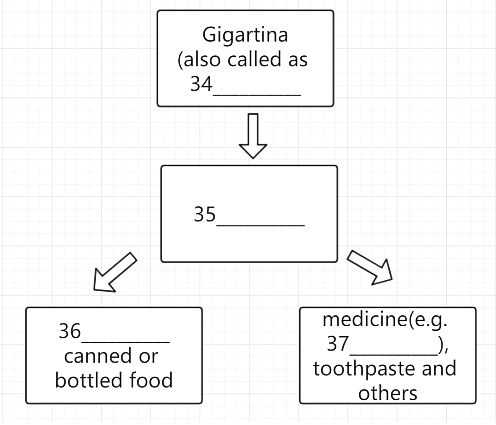
New Zealand lays claim to approximately 700 species of seaweed, some of which have no representation outside this country. Of several species grown worldwide, New Zealand also has a particularly large share. For example, it is estimated that New Zealand has some 30 species of Gigartina, a close relative of carrageen or Irish moss. These are often referred to as the New Zealand carrageens. The gel-forming substance called agar which can be extracted from this species gives them great commercial application in seameal, from which seameal custard is made, and in cough mixture, confectionery, cosmetics, the canning, paint and leather industries, the manufacture of duplicating pads, and in toothpaste. In fact, during World War II, New Zealand Gigartina were sent to Australia to be used in toothpaste.
Section C
Yet although New Zealand has so much of the commercially profitable red seaweeds, several of which are a source of agar (Pterocladia, Gelidium, Chondrus, Gigartina), before 1940 relatively little use was made of them. New Zealand used to import the Northern Hemisphere Irish moss (Chondrus crispus) from England and ready-made agar from Japan. Although distribution of the Gigartina is confined to certain areas according to species, it is only on the east coast of the North Island that its occurrence is rare. And even then, the east coast, and the area around Hokiangna, have a considerable supply of the two species of Pterocladia from which agar is also available. Happily, New Zealand-made agar is now obtainable in health food shops.
Section D
Seaweeds are divided into three classes determined by colour - red, brown and green - and each tends to live in a specific location. However, except for the unmistakable sea lettuce (Ulva), few are totally one colour; and especially when dry, some species can change colour quite significantly - a brown one may turn quite black, or a red one appear black, brown, pink or purple.
Identification is nevertheless facilitated by the fact that the factors which determine where a seaweed will grow are quite precise, and they therefore tend to occur in very well-defined zones. Although there are exceptions, the green seaweeds are mainly shallow-water algae; the browns belong to medium depths, and the reds are plants of the deeper water. Flat rock surfaces near mid-level tides are the most usual habitat of sea bombs, Venus’ necklace and most brown seaweeds. This is also the location of the purple laver or Maori karengo, which looks rather like a reddish-purple lettuce. Deep-water rocks on open coasts, exposed only at very low tide, are usually the site of bull kelp, strap weeds and similar tough specimens. Those species able to resist long periods of exposure to the sun and air are usually found on the upper shore, while those less able to stand such exposure occur nearer to or below the low-water mark. Radiation from the sun, the temperature level, and the length of time immersed all play a part in the zoning of seaweeds.
Section E
Propagation of seaweeds occurs by spores, or by fertilisation of egg cells. None have roots in the usual sense; few have leaves, and none have flowers, fruits or seeds. The plants absorb their nourishment through their fronds when they are surrounded by water: the base or "holdfast" of seaweeds is purely an attaching organ, not an absorbing one.
Section F
Some of the large seaweeds maintain buoyancy with air-filled floats; others, such as bull kelp, have large cells filled with air. Some, which spend a good part of their time exposed to the air, often reduce dehydration either by having swollen stems that contain water, or they may (like Venus' necklace) have swollen nodules, or they may have distinctive shape like a sea bomb. Others, like the sea cactus, are filled with slimy fluid or have coating of mucilage on the surface. In some of the larger kelps, this coating is not only to keep the plant moist but also to protect it from the violent action of waves.
- 26
28 Section A
- i. Locations and features of different seaweeds
- ii. Various products of seaweeds
- iii. Use of seaweeds in Japan
- iv. Seaweed species around the globe
- v. Nutritious value of seaweeds
- vi. Why it doesn't dry or sink
- vii. Where to find red seaweeds
- viii. Underuse of native species
- ix. Mystery solved
- x. How seaweeds reproduce and grow
- 27
- 28
- 29
- 30
- 31
- 32
34 (Flow chart) New Zealand ________
- 33
- 34
- 35
- 36
38 Can resist exposure to sunlight at high-water mark
- A. Green seaweeds
- B. Brown seaweeds
- C. Red seaweeds
- 37
39 Grow in far open sea water
- 38
40 Share their habitat with karengo
Mostrar clave de respuestas