Sobre este conjunto: compilado y ligeramente editado a partir de material real de exámenes recordados por candidatos. IELTS utiliza un banco global de preguntas, así que este material circula en todo el mundo. Para darte una prueba completa y realizable, se agrupa material reportado en el mismo periodo — así que un conjunto puede combinar contenido de varias fechas de examen, no de una sola sesión. Cualquier audio es una recreación para practicar. Organizado para tu comodidad de estudio. Basado en recuerdos de candidatos — no es material oficial de IELTS.
Reading Passage 1: The Way the Brain Buys
Supermarkets take great care over the way the goods they sell are arranged. This is because they know a lot about how to persuade people to buy things.
When you enter a supermarket, it takes some time for the mind to get into a shopping mode. This is why the area immediately inside the entrance of a supermarket is known as the ‘decompression zone’. People need to slow down and take stock of the surroundings, even if they are regulars. Supermarkets do not expect to sell much here, so it tends to be used more for promotion. So the large items piled up here are designed to suggest that there are bargains further inside the store, and shoppers are not necessarily expected to buy them. Walmart, the world’s biggest retailer, famously employs ‘greeters’ at the entrance to its stores. A friendly welcome is said to cut shoplifting. It is harder to steal from nice people.
Immediately to the left in many supermarkets is a ‘chill zone’, where customers can enjoy browsing magazines, books and DVDs. This is intended to tempt unplanned purchases and slow customers down. But people who just want to do their shopping quickly will keep walking ahead, and the first thing they come to is the fresh fruit and vegetables section. However, for shoppers, this makes no sense. Fruit and vegetables can be easily damaged, so they should be bought at the end, not the beginning, of a shopping trip. But psychology is at work here: selecting these items makes people feel good, so they feel less guilty about reaching for less healthy food later on.
Shoppers already know that everyday items, like milk, are invariably placed towards the back of a store to provide more opportunity to tempt customers to buy things which are not on their shopping list. This is why pharmacies are also generally at the back. But supermarkets know shoppers know this, so they use other tricks, like placing popular items halfway along a section so that people have to walk all along the aisle looking for them. The idea is to boost ‘dwell time’: the length of time people spend in a store.
Having walked to the end of the fruit-and-vegetable aisle, shoppers arrive at counters of prepared food, the fishmonger, the butcher and the deli. Then there is the in-store bakery, which can be smelt before it is seen. Even small supermarkets now use in-store bakeries. Mostly these bake pre-prepared items and frozen ingredients which have been delivered to the supermarket previously, and their numbers have increased, even though central bakeries that deliver to a number of stores are much more efficient. They do it for the smell of freshly baked bread, which arouses people’s appetites and thus encourages them to purchase not just bread but also other food, including ready meals.
Retailers and producers talk a lot about the ‘moment of truth’. This is not a philosophical idea, but the point when people standing in the aisle decide to buy something and reach to get it. At the instant coffee section, for example, branded products from the big producers are arranged at eye level while cheaper ones are lower down, along with the supermarket’s own label products.
But shelf positioning is fiercely fought over, not just by those trying to sell goods, but also by those arguing over how best to manipulate shoppers. While many stores reckon eye level is the top spot, some think a little higher is better. Others think goods displayed at the end of aisles sell the most because they have the greatest visibility. To be on the right-hand side of an eye-level selection is often considered the very best place, because most people are right-handed and most people’s eyes drift rightwards. Some supermarkets reserve that for their most expensive own-label goods.
Scott Bearse, a retail expert with Deloitte Consulting in Boston, Massachusetts, has led projects observing and questioning tens of thousands of customers about how they feel about shopping. People say they leave shops empty-handed more often because they are ‘unable to decide’ than because prices are too high, says Mr Bearse. Getting customers to try something is one of the best ways of getting them to buy, adds Mr Bearse. Deloitte found that customers who use fitting rooms in order to try on clothes buy the product they are considering at a rate of 8% compared with 58% for those that do not do so.
Often a customer struggling to decide which of two items is best ends up not buying either. In order to avoid a situation where a customer decides not to buy either product, a third ‘decoy’ item, which is not quite as good as the other two, is placed beside them to make the choice easier and more pleasurable. Happier customers are more likely to buy.
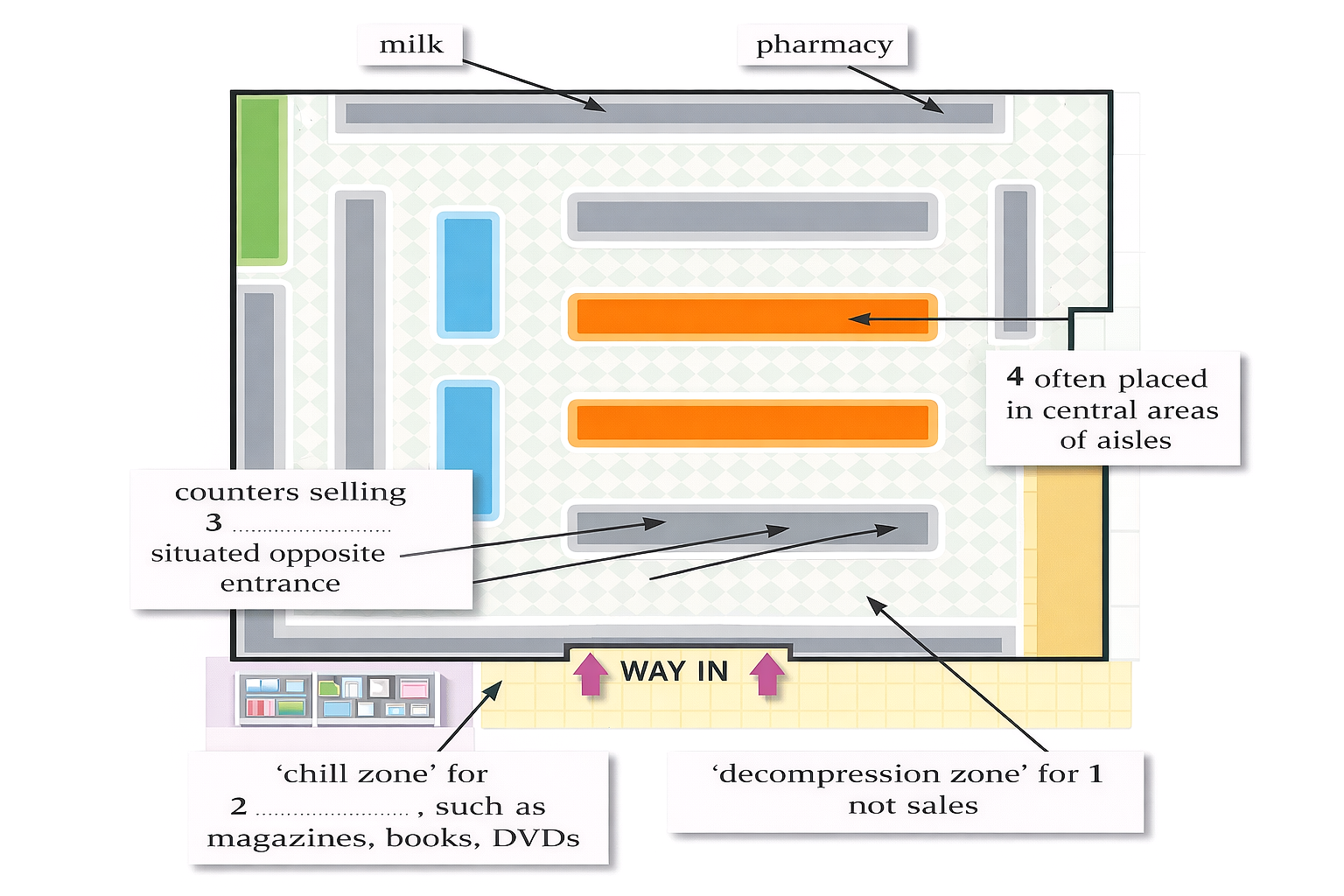
- 1
Layout of Typical Supermarket: 1
- 2
Layout of Typical Supermarket: 2
- 3
Layout of Typical Supermarket: 3
- 4
Layout of Typical Supermarket: 4
- 5
Do the following statements agree with the information given in the reading passage? 5. The ‘greeters’ at Walmart increase sales.
- TRUE. TRUE
- FALSE. FALSE
- NOT GIVEN. NOT GIVEN
- 6
6. People feel better about their shopping if they buy fruit and vegetables before they buy other food.
- TRUE. TRUE
- FALSE. FALSE
- NOT GIVEN. NOT GIVEN
- 7
7. In-store bakeries produce a wider range of products than central bakeries.
- TRUE. TRUE
- FALSE. FALSE
- NOT GIVEN. NOT GIVEN
- 8
8. Supermarkets find right-handed people easier to persuade than left-handed people.
- TRUE. TRUE
- FALSE. FALSE
- NOT GIVEN. NOT GIVEN
- 9
9. The most frequent reason for leaving shops without buying something is price.
- TRUE. TRUE
- FALSE. FALSE
- NOT GIVEN. NOT GIVEN
- 10
10. ‘Decoy’ items are products which the store expects customers to choose.
- TRUE. TRUE
- FALSE. FALSE
- NOT GIVEN. NOT GIVEN
- 11
In-store bread production process: The supermarket is sent 11 __________ and other items which have been prepared earlier.
- 12
In-store bread production process: Baking bread in-store produces an aroma. Shoppers’ 12 __________ are stimulated.
- 13
In-store bread production process: They are then keener to buy food, including bread and 13 __________.
Reading Passage 2: The Fascinating World of Attine Ants
A Leaf-cutting ants and their fungus ‘farm’ are a marvel of nature and perhaps the best-known example of symbiosis — the mutual dependence of two species. Ants cultivate a mushroom-like fungus in ‘farms’. Both the ants and their so-called ‘agriculture’ have been extensively studied over the years, but recent research has uncovered intriguing new findings.
Ants invented agriculture 50 million years before people did, and the leaf-cutters, members of the large attine ant family, practise the most sophisticated example of it. They grow their fungus in underground chambers that can reach the size of a football. A single leaf-cutter nest may contain a thousand such chambers, embedded in an underground metropolis up to 18 feet deep, and support a society of more than a million ants.
B These ant communities are the dominant plant-eaters of the Neotropics, the region comprising South and Central America, Mexico and the Caribbean. Biologists believe 15 percent of the leaf production of tropical forests disappears down the nests of leaf-cutter ants. In the nest, the leaves are shredded and added to the fungus, which digests the leaves and is in turn eaten by the ants. The attine ants’ achievement is remarkable because it allows them to consume, courtesy of their mushroom’s digestive powers, the harvest of tropical forests whose leaves are laden with poisonous chemicals.
C There are more than 200 known species of the attine ant tribe, divided into 12 groups, or genera. The leaf-cutters use fresh vegetation; the other groups, known as the lower attines because their nests are smaller and their techniques more primitive, feed their gardens with similar leaves that have fallen on the ground and insects that lie on the forest floor. Lower attine ants are all a similar size. However, leaf-cutter worker ants come in made-to-fit sizes — large ants to saw off leaves, medium ones to shred them, and miniature workers to seed them with fungus and clean off alien growths.
D In 1994, biologists from the United States Department of Agriculture analysed the DNA of ant fungi. They found that the leaf-cutters’ fungus was descended from a single pure strain, propagated for at least 23 million years. However, the fungi grown by lower attine ants fell into four different groups, as if the ants had domesticated wild fungi at least four times in evolutionary history. What could be driving these two patterns of fungus gardening — the pure clone cultivation of the leaf-cutters and the multiple varieties of the lower attines?
E The answer has been suggested by Cameron Currie of the University of Toronto. The pure strain of fungus grown by the leaf-cutters, it seemed to him, resembled the single crops grown by humans to the exclusion of all others, such as potato growing. These ‘monocultures’, which lack the genetic diversity to respond to changing environmental threats, are particularly vulnerable to parasites — organisms that live and feed on their host, often causing harm. Currie felt there had to be a parasite in the ant-fungus system. But a century of ant research had provided no evidence for his idea. Textbooks describe how leaf-cutter ants scrupulously weed their gardens of all foreign organisms. “People kept telling me the ants keep their gardens free of parasites,” said Currie. Nevertheless, after three years of sifting through attine ant gardens, Currie discovered several alien organisms, particularly a family of parasitic moulds called ‘Escovopsis’.
F Escovopsis is a deadly disease that can devastate a fungus garden in a couple of days. It blooms like a white cloud which envelops the whole garden. Other ants won’t go near it, and the ants associated with the garden just starve to death. Evidently, the ants usually manage to keep Escovopsis and other parasites under control. Nevertheless, with any lapse in control Escovopsis will quickly burst forth. Although new leaf-cutter gardens start off free of Escovopsis, within two years some 60 percent become infected.
G The discovery of Escovopsis’s role brings a new level of understanding to the evolution of the attine ants. In the last decade, evolutionary biologists have been increasingly aware of the role of parasites as driving forces in evolution. With Currie’s work, there is now a possible reason for the different varieties of fungus in the lower attine mushroom gardens — to stay one step ahead of the relentless Escovopsis. Interestingly, the leaf-cutters had, in general, fewer alien moulds in their gardens than the lower attines, yet more Escovopsis infections. Clearly, the price they pay for cultivating a pure variety of fungus is a higher risk from Escovopsis.
H So how do attine ants keep this parasite under control? People have known for a hundred years that ants have a whitish growth on their body surface. It was thought to be wax but, after examining it under a microscope, Currie discovered a specialised patch on the ants’ bodies that harbours a particular kind of bacterium, one well known to the pharmaceutical industry and the source of half the antibiotics used in medicine. This bacterium is a potent poisoner of Escovopsis, inhibiting its growth and suppressing spore formation.
Astoundingly, the leaf-cutter ants are accomplishing feats beyond the power of humans: they are growing a monocultural crop year after year without disaster, and they are using an antibiotic apparently so wisely that, unlike people, they are not provoking antibiotic resistance in the target disease-producing organism.
- 14
two things at which leaf-cutter ants have succeeded but humans have failed.
- 15
a comparison between the nests of leaf-cutter ants and lower attine ants.
- 16
an assessment of the impact leaf-cutter ants have on their environment.
- 17
the effect Escovopsis has on ant communities.
- 18
the advantage for lower attine ants of growing a range of fungi.
- 19
the discovery of the age of the attine-ant fungi.
- 20
the use of dead vegetation to cultivate their fungus
- A. Leaf-cutting ants
- B. Lower attines
- C. Both leaf-cutting ants and lower attine ants
- 21
very small ants that keep the fungus free of foreign organisms
- A. Leaf-cutting ants
- B. Lower attines
- C. Both leaf-cutting ants and lower attine ants
- 22
the ability to safely eat harmful plants
- A. Leaf-cutting ants
- B. Lower attines
- C. Both leaf-cutting ants and lower attine ants
- 23
the cultivation of a single fungus
- A. Leaf-cutting ants
- B. Lower attines
- C. Both leaf-cutting ants and lower attine ants
- 24
a nest with a very large number of rooms for growing fungus
- A. Leaf-cutting ants
- B. Lower attines
- C. Both leaf-cutting ants and lower attine ants
- 25
What does the writer say about Cameron Currie’s research?
- A. No previous work had been done in this area.
- B. Earlier studies did not support his theory.
- C. Textbooks on this subject lacked specific detail.
- D. Currie’s initial theory had proven to be incorrect.
- 26
Using a microscope, Currie was the first to discover that the body of attine ants
- A. has a white covering.
- B. is covered in wax.
- C. is poisonous to humans.
- D. has a substance useful to humans.
Reading Passage 3: Risk Taking
A
We run risks. Most of the time we ignore them; sometimes we stop and decide how to deal with them. That’s life. Risks arise in sports, in business, in personal relationships; they are present in the laboratory, in political calculations, everywhere. Acting individually, we often prefer to gain some benefit by accepting some danger. Acting collectively, we make similar trade-offs.
B
When society must assess risks, and those risks can be clarified, at least in part, by science, technology or mathematics, the responsibility of the research community is to be clear and complete. But that is not always so easy. Furthermore, too few people pay full attention to the best evidence, much less modify their behaviors as a result. Even when the evidence of high risk is clear – about smoking, for instance – many will deny the risk, or dispute it, or accept that it exists and still go ahead. As a former cigarette smoker, I understand denial.
C
Perhaps more important than the basic facts of risk are the varied perception of it. Hearing the prediction of 60% chance of rain, or recognizing the minuscule likelihood of becoming ill from a flu shot, most people understand the right responses: take your umbrella and get your flu shot. But some, fearfully but irrationally, go to the extreme and stay at home and avoid all contact with other people. Irrational decisions occasionally affect us all. When it comes to risks the best odds do not always influence people to make the correct decision.
D
In her book, The Universe and the Teacup, the science writer K. C. Cole reminds us that the risks of losing something and gaining something appear to be calculated in our minds according to quite different scales. People will risk a lot to prevent a loss, she notes; some people will rush into a burning building to save a pet. But they will usually risk very little if the only perceived outcome is a possible gain; many people won’t even risk pursuing an exciting job, if the current job, though unfulfilling, remains comfortable. That psychological mechanism, a desire to maintain the status quo, helps explain the high hurdles that any rational risk assessment must confront.
E
Organizations face the same hurdles whenever they must cope with major shifts in policy. In his classic examination of the character of high-tech industry, Only the Paranoid Survive, Andrew S. Grove gives a perceptive account of a crisis that took place during his tenure as Chairman of the Intel Corporation. The business environment for Intel and its competitors was transformed by a flood of low-cost memory chips from Japan, and Intel made the difficult decision to abandon its chip-making business. Such a period of change in the outside world is filled with danger, Grove notes, precisely because it is so easy for executives to try to disregard it or misinterpret the mounting evidence showing the profound risks of not making change at the very core. The distinction Cole cites is instructive here: one reason management and staff may not act is that they tend to focus on the potential gains of risking change (which they characterize as small), rather than on the catastrophic losses that risking change could prevent. The period becomes critical for a company, according to Grove, and deadly when unattended to.
F
Likewise, at the national level, and even the global one, institutions tend to be more willing to take a risk if it means avoiding a loss, than they are if it might confer a gain. Almost everyone, for instance, sees the signs of ecological decay. Reid J. Lifset’s article, ‘Full Accounting’, describes newly developed techniques for clarifying which critical decision would have the highest pay-offs for the environment. Once these ‘leverage points’ as he calls them, are located, many environmental organizations will be willing to risk the resources needed to prevent further deterioration.
G
More complicated are decisions by nations to invest broadly in educational research. Some governmental leaders are oblivious to the risks posed by social under-investment, because the urgent needs of the present take precedence over actions that would give rise to even more substantial gains in the future. Their attitude is that today’s risks must be manageable, and that tomorrow’s gains are at the very least difficult to measure. Better consideration and decision making for what lies ahead is essential.
H
Nevertheless, I confess to being an optimist. My glass is generally half full – though that may not help me handle risk. Whether one’s temperament is optimistic or pessimistic, everyone in our scientific and engineering community has a social responsibility: measure with care and portray with honesty the level of risk involved in any action or decision.
- 27
K. C. Cole points out that avoiding a loss seems more important to people than
- A. planning for the future.
- B. predicting their errors.
- C. continuing in the present situation.
- D. recent findings on the most effective solutions to problems.
- E. achieving a gain.
- F. changes occurring externally.
- G. a high level of agreement.
- 28
According to Andrew S. Grove, it can be very dangerous for companies to ignore
- A. planning for the future.
- B. predicting their errors.
- C. continuing in the present situation.
- D. recent findings on the most effective solutions to problems.
- E. achieving a gain.
- F. changes occurring externally.
- G. a high level of agreement.
- 29
Reid J. Lifset argues that environmental agencies can benefit from
- A. planning for the future.
- B. predicting their errors.
- C. continuing in the present situation.
- D. recent findings on the most effective solutions to problems.
- E. achieving a gain.
- F. changes occurring externally.
- G. a high level of agreement.
- 30
The writer suggests that government leaders need to focus more on
- A. planning for the future.
- B. predicting their errors.
- C. continuing in the present situation.
- D. recent findings on the most effective solutions to problems.
- E. achieving a gain.
- F. changes occurring externally.
- G. a high level of agreement.
- 31
the areas of study that help us understand risk
- 32
reference to key actions that might benefit the world
- 33
examples of statistical predictions that the majority of the public react to in the same way
- 34
the variety of contexts in which risk occurs
- 35
mention of a habit that has been proved to be very risky
- 36
reference to market forces motivating change
- 37
the writer’s current attitude towards risk
- 38
a reason why some individuals avoid making a career change
- 39
how some people over-react to information about risk
- 40
At the end of the passage the writer concludes that
- A. risk is something we must try to avoid.
- B. experts should be truthful about risk to the public.
- C. optimists are better able to deal with risk than pessimists.
- D. it is important to take risks in order to fulfil social obligations.
Mostrar clave de respuestas