Sobre este conjunto: compilado y ligeramente editado a partir de material real de exámenes recordados por candidatos. IELTS utiliza un banco global de preguntas, así que este material circula en todo el mundo. Para darte una prueba completa y realizable, se agrupa material reportado en el mismo periodo — así que un conjunto puede combinar contenido de varias fechas de examen, no de una sola sesión. Cualquier audio es una recreación para practicar. Organizado para tu comodidad de estudio. Basado en recuerdos de candidatos — no es material oficial de IELTS.
Reading Passage 1: Jethro Tull (1674-1741) - Inventor of the Seed Drill
Jethro Tull was a major pioneer in the modernizing of agriculture. He was born in 1674 in Berkshire, southern England, into a family of land-owning gentry. He studied first at Oxford University and then at the Inns of Court, London, in preparation for a legal or political career. However, his health issues forced him to postpone these plans, and after qualifying as a barrister in 1699, he made a tour of Europe, in the hope that the milder climates of France and Italy would alleviate his breathing problems. In every country through which he passed, he made careful observations of the soil and agricultural production, and on his return to England, the young Tull married, then began farming with his father at Howberry Farm in Oxfordshire.
Tull was determined to improve farming methods and increase crop yield on the family land, and pursued a number of agricultural experiments there. He particularly wanted to increase efficiency in the sowing of seeds. At that time, seeds were still thrown by hand across the field in a haphazard manner, in a traditional method known as broadcasting. Tull soon realized this method of random distribution was inefficient, being wasteful of both seed and labor, so he instructed his staff to sow seeds at very precise, low densities. But by 1701, his frustration with their lack of co-operation prompted him to invent a machine to do the work for him.
Earlier in his life, Tull had once dismantled a pipe-organ, and the application of the technology behind this musical instrument inspired him to devise a drill that would distribute precise amounts of seed into pre-cut channels. Basic seeding devices had been known for almost 2000 years, but Tull took the concept a stage further. In his device, as the main wheels of the drill turned, the cylinder rotated against a spring-held tongue. This allowed seed to pass evenly from the hopper above to a funnel below. From here, the seed was directed at regular intervals into three channels, or furrows, in the earth. These were dug to a specific depth by the blades at the front of the machine. Spikes at the back of the machine then turned the soil over to immediately cover the seeds. Tull's 'seed drill' would limit the wastage of seed, and as the seedlings grew in uniform rows, it would also make it easier to remove any unwanted weeds growing among the crop. Accordingly, each plant would have more space to grow, and although there would be fewer plants, the net yield would be greater.
Initially the machine was only a limited success, and in 1711 Tull decided to travel around Europe again, both to improve his health and to study agricultural techniques there. Upon his return in 1714, he perfected both his system and machinery. Following practices he had observed in the vine-growing methods of southern Europe, he used an animal-drawn hoe to turn over and pulverize the earth between the rows. He wrongly believed that this practice would release enough nutrients in the soil to nourish the crop, and so eliminate the need for manure to be used to fertilize the soil. His experiments were apparently successful, as he did manage to grow wheat in the same field for 13 successive years without the use of manure. However, it is more likely that it was the turning over and pulverization of the soil that cut down on the volume of weeds competing with the seed.
Tull's complete system eventually proved to be a major influence in the agricultural revolution, and its impact can still be seen in today's methods. Most subsequent drilling and hoeing implements have been either copies of, or improvements upon his inventions, and his modifications to the basic model of the plough continue to be visible in modern versions. Tull also advocated the use of horses over the oxen more traditionally used to pull farm machinery, and published a book in 1731 outlining this and other ideas to enhance agricultural efficiency. The book caused great controversy when it appeared, and resistance to his revolutionary theories persisted for many decades. Another century would pass before his eventual vindication. It was only following the editing of his writings in 1822, and the subsequent translations and acceptance in France, that Tull's ideas finally achieved recognition in his native land. Although in his lifetime Tull's methods and inventions were dismissed and ridiculed, they were gradually adopted by large landowners, and in time, came to form the basis of modern agriculture.
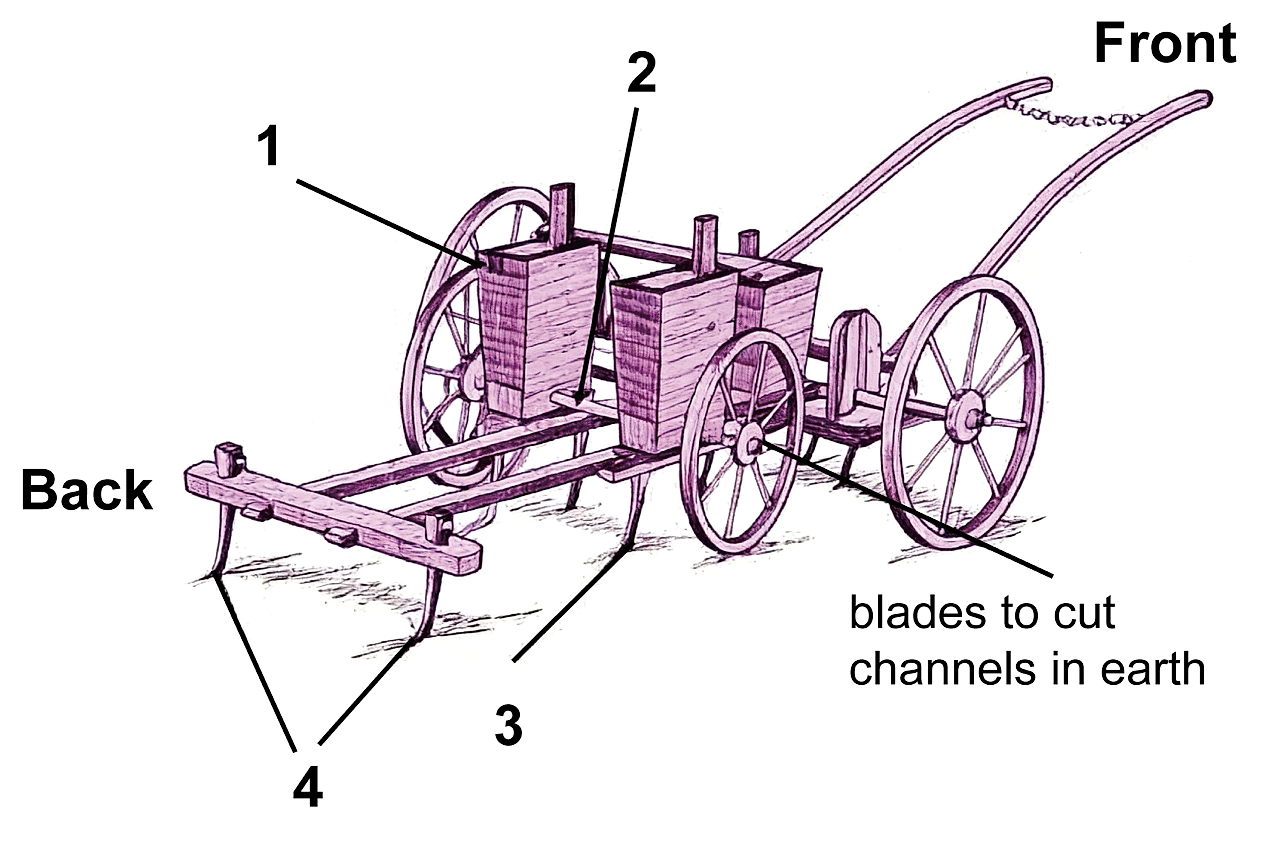
- 1
1. ________ containing seeds
- 2
2. ________ which turns as wheels move
- 3
3. ________ through which seed passes into channels
- 4
4. ________ to distribute earth over seeds
- 5
5. What name was given to the traditional technique of seed-sowing?
- 6
6. What type of agriculture gave Tull inspiration on his second tour of Europe?
- 7
7. What traditional addition to soil did Tull believe to be unnecessary?
- 8
8. What animals did Tull recommend farmers should use to pull their machinery?
- 9
9. Tull was employed in the legal profession before taking up farming.
- TRUE. TRUE
- FALSE. FALSE
- NOT GIVEN. NOT GIVEN
- 10
10. The staff on Tull's farm were unwilling to follow his instructions.
- TRUE. TRUE
- FALSE. FALSE
- NOT GIVEN. NOT GIVEN
- 11
11. Tull reduced the amount of weeds in his Wheatfield.
- TRUE. TRUE
- FALSE. FALSE
- NOT GIVEN. NOT GIVEN
- 12
12. Tull lived to see his ideas finally accepted.
- TRUE. TRUE
- FALSE. FALSE
- NOT GIVEN. NOT GIVEN
- 13
13. Tull's original book, published in 1731, sold very few copies.
- TRUE. TRUE
- FALSE. FALSE
- NOT GIVEN. NOT GIVEN
Reading Passage 2: The Constant Evolution of the Humble Tomato
Heirloom tomatoes—varieties that have been passed down through several generations of a family because they are thought to have a particularly good flavor—are really no more 'natural' than the varieties available in grocery stores. New studies promise to restore their lost, healthy genes.
A
Famous for their taste, color, and organic appearance, heirloom tomatoes are favorites of gardeners and advocates of locally grown foods. The tomato enthusiast might conclude that, given the immense varieties, heirlooms must have a more diverse and superior set of genes than the tomatoes available in grocery stores, those ordinary hybrid varieties such as cherry and plum. However, their seeming diversity is only skin-deep: heirlooms are actually feeble and inbred—the defective product of breeding experiments that began hundreds of years ago, and exploded thanks to enthusiastic backyard gardeners. "The irony of all this," says Steven Tanksley, a geneticist at Cornell University, "is all that diversity of heirlooms can be accounted for by a handful of genes. There're probably no more than 10 mutant genes that create the diversity of heirlooms you see." But rather than simply proving that the myth about the heirloom's diversity is wrong, Tanksley's deconstruction of the tomato genome, along with work by others, is showing how a small berry-like fruit from the Andes became one of the world's top crops.
B
The cultivated tomato is a member of the nightshade family that includes New World crops such as the potato, which spread around the globe after Christopher Columbus brought them back to Spain in the 15th century. But whereas scientists have uncovered a wealth of archaeological evidence on early farming practices in the New World, the record is blank when it comes to the tomato. The modern tomato seems to have its origins in the Andes in South America and may have been domesticated in Vera Cruz, Mexico. Primitive varieties still grow throughout the Americas. All told, botanists call as many as 13 species 'tomatoes' and consider an additional four to be closely related.
C
One might assume that one of these known wild species became today's cultivated crop, but that's not the case: the Mother Tomato has never been found. The closest relative is the currant tomato, which, based on genetic comparisons, split from today's tomato some 1.4 million years ago. So researchers like Tanksley have to work backward, crossing tomato varieties and species in order to understand how various genes influence shape and size. Once isolated, Tanksley later inserts those genes into other tomato varieties to make his case with a dramatic transformation.
D
Tanksley concludes from his analyses that in their effort to make bigger, tastier, and faster-growing fruit, our ancestors ultimately exploited just 30 mutations out of the tomato's 35,000 genes. Most of these genes have only small effects on tomato size and shape, but recently Tanksley and his colleagues reported that they found a gene that increases fruit size by 50 percent. It was probably the most important event in domestication. The first written record of tomatoes—from Spain in the 1500s—confirms that this mutation, which enlarges tomatoes by producing compartments known as locules, existed back in the same yellow tomatoes that gave Italians the word pomodoro, or golden apple. Besides size, tomato farmers also selected for shape. To discover those genes, Esther van der Knaap, a Tanksley alumnus now at The Ohio State University, took a gene from one heirloom tomato and inserted it into a wild relative. She observed that, as a result, the tiny fruits became shaped like pears.
E
The selection of these traits has, however, affected the heirloom's hardiness. They often suffer from infections that cause the fruit to crack, split, and otherwise rot quickly. Wild plants must continuously evolve to fend off such infections, points out Roger Chetelat of the Tomato Genetics Resource Center at the University of California. But in their quest for size, shape, and flavor, humans have inadvertently eliminated defensive genes. As a result, most possess only a single disease-resistant gene. Chetelat elaborates that heirlooms' taste may have less to do with their genes than with the productivity of the plant and the growing environment. Any plant that produces only two fruits, as heirlooms sometimes do, is highly likely to produce juicier, sweeter, and more flavorful fruit than varieties that produce 100, as commercial types do. In addition, heirlooms are sold ripened on the vine, a certain way to get tastier results than allowing them to mature on the shelf. This means breeders feel confident that getting germ-beating genes back into heirlooms won't harm the desirable aspects of the fruit. Modern breeding has resuscitated grocery store tomatoes with an influx of wild genes; in the past 50 years, as many as 40 disease-resistant genes have been bred back into commercial crops.
F
In 1996, a tomato breeder and former Tanksley student named Doug Heath began a favorite project. After 12 years of traditional breeding with the help of molecular markers, he created a new multi-colored tomato less prone to cracking and also endowed with 12 disease-resistant genes. The original heirloom plant, Heath explains, had defective flowers, which is one reason why it produced only two fruits compared with the 30 he gets from his new variety. He claims he is also able to maintain a comparable flavor and sugar profile even on productive plants. The heirloom's defects are, after all, just an accident of a narrow breeding strategy left over from the very beginning of genetic modification.
- 14
14 An explanation of research aimed at restoring the health of the heirloom tomato.
- 15
15 A reference to a false belief about the heirloom tomato.
- 16
16 A description of the flavor of the heirloom tomato.
- 17
17 A reference to a single gene that significantly improves the cultivation of tomatoes.
- 18
18 The transplanting of certain genes into tomatoes can change their shape.
- A. Steven Tanksley
- B. Esther van der Knaap
- C. Roger Chetelat
- D. Doug Heath
- 19
19 The flavor of the heirloom tomato is largely dependent on actual yield and cultivation.
- A. Steven Tanksley
- B. Esther van der Knaap
- C. Roger Chetelat
- D. Doug Heath
- 20
20 A new type of tomato can be produced that is stronger than the original heirloom tomato yet equally sweet and flavorsome.
- A. Steven Tanksley
- B. Esther van der Knaap
- C. Roger Chetelat
- D. Doug Heath
- 21
21 The wide variety of heirloom tomatoes is due to only a small number of genes.
- A. Steven Tanksley
- B. Esther van der Knaap
- C. Roger Chetelat
- D. Doug Heath
- 22
22 There is little information on the ______ of the tomato despite the existence of data on the growing of other New World crops.
- 23
23 Although it is uncertain, the tomato is thought to have first grown in the ______.
- 24
24 In regard to genetic similarities, the type of tomato ______ is the nearest to the earliest.
- 25
25 A genetic ______ which is evident in pomodoro produced larger tomatoes.
- 26
26 ______ are a problem for heirloom tomatoes because they frequently lead to damage and deterioration.
Reading Passage 3: The Future of the World’s Language
Of the world’s 6,500 living languages, around half are expected to be out by the end of this century, according to UNESCO. Just 11 are spoken by more than half of the earth’s population, so it is little wonder that those used by only a few are being left behind as we become a more homogenous, global society. In short, 95 percent of the world’s languages are spoken by only five percent of its population—a remarkable level of linguistic diversity stored in tiny pockets of speakers around the world. Mark Turin, a university professor, has launched WOLP (World Oral Language Project) to prevent the language from the brink of extinction.
He is trying to encourage indigenous communities to collaborate with anthropologists around the world to record what he calls “oral literature” through video cameras, voice recorders and other multimedia tools by awarding grants from a £30,000 pot that the project has secured this year. The idea is to collate this literature in a digital archive that can be accessed on demand and will make the nuts and bolts of lost cultures readily available.
For many of these communities, the oral tradition is at the heart of their culture. The stories they tell are creative as well as communicative. Unlike the languages with celebrated written traditions, such as Sanskrit, Hebrew and Ancient Greek, few indigenous communities have recorded their own languages or ever had them recorded until now.
The project suggested itself when Turin was teaching in Nepal. He wanted to study for a PhD in endangered languages and, while discussing it with his professor at Leiden University in the Netherlands, was drawn to a map on his tutor’s wall. The map was full of pins of a variety of colours which represented all the world’s languages that were completely undocumented.
At random, Turin chose a “pin” to document. It happened to belong to the Thangmi tribe, an indigenous community in the hills east of Kathmandu, the capital of Nepal. “Many of the choices anthropologists and linguists who work on these traditional field-work projects are quite random,” he admits.
Continuing his work with the Thangmi community in the 1990s, Turin began to record the language he was hearing, realising that not only was this language and its culture entirely undocumented, it was known to few outside the tiny community. He set about trying to record their language and myth of origins. “I wrote 1,000 pages of grammar in English that nobody could use - but I realised that wasn’t enough. It wasn’t enough for me, it wasn’t enough for them. It simply wasn’t going to work as something for the community. So then I produced this trilingual word list in Thangmi, Nepali and English.”
In short, it was the first ever publication of that language. That small dictionary is still sold in local schools for a modest 20 rupees, and used as part of a wider cultural regeneration process to educate children about their heritage and language. The task is no small undertaking: Nepal itself is a country of massive ethnic and linguistic diversity, home to 100 languages from four different language families. What’s more, even fewer ethnic Thangmi speak the Thangmi language. Many of the community members have taken to speaking Nepali, the national language taught in schools and spread through the media, and community elders are dying without passing on their knowledge.
Despite Turin’s enthusiasm for his subject, he is baffled by many linguists’ refusal to engage in the issue he is working on. “Of the 6,500 languages spoken on Earth, many do not have written traditions and many of these spoken forms are endangered,” he says. “There are more linguists in universities around the world than there are spoken languages - but most of them aren’t working on this issue. To me it’s amazing that in this day and age, we still have an entirely incomplete image of the world’s linguistic diversity. People do PhDs on the apostrophe in French, yet we still don’t know how many languages are spoken.”
“When a language becomes endangered, so too does a cultural world view. We want to engage with indigenous people to document their myths and folklore, which can be harder to find funding for if you are based outside Western universities.”
Yet, despite the struggles facing initiatives such as the World Oral Literature Project, there are historical examples that point to the possibility that language restoration is no mere academic pipe dream. The revival of a modern form of Hebrew in the 19th century is often cited as one of the best proofs that languages long dead, belonging to small communities, can be resurrected and embraced by a large number of people. By the 20th century, Hebrew was well on its way to becoming the main language of the Jewish population of both Ottoman and British Palestine. It is now spoken by more than seven million people in Israel.
Yet, despite the difficulties these communities face in saving their languages, Dr Turin believes that the fate of the world’s endangered languages is not sealed, and globalisation is not necessarily the nefarious perpetrator of evil it is often presented to be. “I call it the globalisation paradox: on the one hand globalisation and rapid socio-economic change are the things that are eroding and challenging diversity. But on the other, globalisation is providing us with new and very exciting tools and facilities to get to places to document those things that globalisation is eroding. Also, the communities at the coal-face of change are excited by what globalisation has to offer.”
In the meantime, the race is on to collect and protect as many of the languages as possible, so that the Rai Shaman in eastern Nepal and those in the generations that follow him can continue their traditions and have a sense of identity. And it certainly is a race: Turin knows his project’s limits and believes it inevitable that a large number of those languages will disappear. “We have to be wholly realistic. A project like ours is in no position, and was not designed, to keep languages alive. The only people who can help languages survive are the people in those communities themselves. They need to be reminded that it’s good to speak their own language and I think we can help them do that—becoming modern doesn’t mean you have to lose your language.”
- 27
Of the world’s 6,500 living languages, about half of them are expected to be extinct. Most of the world’s languages are spoken by a 27…………….. of people. However, Professor Turin set up a project WOLP to prevent 28…………….. of the languages. The project provides the community with 29…………….. to enable people to record their endangered languages. The oral tradition has a great cultural 30……………… An important 31…………….. between languages spoken by few people and languages with celebrated written documents existed in many communities.
- A. similarity
- B. significance
- C. funding
- D. minority
- E. education
- F. difference
- G. education
- H. diversity
- I. majority
- J. disappearance
- 28
32 Turin argued that anthropologists and linguists usually think carefully before selecting an area to research.
- 29
33 Turin concluded that the Thangmi language had few similarities with other languages.
- 30
34 Turin has written that 1000-page document was inappropriate for the Thangmi community.
- 31
35 Some Nepalese schools lack resources to devote to language teaching.
- 32
36 Why does Turin say people do PhDs on the apostrophe in French?
- A. He believes that researchers have a limited role in the research of languages.
- B. He compares the methods of research into languages.
- C. He thinks research should result in a diverse cultural outlook.
- D. He holds that research into French should focus on more general aspects.
- 33
37 What is discussed in the ninth paragraph?
- A. Forces driving people to believe endangered languages can survive.
- B. The community where people distrust language revival.
- C. The methods of research that have improved language restoration.
- D. Initiatives the World Oral Literature Project is bringing to Israel.
- 34
38 How is the WOLP’s prospect?
- A. It would not raise enough funds to achieve its aims.
- B. It will help keep languages alive.
- C. It will be embraced by a large number of people.
- D. It has a chance to succeed to protect the engendered languages.
- 35
39 What is Turin’s main point of globalisation?
- A. Globalisation is the main reason for endangered languages.
- B. Globalisation has both advantages and disadvantages.
- C. We should have a more critical view of globalisation.
- D. We should foremost protect our identity in face of globalisation.
- 36
40 What does Turin suggest that community people should do?
- A. Learn other languages.
- B. Only have a sense of identity.
- C. Keep up with the modern society without losing their language.
- D. Join the race to protect as many languages as possible but be realistic.
Mostrar clave de respuestas