Las preguntas de mapas y planos no son pruebas de vocabulario — son pruebas de orientación. Los candidatos que las pierden lo hacen en los primeros diez segundos, antes de que el audio siquiera llegue a las respuestas, porque nunca establecen un punto de referencia. Esta lección te da la rutina de previsualización que fija tu posición, el lenguaje direccional que lleva cada respuesta y la disciplina de seguimiento que te mantiene en el mapa cuando el hablante se mueve rápido.
Lo que realmente es la tarea
Recibes un dibujo — un plano de planta, un mapa de sitio, un diagrama de una máquina o proceso — con algunas características etiquetadas y unos cinco espacios numerados en blanco. Un hablante te guía por el espacio ("as you come in through the main entrance...") y tu trabajo es seguir el recorrido, etiquetando a medida que avanzas.
Las palabras que contienen las respuestas no son la parte difícil. Son un conjunto muy pequeño — left, right, opposite, corner, past, behind. Lo que falla es la orientación: si no sabes dónde estás "tú" parado y hacia dónde estás "tú" mirando, cada left en el audio es una moneda al aire.
La previsualización: primero fija tu brújula
Aquí tienes un mapa real de etiquetado de plano de un examen recordado de mayo de 2026 en nuestra biblioteca — un centro recreativo con ocho zonas con letras para etiquetar:
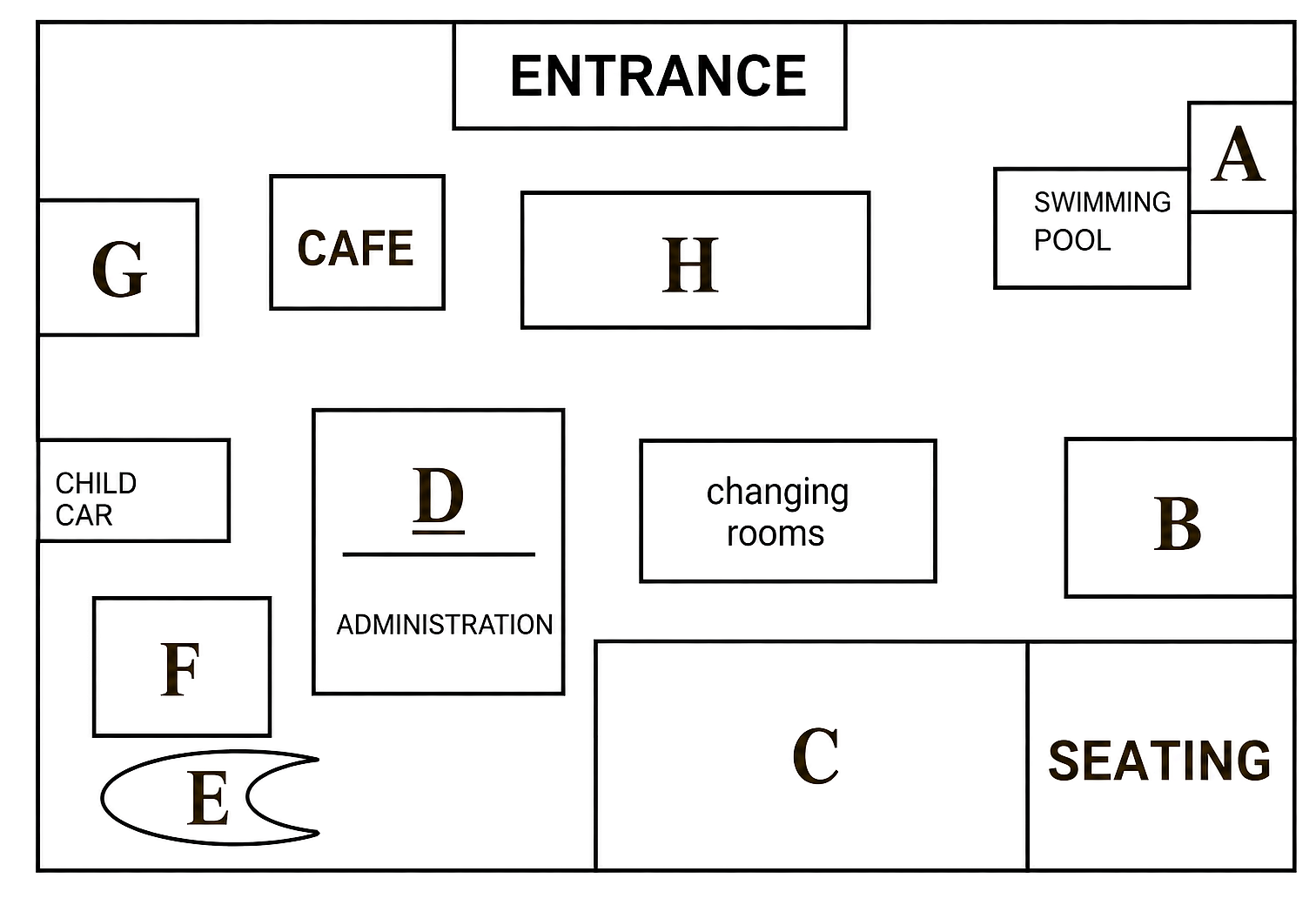
Observa lo que el mapa te da gratis antes de que empiece el audio: una ENTRANCE fija en la parte superior, puntos de referencia impresos (CAFE, SWIMMING POOL, changing rooms, SEATING), y ocho espacios en blanco A–H cuyas posiciones puedes describir espacialmente ahora mismo. Esa información gratuita es lo que aprovecha la previsualización. Antes que nada, dedica tus segundos de previsualización al propio mapa, en este orden:
1. Fija el marco de referencia. Existen dos tipos, y requieren anclajes diferentes:
- Compass maps — aparece una flecha de norte (o las palabras north/south). Escribe N, S, E, W en los cuatro bordes del mapa de inmediato, además de las diagonales si el mapa es terreno abierto (NE, NW, SE, SW). El audio para estos mapas habla en términos de brújula: "in the north-east corner", "along the southern edge".
- Viewer maps — no se da brújula. Entonces el marco es tu página: marca top / bottom / left / right en los bordes. El audio habla en direcciones corporales: "on your left", "straight ahead".
Este único hábito — escribir el marco en el mapa antes del audio — vale más que todo lo demás en esta lección junto.
2. Encuentra la entrada. Casi todos los recorridos comienzan donde lo haría un visitante: la entrada, la recepción, el aparcamiento. Enciérrala en un círculo. Ahí es donde "tú" comienzas y — fundamental — esa es la dirección hacia la que "tú" miras inicialmente.
3. Lee en voz baja las etiquetas impresas. Las características ya etiquetadas (café, storeroom, bridge) son tus puntos de referencia; el hablante las usa constantemente para ubicar los espacios en blanco ("directly opposite the café"). Adivina su pronunciación ahora, para que las reconozcas rápido — incluyendo los nombres propios del mapa: Woodside Road debe ser pre-escuchado, o te costará medio segundo cuando suene.
4. Observa las relaciones espaciales de los espacios en blanco. El espacio 17 está entre dos habitaciones etiquetadas; el 19 está en una esquina. Saber la forma de la posición de cada respuesta te dice qué palabras de dirección esperar.
El léxico direccional
El conjunto completo de trabajo — lo suficientemente pequeño para sobreaprender:
| Grupo | Palabras | Nota |
|---|---|---|
| Body frame | left, right, straight ahead, behind you, in front of | relativo a la orientación actual — que cambia en cada giro |
| Compass | north, south-east, the western end | absoluto — nunca cambia; prefiere estos cuando se dan |
| Relations | opposite, next to, beside, between, adjacent to | opposite = enfrente de, no al lado de |
| Motion | go past, go through, go along, cross, turn into | past significa que NO es la respuesta — sigue avanzando |
| Corners & ends | in the corner, at the end of, at the far side, halfway along | far = alejado de donde estás ahora |
| Order | the first/second door on your right | la cuenta comienza desde donde estás, después del giro |
La trampa en el grupo body-frame: cada turn left rota el significado del siguiente left. El audio espera que lleves la rotación mentalmente. Si la rotación mental te resulta difícil (lo es para la mayoría), usa el truco del bolígrafo: mantenlo apoyado sobre el mapa como una pequeña flecha que muestra hacia dónde miras, y gíralo físicamente en cada giro. El bolígrafo hace la geometría para que tu oído pueda seguir escuchando.
Durante el audio
- Mueve el bolígrafo siguiendo la ruta mientras el hablante avanza. El mismo principio que el seguimiento con bolígrafo de la lección 4, hecho literal: la punta de tu bolígrafo eres tú, en el mapa.
- Las respuestas llegan en orden numérico (17 antes que 18 antes que 19). Si el hablante ha ubicado claramente algo y no captaste a qué espacio correspondía, márcalo y sigue — la regla de pérdida uno-por-uno (lección 4) se aplica aquí con más fuerza, porque perder tu posición te hace perder todas las respuestas restantes, no solo una.
- Escribe la letra/palabra inmediatamente, en el propio mapa, y sigue moviendo el bolígrafo. Transfiere a las casillas de respuesta después.
- Cuando las respuestas se eligen de una lista (características A–H para ubicar), anticipa su pronunciación en la previsualización y táchalas a medida que se usan — normalmente cada letra se usa una vez.
Diagramas y dibujos de procesos
Las mismas habilidades se aplican con una sustitución: para un diagrama de máquina o proceso, el marco no es brújula sino flujo — encuentra el extremo de entrada y el de salida en la previsualización, y sigue el flujo como sigues una ruta. El léxico direccional cambia a above, below, attached to, feeds into, at the base of. Todo lo demás — puntos de referencia, seguimiento con bolígrafo, orden numérico — no cambia.
Una nota de biblioteca importante aquí: nuestros conjuntos de exámenes preservan las imágenes originales de diagramas y mapas de los exámenes reales de los que fueron reconstruidos, así que la disposición espacial con la que practicas es la auténtica, no una aproximación redibujada. Practicar la orientación solo funciona cuando la geometría es real.
Tu práctica (25 minutos)
- Abre el examen del centro recreativo cuyo mapa previsualizaste arriba y ve a su tarea de plano. Ya has hecho la previsualización con esta lección — ahora reproduce el audio y etiqueta A–H con tu bolígrafo siguiendo la ruta. Luego haz una prueba en frío con Listening 2026-05 Test 8: marco escrito en los bordes, entrada rodeada, etiquetas pre-pronunciadas, posiciones de los espacios en blanco anotadas.
- Reproduce una vez, bolígrafo siguiendo la ruta, respuestas escritas en el mapa a medida que aparecen.
- Corrige. Por cada error, repite el recorrido con la transcripción y encuentra la frase exacta donde tu bolígrafo se desvió — casi siempre es un giro perdido, no cinco respuestas fallidas.
- Esta semana, repite la misma rutina en las tareas de mapas de Listening 2026-03 Test 4 y Listening 2025-11 Test 2. Con imágenes originales preservadas y transcripciones palabra por palabra, cada giro equivocado puede reconstruirse paso a paso.
- Estándar de graduación: dos tareas de mapas consecutivas al 100%, sin perder nunca el bolígrafo. La orientación, una vez automática, convierte los mapas en los puntos más fiables de Section 2.