عن هذه المجموعة: مجمعة ومنقحة قليلاً من مواد اختبار حقيقية استرجعها المتقدمون للاختبار. IELTS يستخدم بنك أسئلة عالمي، لذا هذه المواد متداولة حول العالم. لتقديم اختبار كامل يمكنك حله، تم تجميع مواد من نفس الفترة تقريباً — لذلك قد تجمع المجموعة محتوى من عدة تواريخ وليس جلسة واحدة فقط. أي صوت هو إعادة إنشاء للتدريب. منظم لسهولة الدراسة. مبني على ذكريات المتقدمين — ليس مادة IELTS رسمية.
Reading Passage 1: Sydney Opera House
Sydney Opera House is an example of late modern architecture; it is admired internationally and treasured by the people of Australia.
In 1966 the Premier of New South Wales, Australia, announced an international competition for the design of an opera house for Sydney. It attracted more than 200 entries from around the world and was won by Jørn Utzon, a relatively little-known architect from Denmark. The story goes that during the judging of the competition, one judge, American architect Eero Saarinen, arrived in Sydney after the other three judges had started assessing the entries. He looked through their rejected entries and stopped at the Utzon design, declaring it to be outstanding.
It was Utzon's life and travels that had shaped his design for the Sydney Opera House. Though he had never visited the site, he used his maritime background to study naval charts of Sydney Harbour. His early exposure to shipbuilding provided the inspiration for the design of the roof, which is a series of curved 'shells' that look like the sails of a sailing ship billowing in the wind. From his travels to Mexico, he had the idea of placing his building on a wide horizontal platform.
Construction of the platform began in 1959, and throughout the early 1960s Utzon amended his original designs in order to develop a way to build the large 'shells' that cover the two main halls. The construction of the roof brought together some of the world's best engineers and craftsmen, devising innovative techniques to create a major visual impact in accordance with Utzon's vision. The design was one of the first examples of the use of computer-aided design for complex shapes.
Although Utzon had spectacular plans for the interior, he was unable to realise them. Cost overruns contributed to criticism of the project and, after a change of government, the Minister of Works began questioning Utzon's schedules and cost estimates. Payments to Utzon were stopped and he was forced to withdraw as chief architect in 1966. Following his resignation, there were protests through the streets led by prominent architect Harry Seidler and others, demanding that Utzon be reinstated as architect. However, Utzon was not reinstated and left Australia in 1966. He never returned, and new architects were appointed to complete the building in his absence. The original cost estimate for the Opera House was $7 million, with the completion date set for 26 January 1963. However, the Opera House was not formally completed until 1973, having cost $102 million.
Since its opening in 1973, Sydney Opera House has earned a reputation as a world-class performing arts centre and become a symbol of both Sydney and Australia. Situated at Bennelong Point on Sydney Harbour, it consists of a series of large precast 'shells' made of concrete, each composed of sections of a sphere of 75.2 metres radius, forming the roofs of the structure, set on a monumental platform. The building is 183 metres long and 120 metres wide at its widest point. It is supported on 588 concrete piers, which are sunk approximately 25 metres below sea level.
Although the roof structures are commonly referred to as 'shells', they are precast concrete panels supported by concrete ribs. The 'shells' are covered with 1,056,006 white and cream-coloured tiles manufactured in a factory in Sweden that generally produced stoneware tiles for the paper-mill industry. The design solution and construction of the shell structure took eight years to complete, and the development of the special ceramic tiles took over three years. Apart from the tiles covering the 'shells', the building's exterior is mostly clad with granite quarried in Australia.
Contrary to its name, Sydney Opera House includes multiple performance venues. It is among the busiest performing-arts centres in the world, holding over 1,500 performances each year. It hosts a large number of performing-arts companies, including the four resident companies: Opera Australia, the Australian Ballet, the Sydney Theatre Company and the Sydney Symphony Orchestra.
With its grand setting and cathedral-like atmosphere, the Concert Hall is Sydney Opera House's most prestigious performance space. The largest of all interior venues, it delivers outstanding acoustics thanks to its high ceiling and wood panelling. There is a sizeable outdoor forecourt from which people ascend to the main entrance. The steps, which lead up from the forecourt to the main performance venues, are nearly 100 metres wide.
In 1999 Utzon was re-engaged to develop a set of design principles to act as a guide for future changes to the building. All of this design work he did from his base in Europe. These principles help to ensure that the building's architectural integrity is maintained. The first alteration to the exterior was the addition of a new colonnade, which shades nine large glass openings in the previously solid exterior wall. This Utzon-led project, completed in 2006, enabled theatre patrons to see the harbour for the first time from the theatre foyers. The design also incorporates the first public lift and interior escalators to assist less-mobile patrons.
Since 2007, the cultural, heritage and architectural importance of Sydney Opera House has been protected by its inclusion on the World Heritage List.
- 1
Utzon was famous for his work before he designed the Opera House.
- 2
Utzon's design was favoured by the four judges of the competition from the beginning.
- 3
Utzon's knowledge of boats gave him the idea for parts of the Opera House.
- 4
Utzon was impressed by the opera houses he had seen in Mexico.
- 5
Utzon changed his designs in the 1960s after construction began.
- 6
Seidler defended Utzon's role as architect.
- 7
Utzon went back to Australia in 1973 for the opening of the Opera House.
- 8
- 9
Over a million tiles from
- 10
[Material] from Australia covering the outside walls
- 11
[Number of] performing arts companies have their home base at the Opera House
- 12
A large [space] at the foot of a wide staircase
- 13
Openings made the [feature] visible from foyers
Reading Passage 2: The Dingo Debate
Graziers see them as pests, and poisoning is common, but some biologists think Australia’s dingoes are the best weapon in a war against imported cats and foxes.
A plane flies a slow pattern over Carlton Hill station, a 3,600 square kilometre ranch in the Kimberley region in northwest Australia. As the plane circles, those aboard drop 1,000 small pieces of meat, one by one, onto the scrubland below, each piece laced with poison; this practice is known as baiting.
Besides 50,000 head of cattle, Carlton Hill is home to the dingo, Australia’s largest mammalian predator and the bane of a grazier’s (cattle farmer’s) life. Stuart McKechnie, manager of Carlton Hill, complains that graziers’ livelihoods are threatened when dingoes prey on cattle. But one man wants the baiting to end, and for dingoes to once again roam Australia’s wide-open spaces. According to Chris Johnson of James Cook University, “Australia needs more dingoes to protect our biodiversity.”
About 4,000 years ago, Asian sailors introduced dingoes to Australia. Throughout the ensuing millennia, these descendants of the wolf spread across the continent and, as the Tasmanian tiger disappeared completely from Australia, dingoes became Australia’s top predators. As agricultural development took place, the European settlers found that they could not safely keep their livestock where dingoes roamed. So began one of the most sustained efforts at pest control in Australia’s history. Over the last 150 years, dingoes have been shot and poisoned, and fences have been used in an attempt to keep them away from livestock. But at the same time, as the European settlers tried to eliminate one native pest from Australia, they introduced more of their own.
In 1860, the rabbit was unleashed on Australia by a wealthy landowner and by 1980 rabbits had covered most of the mainland. Rabbits provide huge prey base for two other introduced species: the feral (wild) cat and the red fox.
The interaction between foxes, cats and rabbits is a huge problem for native mammals. In good years, rabbit numbers increase dramatically, and fox and cat populations grow quickly in response to the abundance of this prey. When bad seasons follow, rabbit numbers are significantly reduced – and the dwindling but still large fox and cat populations are left with little to eat besides native mammals.
Australian mammals generally reproduce much more slowly than rabbits, cats and foxes – an adaption to prevent overpopulation in the arid environment, where food can be scarce and unreliable – and populations decline because they can’t grow fast enough to replace animals killed by the predators. Johnson says dingoes are the solution to this problem because they keep cat and fox populations under control. Besides regularly eating the smaller predators, dingoes will kill them simply to lessen competition.
Dingo packs live in large, stable territories and generally have only one fertile female, which limits their rate of increase. In the 4,000 years that dingoes have been Australia, they have contributed to few, if any, extinctions, Johnson says.
Reaching out from a desolate spot where three states meet, for 2,500 km in either direction, is the world’s longest fence, two meters high and stretching from the coast in Queensland to the Great Australian Bight in South Australia; it is there to keep dingoes out of southeast, the fence separates the main types of livestock found in Australia. To the northwest of the fence, cattle predominate; to the southwest, sheep fill the landscape. In fact, Australia is a land dominated by these animals – 25 million cattle, 100 million sheep and just over 20 million people.
While there is no argument that dingoes will prey on sheep if given the chance, they don’t hunt cattle once the calves are much past two or three weeks old, according to McKechnie. And a study in Queensland suggests that dingoes don’t even prey heavily on the newborn calves unless their staple prey disappears due to deteriorating conditions like drought.
This study, co-authored by Lee Allen of the Robert Wicks Research Centre in Queensland, suggests that the aggressive baiting programs used against dingoes may actually be counter-productive for graziers. When dingoes are removed from an area by baiting, the area is recolonized by younger, more solitary dingoes. These animals aren’t capable of going after large prey like kangaroos, so they turn to calves. In their study, some of the highest rates of calf predation occurred in areas that had been baited.
Mark Clifford, general manager of a firm that manages over 200,000 head of cattle, is not convinced by Allen’s assertion. Clifford says, “It’s obvious if we drop or loosen control on dingoes, we are going to lose more calves.” He doesn’t believe that dingoes will go after kangaroos when calves are around. Nor is he persuaded of dingoes’ supposed ecological benefits, saying he is not convinced that they manage to catch cats that often, believing they are more likely to catch small native animals instead.
McKechnie agrees that dingoes kill the wallabies (small native animals) that compete with his cattle for food, but points out that in parts of Western Australia, there are no foxes, and not very many cats. He doesn’t see how relaxing controls on dingoes in his area will improve the ecological balance.
Johnson sees a need for a change in philosophy on the part of graziers. “There might be a number of different ways of thinking through dingo management in cattle country,” he says. “At the moment, though, that hasn’t got through to graziers. There’s still just one prescription, and that is to bait as widely as possible.”
- 14
a description of a barrier designed to stop dingoes, which also divides two kinds of non-natives animals
- 15
how dingoes ensure that rival species do not dominate
- 16
a reference to a widespread non-native species that other animals feed on
- 17
a mention of the dingo’s arrival in Australia
- 18
research which has proved that dingoes have resorted to eating young livestock
- 19
a description of a method used to kill dingoes
- 20
the way that the structure of dingo groups affects how quickly their numbers grow
- 21
Dingoes tend to hunt native animals rather than hunting other non-native predators.
- A. Stuart McKechnie
- B. Chris Johnson
- C. Lee Allen
- D. Mark Clifford
- 22
The presence of dingoes puts the income of some people at risk.
- A. Stuart McKechnie
- B. Chris Johnson
- C. Lee Allen
- D. Mark Clifford
- 23
Dingoes have had little impact on the dying out of animal species in Australia.
- A. Stuart McKechnie
- B. Chris Johnson
- C. Lee Allen
- D. Mark Clifford
- 24
The dingo replaced the ______ as the main predatory animal in Australia.
- 25
Foxes and cats are more likely to hunt native animals when there are fewer ______.
- 26
Australian animals reproduce at a slow rate as a natural way of avoiding ______.
Reading Passage 3: Termite Mounds
Could the vast towers of mud constructed by insects in sub-Saharan Africa hold the key to our energy-efficient building of the future?
A To most of us, termites are destructive insects which can cause damage on a devastating scale. But according to Dr Rupert Soar of Loughborough University’s School of Mechanical and Manufacturing Engineering, these pests may serve a useful purpose for us after all. His multidisciplinary team of British and American engineers and biologists has set out to investigate the giant mounds built by termites in Namibia, in sub-Saharan Africa, as part of the most extensive study of these structures ever taken.
B Termite mounds are impressive for their size alone; typically they are three metres high, and some as tall as eight metres have been found. They also reach far into the earth, where the insects ‘mine’ their building materials, carefully selecting each grain of sand they use. The termite’s nest is contained in the central cavity of the mound, safely protected from the harsh environment outside. The mound itself is formed of an intricate lattice of tunnels, which split into smaller and smaller tunnels, much like a person’s blood vessels.
C This complex system of tunnels draws in air from the outside, capturing wind energy to drive it through the mound. It also serves to expel spent respiratory gases from the nest to prevent the termites from suffocating, so ensuring them a continuous provision of fresh, breathable air. So detailed is the design that the nest stays within three degrees of a constant temperature, despite variations on the outside of up to 50 °C, from blistering heat in the daytime to below freezing on the coldest nights. The mound also automatically regulates moisture in the air, by means of both its underground ‘cellar’, and evaporation from the top of the mound. Some colonies even had ‘chimneys’ at a height of 20 m to control moisture loss in the hottest regions of sub-Saharan Africa.
D Furthermore, the termites have evolved in such a way as to outsource some of their biological functions. Part of their digestive process is carried out by a fungus, which they ‘farm’ inside the mound. This fungus, which is found nowhere else on earth, thrives in the constant and optimum environment of the mound. The termites feed the fungus with slightly chewed wood pulp, which the fungus then breaks down into a digestible sugary food to provide the insects with energy, and cellulose which they use for building. And, although the termites must generate waste, none ever leaves the structure, indicating that there is also some kind of internal waste-recycling system.
E Scientists are so excited by the mounds that they have labelled them a ‘super organism’ because, in Soar’s words, “They dance on the edge of what we would perceive to be cool or, if you’re too cold, you need to thrive: that’s called homeostasis.” What the termites have done is to move homeostatic function away from their body, into the structure in which they live. “As more information comes to light about the unique features of termite mounds, we may ultimately need to redefine our understanding of what constitutes a ‘living’ organism.”
F To reveal the structure of the mounds, Soar’s team begins by filling and covering their plaster of Paris, a chalky white paste based on the mineral gypsum, which becomes rock-solid when dry. The researcher then carves the plaster of Paris into half-millimetre-thick slices, and photographs them sequentially. Once the pictures are digitally scanned, computer technology is able to recreate complex three-dimensional images of the mounds. These models have enabled the team to map termite architecture at a level of detail never before attained.
G Soar hopes that the models will explain how termite mounds create a self-regulating living environment which manages to respond to changing internal and external conditions without drawing on any outside source of power. If they do, the findings could be invaluable in informing future architectural design, and could inspire buildings that are self-sufficient, environmentally friendly, and cheap to run. “As we approach a world of climate change and temperatures rise,” he explains, “there will not be enough fuel to drive air conditioners around the world.” It is hoped, says Soar, “that the findings will provide clues that aid the ultimate development of new kinds of human habitats, suitable for a variety of arid, hostile environments not only on the earth but maybe one day on the moon and beyond.”
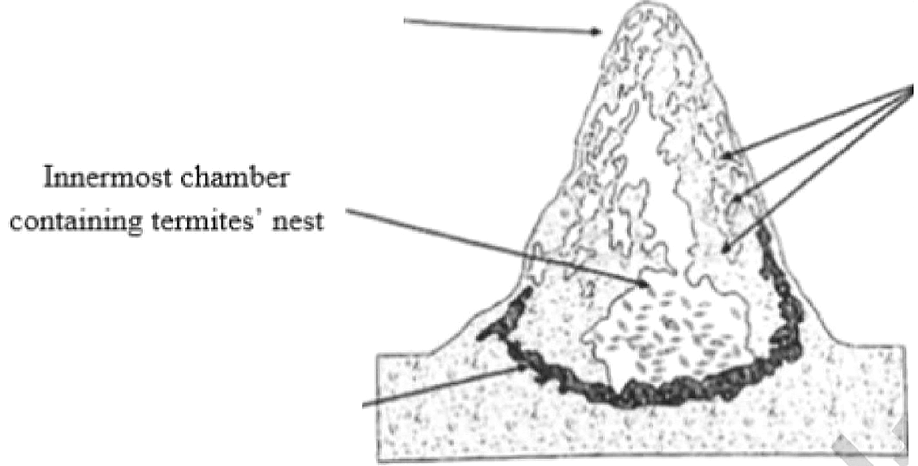
- 27
Paragraph A
- i. methods used to investigate termite mound formation
- ii. challenging our assumptions about the nature of life
- iii. reconsidering the termite’s reputation
- iv. principal functions of the termite mound
- v. distribution of termite mounds in sub-Saharan Africa
- vi. some potential benefits of understanding termite architecture
- vii. the astonishing physical dimensions of the termite mound
- viii. termite mounds under threat from global climate change
- ix. a mutually beneficial relationship
- 28
Paragraph B
- i. methods used to investigate termite mound formation
- ii. challenging our assumptions about the nature of life
- iii. reconsidering the termite’s reputation
- iv. principal functions of the termite mound
- v. distribution of termite mounds in sub-Saharan Africa
- vi. some potential benefits of understanding termite architecture
- vii. the astonishing physical dimensions of the termite mound
- viii. termite mounds under threat from global climate change
- ix. a mutually beneficial relationship
- 29
Paragraph C
- i. methods used to investigate termite mound formation
- ii. challenging our assumptions about the nature of life
- iii. reconsidering the termite’s reputation
- iv. principal functions of the termite mound
- v. distribution of termite mounds in sub-Saharan Africa
- vi. some potential benefits of understanding termite architecture
- vii. the astonishing physical dimensions of the termite mound
- viii. termite mounds under threat from global climate change
- ix. a mutually beneficial relationship
- 30
Paragraph D
- i. methods used to investigate termite mound formation
- ii. challenging our assumptions about the nature of life
- iii. reconsidering the termite’s reputation
- iv. principal functions of the termite mound
- v. distribution of termite mounds in sub-Saharan Africa
- vi. some potential benefits of understanding termite architecture
- vii. the astonishing physical dimensions of the termite mound
- viii. termite mounds under threat from global climate change
- ix. a mutually beneficial relationship
- 31
Paragraph E
- i. methods used to investigate termite mound formation
- ii. challenging our assumptions about the nature of life
- iii. reconsidering the termite’s reputation
- iv. principal functions of the termite mound
- v. distribution of termite mounds in sub-Saharan Africa
- vi. some potential benefits of understanding termite architecture
- vii. the astonishing physical dimensions of the termite mound
- viii. termite mounds under threat from global climate change
- ix. a mutually beneficial relationship
- 32
Paragraph F
- i. methods used to investigate termite mound formation
- ii. challenging our assumptions about the nature of life
- iii. reconsidering the termite’s reputation
- iv. principal functions of the termite mound
- v. distribution of termite mounds in sub-Saharan Africa
- vi. some potential benefits of understanding termite architecture
- vii. the astonishing physical dimensions of the termite mound
- viii. termite mounds under threat from global climate change
- ix. a mutually beneficial relationship
- 33
Paragraph G
- i. methods used to investigate termite mound formation
- ii. challenging our assumptions about the nature of life
- iii. reconsidering the termite’s reputation
- iv. principal functions of the termite mound
- v. distribution of termite mounds in sub-Saharan Africa
- vi. some potential benefits of understanding termite architecture
- vii. the astonishing physical dimensions of the termite mound
- viii. termite mounds under threat from global climate change
- ix. a mutually beneficial relationship
- 34
- 35
helps to give the termites a constant 35 ______ supply and to maintain a limited temperature range
- 36
cellar to aid control of 36 ______ levels in mound
- 37
top of the mound permits 37 ______
- 38
The termite mound appears to process its refuse material internally.
- YES. YES
- NO. NO
- NOT GIVEN. NOT GIVEN
- 39
Dr Soar’s reconstruction involves scanning a single photograph of a complete mound into a computer.
- YES. YES
- NO. NO
- NOT GIVEN. NOT GIVEN
- 40
New information about termite architecture could help people deal with future energy crises.
- YES. YES
- NO. NO
- NOT GIVEN. NOT GIVEN
عرض مفتاح الإجابة