Listening 2026-03 Test 4

شهر الامتحان: 2026-03

أُعيد بناء هذا الاختبار من استرجاعات المتقدمين — ليس مادة رسمية من IELTS. الصوت والنصوص معاد إنشاؤها للتدريب.

الصوت المعاد إنشاؤه

SECTION 1

Complete the notes below. Write ONE WORD AND/OR A NUMBER for each answer.

Enquiry about Airmail Reasons for moving: • Family reunion • Pleasant 1 _________ • Job opportunity Type of work: 2 _________ job Post address: 3 _________ Street, Sydney Accommodation: free for the first 4 _________ Name: Jennifer 5 _________ Current address: 6 _________ Road, Auckland Postcode: 7 _________ Mailing date: 8 _________
  1. 1

    Pleasant 1 _________

  2. 2

    Type of work: 2 _________ job

  3. 3

    Post address: 3 _________ Street, Sydney

  4. 4

    Accommodation: free for the first 4 _________

  5. 5

    Name: Jennifer 5 _________

  6. 6

    Current address: 6 _________ Road, Auckland

  7. 7

    Postcode: 7 _________

  8. 8

    Mailing date: 8 _________

SECTION 1

Choose TWO letters, A-E. Which TWO items will be sent to Australia?

  1. 9

    Which TWO items will be sent to Australia?

    • A. files
    • B. medicine
    • C. music instrument
    • D. diving equipment
    • E. books
  2. 10

    Which TWO items will be sent to Australia?

    • A. files
    • B. medicine
    • C. music instrument
    • D. diving equipment
    • E. books

SECTION 2

Choose the correct letter, A, B or C.

  1. 11

    The speaker stresses the importance to Clifton Bird Park of

    • A. birds that are now endangered.
    • B. birds from all over the world.
    • C. birds that are common in the local area.
  2. 12

    People who volunteer to help with gardening at the park

    • A. must work at weekends.
    • B. need to come at least once a month.
    • C. will only be required in the busy season.
  3. 13

    According to the speaker, who would be the ideal gardening volunteer?

    • A. someone who can work independently.
    • B. someone who is willing to work in any weather.
    • C. someone who knows a lot about plants.
  4. 14

    Volunteer guides will mainly be working with

    • A. international visitors.
    • B. local people from Clifton.
    • C. school groups.
  5. 15

    What is still required for the Maintenance Day at the bird park?

    • A. food and drink.
    • B. transport.
    • C. tools.

SECTION 2

Label the map below. Write the correct letter, A-H, next to questions 16-20.
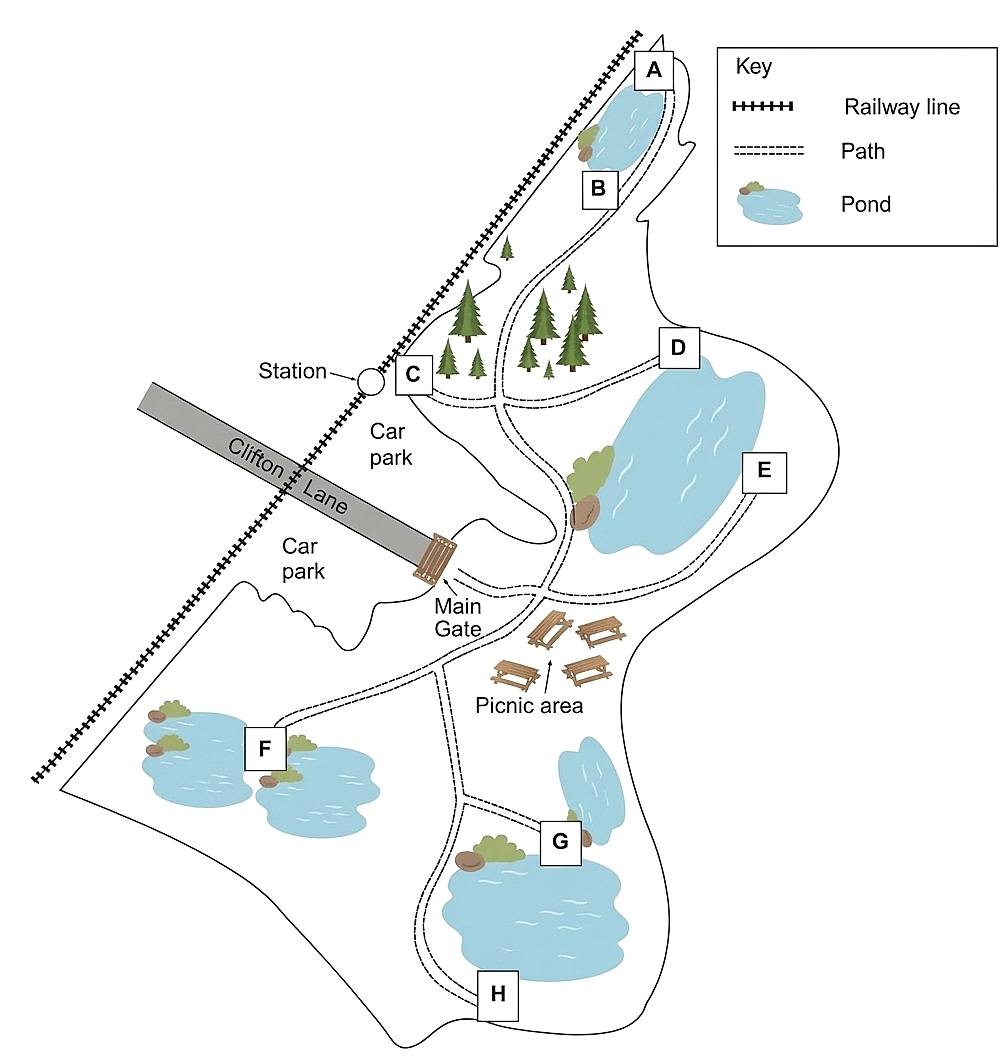
Map of Clifton Bird Park 16. Wooden bridge 17. Observation tower 18. Visitor cabins 19. Nesting boxes 20. Boat sheds
Recreated diagram for questions 16, 17, 18, 19, 20
  1. 16

    Wooden bridge

  2. 17

    Observation tower

  3. 18

    Visitor cabins

  4. 19

    Nesting boxes

  5. 20

    Boat sheds

SECTION 3

Choose the correct letter A, B or C.

  1. 21

    Joy wants to finish this assignment soon because

    • A. there is a lot to do and the assignment will affect her final grade.
    • B. they have another assignment to do and there isn't much time.
    • C. they have to put their findings into practice before the semester ends.
  2. 22

    Why does Tim want to ignore the theory chapter in their textbook?

    • A. The theory is too complex to be of practical help.
    • B. The focus of their project differs from the topic in the book.
    • C. There is insufficient time to read the entire chapter.
  3. 23

    Joy thinks that on the discussion board students should post

    • A. responses to materials they have studied.
    • B. suggestions on what books they think would be useful.
    • C. new areas of research that need to be investigated.
  4. 24

    What does Tim want to discuss?

    • A. the function of a teacher
    • B. the role of individual learner
    • C. teacher-student dynamics
  5. 25

    Joy and Tim decide not to interview the teachers because

    • A. the teachers are too busy.
    • B. the result will be marked by the teachers.
    • C. interviewing students would be more productive.

SECTION 3

What comment do Tim and Joy make about each of the following factors involved in successful learning outcomes? Choose FIVE answers from the box and write the correct letter, A-G, next to Questions 26-30.

Factors 26. classroom management _____ 27. feedback _____ 28. lesson planning _____ 29. individual tutoring _____ 30. access to technology _____ Comments A It needs funding. B It is necessary for progress. C It needs better supervision. D It is a basic requirement. E It should be optional. F It saves time. G It is the key to success.
  1. 26

    classroom management

  2. 27

    feedback

  3. 28

    lesson planning

  4. 29

    individual tutoring

  5. 30

    access to technology

SECTION 4

Write ONE WORD ONLY for each answer.

Intelligence Investigation Theory from a psychologist-Spearman: • IQ is passed down from parents, keeping the same through each one's 31 _________ • Intelligence can't be changed since it was believed a genetic 32 _________ • The evidence originated from the research of 33 _________ Theory from other psychologists: • Children grew up in the same family tend to go through similar 34 _________ • Children moved to another culture witnessed a great 35 _________ in the research. Theory from Howard Gardner: • there are at least 7 different types of intelligence, such as linguistic, logical and 36 _________ skills. • Various cognitive skills like speech, are regulated by various circuits in the 37 _________ • Some people are not good at identifying others' 38 _________ Conclusion • When a sense of rhythm is developed, you can unexpectedly improve your music, dancing and 39 _________ • To remember a chemical formula or physical law, the best way is to make it into a 40 _________
  1. 31

    IQ is passed down from parents, keeping the same through each one's 31 _________

  2. 32

    Intelligence can't be changed since it was believed a genetic 32 _________

  3. 33

    The evidence originated from the research of 33 _________

  4. 34

    Children grew up in the same family tend to go through similar 34 _________

  5. 35

    Children moved to another culture witnessed a great 35 _________ in the research.

  6. 36

    there are at least 7 different types of intelligence, such as linguistic, logical and 36 _________ skills.

  7. 37

    Various cognitive skills like speech, are regulated by various circuits in the 37 _________

  8. 38

    Some people are not good at identifying others' 38 _________

  9. 39

    you can unexpectedly improve your music, dancing and 39 _________

  10. 40

    the best way is to make it into a 40 _________

عرض النص المكتوب
==================== IELTS Listening Transcript ==================== PART 1 Speaker 0: Part one. Speaker 1: You will hear a man from the New Zealand Post Office Service telephoning a woman. First, you have some time to look at questions one to eight. Now listen carefully and answer questions one to eight. Speaker 2: Hello. Speaker 3: Jennifer speaking. Hello, Jennifer. My name's Ben Smith. I'm from the New Zealand Post Office Service. I understand you left a couple of questions on our website forum. Seeing as though you left your phone number as a contact, I thought you might prefer us to call. Speaker 2: Oh, Ben. It's nice to speak to you again. I really appreciate your help last month. Yes, as I will be moving to Australia soon and need to send some of my things via air mail. I just wasn't sure how to get my mail redirected. Speaker 3: I can help you with that. It's interesting that I recently got more inquiries about international mailing due to migration to other countries. May I ask why you are moving? Speaker 2: There are a few reasons, such as I have family in Australia, and the weather there is warmer, but mainly because it's hard to find a job here. I have just got the news that I was successful in applying for a job in Australia. I'll be starting in November. Speaker 3: How exciting. Congratulations. I have never been to Australia, but I've heard it's a nice place. Is it a permanent job? Speaker 2: No. I will only be working for that company as a temporary assistant over this summer. Speaker 3: You never know. I might get homesick and want to come back after a few months anyway. I hope the job goes well for you. What postal address will you be using in Australia? Speaker 2: I had organised some accommodation at a hostel in Sydney for the first week, but that fell through, so I will stay at my friend's house until I find somewhere else. My things will have to be sent to her place for now, and the address is 9 Queen Street, Sydney. Speaker 3: Can I know how long you will be staying there? We want to make sure you get your mail while you are there. Speaker 2: I will be staying there for the first two months. You know, it's free staying with her. Speaker 3: That's nice. Now, I've got a couple more questions for you. What is your full name and current address? Speaker 2: My name is Jennifer Simmons. Speaker 3: How do you spell your surname, please? Speaker 2: It's S-I-M-M-O-N-S. Speaker 3: Got that. And your address, please? Speaker 2: Oh, right. I'm currently living at 16 Ocean Road, Auckland. Speaker 3: And your postcode? Speaker 2: It's 245. Speaker 3: That doesn't come up in our system as a valid postcode. Can you check that again, please? Speaker 2: Yes. Sorry. I'm not good at remembering numbers. It's 425. Speaker 3: When would you like your things to be emailed? Speaker 2: I will leave New Zealand on the September 23, but I will try to send them on the twenty second. So that's the day before. How long will it take for my things to get to Australia? Speaker 3: It will take about a week. Speaker 2: Perfect. That should give me time to get organised in Australia before everything arrives. Speaker 1: Before you hear the rest of the conversation, you have some time to look at questions nine to 10. Now listen and answer questions nine to 10. Speaker 3: May I ask about the content of your delivery? There are some things that you have to sign a goods declaration for, such as expensive items or if you're importing medications in bulk. Speaker 2: I won't be sending anything like that. It'll mainly be personal items. I was thinking of posting some books, but I guess that's quite expensive because they are heavy and my guitar is kind of big. Speaker 3: Yes, it can be quite expensive. Speaker 2: I might not send them then. I definitely need to send some of my files. I have one standard size file box full of them. Speaker 3: Sure. Anything else? Speaker 2: I've heard the beaches and the ocean are beautiful in Australia. I enjoy diving, so I'm going to send my diving gear as well. I have packed it into a box to send it more easily. Would you mind if I weighed everything and sent you information to get a quote on the price? Speaker 3: Just send it to info@postalservice.nz. Can I help you with anything else? Speaker 2: No. That's everything. Thank you for your help. Speaker 0: That is the end of part one. You now have half a minute to check your answers to part one. PART 2 Speaker 4: Part two. You will hear a woman called Sandra Hayes who works at a bird park talking to a group of people who want to volunteer there. First, you have some time to look at questions 11 to 15. Now listen carefully and answer questions 11 to 15. Speaker 5: Hello. My name is Sandra Hayes, and I'm from Clifton Bird Park. It's great to see so many possible volunteers here. The park is now a very popular attraction in this area. I think people love coming to see so many different types of birds in a beautiful environment. For some species that we have here, there aren't many still alive in the wild, so a big part of our job is to make sure we help their numbers increase. All the birds are native species. We need volunteers to help the bird park officers with different jobs. One of these is gardening. Obviously, summer is the time when we have most visitors, but the park needs looking after all year round. If you want to help, you can choose which day, although we do already have plenty of volunteers working Saturdays and Sundays. But one day every four weeks is the minimum commitment that we ask for. So who's the ideal volunteer for gardening work? If you have expert knowledge about flowers and trees, great. But we're looking more for people who are flexible and turn up no matter whether it's raining or baking hot. That's what'll make you the best person for the job. It's all teamwork, so you'll have plenty of support. What about volunteer guides? A guide's role is to point out the birds and talk about the conservation program. In general, it's people in a foreign tour group that you're responsible for. The Clifton residents who come to the park usually know their way around. We get a few teachers bringing in classes, but they're the park officer's responsibility. The last thing to mention is the park's maintenance day, which is coming up soon. We're hoping to get as many volunteers as possible to come and help tidy things up. If anyone is able to drive some other volunteers to the event, please let me know because we need help there. The park officers will provide you with spades and drills and hammers, all of that stuff, and they'll be offering you some refreshments too, so it should be a good day out. Speaker 4: Before you hear the rest of the talk, you have some time to look at questions 16 to 20. Now listen and answer questions 16 to 20. Speaker 5: So here's a map of Clifton Bird Park. As you can see, the railway line runs along the northwest of the park, and road access is on that side too from Clifton Lane. We want volunteers to work on a few different areas on maintenance day, which is coming up soon. Firstly, the wooden bridge. I'll explain where that is. You can see Clifton Lane in the main gate into the park. On the southern side of Clifton Lane is one of our car parks, and below that, there are two similar sized ponds. The wooden bridge runs between those two ponds. We just need to make it a bit stronger. Some volunteers will be doing a bit of painting at the observation tower. The tower's in the southeast corner of the map. You see there are two different sized ponds there? The tower's on the south side of the larger pond at the end of the path. We'll need about three people to help out. We need to replace the windows and the visitor cabins. So on the map, you can see our car park on the north side of Clifton Lane. There's the woods, and on the left hand side of the map, the railway line. The visitors' cabins are marked there between the woods and the railway station. You'll also be repairing some nesting boxes. See the picnic area? The path you want is between there and the big pond. Follow it round all the way to the end. So as we're looking at the map now, the nesting boxes are on the right of that pond. Finally, the boat sheds. Towards the top of the map, you've got that smallish pond quite near the railway line, and there are two places marked up there. The boat sheds are on the same side of the pond as the woods, not the place marked at the tip of the park. What we want you to do... Speaker 4: That is the end of part two. You now have thirty seconds to check your answers to part two. PART 3 Speaker 6: Part three. You will hear two students named Joy and Tim discussing their classroom management project. First, you have some time to look at questions 21 to 25. Now listen carefully and answer questions 21 to 25. Speaker 7: Hi, Tim. I thought you'd never get here. We still have so much of our classroom management project to complete. I don't know how we'll get it done. Speaker 6: Take it easy, Joy. Our results for this course won't be high enough if we rush to finish. It's our final assignments for the semester. We don't have any other projects to do, so we can focus on this. Speaker 7: I'm not worried about my results, but we need to finish it because part of the project is to implement the results of our research and make the classroom a better learning environment. If we don't start soon, we'll run out of time. You know, the semester will finish next month. Speaker 6: That's true. What do you think of the theory chapter in our textbook? I don't think we should bother with it. Speaker 7: Are you saying that because you find the theory in that chapter too difficult to understand, or is the chapter just too long? Speaker 6: Neither. My real issue is that it doesn't have much bearing on the subject we're researching. Our project is on classroom management, not on company structuring. Speaker 7: There are parallels, though. We're learning about management and structure for careers in business management. This classroom based project is just a training ground. Speaker 6: Maybe. Anyway, last time we were considering the benefits of a discussion board in each home group room. What have you come up with? Speaker 7: The role of the discussion board is for sharing ideas. Each of us can learn from what others have done before us. I thought instead of the students merely stating what textbooks they think will be beneficial, it would be more useful to document what they've already studied and the reactions they had to the material. Speaker 6: In that way, we can find books that will further their own research. Speaker 7: That's great. What about you? How have you been getting on with your analysis of classroom structure? Speaker 6: I've been thinking about what we should discuss in our essay on that topic. The teacher's role has been discussed in previous research papers, as has the important relationship between teachers and their students. But I haven't come across much research on the place an individual student holds in the classroom. So this is what I want to talk about. Speaker 7: That could be a controversial topic. The roles have slowly evolved. Traditionally, the teacher dominated the classroom. Now the general idea is that the teacher is a mentor to guide students' learning rather than telling them what to do. Speaker 6: I agree. It places the students on a more equal footing with the teacher, so the students have more respect for their teachers. Should we conduct interviews with the teachers regarding this developing interaction? It's not required that we do it. We could interview the students instead. Speaker 7: I was considering it, but I think it may be difficult for many of the teachers to find the time. I tried to have discussion with some of the professors, but they were all tied up with marking the first year students' exam papers and suggested I come back in a week or so. Speaker 6: If that's the case, we'd better not bother them. Speaker 6: Before you hear the rest of the discussion, you have some time to look at questions 26 to 30. Now listen carefully and answer questions 26 to 30. Speaker 6: What about this last research question about the factors that contribute to successful learning outcomes? Speaker 7: Well, obviously, classroom management comes into it. I think for students, it's impossible to gain the full benefits of studying without it. Speaker 6: In fact, I'd say it is the single most important factor of success in learning. Speaker 7: I agree, but I think feedback is pretty important too. There has to be a real dialogue going on between teachers and students, and constructive criticism is essential to students' progress and development. Speaker 6: True. And I've been thinking about the shift in roles in recent years, but the essentials are still the same. For instance, effective lesson planning is pretty fundamental. Speaker 7: Teachers have the responsibility to do it properly. Speaker 6: I agree. That is a requirement for every teacher. I believe that each student learns at his or her own pace. Some students may need individual tutoring. I think it should be a matter of choice, though, as it doesn't work well for everyone. Speaker 7: You are right. I'd like to see more supervision in the lab too. Some of the students need a lot more help than they're getting. Speaker 6: Yes. That's true. And it would also be beneficial if students had more access to technology. Nowadays, teachers can use a few simple clicks with a computer to finish something that might take them hours or even days in the past. Speaker 7: I agree. Even though funding technology can be expensive, it pays in the long run. Speaker 6: I am not sure. We can record it in our research though as a recommendation. Speaker 6: That is the end of part three. You now have thirty seconds to check your answers to part three. PART 4 Speaker 4: Part four. First, you have some time to look at questions 31 to 40. Now listen carefully and answer questions 31 to 40. Speaker 8: Today, I am going to consider three series of intelligence. Early psychologist states, such as Spearman in the 1920s, believed that each individual has a single general level of intelligence known as IQ. According to the theory, we are born with a certain level of intelligence, which is inherited from our parents, and our intelligence remains constant throughout our life. It follows that any intelligence tests we do at any time will give broadly similar results. If this is true, it suggests that there isn't much you can do to make yourself more intelligent, since it's a genetic feature. Most of the evidence for the genetic origin of intelligence has come from studies of twins, which shows considerable similarity in their intelligence. However, other psychologists have interpreted the findings of this research differently. The theory says that the similarity in intelligence between the subjects used in such studies may have an environmental rather than genetic origin. These psychologists point out that children brought up in the same family are likely to have experiences which are very similar. Yet some research into children who have moved home and live in another culture, from the after few years, there was a significant improvement in the results. In the 1990s, Howard Gardner claimed that there are at least seven separate intelligences such as linguistic and logical skills and also other less traditional ones such as the category of musical abilities. Research in neuropsychology suggests that different cooperative abilities such as speech may be partially independent of each other and controlled by different circuits within the brain. Support for this theory comes from the fact that some people show weakness in one particular area, for instance some find it very difficult to recognise someone's face. Well they may have no problem remembering names. This apparent variation in strengths and weaknesses within one person supports Gardner's view, and the intelligence is multiple rather than general. If you develop a sense of rhythm, this can improve not only music and dance as you'd expect but also areas that aren't obviously linked. Spelling for instance. If you need to learn the chemical formula or law of physics by heart, turn it into a song. It doesn't matter at all if you are out of a key but it will be easier for you to learn it. Speaker 4: That is the end of part four. You now have one minute to check your answers to part four. ==================== Chinese Translation ==================== 第一部分 Speaker 0: 第一部分。 Speaker 1: 你将听到一位来自新西兰邮政服务的男士给一位女士打电话。首先,你有时间看一下问题1到8。现在请仔细听,并回答第1到8题。 Speaker 2: 你好。 Speaker 3: 我是詹妮弗。你好,詹妮弗。我叫本·史密斯,来自新西兰邮政服务。我了解到你在我们的网站论坛上留了几个问题。既然你留了电话号码作为联系方式,我想你可能更希望我们打电话给你。 Speaker 2: 哦,本。很高兴再次和你通话。非常感谢你上个月的帮助。是的,我很快要搬到澳大利亚去,需要寄一些东西通过航空邮件。我只是不确定如何转寄我的邮件。 Speaker 3: 我可以帮你处理。有趣的是,最近我收到了很多关于国际邮寄的咨询,因为很多人移民到其他国家。我可以问一下你为什么要搬家吗? Speaker 2: 有几个原因,比如我在澳大利亚有家人,那里的天气更暖和,但主要是因为在这里很难找到工作。我刚收到消息,我成功申请到了澳大利亚的一份工作。我将在11月开始上班。 Speaker 3: 太令人兴奋了。恭喜你。我从未去过澳大利亚,但我听说那是个好地方。是永久性工作吗? Speaker 2: 不是。我只会在那家公司做这个夏天的临时助理。 Speaker 3: 谁知道呢。也许几个月后我会想家,想回来。希望你的工作顺利。你在澳大利亚会用哪个邮寄地址? Speaker 2: 我本来在悉尼安排了一家旅馆住第一周,但没成,所以我会先住在朋友家,直到找到其他地方。我的东西暂时得寄到她那里,地址是悉尼皇后街9号。 Speaker 3: 我能知道你会住多久吗?我们想确保你在那里能收到邮件。 Speaker 2: 我会在那里住头两个月。你知道,住她那里是免费的。 Speaker 3: 那很好。现在,我还有几个问题要问你。你的全名和当前地址是什么? Speaker 2: 我叫詹妮弗·西蒙斯。 Speaker 3: 请拼写你的姓氏。 Speaker 2: 是S-I-M-M-O-N-S。 Speaker 3: 记下了。那你的地址呢? Speaker 2: 哦,好的。我目前住在奥克兰海洋路16号。 Speaker 3: 你的邮政编码呢? Speaker 2: 是245。 Speaker 3: 这个邮编在我们的系统中无效。你能再核对一下吗? Speaker 2: 好的。抱歉,我不太擅长记数字。是425。 Speaker 3: 你希望什么时候寄出你的东西? Speaker 2: 我将在9月23日离开新西兰,但我会尽量在22日寄出。也就是前一天。我的东西到澳大利亚需要多长时间? Speaker 3: 大约需要一周。 Speaker 2: 完美。那应该能让我在澳大利亚安顿好,等东西到达。 Speaker 1: 在你听到对话的其余部分之前,你有时间看一下问题9到10。现在请听并回答第9到10题。 Speaker 3: 我可以问一下你要寄送的内容吗?有些东西你需要签署货物申报单,比如贵重物品或批量进口药品。 Speaker 2: 我不会寄那些东西。主要是个人物品。我本来想寄一些书,但我想那会很贵,因为它们很重,而且我的吉他有点大。 Speaker 3: 是的,可能会很贵。 Speaker 2: 那我可能就不寄了。我肯定需要寄一些文件。我有一个标准尺寸的文件箱装满了文件。 Speaker 3: 好的。还有其他东西吗? Speaker 2: 我听说澳大利亚的海滩和海洋很美。我喜欢潜水,所以我也会寄我的潜水装备。我已经把它装进一个箱子里,方便寄送。你介意我称一下所有东西的重量,然后把信息发给你,让你给我一个报价吗? Speaker 3: 请发到info@postalservice.nz。还有其他需要帮忙的吗? Speaker 2: 没有了。就这些。谢谢你的帮助。 Speaker 0: 第一部分结束。你现在有半分钟时间检查第一部分的答案。 第二部分 Speaker 4: 第二部分。你将听到一位名叫桑德拉·海耶斯的女士,她在鸟类公园工作,正在对一群想在那里做志愿者的人讲话。首先,你有时间看一下问题11到15。现在请仔细听,并回答第11到15题。 Speaker 5: 大家好。我叫桑德拉·海耶斯,来自克利夫顿鸟类公园。很高兴看到这么多潜在的志愿者。这个公园现在已经成为这个地区非常受欢迎的景点。我想人们喜欢来这里,在优美的环境中看到这么多不同种类的鸟。对于这里的一些物种,野外存活的已经不多了,所以我们工作的重要部分就是确保帮助它们的数量增加。所有的鸟都是本地物种。我们需要志愿者帮助鸟类公园的工作人员完成不同的工作。其中之一是园艺。显然,夏天是我们游客最多的时候,但公园全年都需要照料。如果你想帮忙,你可以选择哪一天,尽管我们已经有足够多的志愿者在周六和周日工作。但我们要求的最低承诺是每四周一天。那么,谁是园艺工作的理想志愿者呢?如果你对花草树木有专业知识,那很好。但我们更看重的是那些灵活应变、无论下雨还是酷热都能出现的人。那会让你成为这份工作的最佳人选。这完全是团队合作,所以你会得到很多支持。那志愿者导游呢?导游的角色是指出鸟类的位置,并讲解保护项目。一般来说,你负责的是外国旅游团的人。来公园的克利夫顿居民通常都认识路。我们也有一些老师带班级来,但那是公园工作人员的责任。最后要提的是公园的维护日,很快就要到了。我们希望尽可能多的志愿者来帮忙整理。如果有人能开车带其他志愿者来参加活动,请告诉我,因为我们那里需要帮助。公园工作人员会提供铁锹、电钻和锤子等工具,他们还会提供一些茶点,所以应该会是很愉快的一天。 Speaker 4: 在你听到讲话的其余部分之前,你有时间看一下问题16到20。现在请听并回答第16到20题。 Speaker 5: 这是克利夫顿鸟类公园的地图。你可以看到,铁路线沿着公园的西北方向延伸,道路入口也在那边,从克利夫顿巷进入。我们希望志愿者在即将到来的维护日里在几个不同的区域工作。首先是木桥。我来解释一下它的位置。你可以看到克利夫顿巷和公园的正门。在克利夫顿巷的南侧是我们的一个停车场,下面有两个大小相似的池塘。木桥就建在这两个池塘之间。我们只需要让它更坚固一些。一些志愿者会在观景塔做一些油漆工作。观景塔在地图的东南角。你看到那里有两个大小不同的池塘了吗?观景塔在较大池塘的南侧,小路的尽头。我们需要大约三个人帮忙。我们需要更换窗户和游客小屋。在地图上,你可以看到我们在克利夫顿巷北侧的停车场。那里有树林,在地图的左侧是铁路线。游客小屋就标在树林和火车站之间。你们还要修理一些巢箱。看到野餐区了吗?你要走的小路就在那里和大池塘之间。沿着它一直走到尽头。现在我们看地图,巢箱就在那个池塘的右侧。最后是船库。在地图的顶部,有一个靠近铁路线的小池塘,那里标着两个地方。船库在池塘的同一侧,靠近树林,而不是公园顶端标记的那个地方。我们希望你们做的是…… Speaker 4: 第二部分结束。你现在有三十秒时间检查第二部分的答案。 第三部分 Speaker 6: 第三部分。你将听到两名学生,名叫乔伊和蒂姆,在讨论他们的课堂管理项目。首先,你有时间看一下问题21到25。现在请仔细听,并回答第21到25题。 Speaker 7: 嗨,蒂姆。我以为你永远不会来了。我们还有那么多课堂管理项目要做。我不知道我们怎么能完成。 Speaker 6: 别着急,乔伊。如果我们匆忙完成,这门课的成绩不会高的。这是我们这学期的最后作业。我们没有其他项目要做,所以我们可以专注于这个。 Speaker 7: 我不担心我的成绩,但我们需要完成它,因为项目的一部分是实施我们的研究成果,让课堂成为更好的学习环境。如果我们不尽快开始,时间就不够了。你知道,下学期就结束了。 Speaker 6: 没错。你觉得我们课本里的理论章节怎么样?我觉得我们不应该费心去读它。 Speaker 7: 你这么说是因为你觉得那章的理论太难理解,还是那章太长了? Speaker 6: 都不是。我真正的问题是它和我们研究的主题关系不大。我们的项目是关于课堂管理的,而不是公司结构。 Speaker 7: 不过还是有相似之处的。我们学习管理和结构是为了商业管理的职业生涯。这个基于课堂的项目只是一个训练场。 Speaker 6: 也许吧。不管怎样,上次我们在考虑在每个小组房间里设一个讨论板的好处。你有什么想法? Speaker 7: 讨论板的作用是分享想法。我们每个人都可以从别人之前做过的事情中学习。我想,与其让学生仅仅陈述他们认为哪些教科书会有用,不如记录他们已经学过的东西以及他们对材料的反应,这样更有用。 Speaker 6: 这样,我们就能找到能进一步推进他们自己研究的书。 Speaker 7: 太好了。你呢?你对课堂结构的分析进展如何? Speaker 6: 我一直在想我们关于那个主题的论文应该讨论什么。教师角色在以前的研究论文中已经讨论过了,教师和学生之间的重要关系也是如此。但我还没有看到太多关于个别学生在课堂中所处位置的研究。所以这就是我想谈的。 Speaker 7: 那可能是一个有争议的话题。角色已经慢慢演变。传统上,教师主导课堂。现在普遍的观点是,教师是指导学生学习、而不是告诉学生做什么的导师。 Speaker 6: 我同意。这让学生和教师处于更平等的地位,所以学生更尊重他们的老师。我们应该就这种不断发展的互动采访教师吗?这不是必须的。我们可以改采访学生。 Speaker 7: 我考虑过,但我认为很多老师可能很难抽出时间。我试着和一些教授讨论过,但他们都在忙着批改一年级学生的考试卷,建议我一周左右再来。 Speaker 6: 如果是这样,我们最好别打扰他们了。 Speaker 6: 在你听到讨论的其余部分之前,你有时间看一下问题26到30。现在请仔细听,并回答第26到30题。 Speaker 6: 那最后一个研究问题呢?关于促成成功学习成果的因素。 Speaker 7: 嗯,显然,课堂管理是其中的一部分。我认为对学生来说,没有课堂管理就不可能获得学习的全部好处。 Speaker 6: 事实上,我会说它是学习中最重要的成功因素。 Speaker 7: 我同意,但我认为反馈也很重要。教师和学生之间必须有真正的对话,建设性的批评对学生的进步和发展至关重要。 Speaker 6: 没错。我一直在思考近年来角色的转变,但基本要素还是一样的。例如,有效的课程计划是非常基本的。 Speaker 7: 教师有责任把它做好。 Speaker 6: 我同意。这是每位教师的要求。我相信每个学生都有自己的学习节奏。有些学生可能需要个别辅导。不过,我认为这应该是一个选择问题,因为它对每个人不一定都有效。 Speaker 7: 你说得对。我也希望在实验室里看到更多的监督。有些学生需要比现在更多的帮助。 Speaker 6: 是的,没错。如果学生能更多地接触技术,那也会很有益。如今,教师只需用电脑点击几下,就能完成过去可能需要几个小时甚至几天的事情。 Speaker 7: 我同意。尽管为技术提供资金可能很昂贵,但从长远来看是值得的。 Speaker 6: 我不太确定。不过我们可以把它作为建议记录在我们的研究中。 Speaker 6: 第三部分结束。你现在有三十秒时间检查第三部分的答案。 第四部分 Speaker 4: 第四部分。首先,你有时间看一下问题31到40。现在请仔细听,并回答第31到40题。 Speaker 8: 今天,我将探讨三种智力理论。早期的心理学家,比如20世纪20年代的斯皮尔曼,认为每个人都有一个单一的总体智力水平,即智商。根据这一理论,我们生来就有一定水平的智力,这是从父母那里遗传的,并且我们的智力在一生中保持不变。因此,我们在任何时候做的任何智力测试都会得出大致相似的结果。如果这是真的,那就意味着你无法做太多事情来让自己变得更聪明,因为这是一个遗传特征。支持智力遗传起源的大部分证据来自对双胞胎的研究,这些研究显示他们的智力有相当大的相似性。然而,其他心理学家对这项研究的结果有不同的解释。该理论认为,此类研究中受试者之间的智力相似性可能源于环境而非遗传。这些心理学家指出,在同一个家庭长大的孩子很可能有非常相似的经历。然而,一些对搬家和生活在另一种文化中的孩子的研究显示,几年后,他们的结果有了显著改善。在20世纪90年代,霍华德·加德纳声称至少有七种独立的智力,比如语言和逻辑技能,以及其他不那么传统的智力,比如音乐能力类别。神经心理学的研究表明,不同的认知能力,比如语言,可能部分相互独立,并由大脑内不同的回路控制。支持这一理论的证据来自这样一个事实:有些人在某个特定领域表现出弱点,例如有些人很难认出别人的脸,但他们可能记名字没有问题。一个人内部这种明显的优势和劣势差异支持了加德纳的观点,即智力是多元的而不是单一的。如果你培养节奏感,这不仅能像你期望的那样提高音乐和舞蹈,还能提高那些没有明显联系的领域,比如拼写。如果你需要记住化学公式或物理定律,把它编成一首歌。即使你跑调了也没关系,但你会更容易学会它。 Speaker 4: 第四部分结束。你现在有一分钟时间检查第四部分的答案。
عرض مفتاح الإجابات

مفتاح الإجابات

  1. 1. weather

    Jennifer says she is moving because 'the weather there is warmer,' so 'weather' is the correct answer.

  2. 2. temporary

    Jennifer says, 'I will only be working for that company as a temporary assistant over this summer,' so the job is 'temporary.'

  3. 3. 9 Queen

    Jennifer says, 'the address is 9 Queen Street, Sydney,' so '9 Queen' is correct.

  4. 4. 2 months

    Jennifer says, 'I will be staying there for the first two months,' so '2 months' is the answer.

  5. 5. Simmons

    Jennifer spells her surname as 'S-I-M-M-O-N-S,' so 'Simmons' is correct.

  6. 6. 16 Ocean

    Jennifer says, 'I'm currently living at 16 Ocean Road, Auckland,' so '16 Ocean' is the answer.

  7. 7. 0425

    Jennifer first says '245' but then corrects herself to '425,' and the answer is written as '0425' to match the format.

  8. 8. 22nd September

    Jennifer says, 'I will try to send them on the twenty second,' so '22nd September' is correct.

  9. 9. A

    Jennifer says, 'I definitely need to send some of my files. I have one standard size file box full of them,' so 'files' is correct. She considers sending books and her guitar but decides not to because they are too heavy or big.

  10. 10. D

    Jennifer says, 'I'm going to send my diving gear as well,' so 'diving equipment' is correct. She decides not to send books or her guitar.

  11. 11. A

    The speaker says, 'For some species that we have here, there aren't many still alive in the wild, so a big part of our job is to make sure we help their numbers increase,' showing the focus is on endangered birds. Option B is tempting but the passage only mentions native species, not birds from all over the world.

  12. 12. B

    The speaker says, 'one day every four weeks is the minimum commitment that we ask for,' so volunteers need to come at least once a month. Option A is wrong because volunteers can choose the day, and C is wrong because work is needed all year round.

  13. 13. B

    The speaker says, 'we're looking more for people who are flexible and turn up no matter whether it's raining or baking hot,' so willingness to work in any weather is most important. Option C is tempting but expert knowledge is not required.

  14. 14. A

    The speaker says, 'A guide's role is to point out the birds... In general, it's people in a foreign tour group that you're responsible for,' so guides mainly work with international visitors. Option B is wrong because locals know their way around.

  15. 15. B

    The speaker says, 'If anyone is able to drive some other volunteers to the event, please let me know because we need help there,' so transport is still required. Food and tools are already provided.

  16. 16. F

    The speaker says, 'The wooden bridge runs between those two ponds,' which matches location F on the map.

  17. 17. H

    The speaker says, 'The tower's in the southeast corner of the map... at the end of the path,' which matches location H.

  18. 18. C

    The speaker says, 'The visitors' cabins are marked there between the woods and the railway station,' which matches location C.

  19. 19. E

    The speaker says, 'the nesting boxes are on the right of that pond,' which matches location E.

  20. 20. B

    The speaker says, 'The boat sheds are on the same side of the pond as the woods,' which matches location B.

  21. 21. C

    Joy says, 'part of the project is to implement the results of our research and make the classroom a better learning environment. If we don't start soon, we'll run out of time. You know, the semester will finish next month,' so they need to put their findings into practice before the semester ends.

  22. 22. B

    Tim says, 'My real issue is that it doesn't have much bearing on the subject we're researching. Our project is on classroom management, not on company structuring,' so the focus is different.

  23. 23. A

    Joy says, 'it would be more useful to document what they've already studied and the reactions they had to the material,' so students should post responses to materials they have studied.

  24. 24. B

    Tim says, 'I haven't come across much research on the place an individual student holds in the classroom. So this is what I want to talk about,' so he wants to discuss the role of the individual learner.

  25. 25. A

    Joy says, 'I think it may be difficult for many of the teachers to find the time,' so they decide not to interview teachers because they are too busy.

  26. 26. G

    Tim says, 'classroom management comes into it. I think for students, it's impossible to gain the full benefits of studying without it,' so classroom management is a key factor.

  27. 27. B

    Joy says, 'I think feedback is pretty important too. There has to be a real dialogue going on between teachers and students,' so feedback is another factor.

  28. 28. D

    Tim says, 'effective lesson planning is pretty fundamental,' so lesson planning is important.

  29. 29. E

    Tim says, 'Some students may need individual tutoring. I think it should be a matter of choice,' so individual tutoring is a factor.

  30. 30. F

    Tim says, 'it would also be beneficial if students had more access to technology,' so access to technology is a factor.

  31. 31. Life

    The passage says, 'our intelligence remains constant throughout our life,' so 'life' is the answer.

  32. 32. Feature

    The passage says, 'it's a genetic feature,' so 'feature' is correct.

  33. 33. Twins

    The passage says, 'Most of the evidence for the genetic origin of intelligence has come from studies of twins,' so 'twins' is the answer.

  34. 34. Experiences

    The passage says, 'children brought up in the same family are likely to have experiences which are very similar,' so 'experiences' is correct.

  35. 35. Improvement

    The passage says, 'there was a significant improvement in the results,' so 'improvement' is the answer.

  36. 36. Musical

    The passage says, 'there are at least seven separate intelligences such as linguistic and logical skills and also other less traditional ones such as the category of musical abilities,' so 'musical' is correct.

  37. 37. Brain

    The passage says, 'different cooperative abilities such as speech may be partially independent of each other and controlled by different circuits within the brain,' so 'brain' is the answer.

  38. 38. Face

    The passage says, 'some people show weakness in one particular area, for instance some find it very difficult to recognise someone's face,' so 'face' is correct.

  39. 39. Spelling

    The passage says, 'If you develop a sense of rhythm, this can improve not only music and dance as you'd expect but also areas that aren't obviously linked. Spelling for instance,' so 'spelling' is the answer.

  40. 40. Song

    The passage says, 'If you need to learn the chemical formula or law of physics by heart, turn it into a song,' so 'song' is correct.

Listening 2026-03 Test 4 — IELTS Listening Actual Test with Answers | IELTS Actual Tests