أُعيد بناؤه من ذكريات المتقدمين للاختبار — ليس مادة IELTS رسمية. الصوت والنصوص أُعيد إنشاؤها للتدريب.
عرض النص المكتوب
====================
IELTS Listening Transcript
====================
PART 1
Speaker 0: Part one. You will hear a man phoning an aquatic center inquiring about a part time job as a lifeguard. First, you have some time to look at questions one to five. Now listen carefully and answer questions one to five.
Speaker 0: Hello. North Bay Aquatic Center. Jane is speaking.
Speaker 1: Oh, hello. I'm calling to apply for a part time lifeguard position. Am I speaking to the right person?
Speaker 0: Yes. You are. We are currently recruiting lifeguards for two different positions. But first, I'll have to jot down some of your personal information before we officially invite you for an interview. Is that alright?
Speaker 1: Sure. No problem.
Speaker 0: May I have your name, please?
Speaker 1: It's Peter. Peter Smith.
Speaker 0: Okay. And what is your current address?
Speaker 1: It's 130 South Main Street, Lake Elsinore.
Speaker 0: I'm sorry. Elsinore?
Speaker 1: Oh, it's E L S I N O R E, Elsinore.
Speaker 0: Right. Got it. What is your phone number?
Speaker 1: My home phone number is 077995362. Actually, it's easier to reach me by my cell phone number. It's 077896245. I'm mainly out these days.
Speaker 0: Right. Can you tell me about your work experience?
Speaker 1: Well, I now work as a waiter, and that's just a part time gig. It requires serving customers, and I also have some cleaning duties.
Speaker 0: Okay. Do you have any other part time job?
Speaker 1: No. But I'm majoring in physical education right now. I'm learning exercise physiology, sports nutrition, and individual fitness activities, and I want to become a baseball coach for a local high school.
Speaker 0: So do you have any other relevant work experience to a lifeguard position?
Speaker 1: Oh, right. I also worked part time as a rescue diver for a local beach last summer. I'm certified for open water rescue missions.
Speaker 0: Excellent. That's exactly what we're looking for. Before you hear the rest of the conversation, you have some time to look at questions six to 10. Now listen and answer questions six to 10.
Speaker 0: Before we continue, I need to know a few more things to ensure that you are qualified for maintaining water safety during work.
Speaker 1: Okay. Go ahead.
Speaker 0: As a lifeguard, you will spend most of your time monitoring the area near the water and reducing risks to everyone here. So we are looking for someone who can stay focused. Do you have difficulties concentrating or any related disorders?
Speaker 1: No. I don't have any medical disorders relating to that sort of problem.
Speaker 0: We're also expecting someone with good eyesight because a lifeguard must be able to recognize and respond to any struggling swimmers quickly.
Speaker 1: I have sharp vision. I mean, both eyes are 20/10 without correction.
Speaker 0: Good. Do you have relevant skills in terms of lifeguarding?
Speaker 1: I'm good at diving. You know my previous job requires training in that.
Speaker 0: We only need lifeguards with certification. I assume you already have one. Right?
Speaker 1: Yes. To get the certificate, I received training for Waterfront Lifeguarding two years ago. The training includes things like providing first aid and emergency care, but mine is about to expire in November. Oh, wait. Let me check. It's a month earlier, in October.
Speaker 0: Okay. You're good for now before it expires. But if you want to work here for the whole year, you'll have to renew it.
Speaker 1: I see.
Speaker 0: What time do you prefer to work?
Speaker 1: I already work part time in a restaurant on weekdays, so I'd like to work on the weekend.
Speaker 0: We already have enough people working here on Sundays.
Speaker 1: I can work on Saturday mornings then.
Speaker 0: Right.
Speaker 1: And I can start from 06:00 in the morning. I'm a morning person.
Speaker 0: Sounds great. Where did you hear about our recruitment information from?
Speaker 1: I heard it on radio this morning while driving. I wouldn't say I like reading newspapers.
Speaker 0: Thank you for calling. We'll notify you about the interview details in two days.
Speaker 1: Thank you. Bye.
Speaker 0: Goodbye. That is the end of part one. You now have half a minute to check your answers to part one.
PART 2
Speaker 2: Two. You will hear the supervisor of a home improvement store giving a tour of the store to some new staff. First, you have some time to look at questions 11 to 15 on page four. Now listen carefully and answer questions 11 to 15.
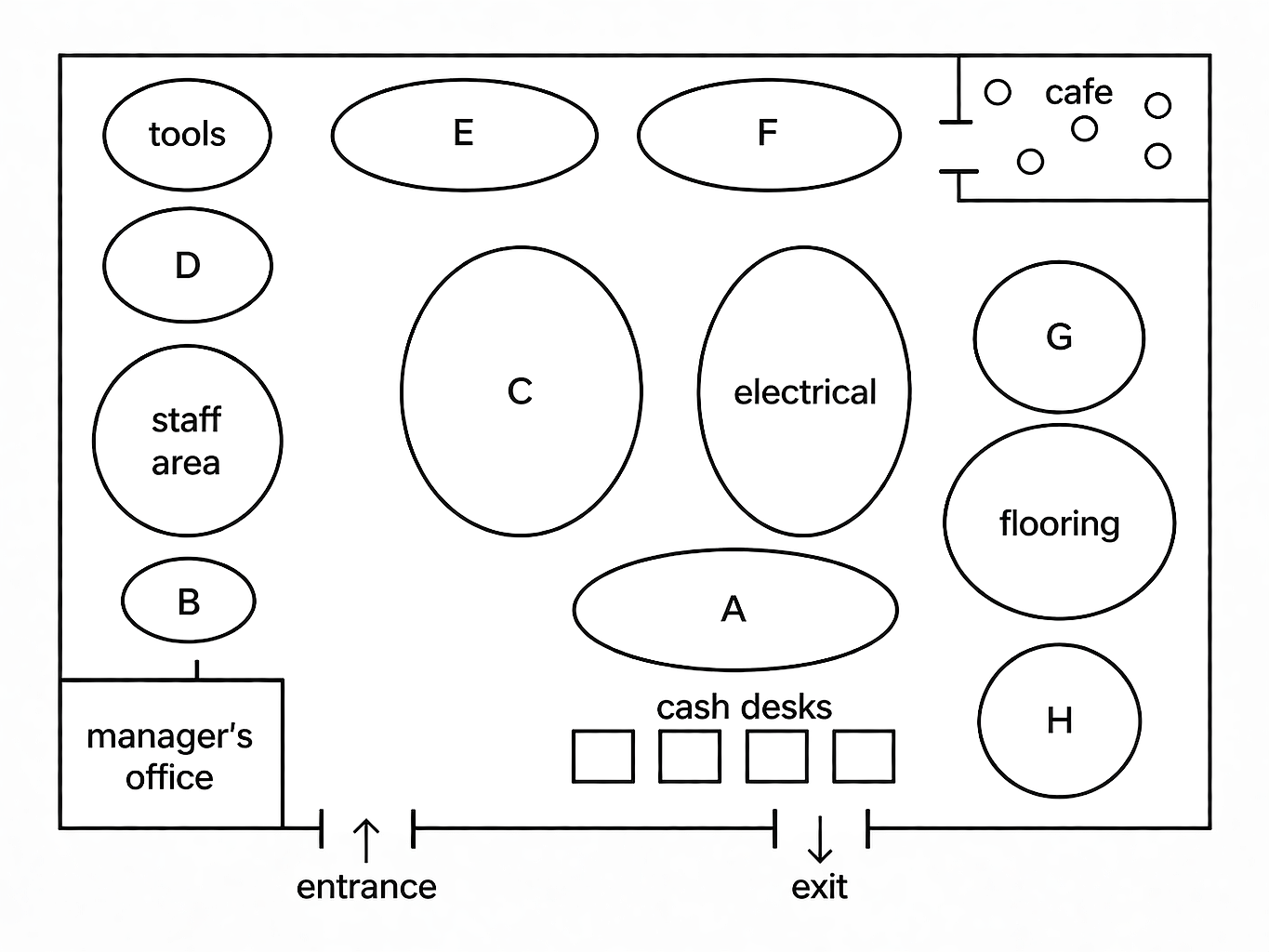
Speaker 3: Welcome to today's staff orientation at the home improvement store. My name is John. I look after new staff, and I'll be with you here in the training room all morning. We are the biggest hardware store in the country. And as home improvement is now so popular, hundreds of customers visit our store each week to buy products to improve every part of their house, inside or out. First, let me introduce you to the most popular sections of our superstore. Can you all take a look at the store plan you have in front of you? We stock every kind of flooring, including carpets, wooden flooring, and tiling. Our paint department is next to flooring. That's it in the bottom right hand corner of the map. We offer advice to customers on color combinations inside or outside before they purchase. We've become well known in the last few years for selling the latest kitchen designs for all budgets, and we also stock quality appliances recommended by top chefs. These products can be found right in the middle of the store just next to electrical goods. You may not be aware that one reason we are such a popular store is our great cafe, which serves cheap, nutritious lunches. That's in the top right of your map. Staff should also make customers aware of the children's play area, which is between the cafe and flooring, so mom and dad can get something to eat or drink or even continue their shopping while the kids are safe with our trained child care workers. Now what else should I mention? Ah, yes. We recently moved our stock of showers and baths from the left side of the store to the area along the back wall next to the tool section. We offer practical advice to customers about their bathrooms before they buy, such as where to locate a new toilet or shower. I have left my favorite area till last, gardens. It's marked on the left side of the map after the staff area and before the tool section. There, you'll find our extensive range of plants, flowers, and related products inside or outside. If you get to work there, I'm sure you'll find it a very pleasant section to work in. Right. Well, that's it for the store plan.
Speaker 2: Before you hear the rest of the talk, you have some time to look at questions 16 to 20 on page five. Now listen and answer questions 16 to 20.
Speaker 3: Now there is some other general information I need to give you before you start your specific training. The first thing staff need to know is what makes us different to our competitors. Our main advantage, due to our size, is that we can cut our costs and offer the best deals. Of course, we are proud of the great service we provide to our customers, especially through our help desk. We also have an excellent choice of goods so that we can provide plenty of options to our customers, but, of course, that isn't unique to us. The home improvement store has 60 stores nationwide, and we promote our stores and products in a range of different ways. First, there's our catalog, which lists all our items. It's been around for years, but we still have a policy of staff use only. The most important marketing material, and the one you want to ensure is given to every customer, is our store magazine, showing the latest products, workshops, and offers. The website is being redeveloped at the moment, so customers can't access it right now. The home improvement store is a great place to work. Like most of the staff, I'm sure you'll appreciate the fact that you can choose your hours to fit your lifestyle, family, or study. We hope you'll find that there's a nice atmosphere here. We are thinking of introducing a staff discount on our products, so that would be a real benefit to all staff. Every weekend, we offer workshops to help customers carry out their own home improvements. Workshops range from indoor painting to outdoor gardening and plant ideas. This coming weekend, there'll be one on mending a broken fence. Please remind customers of the workshops, especially if there is one related to your section. Finally, I wanted to let you know about a special deal for people renovating their kitchen. As you know, we sell all products and appliances connected to the kitchen, and we also have a delivery service. If customers buy one of our total kitchen designs, we will install it free of charge. So let's take a short break, and then we'll start.
Speaker 2: That is the end of section two. You now have half a minute to check your answers.
PART 3
Speaker 4: Business students called Janet and Michael discussing their research into the marketing of different kinds of shampoo. First, you have some time to look at questions 21 to 26. Now listen carefully and answer questions 21 to 26.
Speaker 5: Hi, Janet. How are you getting on with the shampoo marketing project?
Speaker 6: Hi, Michael. It's interesting. I've read how shampoo marketing has developed over the last hundred years.
Speaker 5: Oh, I didn't think we needed to do that.
Speaker 6: True, but I'm interested anyway. Basically, what was once sold as an economical way of getting your hair clean has evolved into a beauty product. Right. And shampoo's interesting because it's a key influence in how we see ourselves. You've heard of bad hair days.
Speaker 5: When your hair looks bad, maybe you didn't wash it and you feel bad about it. Heard of them? Yes. Had one? No. Don't think they're real.
Speaker 6: Bad hair days? Come on. Well, whatever you want to call them, that's not what research from Yale is suggesting. They're not just imagined, and both sexes are equally affected by them. And when they happen, people tend to perform and feel worse than usual.
Speaker 5: Right. And I've been reading about shampoo ingredients chemicals like sodium lauryl sulfate.
Speaker 6: Methyl chloride. Many of the manufacturers tend to use these or others like them, though they keep it quiet. Right. When it comes to the product packaging, they're strangely silent about it. Another area it would be interesting to investigate is the labeling on bottles. Apparently, printing directly onto the bottles costs about 50% less than sticking a printed label on, because it's a much quicker process. But manufacturers are lukewarm about this because it doesn't enhance the visual impact of the bottle. It comes across as a bit cheap.
Speaker 5: We need to think about environmental issues. I was surprised how little recycled plastic goes into the bottles.
Speaker 6: I think it's because light colored plastic is more difficult to make from recycled stuff.
Speaker 5: Yeah. But manufacturers can make their packaging more environmentally friendly just by making it less heavy. I'd like to find out whether some of them actually do when we do the research.
Speaker 6: Yes. That's worth looking into. Thinking about you as a customer, what's important when choosing shampoo?
Speaker 5: I'm always wary of special offers. When something's flagged as being half price, it rarely is, really. But if there's a make I've never seen before, I'm usually up for giving it a go rather than sticking to one or two favorite brands all my life.
Speaker 0: Interesting.
Speaker 4: Before you hear the rest of the discussion, you have some time to look at questions 27 to 30. Now listen and answer questions 27 to 30.
Speaker 6: Shall we discuss some of these shampoo advertisements then, and try and identify what sort of psychological response each one is trying to get from the viewer.
Speaker 5: Okay. What about Zing? Well,
Speaker 6: it'd probably appeal equally to men and women. In the ad, we see this happy family, lovely home, healthy, good looking children.
Speaker 5: With clean hair.
Speaker 6: Obviously, yes. And I think we're supposed to watch the ad and think, wow, if only my life was like that.
Speaker 5: Yeah. I know what you mean. I think the advertisers want the viewers to almost wish they were the people in the ad.
Speaker 6: Sure. I mean, that's very common in advertising.
Speaker 5: But not universal. You know that ad for splash shampoo that lasts about five minutes and where there's a story?
Speaker 6: Oh, yes. The commercial about the couple. And all through the commercial, it's not clear if they're going to break up or stay together?
Speaker 5: Exactly. Well, I think the marketing's been done very cleverly there. I don't think we're supposed to want to be the characters in the commercial, but we're supposed to get to know them a bit.
Speaker 6: Yes. Well, I thought the story was effective. You're glad to learn when it's over that they're obviously going to stay together. But I think the role of the shampoo in the story was a bit thin, to say the least.
Speaker 5: Maybe. I suppose some manufacturers don't wanna bore people with all the science.
Speaker 6: Sure. And then there's the Just Go advertisement.
Speaker 5: Yes.
Speaker 6: That had lots of technical information about what the shampoo actually consists of. I suppose they want customers to feel confident that when they buy Just Go, they are at least making an informed decision?
Speaker 5: Yes. They're buying something that will do the job they want it to. That's it.
Speaker 5: I've read one of the most effective shampoo ads in recent times was the one for Brozine.
Speaker 6: Yes. But there's no commentary, just images of the shampoo and lots of clean hair. I suppose the effect though is very calming with soft music and very peaceful imagery.
Speaker 5: Yes. But at the end of the ad, we've hardly learned anything about the product, have we?
Speaker 6: I suppose not. But isn't it interesting how much the ads for what are essentially very similar products vary so much?
Speaker 4: That is the end of part three. You now have thirty seconds to check your answers to part three.
PART 4
Speaker 4: Section four. First, you have some time to look at questions 31 to 40 on page seven.
Speaker 7: Today we will discuss the Adwaita turtle, a species that has drawn significant attention due to its unique characteristics and conservation challenges. These turtles are typically found in streams of freshwater, where they thrive in slow moving water. Their preferred environment consists of shallow areas with abundant vegetation, offering both food and shelter. Unlike some other turtles, they are not well adapted to deep or fast moving rivers.
One of the most distinguishing features of the Adwaita turtle is its shell. Unlike species with tough, protective outer layers, this turtle's shell is unusually fragile. This makes it highly vulnerable to predators and environmental damage. As a result, they tend to stay hidden for long periods, avoiding direct threats whenever possible.
Another key characteristic is their strong claws, which serve multiple purposes. These turtles use their claws for digging burrows in soft riverbeds, allowing them to rest safely out of sight. Additionally, their claws help them in foraging, as they scrape through mud and vegetation to uncover food sources.
Speaking of diet, Adwaita turtles are omnivorous, meaning they consume both plant and animal matter. While they often feed on insects and aquatic plants, they are also known to eat mushrooms that grow near the water's edge. These fungi provide essential nutrients that contribute to their growth and overall health.
Despite their adaptability, Adwaita turtles face significant risks. Their population is currently under a critical threat due to several environmental challenges. Deforestation and water pollution have destroyed many of their natural habitats, making it increasingly difficult for them to find safe nesting areas.
One of the greatest dangers they face comes from domestic dogs. These animals often disturb nesting sites, preying on young turtles before they have a chance to develop properly. Conservation efforts have attempted to reduce these attacks by setting up protective barriers around known nesting areas.
Another issue impacting their survival is climate change. Rising temperatures and deforestation have led to a loss of moisture in many of their traditional habitats. As a result, some areas that once supported these turtles have now become dry, forcing them to migrate in search of better conditions. Unfortunately, many turtles do not survive these long journeys.
To combat these challenges, conservationists have implemented species relocation programmes. These initiatives involve moving turtles from high risk zones to safer, protected areas where they can thrive without external threats. In some cases, relocating turtles has required creative solutions. Due to the difficult terrain in certain regions, researchers have used an elephant to help transport turtles across long distances. This has proven to be an effective method for ensuring their safe relocation.
Finally, community involvement plays a crucial role in conservation efforts. Local populations are now receiving specialised training on how to protect Adwaita turtles and their habitats. By educating people on the importance of these turtles, conservationists hope to create long term solutions that will secure their future.
Speaker 4: That is the end of section four. You now have half a minute to check your answers.